
FUEL ONLINE / Dumpster Rental Companies / AI SEO, AEO & GEO
Dumpster Rental AI SEO, AEO and GEO Agency
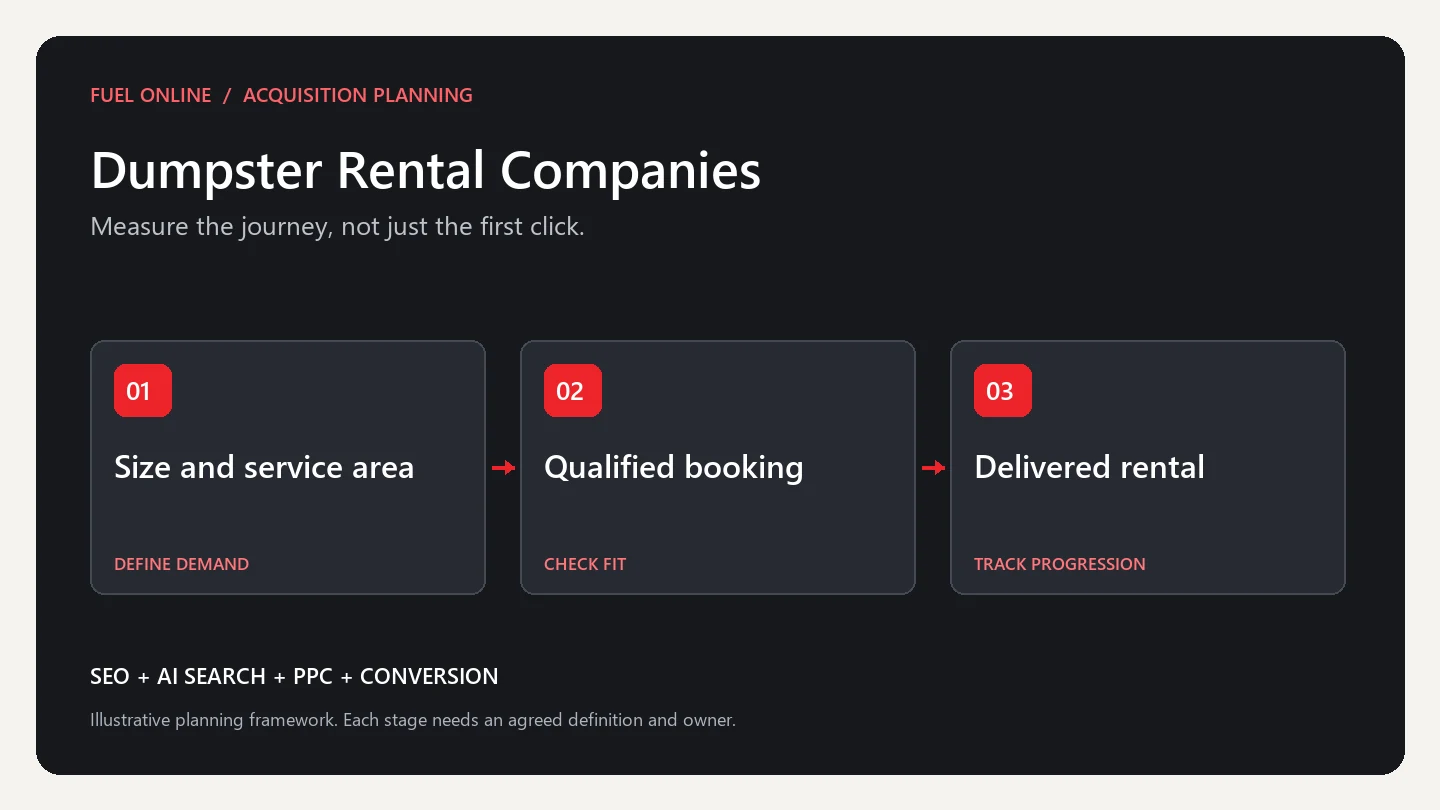
A dumpster rental company wastes dispatch time when inquiries omit the address, material, container need or placement constraint that determines serviceability. As a dumpster rental AI SEO agency, Fuel Online builds reviewed answers and tests their accuracy, sources and commercial relevance. Pages, campaigns and handoffs use address, material, size, placement and delivery date to separate fit, and reporting follows qualified booking requests and completed bookings.
delivery address, material type, container size needs, delivery date and placement constraints
Compare dumpster rental AI-search work through the rental facts behind an answer
Fuel Online’s dumpster rental AI SEO, AEO and GEO service helps an operator make container information, material rules, delivery scope and the inquiry process easier to understand across discovery experiences. The useful first assignment begins with a customer question and the maintained business source that answers it. Compare agencies through the distinction they clarify and the record they leave, rather than through a favorable answer screenshot without its question or source context.
Choose questions that change the rental conversation
Homeowners, renovation contractors and commercial project managers can approach a rental with different starting knowledge. One may need to understand the operator’s container range; another may know the project but need to clarify the relevant material rules or delivery area. Choose questions that expose a consequential uncertainty. The source assignment should help a person prepare the next conversation, using the operator’s actual information instead of a generic answer about every rental business.
A container-size question and a material question require different evidence. A size description can establish the operator’s stated specification, while the accepted-material explanation determines what the operator says about the proposed load. A delivery question needs the actual coverage information. The agency should map those sources separately before combining them into a concise summary. A useful answer preserves the qualifications that change the customer’s next decision.
| Question purpose | Operator source to inspect | Useful acceptance evidence |
|---|---|---|
| Understand a container option | Actual container description and specification. | The answer identifies the intended option without inventing a universal project-to-size rule. |
| Ask about a proposed load | The operator’s maintained material guidance and inquiry route. | The summary preserves the stated distinctions and directs unresolved questions to the operator. |
| Check a delivery relationship | Verified coverage and the supported address-review process. | The answer distinguishes general coverage from confirmation of a particular delivery request. |
Separate general information from a specific rental confirmation
A page describing a container does not establish that it is available for a requested date. A coverage description does not by itself confirm the placement conditions at an individual address. The operator’s sources should make those relationships understandable. This is useful marketing clarity: a customer can learn about the offering and prepare relevant information without mistaking an overview for a completed booking or an operational decision.
Ask the agency to identify the source that governs changing information and the resources that summarize it. A stable container explanation can have a different maintenance pattern from a current access or availability message. The proposal should describe how the team keeps those roles connected. This gives the operator a concrete way to compare the upkeep included in an AI-search engagement, rather than assuming every source requires the same revision schedule.
Use a project question as a source-review exercise
Consider an illustrative question about a renovation cleanup. The agency can identify which actual container resources and material explanations relate to the question, while leaving the operator’s load and delivery decisions intact. Ask what the proposed summary helps the customer understand and which information it asks them to supply. The useful result is a clearer source path, not an invented assertion that one container or arrangement fits every renovation.
Now change one condition in the fictional question, such as the stated material or address. Ask whether the same summary still holds and which source relationship changes. This reveals whether the agency preserved meaningful qualifications or flattened the answer into a broad promotional statement. Retain the two examples together so another reviewer can understand the reason for the distinction.
Record outside answers without losing their meaning
An observation record should contain the exact question, date, experience used, answer wording and sources shown. A rental-company mention, a container reference and a citation are different findings. Compare the actual statement with the supporting page where a source is visible. If the answer lacks enough context to identify the operator or the relevant offering, retain that uncertainty rather than count a familiar phrase as a verified reference.
A cited container page may support a specification without supporting every statement about materials or delivery attached to it. Ask the agency to annotate the specific passage and the claim it establishes. This makes the review precise enough to select a useful next task. The issue may concern an unclear owned explanation, a missing connection or an external statement whose source cannot yet be established.
Accept an owned-source improvement directly
Give an unfamiliar reviewer a practical question and the proposed destination. Ask them to identify the relevant container information, find the material guidance and locate the address or date inquiry step where appropriate. Record where they have to guess. This provides direct evidence about the operator’s resource, even when an outside answer changes between observations. The acceptance test should inspect the customer’s task rather than simply confirm that new paragraphs were published.
Retain the source annotation, implemented edit and reader result together. A future contributor should be able to identify what the page now clarifies and which operator fact supports it. If that fact changes, the record shows which summaries and links need review. This maintenance relationship is useful in its own right because container, material and delivery explanations can otherwise drift apart across several campaign resources.
Compare the implementation work behind the retainer
Ask which parts of the engagement include source investigation, writing, website implementation and recurring answer observation. A report identifying an issue is different from a completed source repair. The operator should know who can publish the change and which dependency belongs to another team. Comparing those responsibilities makes an AI-search proposal more assessable than a broad promise about visibility or a larger count of sampled questions.
Before expanding the question library, choose a genuinely different rental decision. Another wording of the same size question may add little value, while a distinct material or coverage question may reveal a useful source gap. The agency should explain why the question belongs and which resource will answer it. This keeps the program manageable for the people maintaining operational information.
Review completed source changes, outside answer observations and available inquiry evidence separately. The team can verify an implemented explanation directly and record an external answer at a particular time. Later accepted-rental evidence requires its own compatible records. Keeping those layers understandable gives the operator a clearer basis for deciding whether to clarify, connect, investigate or maintain the next resource.
A useful final comparison exercise gives another employee the retained question and source record without an account-team explanation. Can they identify what the source establishes and where an unresolved condition goes? If not, the working record may need a clearer definition. This makes the deliverable usable beyond one analyst and supports a maintainable rental-information system.
Inspect a summary that answers only part of the rental question
Suppose a fictional answer cites the operator’s container description while also making a statement about the proposed material. Ask the agency to mark which portion the cited passage actually establishes. The container source may be useful without supporting the material conclusion. The next investigation should locate the operator’s maintained material explanation and compare the relationship. This statement-level review gives the operator something precise to inspect instead of an overall accurate-or-inaccurate label.
Now consider a coverage statement attached to the same answer. The agency should identify whether it describes a general area relationship or claims that the individual request can be fulfilled. The relevant source and next step may differ. Retain that distinction in the observation record, with the operator’s actual explanation beside it. This prevents a useful general source from acquiring a stronger operational meaning when it is condensed into an answer.
Use the exercise during vendor selection by giving every finalist the same source set and question. Compare the annotations, proposed owned edit and unresolved items. A clear response may recommend one narrow clarification while retaining the rest of the source. Another may identify an information decision the operator needs to make first. These are inspectable differences in judgment and scope, rather than differences in the confidence of the presentation.
The accepted example can become a reference for later reviews. A new analyst should be able to explain why the container, material and coverage claims were evaluated separately. If the record does not make that reasoning clear, improve the definitions before expanding the question sheet. This small quality-control step helps maintain a consistent observation practice while keeping the underlying rental decisions with the operator.
Check operator identity before interpreting a mention
An answer can use a familiar rental-company phrase without establishing the intended business. Add an identity check to the observation exercise: which approved name, destination or other identifying detail supports the match? The operator’s own reference set supplies that evidence. If the answer does not contain enough context, classify the relationship as unresolved rather than attach another company’s offering to the client’s visibility record.
Compare that finding with an answer that clearly identifies the operator but misstates a material relationship. The first needs an identity investigation; the second needs a statement-level source comparison. Keeping both examples in the working record makes the reporting definitions more useful and helps a later reviewer avoid treating every unfavorable observation as the same editorial task.
When source questions reveal unclear resource roles, dumpster rental SEO planning can organize the container, material and coverage explanations.
AGGRESSIVE FROM THE START
One month. The work many agencies stretch across three.
Our mandate: move faster, go deeper and put experienced specialists to work immediately.
Fuel attacks the work in parallel: site audits, technical errors, new content, internal links, backlink outreach and conversion improvements. Your agreed scope determines the channels; urgent fixes do not wait behind a drawn-out planning phase.
The dumpster rental AI SEO agency brief identifies visibility and lead barriers. Actionable fixes move into production while deeper analysis continues.
Your dumpster rental AEO work runs alongside industry-specific content, relevant links and earned-authority outreach, based on your agreed scope.
The dumpster rental GEO review shows completed work, lead quality and the next opportunities. You see who owns each action.
Fast execution is the operating standard. Access, approvals and scope shape delivery; search and revenue results have their own timelines.
What the dumpster rental AI SEO agency scope needs to solve
AI SEO improves the material search and answer systems can retrieve. Answer engine optimization shapes concise responses to direct questions. Generative engine optimization strengthens the sources and entity facts that generative systems may use.
For a dumpster rental company, all three start with the questions homeowners, renovation contractors and commercial project managers ask while deciding whether the provider can deliver the right container to the address, accept the material and meet the delivery and pickup window. None provides control over whether a platform mentions or cites the business.
The first decision in a dumpster rental AI SEO agency engagement is whether the buyer, request and next step fit the business.
Decision map for dumpster rental AEO
Fuel Online creates a question set and source library from actual container specifications, documented material rules, verified delivery coverage, placement guidance and authorized project images. Each answer records its approved wording, supporting page or document, reviewer and review date.
The library documents what a buyer needs before taking the next step. The live site then supports the operational handoff: collect delivery address, material, estimated volume, placement conditions, delivery date and rental period before confirming the appropriate next step. Contradictions across pages and profiles enter a correction queue before more content is published.
The page and handoff map makes dumpster rental AEO inspectable before production expands.
Operational requirements for dumpster rental GEO
Content covers container sizes, cleanouts, renovation debris, roofing or construction uses, accepted materials, prohibited materials, delivery coverage and booking guidance, but an answer is useful only when it also explains fit, limits and the next step. It explicitly filters prohibited materials, addresses outside delivery coverage, requests for unavailable sizes and price shoppers whose scope omits weight or placement constraints.
Short answers sit near deeper evidence instead of floating as unsupported summaries. Structured data is used only when it describes visible content and the organization can maintain the underlying facts.
The operating standard for dumpster rental GEO names the approved source, reviewer and next buyer action.
Illustrative answer-engine example
This is an illustrative AI search decision, not a client result. The dumpster rental AEO choice is shown so a buyer can inspect the logic before approving similar work.
Test one consequential buyer question
Illustrative prompt: “What dumpster size is appropriate for roofing debris, and is my address in the delivery area?” The review records the answer, cited sources, omissions and any unsupported statement. The dumpster rental AI SEO agency review must record whether the answer is supported, incomplete or unsafe to reuse.
Correct the owned source and retest
Fuel Online would compare the response with the roofing-use guide, container specifications, material rules and coverage page, correct missing or conflicting facts on the owned source, and repeat the same prompt after the change. The log would show what changed without claiming control over the next answer. This dumpster rental AEO decision and its dumpster rental GEO retest record become inspectable deliverables.
How to audit a dumpster rental AI SEO agency plan
Use this framework when activity looks healthy but the commercial result is unclear. It turns a visible symptom into an evidence check, a bounded change and a deliverable the business can verify. The diagnostic for the dumpster rental AI SEO agency plan keeps the symptom, evidence check, action and output in one decision record.
1. Observable symptom
Dispatch reviews requests with prohibited material, an unserviceable address or no usable size and placement details.
2. What to inspect
Run the same buyer question across the selected answer systems. Record the answer, cited sources, factual gaps and whether the owned page clearly explains delivery address, material type, container size needs, delivery date and placement constraints. This evidence check shows whether dumpster rental AEO reflects the real offer and handoff.
3. Decision and action
Correct the owned source first, assign a subject-matter reviewer and retest the same prompt after publication. Record uncertainty rather than treating one answer as stable visibility.
4. Inspectable output
A dated answer-test record with prompt, output, cited sources, accuracy review, owned-source correction and any assisted connection to qualified booking requests and completed bookings.
Deliverables and reporting for dumpster rental GEO
The program tracks answer accuracy, source visibility, branded and nonbranded discovery, assisted visits and, where the data supports it, qualified booking requests, completed bookings, cost per completed booking and revenue by container size.
A qualified agency supplies the question map, source ledger, correction queue, test protocol and change log. Buyers should reject guaranteed-citation claims and ask how human review, platform volatility, privacy and uncertain attribution are handled.
For Dumpster Rental Companies, the AI-search scope documents how delivery address, material type, container size needs, delivery date and placement constraints affect page, campaign or routing decisions. Before release, the assigned business reviewer checks actual container specifications, material restrictions, delivery coverage and authorized project images against every visible claim and records any dependency that remains unresolved.
The monthly review for dumpster rental GEO compares completed work with accepted demand and identifies the next commercial decision.
- Reviewed buyer-question set and source ledger
- Approved answer modules with owners and review dates
- Prompt test log with dates, outputs, sources and accuracy review
- Entity-fact correction queue across priority profiles and pages
- Commercial reporting tied carefully to qualified booking requests, completed bookings, cost per completed booking and revenue by container size
How we measure dumpster rental AEO
- qualified booking requests
- completed bookings
- cost per completed booking
- revenue by container size
Keep AI citation observations measurable
Observed citation rate = sampled answers citing your site ÷ sampled answers checked.
Illustrative arithmetic: 5 citations in 20 recorded answers is 25% of that sample. It is not a platform-wide visibility share, a guaranteed repeat result or proof that the citations generated revenue. Record the prompts, platform and dates.
Agree on the baseline, data source and qualification criteria before comparing results. Separate visibility from inquiries and accepted business opportunities.
CONNECTED SERVICES
Choose the right next step for your business
Explore Fuel’s AI SEO, AEO & GEO capabilities, published campaign work and team to evaluate how we would support your organization.
BEFORE YOU CHOOSE AN AGENCY
Questions about dumpster rental AEO
Where should a dumpster rental AI SEO agency plan start?
Start where the business can see a costly mismatch: dispatch reviews requests with prohibited material, an unserviceable address or no usable size and placement details. A dumpster rental AI SEO agency review should trace one real example from its source through the page or campaign and into the receiving team's disposition. Run the same buyer question across the selected answer systems. Record the answer, cited sources, factual gaps and whether the owned page clearly explains delivery address, material type, container size needs, delivery date and placement constraints. The first dumpster rental AI SEO agency action should produce a named owner, a bounded correction and a release check rather than a broad activity list.
What does dumpster rental AEO include?
Expect a reviewed question set, source ledger, concise approved answers, dated prompt tests and a correction queue. The report should show what answer appeared, which sources were cited, whether the response was accurate and what content or entity fact needs attention next. A dumpster rental AEO scope should name the owner, deliverable, dependency and review gate.
How do we measure dumpster rental GEO?
Agree on definitions and data sources for qualified booking requests, completed bookings, cost per completed booking and revenue by container size before launch. Channel metrics explain what happened upstream, while staff disposition and downstream stages show whether the work created demand the business could accept. Measure dumpster rental GEO through the accepted commercial stages the receiving team can verify. Reporting for dumpster rental GEO should show the source, stage definition, owner and limitation behind each decision metric.
What should a dumpster rental company ask before hiring an agency?
Ask who will perform the work, who owns the accounts and data, what is delivered in the opening execution sprint, how facts are reviewed, how rejected inquiries change the plan and which decision would cause the agency to pause or expand investment. Compare a dumpster rental AI SEO agency engagement with other proposals by inspecting the proposed work, account ownership and response to rejected demand.
What source material is useful for AI-search work?
Useful inputs include approved service facts, process explanations, locations, reviewer-approved questions and answers, and evidence such as actual container specifications, documented material rules, verified delivery coverage, placement guidance and authorized project images. The material must be readable, attributable and maintainable; a folder of images or unsupported promotional claims is not enough. For dumpster rental AEO, document access, approvals and handoffs across internal and agency roles.
How often should answer visibility be reviewed?
Use a stable, decision-relevant prompt set and a cadence that allows meaningful comparison after material changes. Record dates, platforms, outputs and cited sources. Constant ad hoc checking creates noise and can encourage reactions to one response that may not repeat. A useful dumpster rental GEO scope starts with current offers, capacity, evidence and examples of accepted and rejected inquiries.
Make your next agency conversation specific.
Tell us which services or markets matter to your dumpster rental business, which inquiries your team accepts, and where the current AI-search program breaks down. Bring one accepted and one rejected example. Fuel Online will help identify the first page, campaign, answer or handoff worth changing. Use the working session to define one dumpster rental GEO action with a source, owner, release check and downstream measure.
Talk with a Fuel strategist →