
FUEL ONLINE / Fintech Companies / AI SEO, AEO & GEO
Fintech AI SEO agency: AEO and GEO

Fintech growth gets noisy when product research, consumer questions, and technical evaluation are treated as the same demand. For fintech AI SEO agency, Fuel organizes approved service facts, tests the category, fit, process, and comparison questions people ask, and repairs conflicting pages or profiles. You receive a fact sheet, prompt log, correction backlog, and named reviewers. Progress is judged by clearer sources and journeys that result in accepted product demos, without promises of citations or answer control.
Product category and markets served; Buyer role, company size and sales cycle; Regulatory review ownership; Demo acceptance and pipeline definitions
Evaluate fintech AI SEO through the questions a platform buying group must resolve
Define the product evaluation
A fintech company comparing AI SEO agencies should ask for a product-evaluation evidence plan before asking for a visibility score. The agency should connect a buyer question to a maintained product resource, distinguish what the product company actually supports from what an answer suggests, and explain the commercial decision the work is intended to help. For a platform business, an accurate category description is only the beginning. A useful answer also needs to lead an appropriate evaluator toward supported capability, integration, market and implementation information without making promises the product team has not supplied.
Start with the product boundary. Ask the agency to write a plain description of what the company sells, who buys it and which adjacent categories it should not be mistaken for. The stored page's contrast between a marketplace evaluating payment orchestration and a visitor using a personal loan calculator is a useful planning example. Those visitors have different jobs. An agency should show how its source and observation plan keeps the business-platform evaluation distinct from consumer research rather than treating every fintech-related mention as progress toward a product demo.
Build the question set around decisions, not a collection of near-identical prompts. A business sponsor may ask whether the platform addresses a particular operating problem. An integration evaluator may ask how to establish compatibility. A procurement reviewer may ask where to find the company's current evaluation material. Ask the bidder to group these tasks and show which product resource answers each. This creates a useful comparison between proposed source work and the actual information a buying group needs, even when generated answers remain variable.
Use a hypothetical marketplace evaluation to test the proposal. The agency does not need to invent a feature list. Give it a small set of approved product facts and ask it to map a question about platform fit, a question about an integration and a question about implementation planning. The answer should identify the relevant resource and any information still missing. A bidder that supplies confident product capabilities not present in the materials has demonstrated a content risk, not a stronger grasp of the category.
Trace capability and integration evidence
Treat an integration mention as a claim with a precise meaning. Ask whether the source describes an available integration, documentation for a particular connection, a partner relationship or a possible future discussion. Those are not interchangeable. The marketing agency should preserve the meaning supplied by the product team and make the supporting resource easy to find. It should not turn a logo in a directory into a promise that a particular buyer's environment is supported. The evaluation task is to connect claims to inspectable evidence, not expand them for a more persuasive answer.
Separate product availability from suitability for a specific organization. A platform may publish information about its supported markets or use cases, but an individual evaluation can still require a conversation with the company. Ask the agency how the public resource states the relevant scope and directs unresolved questions. The content can explain what the company has documented and what the next evaluation step involves. It should not imply a guarantee of compatibility, approval or commercial acceptance merely because an answer includes the platform name.
Create an evidence ladder for each important product statement. A category page can introduce the offering, a use-case resource can explain the business problem, documentation can support a capability statement and a permissioned customer example can illustrate an actual application. Ask which rung is missing when an observed answer becomes vague. This gives the agency a concrete editorial decision. It may need a better connection between existing resources rather than another broad article that repeats the category description without helping an evaluator reach evidence.
Comparison questions need a different review from simple identity questions. Ask the agency to distinguish a supported comparison of evaluation criteria from an unsupported ranking of named vendors. Useful criteria might include the buyer's required workflow, the information needed to evaluate an integration and the division of implementation responsibilities. The product team supplies the actual facts. Where a competitor's current information has not been checked, the content should not manufacture a feature contrast. A comparison framework can still help a buying group prepare better questions without pretending to resolve every vendor decision.
Read answer observations in context
Define a source owner for changing product information. Product naming, documentation locations and supported-market descriptions can change on different schedules. Ask how an agency finds repeated references and proposes a limited correction when one fact changes. The deliverable should show the authoritative product resource, affected derivatives and unresolved external references. This is particularly useful for answer observations: an old public explanation may be a more actionable problem than the answer itself, while an accurate source should not be rewritten solely because one observation omitted it.
Specify what an observation record contains. It should preserve the question, date, visible response, named product or company and any linked source that can be inspected. Distinguish an uncited mention from a source link and from a general category response that names no vendor. Those observations cannot be combined into one meaningful measure of buyer usefulness. Ask the agency to explain how another reviewer would reproduce the information task and understand the limitation of the result without relying on a selected screenshot in a sales presentation.
Review the destination after the answer, not just the answer. If an evaluator reaches a capability page, can they identify the relevant documentation or ask a focused product question? If they reach a general company page, is the route to the specific use case apparent? The agency should inspect this journey with the same care it gives the visible mention. A product demo request that loses the use case or integration context creates extra discovery work for the receiving team, even if the initial answer appeared favorable.
Connect source improvements to an observable commercial hypothesis. For example, a clearer relationship between a use-case page and integration documentation might help an evaluator decide whether to request a technical conversation. The report can show the change and the subsequent observed contacts without claiming that the change alone caused them. Ask which evidence comes from site behavior, which comes from the sales team and which remains unavailable. This avoids replacing a vague visibility promise with an equally vague pipeline promise that cannot be examined.
Prioritize actionable source gaps
Do not treat every omission as a production request. An answer may omit a product because the question is broad, because the visible response changes or because the source relationship is weak. Ask the agency to categorize the uncertainty before proposing work. A documented source gap deserves a specific content task; a single unexplained observation may deserve more observation. This discipline protects the product team's review capacity and keeps the program from generating large quantities of repetitive text that do not resolve a buyer's actual question.
A release announcement needs to remain connected to current product documentation. Ask what happens when an announcement describes a new capability and later becomes older than the main capability page. The agency should identify which resource remains the continuing explanation and how a reader following the announcement reaches it. This does not require removing useful historical context. It requires a deliberate relationship between dated news and the maintained product information on which an evaluator is expected to rely during a current purchasing discussion.
Buyer-role language should be tested against the actual product. Ask the agency to show how a business sponsor, technical evaluator and procurement reviewer would each recognize the next useful resource. This is not a request to create a separate page for every job title. It is a check that the public explanation does not force every reader through the same generic demo pitch before they can find basic evaluation information. One well-organized resource may serve several roles when its sections and supporting links have clear purposes.
Use a small failure exercise during selection. Give the bidder an observation that confuses the platform with a consumer service and ask for its next three decisions. A useful response inspects category wording, the supporting product resources and the question context. It does not immediately promise to control future answers. Compare whether the proposed correction addresses the specific confusion, whether the company can approve it and whether the next observation will test the same information task rather than search for an unrelated favorable response.
Accept useful commercial evidence
Evaluate the commercial scope by maintained resource groups. Ask how many distinct product explanations the agency will inspect, how it prioritizes them and how it handles documentation owned by another team. An open-ended commitment to publish more AI content makes review effort hard to predict. A bounded plan for category, use-case, integration and implementation resources makes the work more concrete. It also reveals whether the agency understands that the product company has finite subject-matter time and that each requested review should resolve a named uncertainty.
Keep the output useful to sales without turning marketing records into a substitute for product discovery. A lead may have arrived after reading a comparison or integration resource, but that does not establish that the buyer's requirements are known. Ask the agency to preserve the relevant resource and stated question as context. The receiving team can then confirm the requirement through its normal process. This gives the content program a practical handoff role while keeping unsupported assumptions out of both public copy and lead-quality reporting.
Accept the first release through a short evidence pack. It should contain the selected buyer questions, approved source relationships, exact content changes, unresolved capability questions and observation method. Include an example of the route from a product resource to a focused inquiry using invented business details. The company can then decide whether the agency improved the evaluator's experience and whether the next phase should expand the resource map or resolve a specific remaining gap. That is a stronger purchasing basis than activity volume alone.
Ask how the agency handles a product family with more than one offering. A question about one platform should not inherit capabilities documented only for another. The resource map should identify the product named in each statement and the route between family-level and product-level information. Review a sample observation that uses the company name without specifying the product. The next action may be to clarify the source relationship rather than celebrate the brand mention or expand the answer into an unsupported claim about the entire portfolio.
The ongoing decision is where the next hour of product review will help most. A missing integration explanation, an ambiguous category boundary and an outdated implementation reference require different expertise. Ask the agency to rank its next actions by the buyer uncertainty they resolve and the evidence available, rather than by how easy the text is to produce. A program organized this way can remain useful even while answer appearances fluctuate, because the company retains clearer product resources and a repeatable method of evaluating what readers encounter.
AGGRESSIVE FROM THE START
One month. The work many agencies stretch across three.
Our mandate: move faster, go deeper and put experienced specialists to work immediately.
Fuel attacks the work in parallel: site audits, technical errors, new content, internal links, backlink outreach and conversion improvements. Your agreed scope determines the channels; urgent fixes do not wait behind a drawn-out planning phase.
The fintech AI SEO agency brief identifies visibility and lead barriers. Actionable fixes move into production while deeper analysis continues.
Your fintech AI SEO work runs alongside industry-specific content, relevant links and earned-authority outreach, based on your agreed scope.
The fintech AEO and GEO review shows completed work, lead quality and the next opportunities. You see who owns each action.
Fast execution is the operating standard. Access, approvals and scope shape delivery; search and revenue results have their own timelines.
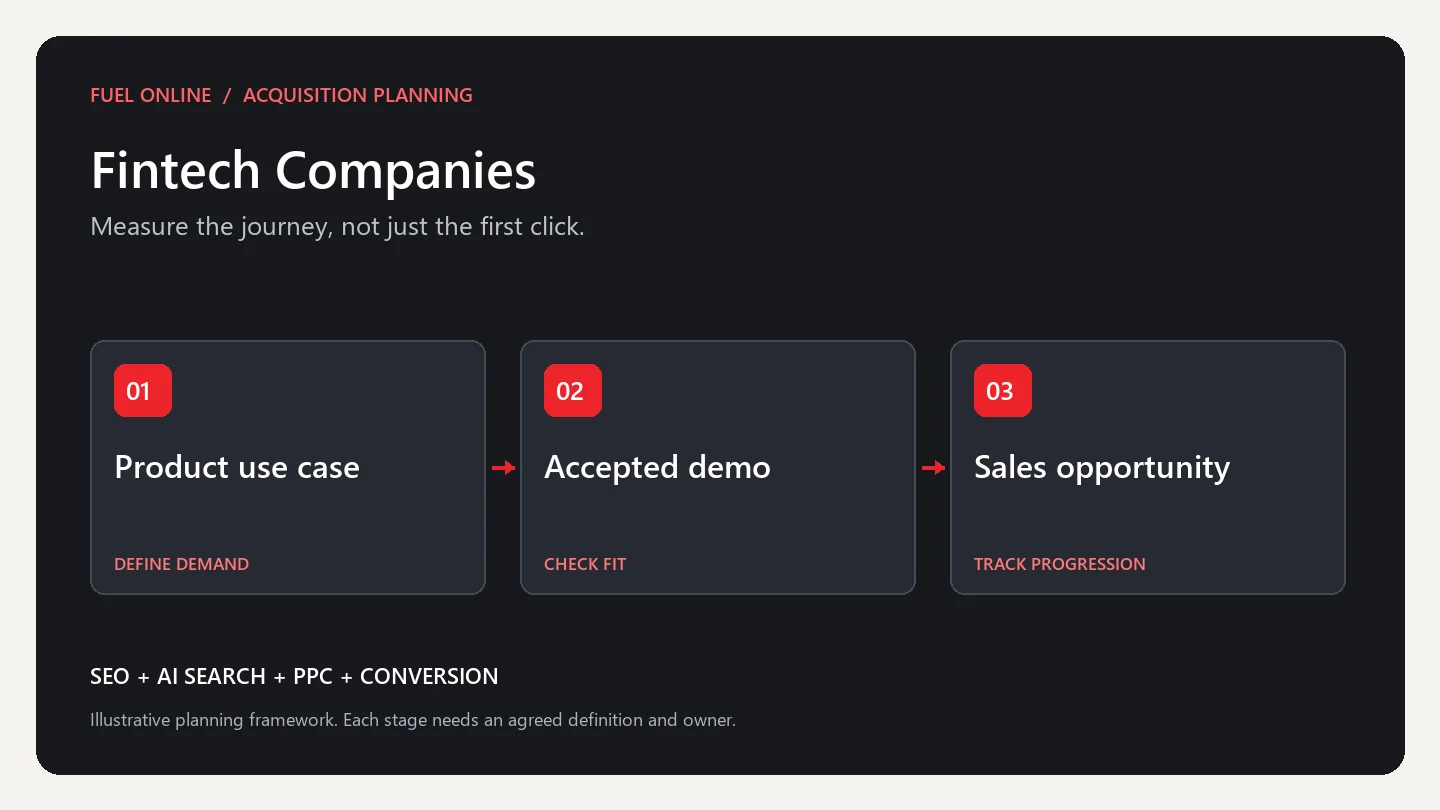
What fintech AI SEO agency changes for fintech demand
AI SEO, AEO, and GEO overlap, so the work matters more than the label. Fuel improves the public source layer used to explain use case, company profile, supported market, integration need, buying role, and implementation timing. That means fixing the facts and pages first, then observing answer behavior with a repeatable prompt set.
Fuel inventories category, use-case, integration, implementation, and comparison pages and records approved product capabilities, current integration documentation, and permissioned customer evidence in an approved fact sheet. Prompt observations become source corrections, content decisions, or profile updates, not unsupported claims about influencing a model.
A practical fintech AI diagnostic
Use this diagnostic when answer visibility improves but the receiving team does not see a comparable change in accepted product demos. The diagnostic for fintech AI SEO agency starts with the observable symptom, checks the page, source, campaign, or handoff responsible for it, and ends with one reviewed action, owner, and validation method.
Observable symptom
Answer systems blur fintech services, fit, or geography because public pages and profiles provide incomplete or conflicting explanations.
What to inspect
Compare the approved fact sheet, service pages, profiles, prompt observations, and the named owner of every changing fact.
Decision criteria for fintech AEO and GEO
Correct the authoritative source, record its reviewer, and rerun the same buyer questions after publication.
Inspectable output
A dated source correction, approval owner, prompt retest, and observation record tied to qualified fintech journeys.
Fintech AEO and GEO deliverables you can inspect
The team receives an approved fact sheet, buyer-question prompt library, source correction backlog, governance owners, and dated retest record.
- Approved entity and service fact sheet, used to define the fintech AI SEO agency scope.
- Buyer-question prompt library, used to govern the fintech AI SEO release.
- Dated answer and source observation log, used to evaluate the fintech AEO and GEO decision.
- Source correction and content backlog
- Governance owners and retest record
Illustrative fintech example
Illustrative example, not a client result: Public pages describe the product as both consumer lending and payments infrastructure. Fuel would identify the approved fact owner, correct the authoritative page or profile, record the source change, and rerun the same buyer questions.
The fintech AI SEO retest would record what changed and what remained variable. A different answer is an observation, while the commercial check is whether corrected sources support qualified journeys toward accepted product demos.
Within fintech AEO and GEO, the buyer team can inspect the artifact, approval, and next investment decision.
How commercial progress is judged
Fuel connects page, query, campaign, or source context with acceptance, rejection reasons, response, capacity, and accurate brand and service descriptions, relevant citations, qualified visits from AI systems, accepted demos, opportunity creation, sales-cycle stage progression, and pipeline by use case. Diagnostic measures explain where the journey breaks; they do not replace the business outcome.
The decision record for fintech AI SEO agency states what changed, why it changed, who approved it, and whether the next action is to expand, revise, consolidate, or stop.
Reporting for fintech AEO and GEO must connect the service-specific diagnostic to accepted product demos, explain data limits, and name the next decision rather than treating activity as proof of value.
Questions to ask a fintech agency
Ask for a sample fact sheet, prompt protocol, source-correction record, and governance matrix. Confirm how observations are dated, retested, and separated from claims of model control.
When reviewing fintech AI SEO agency, require a named practitioner, implementation owner, approval path, and sample artifact. Reject unsupported promises of rankings, citations, lead volume, cost, or revenue.
RELEVANT PUBLISHED WORK
A fintech acquisition example
The published Fuel Online B2B payment-processing case study reports cost per acquisition moving from $1,250 at baseline to $685 in month 3, a reduction of about 45%. The case combines paid search with semantic intent research.
Read the fintech PPC and GEO case study, including its baseline and measurement period. This is one reported engagement, not a forecast for your business.
How we measure fintech AEO and GEO
- accurate brand and service descriptions
- relevant citations
- qualified visits from AI systems
- accepted demos
- opportunity creation
- sales-cycle stage progression
- pipeline by use case
Keep AI citation observations measurable
Observed citation rate = sampled answers citing your site ÷ sampled answers checked.
Illustrative arithmetic: 5 citations in 20 recorded answers is 25% of that sample. It is not a platform-wide visibility share, a guaranteed repeat result or proof that the citations generated revenue. Record the prompts, platform and dates.
Agree on the baseline, data source and qualification criteria before comparing results. Separate visibility from inquiries and accepted business opportunities.
CONNECTED SERVICES
Choose the right next step for your business
Explore Fuel’s AI SEO, AEO & GEO capabilities, published campaign work and team to evaluate how we would support your organization.
BEFORE YOU CHOOSE AN AGENCY
Questions about fintech AEO and GEO
What does the first AI search month produce?
During the first month, the fintech AI SEO agency scope produces an approved fact sheet, buyer-question prompt set, source inventory, and the first correction record. Fuel also records the client inputs and approval needed for the first release.
What does Fuel need from our fintech team?
Effective fintech AI SEO work requires approved service facts, named fact owners, source and profile access, subject-matter review, and permission to correct conflicting public information. Fuel identifies missing access or ownership before work is scheduled around it.
How will we know the work is commercially useful?
Under fintech AEO and GEO, commercial usefulness depends on whether the diagnostic connects to accepted product demos, the data limits are stated, and the evidence supports a clear keep, revise, or stop decision.
Does AI search optimization replace conventional SEO?
No. Fintech AI SEO agency depends on accurate, accessible source pages and sound conventional SEO. AEO and GEO add approved fact governance, buyer-question testing, source correction, and repeatable observation; they do not replace crawlability, page quality, or authority.
What does a credible fintech AI SEO scope include?
A credible fintech AI SEO scope includes fact governance, a stable prompt protocol, source corrections, named reviewers, dated retests, and clear limits on answer-system control. It also names the client dependencies, practitioner, deliverable, and approval path.
How should fintech AEO and GEO report commercial progress?
Reporting under fintech AEO and GEO should connect the service-specific diagnostic to accepted product demos, show what changed and why, state data limits, and name the next decision.
Make your next agency conversation specific.
Bring the fintech questions answer systems get wrong or leave incomplete and the sources your team can approve. The first working session on fintech AI SEO will identify the priority artifact, evidence, owner, and approval decision for accepted product demos.
Talk with a Fuel strategist →