
FUEL ONLINE / Fintech Companies / PPC & Google Ads
Fintech PPC and Google Ads Agency

Fintech growth gets noisy when product research, consumer questions, and technical evaluation are treated as the same demand. Fuel separates paid searches such as 'payment orchestration platform for marketplaces' from low-fit intent such as 'personal loan calculator', then aligns ads, geography, landing pages, and contact actions with use case, company profile, market, integration need, and buying role. Search-term reviews and sales team feedback move budget toward accepted product demos, not the cheapest clicks or form fills.
Product category and markets served; Buyer role, company size and sales cycle; Regulatory review ownership; Demo acceptance and pipeline definitions
AGGRESSIVE FROM THE START
One month. The work many agencies stretch across three.
Our mandate: move faster, go deeper and put experienced specialists to work immediately.
Fuel attacks the work in parallel: site audits, technical errors, new content, internal links, backlink outreach and conversion improvements. Your agreed scope determines the channels; urgent fixes do not wait behind a drawn-out planning phase.
The fintech PPC agency brief identifies visibility and lead barriers. Actionable fixes move into production while deeper analysis continues.
Your fintech Google Ads work runs alongside industry-specific content, relevant links and earned-authority outreach, based on your agreed scope.
The PPC management for fintech companies review shows completed work, lead quality and the next opportunities. You see who owns each action.
Fast execution is the operating standard. Access, approvals and scope shape delivery; search and revenue results have their own timelines.
What fintech PPC agency changes for fintech demand
Paid acquisition becomes useful when the account mirrors the business. Fuel separates campaigns when geography, service, economics, qualification, or next step differs. The distinction between 'payment orchestration platform for marketplaces' and 'personal loan calculator' becomes visible in queries, exclusions, ads, pages, and reporting.
Each ad group has a defined buyer, promise, evidence need, destination, and contact action. The landing page uses approved product capabilities, current integration documentation, and permissioned customer evidence and gives the sales team company, role, use case, market, integration context, and timing.
A practical fintech PPC diagnostic
Use this diagnostic when paid conversion volume improves but the receiving team does not see a comparable change in accepted product demos. The diagnostic for fintech PPC agency starts with the observable symptom, checks the page, source, campaign, or handoff responsible for it, and ends with one reviewed action, owner, and validation method.
Observable symptom in fintech PPC agency performance
Reported conversions increase, but search terms and landing pages still send 'personal loan calculator' demand instead of opportunities closer to 'payment orchestration platform for marketplaces'.
What to inspect in fintech Google Ads
Review actual search terms, geography, ad promise, landing-page fit, contact action, and the sales, intake, or scheduling decision.
Decision criteria for PPC management for fintech companies
Add or remove a reviewed exclusion, separate the campaign, revise the landing page, or hold budget until the handoff works.
Inspectable output
A search-term and landing-page decision log showing what changed, why budget moved, and whether accepted product demos improved.
PPC management for fintech companies deliverables you can inspect
The team receives a campaign and budget matrix, reviewed query decisions, exclusions, landing-page message map, conversion tracking, and a weekly budget log.
- Campaign, geography, and budget matrix, used to define the fintech PPC agency scope.
- Reviewed query and exclusion set, used to govern the fintech Google Ads release.
- Ad and landing-page message map, used to evaluate the PPC management for fintech companies decision.
- Conversion and offline-disposition tracking
- Weekly search-term and budget decision log
Illustrative fintech example
Illustrative example, not a client result: Fuel would separate paid-search demand from a marketplace payments buyer that needs orchestration and integration detail and consumer calculator traffic with no product-evaluation intent in the account, then review the actual query, geography, promise, landing page, contact action, and final disposition before changing budget.
The fintech Google Ads decision log would show the exclusion, campaign split, landing-page revision, or budget hold and its owner. Spend expands only after reviewed evidence shows a stronger path to accepted product demos.
Within PPC management for fintech companies, the buyer team can inspect the artifact, approval, and next investment decision.
How commercial progress is judged
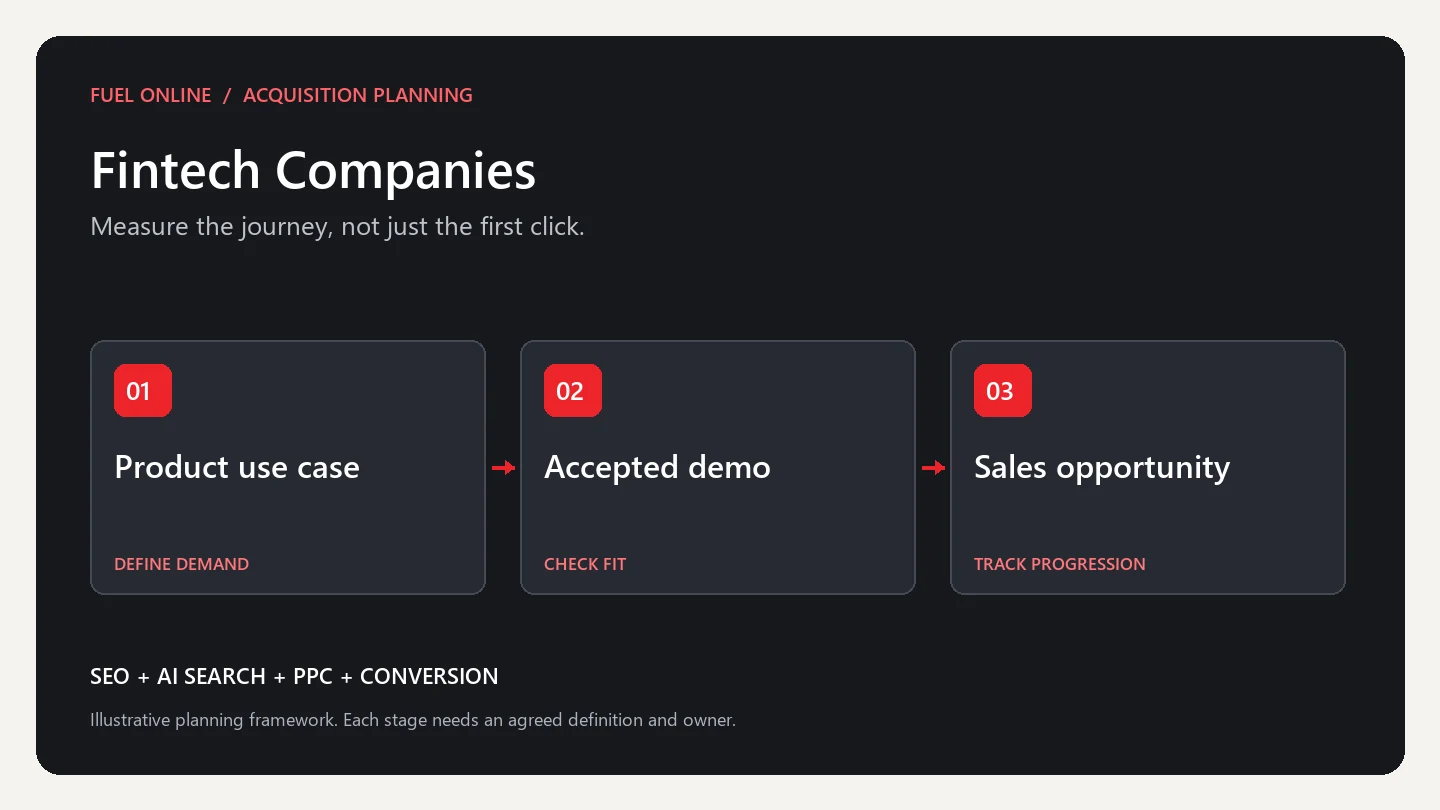
Fuel connects page, query, campaign, or source context with acceptance, rejection reasons, response, capacity, and accepted demos, opportunity creation, sales-cycle stage progression, and pipeline by use case. Diagnostic measures explain where the journey breaks; they do not replace the business outcome.
The decision record for fintech PPC agency states what changed, why it changed, who approved it, and whether the next action is to expand, revise, consolidate, or stop.
Reporting for PPC management for fintech companies must connect the service-specific diagnostic to accepted product demos, explain data limits, and name the next decision rather than treating activity as proof of value.
Questions to ask a fintech agency
Ask for a search-term decision log, landing-page map, conversion definition, and budget-change record. Confirm who approves exclusions, creative, tracking, and offline disposition imports.
When reviewing fintech PPC agency, require a named practitioner, implementation owner, approval path, and sample artifact. Reject unsupported promises of rankings, citations, lead volume, cost, or revenue.
RELEVANT PUBLISHED WORK
A fintech acquisition example
The published Fuel Online B2B payment-processing case study reports cost per acquisition moving from $1,250 at baseline to $685 in month 3, a reduction of about 45%. The case combines paid search with semantic intent research.
Read the fintech PPC and GEO case study, including its baseline and measurement period. This is one reported engagement, not a forecast for your business.
How we measure fintech Google Ads
- accepted demos
- opportunity creation
- sales-cycle stage progression
- pipeline by use case
Use a cost metric that reflects qualified demand
Cost per qualified inquiry = campaign spend ÷ inquiries meeting the agreed criteria.
Define the included spend, reporting window and qualification rules before comparing campaigns. Track raw leads separately so cheaper but unsuitable inquiries do not make performance look better.
Agree on the baseline, data source and qualification criteria before comparing results. Separate visibility from inquiries and accepted business opportunities.
CONNECTED SERVICES
Choose the right next step for your business
Explore Fuel’s PPC & Google Ads capabilities, published campaign work and team to evaluate how we would support your organization.
BEFORE YOU CHOOSE AN AGENCY
Questions about fintech Google Ads
What happens before Fuel increases paid spend?
During the first month, the fintech PPC agency scope produces a search-term review, campaign and geography matrix, conversion definition, and the first budget decision. Fuel also records the client inputs and approval needed for the first release.
What does Fuel need from our fintech team?
Effective fintech Google Ads work requires ad-account, analytics, landing-page, call, and disposition access plus budget constraints, approved claims, and timely query review. Fuel identifies missing access or ownership before work is scheduled around it.
How will we know the work is commercially useful?
Under PPC management for fintech companies, commercial usefulness depends on whether the diagnostic connects to accepted product demos, the data limits are stated, and the evidence supports a clear keep, revise, or stop decision.
What should the first fintech PPC agency priority be?
Start with the query, geography, ad promise, landing page, contact action, and receiving path closest to accepted product demos. The fintech PPC agency plan should hold expansion when a landing-page or handoff defect would turn more spend into unusable conversions.
What does a credible fintech Google Ads scope include?
A credible fintech Google Ads scope includes query and exclusion review, geography and budget rules, landing-page alignment, conversion definitions, disposition feedback, and documented budget decisions. It also names the client dependencies, practitioner, deliverable, and approval path.
How should PPC management for fintech companies report commercial progress?
Reporting under PPC management for fintech companies should connect the service-specific diagnostic to accepted product demos, show what changed and why, state data limits, and name the next decision.
Make your next agency conversation specific.
Bring recent search terms, landing pages, and accepted or rejected contacts so we can identify the first paid-media decision. The first working session on fintech Google Ads will identify the priority artifact, evidence, owner, and approval decision for accepted product demos.
Talk with a Fuel strategist →