
FUEL ONLINE / Custom Home Builders / Industry growth plan
Custom Home Builders Marketing

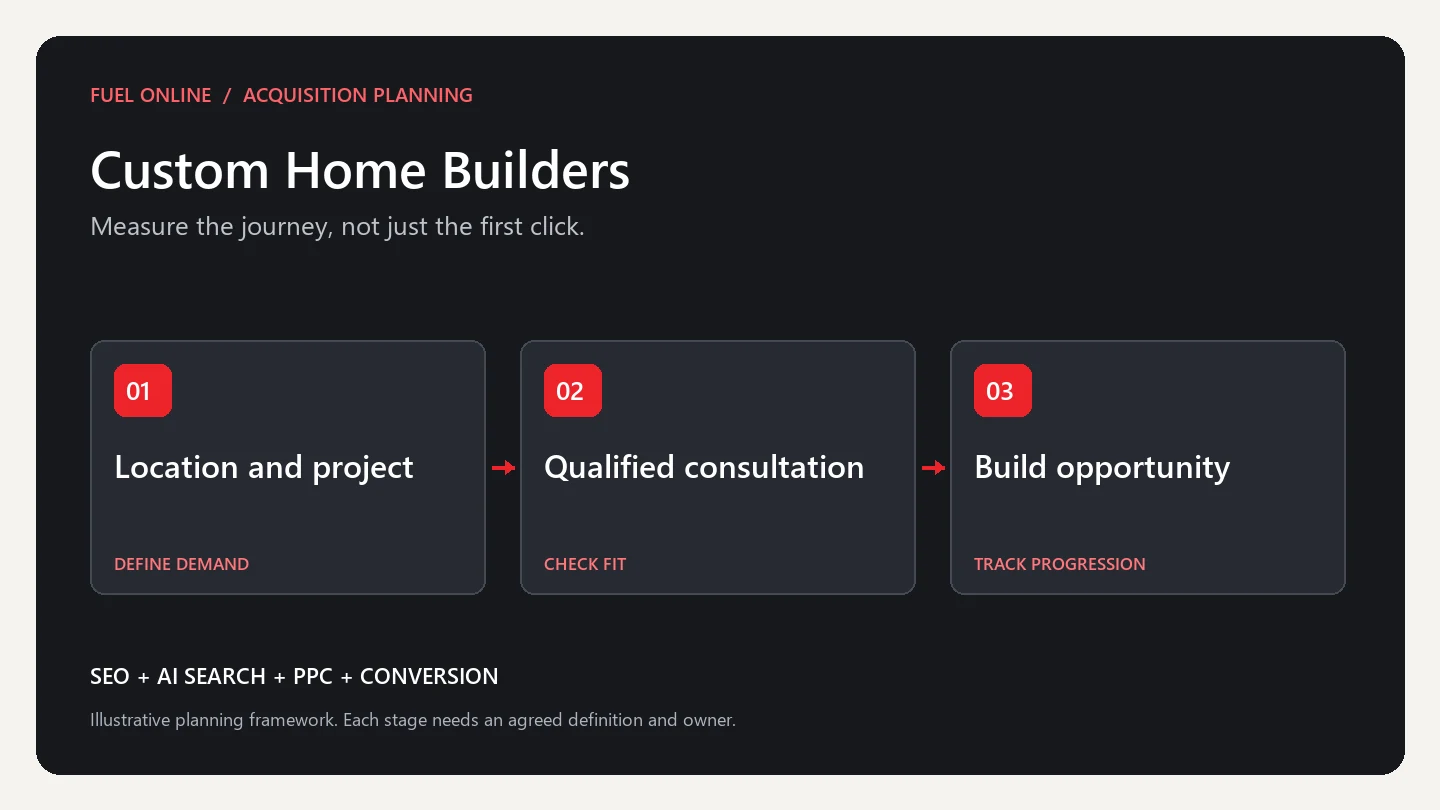
Custom builders need land-ready owners in actual build markets, not renovation, rental, or plan-only traffic. Fuel builds a home builder marketing program around build location, lot status, plans, home type, project range, and timing. We connect decision pages, approved proof, channel priorities, and the inquiry path, then use sales team feedback to improve fit. The goal is qualified custom-home consultations, with work prioritized against evidence and operating capacity rather than traffic alone.
Build location and land ownership; Project scope and budget range; Expected start timing; Custom build versus renovation or tract-home purchase
Make custom home marketing useful before the first planning conversation
Choose a custom home builder marketing agency by the project-fit journey it can help your business explain. Fuel Online can connect discovery, approved project evidence and consultation routing around the homes and locations the builder wants to discuss. A useful first assignment helps a prospective client understand the process and prepare for a conversation, rather than treating every design inspiration visit as a ready construction opportunity.
Start with one representative client and ask the builder what information makes the first discussion useful. The answer may involve the intended location, project vision and broad readiness. Use the company’s actual process to explain what happens next. The website can help someone prepare without implying that a general inquiry provides enough information for a complete design, feasibility or price determination.
| Prospective client question | Useful explanation | Business owner |
|---|---|---|
| Does the builder fit the project? | Approved home and service scope | Builder leadership |
| What preparation is useful? | Actual initial planning process | Project development |
| How does the conversation begin? | Supported consultation route | Client relations |
Connect inspiration to the builder’s actual scope
Project images can help a visitor understand the work, but the accompanying explanation should identify the approved context. Ask which facts the builder can publish and what the example helps a client decide. A gallery should not require the reader to infer which elements are available or applicable to a future project. The agency should organize the evidence around the buyer’s question.
Create a brief for one recurring consultation question. It may explain the initial planning sequence or the relationship between the client’s project idea and the builder’s process. Identify the source owner and reviewer before writing. Connect the resource to relevant project and service information so each page has a distinct role rather than repeat the same broad craftsmanship message.
Explain readiness without making the form a full project brief
Ask which initial facts help route a request and which belong in a later conversation. The page should distinguish an early question from a more developed project discussion using the business’s supported process. Keep the request proportionate. A prospective client should understand what information is useful now and what the team will help clarify afterward.
Test a fictional request and confirm the receiving employee sees the project and location context. If requests are assigned by region or project type, test those rules. Include the owner of any separate account or scheduling system. A usable handoff is a concrete implementation deliverable that can be accepted before the company evaluates later consultation and project outcomes.
Maintain the project information as the offering changes
Identify who confirms operating coverage, service scope and public project details. Use a hypothetical update to map the pages and campaign destinations affected. A maintained source register helps the builder keep the explanation consistent and gives future writers a reliable basis for updates. The agency manages publication while the business remains the authority on its process and work.
Review project fit through the stages
Keep inquiry, completed discussion, accepted planning opportunity and project engagement separate. Review the location and broad readiness alongside the source. Repeated requests outside the builder’s scope may call for clearer information; suitable discussions that do not progress require a different commercial review. Fuel’s first assignment should deliver an approved project-fit path, useful preparation resource and tested consultation route.
Ask a colleague outside the project to describe the client and project the page invites. Resolve any mismatch before extending the pattern to more locations or home types. This is an inspectable acceptance check for the explanation, with later demand and project results evaluated on their own evidence.
For the broader sector strategy, explore construction marketing. Bring the priority journey, current offer and operational owner to the scope discussion so the next assignment is concrete.
Evaluate builder marketing through a project-information handoff
A custom-home builder needs marketing that helps a prospective client understand how the business begins a project conversation. An attractive portfolio can establish interest while leaving the visitor uncertain about service boundaries, preparation and the next decision. Evaluate an agency by the information system it proposes around one representative inquiry. The exercise should clarify the commercial process without asking a marketing team to determine design feasibility, engineering requirements or a construction price.
Choose a project-information problem worth solving
Ask the people who receive inquiries to identify one recurring misunderstanding. A prospect may assume that a photographed home is a standard product, believe that an online message starts a complete estimate, or be unsure whether the builder works in the intended area. Choose one problem for the pilot. Give the agency approved business facts and ask it to show the smallest useful release that would make the next conversation clearer.
Specify the first deliverable as a decision record. It should name the audience, the question being answered, the approved source of the answer and the next action the business supports. For example, the builder might want a visitor to understand the distinction between an inspiration inquiry and an introductory project discussion. The agency should demonstrate that distinction using the builder’s actual process rather than inventing stages that staff do not use.
Define what the agency is allowed to publish from the project record. A useful example can describe the client’s approved objective, the builder’s role and the aspect of the process the example illustrates. Permission to use photographs does not automatically establish that every associated project detail should be public. The builder should identify the authorized reviewer and the limits of the material before the agency turns it into a case study or campaign.
Compare three levels of inquiry readiness
Use three fictional inquiries to evaluate the proposed journey. One person is exploring the possibility of a home and wants to understand the builder’s approach. A second has a preferred area and a project concept but is unsure what information to bring. A third has already discussed a project with other professionals and wants to understand the builder’s next commercial step. These examples test communication and routing, not whether a project should be approved.
For the exploratory inquiry, ask the agency to show which resource helps the person understand the working process without requiring a detailed form. The page should explain a supported next step and help the reader recognize the kind of conversation the business can have. Do not treat a visitor’s interest in design ideas as evidence that the company has a ready construction opportunity.
For the second inquiry, inspect how the website explains preparation. Have the builder identify the initial facts that make its first discussion useful. The agency’s job is to communicate those facts and route the request, while the builder decides what further review is needed. A public checklist should not imply that entering a location or describing an idea establishes site suitability, permitting status or a complete project scope.
For the more developed inquiry, test whether the receiving team can understand what stage the requester believes has been reached. The agency should explain how the request is labeled and where supporting information belongs under the builder’s approved handling process. It should avoid creating an impression that a marketing form can replace the builder’s project-development conversation or the work of the relevant professionals.
Make the portfolio explain decisions
Select one approved project and ask the agency to prepare two versions of its presentation. The first should help a visitor understand the type of work the builder undertakes. The second should explain one aspect of the client’s journey through the business process. Compare whether each version adds information beyond repeating descriptive praise about quality and craftsmanship.
Keep the source of important statements visible in the internal brief. If an explanation describes how the builder coordinates a planning conversation, identify the staff member who can verify that process. If the project illustrates a particular offering, confirm that the offering remains part of the company’s supported scope. The agency should not infer current availability or future project characteristics from a completed home’s photographs.
Ask how the agency will connect the project example to service and location information. A reader should be able to move from an inspiring image to a useful explanation of the builder’s work and then to the supported contact route. The navigation should not depend on the customer knowing the company’s internal terminology. Test the route with someone who was not involved in producing the material.
Keep the proposal's implementation boundary visible
Require a release plan that distinguishes writing, publication, tracking configuration and inquiry routing. A proposal may include one of those tasks while assuming that your staff or another supplier completes the others. Identify the receiving owner and approval dependency for each promised deliverable. The first release should be small enough that the company can check whether the handoff works before commissioning a much larger content program.
Introduce a change request during the proposal review. Suppose the builder narrows the geographic area it wants to promote or changes the introductory contact process. Ask the agency which pages and campaign assets would need review, who approves the wording and how the receiving team learns about the change. This reveals whether the proposed operating model can maintain consistent facts after launch.
Clarify the record you will retain if the engagement ends. The business should be able to locate the approved source descriptions, published assets, measurement definitions and implementation notes. Ask the agency to identify how those materials will be organized and who can maintain them. A handover should let the next responsible person understand the reason for the current journey rather than merely inherit a folder of finished designs.
Review progress without confusing interest with project value
Evaluate early results through the pilot’s original communication problem. Review whether staff received more understandable requests, whether the public explanation reduced repeated clarification and whether the intended contact route worked. Separate unsupported-area inquiries from service misunderstandings or failed contact attempts. Each category suggests a different correction and should not disappear inside a single total labeled as leads.
Use observed business stages when discussing later progression. An introductory conversation, a developed project discussion and an agreed engagement are different events. Ask the builder which stages it can actually support from its records and compare compatible groups over an appropriate period. Neither portfolio engagement nor an inquiry count demonstrates a construction outcome, a financial return or the value of an individual project.
At the review meeting, compare the approved brief, the implemented release and the receiving team’s experience. Identify the question that is now clearer and the obstacle that remains. A useful agency recommendation names the next bounded change and the evidence that would justify it. This gives the builder an accountable way to expand marketing while preserving control over professional assessment and the business’s actual project process.
AGGRESSIVE FROM THE START
One month. The work many agencies stretch across three.
Our mandate: move faster, go deeper and put experienced specialists to work immediately.
Fuel attacks the work in parallel: site audits, technical errors, new content, internal links, backlink outreach and conversion improvements. Your agreed scope determines the channels; urgent fixes do not wait behind a drawn-out planning phase.
The home builder marketing brief identifies visibility and lead barriers. Actionable fixes move into production while deeper analysis continues.
Your home builder marketing agency work runs alongside industry-specific content, relevant links and earned-authority outreach, based on your agreed scope.
The marketing for custom home builders review shows completed work, lead quality and the next opportunities. You see who owns each action.
Fast execution is the operating standard. Access, approvals and scope shape delivery; search and revenue results have their own timelines.
What home builder marketing changes for custom home building demand
A useful home builder marketing plan starts with the commercial constraint. Fuel identifies which buyers the organization wants more of, what they need to believe before contact, and which requests consume time without a realistic next step. For custom home building, the fit decision turns on build location, lot status, plans, home type, project range, financing readiness, and timing.
Fuel turns that definition into build-area, home-type, portfolio, process, community, and investment pages, channel priorities, proof requirements, and a handoff that retains location, lot status, plans, desired home type, project range, financing stage, and timing. Work that cannot be supported by permissioned project photography, accurate build locations and scope, current process details, and reviewed material claims stays out of the public claim set.
A practical home builder hub diagnostic
Use this diagnostic when channel activity improves but the receiving team does not see a comparable change in qualified custom-home consultations. The diagnostic for home builder marketing starts with the observable symptom, checks the page, source, campaign, or handoff responsible for it, and ends with one reviewed action, owner, and validation method.
Observable symptom
Marketing activity rises, but the team still cannot tell why 'custom home builder in Middlesex County' inquiries are mixed with demand closer to 'kitchen remodeling near me'.
What to inspect in home builder marketing agency
Review source, page, offer, contact path, and the final acceptance or rejection reason together.
Decision criteria for marketing for custom home builders
Prioritize the page, message, exclusion, or handoff with the clearest connection to unsuitable demand.
Inspectable output
A one-page home builder marketing decision record naming the symptom, evidence, owner, release, and measure tied to qualified custom-home consultations.
Marketing for custom home builders deliverables you can inspect
The team receives a demand map, evidence register, prioritized channel backlog, conversion specification, and commercial decision cadence it can inspect and own.
- Buyer and offer map, used to define the home builder marketing scope.
- Evidence and approval register, used to govern the home builder marketing agency release.
- Prioritized page and campaign backlog, used to evaluate the marketing for custom home builders decision.
- Conversion and routing specification
- Commercial scorecard and decision cadence
Illustrative custom home building example
Illustrative example, not a client result: Fuel would compare the path taken by a land-ready owner evaluating a custom build in an active service market with the activity created by remodeling, tract-home, floor-plan, and out-of-area requests. The decision is whether to fix the decision page, proof, contact path, or channel sequence before adding spend.
The home builder marketing agency work would produce a one-page demand map showing fit, friction, evidence, owner, and the next controlled release. The example becomes useful only when the team can trace the change to qualified custom-home consultations.
Within marketing for custom home builders, the buyer team can inspect the artifact, approval, and next investment decision.
How commercial progress is judged
Fuel connects page, query, campaign, or source context with acceptance, rejection reasons, response, capacity, and qualified project consultations, land-ready inquiries, proposal opportunities, and contract pipeline. Diagnostic measures explain where the journey breaks; they do not replace the business outcome.
The decision record for home builder marketing states what changed, why it changed, who approved it, and whether the next action is to expand, revise, consolidate, or stop.
Reporting for marketing for custom home builders must connect the service-specific diagnostic to qualified custom-home consultations, explain data limits, and name the next decision rather than treating activity as proof of value.
Questions to ask a custom home building agency
Ask for the first demand map and channel decision, then confirm who owns pages, campaigns, tracking, approvals, and the handoff to the receiving team. A useful proposal explains which channel waits and why.
When reviewing home builder marketing, require a named practitioner, implementation owner, approval path, and sample artifact. Reject unsupported promises of rankings, citations, lead volume, cost, or revenue.
How we measure home builder marketing agency
- qualified project consultations
- land-ready inquiries
- proposal opportunities
- contract pipeline
Separate inquiry volume from usable demand
Qualified-inquiry rate = inquiries meeting your agreed criteria ÷ total inquiries reviewed.
Illustrative arithmetic: 20 suitable inquiries out of 50 reviewed inquiries is a 40% qualified-inquiry rate. Record why the other 30 did not fit before increasing investment.
Agree on the baseline, data source and qualification criteria before comparing results. Separate visibility from inquiries and accepted business opportunities.
CONNECTED SERVICES
Choose the right next step for your business
Explore Fuel’s Industry growth plan capabilities, published campaign work and team to evaluate how we would support your organization.
BEFORE YOU CHOOSE AN AGENCY
Questions about home builder marketing agency
What will Fuel deliver in the first 30 days?
During the first month, the home builder marketing scope produces a demand map, evidence register, prioritized journey decision, and the owner of the first controlled release. Fuel also records the client inputs and approval needed for the first release.
What does Fuel need from our custom home building team?
Effective home builder marketing agency work requires a commercial owner, account and page access, approved proof, acceptance criteria, capacity limits, and feedback from the receiving team. Fuel identifies missing access or ownership before work is scheduled around it.
How will we know the work is commercially useful?
Under marketing for custom home builders, commercial usefulness depends on whether the diagnostic connects to qualified custom-home consultations, the data limits are stated, and the evidence supports a clear keep, revise, or stop decision.
Should we invest in SEO or paid acquisition first?
Choose the channel that addresses the closest constraint to qualified custom-home consultations. In home builder marketing, paid acquisition can test active demand quickly, while SEO is better for durable decision pages; both wait if the offer, proof, contact path, or receiving capacity is the real problem.
What does a credible home builder marketing agency scope include?
A credible home builder marketing agency scope includes buyer-fit criteria, evidence governance, journey priorities, channel sequencing, conversion ownership, and a commercial decision cadence. It also names the client dependencies, practitioner, deliverable, and approval path.
How should marketing for custom home builders report commercial progress?
Reporting under marketing for custom home builders should connect the service-specific diagnostic to qualified custom-home consultations, show what changed and why, state data limits, and name the next decision.
Make your next agency conversation specific.
Show us where home builder demand becomes unclear between 'custom home builder in Middlesex County' and 'kitchen remodeling near me'. The first working session on home builder marketing agency will identify the priority artifact, evidence, owner, and approval decision for qualified custom-home consultations.
Talk with a Fuel strategist →