
FUEL ONLINE / Custom Home Builders / SEO
Custom Home Builders SEO Agency

Custom builders need land-ready owners in actual build markets, not renovation, rental, or plan-only traffic. Fuel maps searches such as 'custom home builder in Middlesex County' to focused service, location, process, proof, and comparison pages, while treating 'kitchen remodeling near me' as different intent. The home builder SEO work also fixes indexation and internal-link gaps and produces evidence-backed briefs. Reporting connects search visibility with qualified custom-home consultations, not traffic or rankings in isolation.
Build location and land ownership; Project scope and budget range; Expected start timing; Custom build versus renovation or tract-home purchase
Give custom-home SEO distinct builder, portfolio and project-start resources
Choose a custom-home SEO agency by comparing the distinct questions its resources will answer before a prospective owner begins a project conversation. Builder identity, offered project models, portfolio examples and geographic context can share language while establishing different things. A useful organic-search plan gives each resource a clear role and relevant next destination. The buyer should see what each new or revised page contributes and where its facts are maintained, rather than assume a longer publication list creates a more useful project-start journey.
Give builder and portfolio resources different jobs
Begin with the actual website. Ask the agency to map each principal resource to its reader question, supporting builder information and next useful destination. Several search phrases can express a need already answered clearly in one place. Similar wording can also lead to different tasks. The map should explain that distinction before production volume is selected. Both improving an existing page and adding a resource can be useful when the contribution and required builder input are specific.
The builder introduction establishes the organization and the work it chooses to describe publicly. A service resource explains its offered project relationship. A portfolio example illustrates authorized context about a particular home. Ask how the reader moves between those roles and what each link promises. An attractive project image should not establish every service arrangement the builder offers. The agency can make the relationship clearer without expanding scope to fill a query or treating appearance as technical proof.
Project models should use distinctions the builder actually supplies. A prospective owner may arrive with land, an early idea or a question about how the business starts a conversation. The agency should not invent a universal project path from those examples. Ask which maintained resource explains the supported process and which questions belong later. A useful brief records what the builder is prepared to publish instead of asking a writer to settle an operational fact through confident introductory copy.
| Resource role | Contribution to establish | Useful acceptance evidence |
|---|---|---|
| Builder and service | The actual offered project relationship stays distinct from a particular portfolio example. | A home image does not silently establish every service model or project arrangement. |
| Portfolio context | Authorized description identifies what a completed image, construction view or rendering illustrates. | The presentation does not invent specifications, schedules or future customer outcomes. |
| Project area | Distinct builder-supplied geographic information justifies the local destination and its connections. | A town label does not imply another office, available land or automatic project acceptance. |
| Contact explanation | The maintained source preserves the meaning of the initial administrative inquiry. | A request does not become a quotation, accepted project or scheduled build. |
A separate service resource earns its role through a distinct supported answer. Ask what it explains beyond the organization introduction and which facts make the difference meaningful. A new heading or query variation does not create another decision by itself. Where the information already has a clear home, better orientation may be sufficient. Where a genuine gap exists, record its source needs and next destination before committing the builder to another independently maintained explanation.
Earn service-area and project-model resources
Geographic resources need actual builder context. An office, stated project area and location within a portfolio example establish different facts. Ask which source supports each and how they relate. A town name should not create another office, imply available land or promise that a particular project will be accepted. The useful local resource explains the relationship the builder supplies and helps the reader find the appropriate administrative destination without inference from nearby addresses.
Compare two proposed local briefs using the same source material. Ask what a reader learns from each beyond a changed place label. If the only difference is the location name, a stronger shared explanation may be more manageable. If distinct supported context exists, record its contribution and maintainer. This lets the buyer compare immediate usefulness with ongoing review work rather than accept an unqualified target for the number of local pages the agency will produce.
Portfolio material should retain the meaning authorized by the builder. A documented completed home, construction-stage image and conceptual rendering can have different roles. Ask which label and surrounding description establish that context. The agency should not infer specifications, schedule or a future owner's result from appearance. An image can remain useful when a clearer caption explains its role; a new page or new asset is not an automatic requirement for every portfolio item.
A project page can help a prospective owner understand a particular example while a service resource maintains the general offering. Ask what the page adds beyond a gallery image and how the reader reaches the relevant explanation. A strong contribution uses context the builder actually supplies, not an invented story. The agency should show that source before drafting. This makes project-content production comparable through useful information rather than the number of image-heavy pages released.
Review internal links through the next question. A portfolio example can lead to its related service explanation, a local resource to the builder's published area context and a process resource to the supported inquiry route. Ask why the surrounding sentence makes the destination useful. A large list of related links can leave readers guessing. The aim is an understandable project-research path rather than the highest possible link count or a repeated generic consultation invitation beneath every paragraph.
Make portfolio context help the next question
The initial contact explanation should describe the builder's actual administrative action. A request to discuss a project does not establish acceptance, a quotation or a schedule. Ask which maintained resource supplies the next-step wording and how related pages use it. The agency should not invent prices, build timelines or project requirements to make the resource appear comprehensive. The builder supplies its process; the marketing task is a readable and consistent public representation of it.
Test the architecture through two reader exercises. Begin with a builder-service question and locate the offering, relevant portfolio context and supported inquiry route. Then start from a home example and find the fuller explanation connected with it. Ask an unfamiliar reviewer what each resource establishes. Record where they need to infer a relationship. A descriptive link or clearer transition may address the uncertainty more directly than another guide repeating information already available elsewhere.
Technical tasks should identify the affected resource, observed issue, responsible implementer and completed check. A generic audit list does not establish priority by itself. Ask which project-research task becomes easier to access or follow and what evidence confirms the change. This makes technical and editorial scope comparable without implying that one adjustment guarantees rankings or qualified project inquiries. The task should connect with the actual site rather than remain a checklist detached from its useful resources.
A future-change exercise tests the dependency map. Revise a sample project-area or service statement in the review materials and ask which portfolio captions, introductions and links depend on it. The agency should distinguish passages requiring new wording, resources needing a link check and accurate unrelated material. Retain that explanation with completed work. Another contributor should identify specific dependencies instead of marking every page containing a project term as equally affected.
Reporting should use the same resource purposes as the roadmap. Identify the destination changed, reader question clarified and observation that helped choose the next task. Discovery, inquiry and later project records establish different things. A portfolio visit may inform a person before immediate contact. The agency should explain that role using available information instead of treating every research visit as a failed inquiry or every visibility change as proof of a future build relationship.
Accept a maintainable information system
Compare an initial engagement through one accepted resource improvement. Ask what source material the builder supplies, who implements the change and which reading exercise establishes completion. A bounded release might clarify the offered project relationship and connect it with a useful home example. The next task can follow an inspected gap. This is a more practical continuing-work comparison than a page target whose proposed answers overlap with resources already maintained on the website.
For a concrete finalist exercise, give agencies the same builder introduction, project image and service-area explanation. Ask whether the next useful contribution is a clearer passage, contextual connection or separate resource. The answer should identify the reader question and source facts, not simply choose the largest production package. This makes architecture inspectable and shows which responsibilities belong to the agency, builder or another supplier before the scope expands.
Introduce a changed image-context label in the review materials as a second exercise. Ask which captions and portfolio introductions depend on it and which service explanations remain accurate. A narrow source correction does not automatically require rewriting the entire site. Retain the reason with the accepted example so a future editor can shorten the presentation without removing the distinction that made the original image understandable.
At handover, give another contributor a proposed home or area topic and the retained map. They should identify the question, source needs and next destination before drafting. If it repeats an existing answer, compare a revision or stronger connection first. If it is distinct, retain the reason with the brief. This makes the register a working editorial tool and helps preserve accurate resources while adding only the explanations the builder's facts and reader tasks support.
Choose the next investment from a named information or discovery gap. It may concern weak portfolio orientation, unclear project-area meaning or a confusing contact explanation. Ask the agency to prioritize those needs using actual sources and builder input. This leaves custom-home SEO as a maintainable information system while keeping invented project facts, construction guidance, available-land assumptions and schedule promises outside the marketing production process.
For the related builder-wide scope, explore custom home builder marketing.
AGGRESSIVE FROM THE START
One month. The work many agencies stretch across three.
Our mandate: move faster, go deeper and put experienced specialists to work immediately.
Fuel attacks the work in parallel: site audits, technical errors, new content, internal links, backlink outreach and conversion improvements. Your agreed scope determines the channels; urgent fixes do not wait behind a drawn-out planning phase.
The home builder SEO brief identifies visibility and lead barriers. Actionable fixes move into production while deeper analysis continues.
Your home builder search engine optimization work runs alongside industry-specific content, relevant links and earned-authority outreach, based on your agreed scope.
The SEO services for custom home builders review shows completed work, lead quality and the next opportunities. You see who owns each action.
Fast execution is the operating standard. Access, approvals and scope shape delivery; search and revenue results have their own timelines.
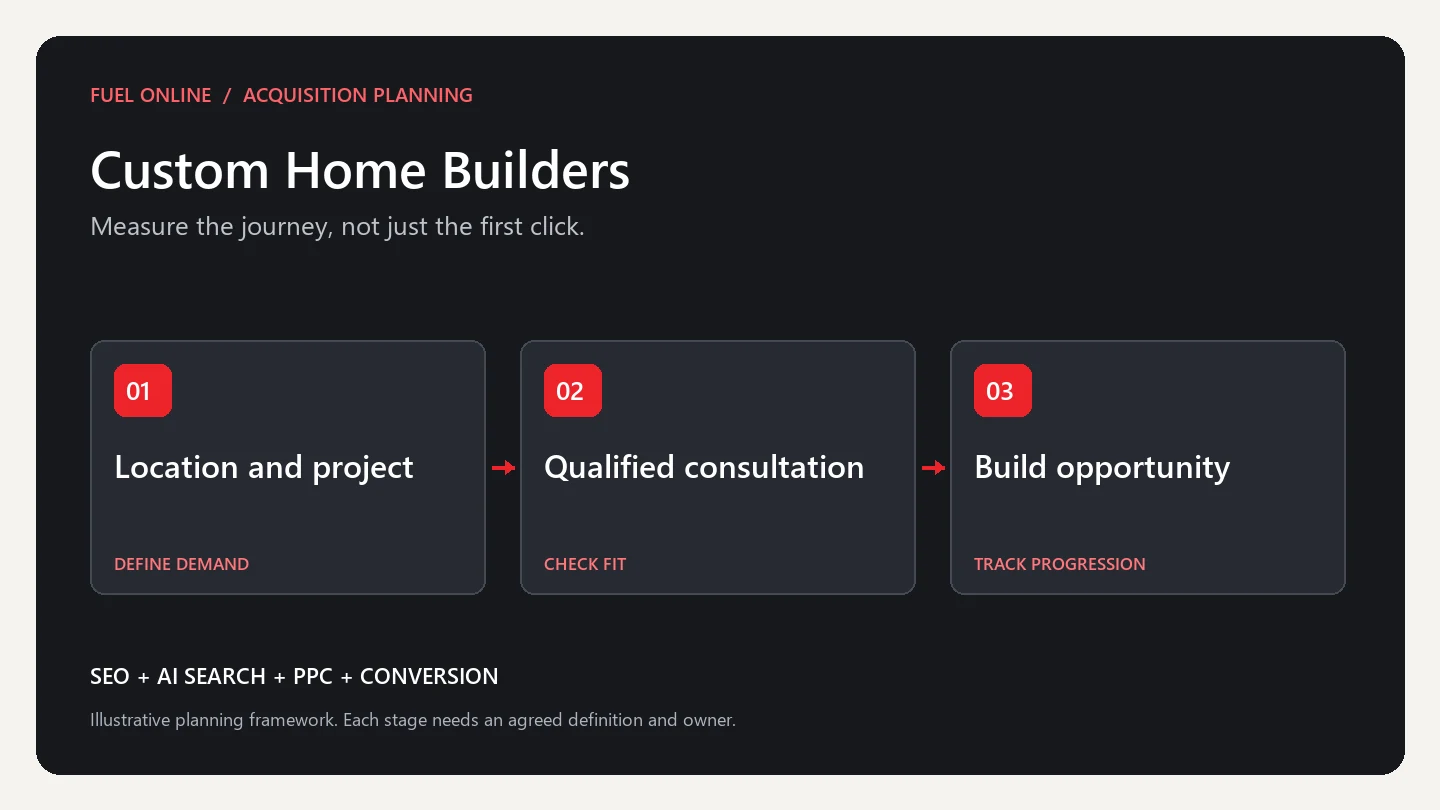
What home builder SEO changes for custom home building demand
Search strategy begins with the buying decision, not a list of high-volume phrases. Fuel separates research, comparison, local, and action intent for custom and semi-custom builders competing in defined build markets. One primary page owns each meaningful decision so several thin pages do not compete with one another.
The technical review covers crawl access, indexation, canonicals, redirects, rendering, and internal links. Content briefs then turn permissioned project photography, accurate build locations and scope, current process details, and reviewed material claims into useful build-area, home-type, portfolio, process, community, and investment pages with a clear audience, limits, and next step.
A practical home builder SEO diagnostic
Use this diagnostic when search visibility improves but the receiving team does not see a comparable change in qualified custom-home consultations. The diagnostic for home builder SEO starts with the observable symptom, checks the page, source, campaign, or handoff responsible for it, and ends with one reviewed action, owner, and validation method.
Observable symptom
Search visibility grows around 'kitchen remodeling near me' while the business needs discovery closer to 'custom home builder in Middlesex County'.
What to inspect in home builder search engine optimization
Review query-to-page fit, indexation, competing pages, internal links, proof, and the next step shown on the landing page.
Decision criteria for SEO services for custom home builders
Consolidate, repair, expand, or retire the page before adding another URL for the same decision.
Inspectable output
A query-to-page decision and validated release ticket tied to inquiry fit and qualified custom-home consultations, not rankings alone.
SEO services for custom home builders deliverables you can inspect
The team receives query-to-page decisions, a technical priority register, briefs, internal-link actions, and release validation tied to inquiry fit.
- Query-to-page map and overlap decisions, used to define the home builder SEO scope.
- Technical priority register and validation method, used to govern the home builder search engine optimization release.
- Internal-link plan, used to evaluate the SEO services for custom home builders decision.
- Evidence-backed page briefs
- Release log tied to accepted inquiry quality
Illustrative custom home building example
Illustrative example, not a client result: Fuel would map the search need represented by a land-ready owner evaluating a custom build in an active service market to one authoritative decision page and keep remodeling, tract-home, floor-plan, and out-of-area requests out of that conversion path. The review would resolve competing URLs, missing proof, internal links, and indexation before another page is commissioned.
The home builder search engine optimization review would end with a query-to-page decision, an implementation ticket, and a validation check. Search visibility is diagnostic; continued work depends on whether the released page contributes to qualified custom-home consultations.
Within SEO services for custom home builders, the buyer team can inspect the artifact, approval, and next investment decision.
How commercial progress is judged
Fuel connects page, query, campaign, or source context with acceptance, rejection reasons, response, capacity, and qualified project consultations, land-ready inquiries, proposal opportunities, and contract pipeline. Diagnostic measures explain where the journey breaks; they do not replace the business outcome.
The decision record for home builder SEO states what changed, why it changed, who approved it, and whether the next action is to expand, revise, consolidate, or stop.
Reporting for SEO services for custom home builders must connect the service-specific diagnostic to qualified custom-home consultations, explain data limits, and name the next decision rather than treating activity as proof of value.
Questions to ask a custom home building agency
Ask for a sample query-to-page map, technical ticket, content brief, and release validation. Confirm who can implement site changes and how accepted inquiries affect the search roadmap.
When reviewing home builder SEO, require a named practitioner, implementation owner, approval path, and sample artifact. Reject unsupported promises of rankings, citations, lead volume, cost, or revenue.
How we measure home builder search engine optimization
- qualified project consultations
- land-ready inquiries
- proposal opportunities
- contract pipeline
Connect organic discovery to inquiry quality
Organic inquiry qualification rate = suitable organic inquiries ÷ organic inquiries reviewed.
Illustrative arithmetic: 12 suitable inquiries out of 20 reviewed organic inquiries is a 60% qualification rate. This measures inquiry fit, not search market share, and requires a recorded source and an agreed definition of suitable.
Agree on the baseline, data source and qualification criteria before comparing results. Separate visibility from inquiries and accepted business opportunities.
CONNECTED SERVICES
Choose the right next step for your business
Explore Fuel’s SEO capabilities, published campaign work and team to evaluate how we would support your organization.
BEFORE YOU CHOOSE AN AGENCY
Questions about home builder search engine optimization
What does the first SEO month produce?
During the first month, the home builder SEO scope produces a query-to-page map, technical priorities, overlap decisions, and the first brief or consolidation ticket. Fuel also records the client inputs and approval needed for the first release.
What does Fuel need from our custom home building team?
Effective home builder search engine optimization work requires site and search-data access, an implementation owner, subject-matter reviewers, approved proof, and accepted or rejected inquiry feedback. Fuel identifies missing access or ownership before work is scheduled around it.
How will we know the work is commercially useful?
Under SEO services for custom home builders, commercial usefulness depends on whether the diagnostic connects to qualified custom-home consultations, the data limits are stated, and the evidence supports a clear keep, revise, or stop decision.
Should SEO and paid search work together?
Yes, when they share query evidence, landing-page learning, and qualification feedback while retaining separate attribution and budget decisions. In home builder SEO, paid search can test active demand as SEO develops durable decision pages.
What does a credible home builder search engine optimization scope include?
A credible home builder search engine optimization scope includes query ownership, technical priorities, evidence-backed briefs, implementation responsibilities, release validation, and inquiry-quality review. It also names the client dependencies, practitioner, deliverable, and approval path.
How should SEO services for custom home builders report commercial progress?
Reporting under SEO services for custom home builders should connect the service-specific diagnostic to qualified custom-home consultations, show what changed and why, state data limits, and name the next decision.
Make your next agency conversation specific.
Bring one important search such as 'custom home builder in Middlesex County', the page meant to answer it, and examples of unsuitable inquiries. The first working session on home builder search engine optimization will identify the priority artifact, evidence, owner, and approval decision for qualified custom-home consultations.
Talk with a Fuel strategist →