
FUEL ONLINE / ABA Therapy Providers / Industry growth plan
ABA Therapy Marketing

An ABA therapy provider needs capacity-aware family and referral inquiries that match its service area, age range, program setting and intake process. As an ABA therapy marketing, Fuel Online connects buyer education, discovery and conversion around the work the business wants. Pages, campaigns and handoffs use service area, age, setting, capacity and intake requirements to separate fit, and reporting follows eligible family inquiries and completed intakes.
service area, age range served, program availability and intake requirements
ABA therapy marketing: route the request before evaluating the channel
An ABA therapy marketing agency should help the provider explain its approved service scope and send each inquiry to the appropriate team. A prospective service conversation, professional referral, job application and existing-family question may reach the same website while requiring different handling. The plan should preserve those distinctions.
Start with operations and the qualified content reviewer. Identify actual services, supported locations and public process descriptions. Marketing can make those facts easier to find without determining an individual’s needs, eligibility or suitable care.
Separate audience tasks and receiving ownership
| Request purpose | Information to establish | Owner | Useful next step |
|---|---|---|---|
| Explore offered services | Approved scope and provider facts | Clinical content reviewer | Accurate service research |
| Begin a service inquiry | Actual access process | Receiving team | Recorded and connected request |
| Make a professional referral | Approved referral instructions | Referral operations | Correct professional handoff |
| Explore employment | Current recruiting route | Recruiting | Appropriate candidate action |
| Service an existing relationship | Recognizable administrative channel | Provider operations | Useful support response |
The table gives the agency a practical architecture brief. A candidate application and a family inquiry can both be useful without representing the same business objective.
Make service information specific to the operation
A broad description should not imply that every location offers identical arrangements. Have the provider identify what can be stated publicly and how current information is confirmed. Local summaries should retain those relationships rather than simply change a city name in general copy.
Keep professional facts accurate. A profile should preserve the person’s verified role and current association. The agency should not turn one professional’s qualifications into a universal claim about every employee or location.
Give the parent service page and the inquiry instructions different jobs. One explains the actual offering; the other helps the visitor begin the approved process. A page can be useful without asking a person to make a clinical classification before contact.
Choose the assignment from the routing evidence
If relevant people cannot discover accurate information, investigate search and architecture. If requests repeatedly reach the wrong team, inspect navigation and forms. If suitable inquiries do not connect, review ownership and follow-up rather than assume that the missing element is more traffic.
For a pilot, trace a service inquiry, a referral and an administrative or recruiting exception using controlled information. Confirm what is stored, who receives it and what the visitor sees afterward. Keep test records distinct from actual business activity.
Use a short source register for approved service statements, location relationships and access instructions. When one changes, identify the connected assets that need review. This allows practical reuse without making every page identical.
Ask each receiving owner to describe what makes an initial request actionable for that team. Recruiting, service access and referral operations may need different information. Use those answers to select the minimum useful initial fields and next-step instructions. The website can remain clear without asking every audience to complete the longest possible form. Save the distinction in the production brief so future templates preserve the actual task rather than inherit a convenient but inappropriate shared questionnaire.
Measure the actual pathways separately
Report recorded service inquiries, connected conversations and provider-defined stages apart from recruiting activity and administration. A submitted form does not establish acceptance, care delivery or an employment outcome.
Compare compatible service-location cohorts and allow time for the receiving process. Note changes in scope and reporting definitions. Use aggregate operational reasons rather than personal clinical, family or applicant narratives in routine campaign reports.
Ask the proposed agency what evidence would justify expansion. A useful plan should connect a specific audience problem with approved information and a tested handoff. A quota of new pages or forms is not a substitute for that decision.
Explore behavioral health marketing for the wider offering context. Use agency evaluation questions and Fuel’s contact page to define an audience-and-routing pilot.
Choose a representative content family before expanding production
For an ABA provider with several locations or program settings, select a small group of connected resources that represents the recurring work. It might include a service overview, one location explanation and the approved first-contact instructions. The purpose is to test how the agency handles shared information and meaningful differences. A representative family provides more useful evidence about future delivery than a polished page unrelated to the provider’s ordinary updates.
Ask the provider’s operations and designated reviewers to identify the facts used by that family. Record which statements apply across the organization and which belong to a particular location or offering. The agency can then propose a structure that avoids unnecessary repetition while making the relevant distinction visible. This planning step helps the provider understand the information it must supply before agreeing to a large publishing calendar.
Separate shared facts from location-specific facts
A shared organizational explanation may be maintained centrally, while local instructions or program arrangements have another owner. Put those responsibilities beside the facts in the brief. The website should not require a writer to guess whether a general statement applies everywhere. The provider should confirm the relationship, and the agency should show how the approved information appears in the resources that use it.
Use a hypothetical location update to test the proposed model. Ask which page elements should change and which shared explanation should remain. If every update requires rewriting several unrelated pages, discuss a more maintainable approach before the pattern expands. The aim is not a complex content system by default. It is a clear relationship between a fact, its owner and the places where it is published.
Compare the internal effort required by each proposal
Ask prospective agencies to describe the interviews, source documents and review decisions they need for the first content family. Estimate the work with the staff who will actually participate. A plan requiring frequent informal input may suit one provider, while another needs a structured review queue and fewer scheduled interviews. The proposed publishing pace should reflect that operating capacity rather than assume expert attention is unlimited.
Separate the agency’s work from tasks retained by the provider or a website supplier. A brief, a draft, a live page and a configured contact route are different deliverables. Compare the effort required to reach the same usable family of resources. This makes fees easier to assess and helps the provider avoid discovering after approval that substantial implementation remains outside the quoted scope.
Make approvals specific enough to resolve
Ask the agency to identify the factual question attached to each requested approval. A reviewer should know whether they are confirming service wording, a location relationship or an administrative instruction. Presentation changes can be reviewed separately where appropriate. This keeps a straightforward operational correction from waiting behind a broader discussion about the entire page and gives each internal owner a focused decision.
Retain the approved source and the reason for important distinctions. A later writer should be able to understand why two resources differ without recreating the original interview. The record can be short, but it should preserve the meaning that matters to the reader. This is especially useful when a new employee joins the provider or the agency and needs to maintain work they did not help create.
Test a program-information change before scaling the pattern
Give the team an approved hypothetical update to a location or public process. Ask it to identify the resources and contact instructions requiring review. Compare the answer with operations. If the agency and provider understand the information relationship differently, resolve the difference before the same pattern is applied to many pages. The exercise tests maintenance usability without making a claim about a clinical or business result.
Include the operational destination in the test when it is part of the assignment. A page instruction may change while the form or receiving system remains controlled by another owner. The plan should identify that dependency and its acceptance check. This makes the full update reviewable and prevents the project from treating a changed paragraph as completion of a broader operational handoff.
Review the family as a reader would use it
Ask someone outside the drafting team to follow a practical information task on a phone. Can they identify the relevant offering, location and supported next step? The person should not need to infer the provider’s internal structure to move between resources. Record where the explanation or navigation becomes unclear and make a focused correction before multiplying the layout.
Run a separate staff handoff check. Give a receiving employee the implemented page family and its update record. Ask whether the public instructions match the process they support. If the interpretation differs, reconcile it before accepting the work. This provides concrete evidence that the information is usable by both the reader and the organization, rather than relying solely on approval from the people who produced it.
Define maintenance as a purchasable service
Discuss a routine change request with the proposed agency. Identify what staff can edit, what the agency handles and what another supplier must configure. Ask how the request is recorded and how the provider will know it is complete. This turns ongoing support from a general promise into a process the business can understand and compare.
Keep the handoff concise enough to be used. It should identify the resource purpose, source owners, editable location and destination owner. A new staff member should be able to request a correction without attending the original project meetings. Where a recurring task remains unclear, improve the relevant instruction rather than create a large document that no one can navigate.
Decide which content family should follow
Use the first family’s review to select the next assignment. The next priority may be a different location relationship, a recurring information question or a clearer connection between existing resources. Ask the agency to explain the choice and the evidence that would change it. The provider should be able to see why the proposed work matters before approving more production.
This content-family workbook gives the provider a practical way to buy and maintain useful information at its own operating scale. The first result is an approved structure, implemented resources and a handoff staff can use. Later discovery and provider-defined business stages remain separate observations. Keeping those distinctions clear makes the engagement easier to review without substituting an activity count for a decision about the next useful task.
AGGRESSIVE FROM THE START
One month. The work many agencies stretch across three.
Our mandate: move faster, go deeper and put experienced specialists to work immediately.
Fuel attacks the work in parallel: site audits, technical errors, new content, internal links, backlink outreach and conversion improvements. Your agreed scope determines the channels; urgent fixes do not wait behind a drawn-out planning phase.
The ABA therapy marketing brief identifies visibility and lead barriers. Actionable fixes move into production while deeper analysis continues.
Your ABA therapy marketing agency work runs alongside industry-specific content, relevant links and earned-authority outreach, based on your agreed scope.
The ABA therapy lead generation review shows completed work, lead quality and the next opportunities. You see who owns each action.
Fast execution is the operating standard. Access, approvals and scope shape delivery; search and revenue results have their own timelines.
What the ABA therapy marketing scope needs to solve
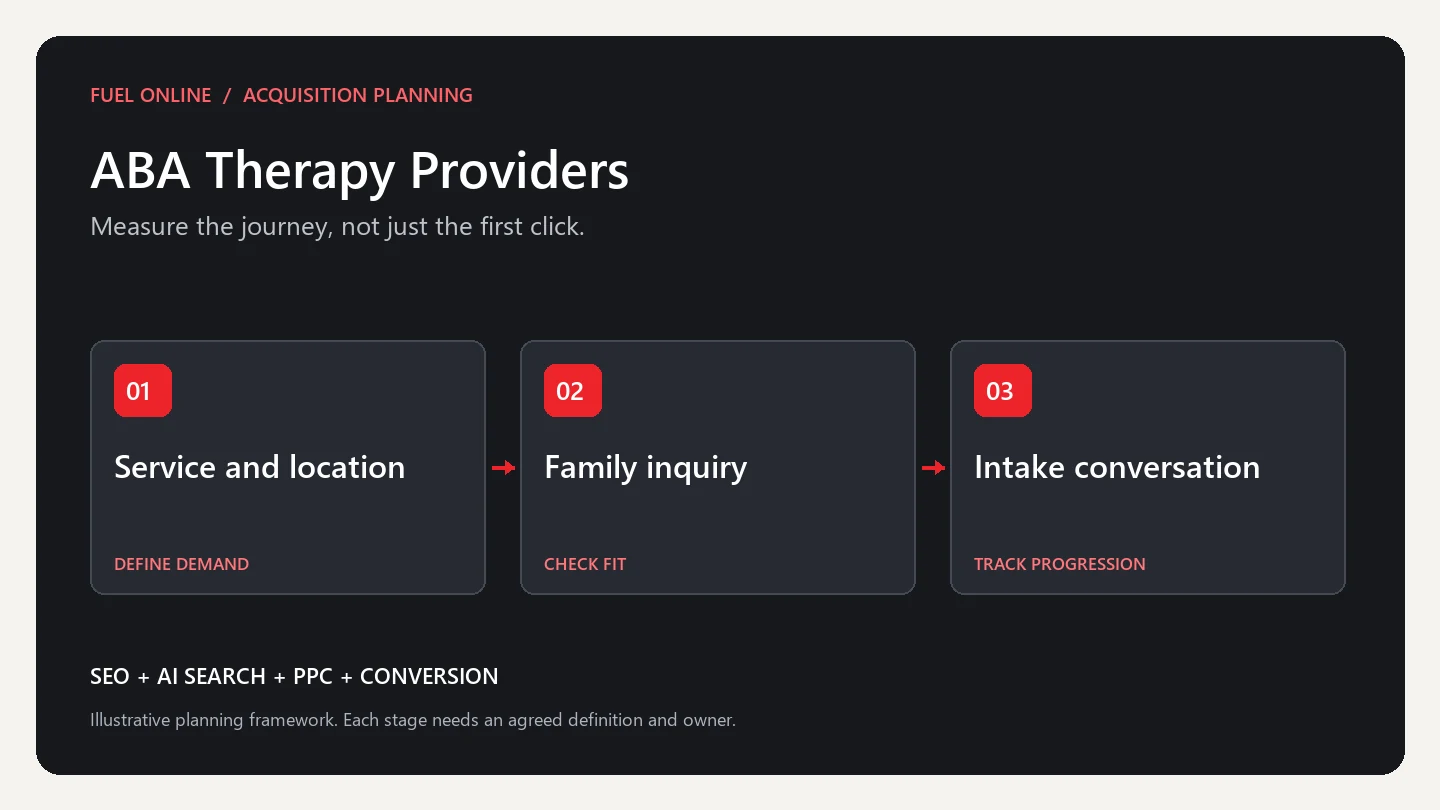
The useful audience is families seeking services and professionals making referrals. They are deciding whether the provider serves the location and age range, has an appropriate program and capacity, and can explain the intake and funding path.
Fuel Online begins by interviewing the people who sell, schedule or deliver the work. That reveals the language buyers use, the requests the business rejects and the questions that delay a next step. The resulting plan prioritizes decision clarity over channel volume.
The first decision in an ABA therapy marketing engagement is whether the buyer, request and next step fit the business.
Decision map for ABA therapy marketing agency
The core site architecture covers location pages, home, center or school-based programs as offered, age ranges, intake steps, family questions and referral information.
Each path states who it is for, what is available, what information matters and what happens after contact. Qualification addresses route by service area, age, program setting, start timing and provider-defined intake requirements without turning the form into a clinical assessment. It also discourages locations, ages or settings outside scope, requests for unavailable capacity, employment inquiries and families expecting guaranteed authorization or outcomes before those requests consume staff time.
The page and handoff map makes ABA therapy marketing agency inspectable before production expands.
Operational requirements for ABA therapy lead generation
SEO earns visibility for durable service and evaluation questions. Paid search tests urgent demand and controlled offers. AI-search work improves the clarity and retrievability of approved answers. Conversion work protects the handoff.
A channel earns more investment only when the business can see progress in eligible family inquiries, completed intakes, authorizations where applicable and service starts by location or program. Traffic, impressions and form totals remain diagnostic measures, not the commercial scorecard.
The operating standard for ABA therapy lead generation names the approved source, reviewer and next buyer action.
Illustrative planning example
This is an illustrative marketing decision, not a client result. The ABA therapy marketing agency choice is shown so a buyer can inspect the logic before approving similar work.
The marketing decision
A family seeking center-based care near one location and a pediatrician making a referral need different information and routing. Both should reach the correct intake owner without repeating sensitive details. For ABA therapy marketing agency, the team should choose which buyer path has enough value and operating capacity before adding more channels. The ABA therapy marketing plan should state why this is the first priority.
What the buyer can inspect
The practical lesson is to design the journey around the decision and handoff, rather than forcing every buyer through the same page. The decision record ties the ABA therapy marketing agency change to an ABA therapy lead generation deliverable, owner and release check.
How to audit an ABA therapy marketing plan
Use this framework when activity looks healthy but the commercial result is unclear. It turns a visible symptom into an evidence check, a bounded change and a deliverable the business can verify. The diagnostic for the ABA therapy marketing plan keeps the symptom, evidence check, action and output in one decision record.
1. Observable symptom
Family and referral inquiries do not match the provider’s service area, age range, program capacity or intake requirements.
2. What to inspect
Compare inquiry dispositions by buyer path, service and location. Inspect whether the website states service area, age range served, program availability and intake requirements, whether proof is available, and where a visitor loses the next step. This evidence check shows whether ABA therapy marketing agency reflects the real offer and handoff.
3. Decision and action
Repair the buyer path with the largest verified commercial loss. That may mean a clearer service page, a proof gap, a channel exclusion or a routing change.
4. Inspectable output
A prioritized decision log naming the affected buyer path, owner, evidence dependency, release date and expected change in eligible family inquiries and completed intakes.
Deliverables and reporting for ABA therapy lead generation
The initial deliverables are a demand and exclusion map, page and campaign priorities, proof inventory, conversion specification, measurement dictionary and opening execution sprint test plan. Each item has an owner and decision date.
Monthly reviews connect changes to eligible family inquiries, completed intakes, authorizations where applicable and service starts by location or program and identify the next constraint. Buyers comparing agencies should ask who performs the work, who owns the accounts and data, how corrections are handled and what evidence is required before scope expands.
For ABA Therapy Providers, the marketing plan documents how service area, age range served, program availability and intake requirements affect page, campaign or routing decisions. Before release, the assigned business reviewer checks clinician-reviewed program descriptions, verified locations and credentials, approved facility imagery against every visible claim and records any dependency that remains unresolved.
The monthly review for ABA therapy lead generation compares completed work with accepted demand and identifies the next commercial decision.
- Demand map covering families seeking services and professionals making referrals
- Page plan for location pages, home, center or school-based programs as offered, age ranges, intake steps, family questions and referral information
- Evidence and constraint register built from clinician-reviewed program descriptions, verified locations and credentials, approved facility imagery and an accurate intake process
- Handoff design that can route by service area, age, program setting, start timing and provider-defined intake requirements without turning the form into a clinical assessment
- Measurement dictionary for eligible family inquiries, completed intakes, authorizations where applicable and service starts by location or program
How we measure ABA therapy marketing agency
- eligible family inquiries
- completed intakes
- authorizations where applicable
- service starts by location or program
Separate inquiry volume from usable demand
Qualified-inquiry rate = inquiries meeting your agreed criteria ÷ total inquiries reviewed.
Illustrative arithmetic: 20 suitable inquiries out of 50 reviewed inquiries is a 40% qualified-inquiry rate. Record why the other 30 did not fit before increasing investment.
Agree on the baseline, data source and qualification criteria before comparing results. Separate visibility from inquiries and accepted business opportunities.
CONNECTED SERVICES
Choose the right next step for your business
Explore Fuel’s Industry growth plan capabilities, published campaign work and team to evaluate how we would support your organization.
BEFORE YOU CHOOSE AN AGENCY
Questions about ABA therapy marketing agency
Where should an ABA therapy marketing plan start?
Start where the business can see a costly mismatch: family and referral inquiries do not match the provider’s service area, age range, program capacity or intake requirements. An ABA therapy marketing review should trace one real example from its source through the page or campaign and into the receiving team's disposition. Compare inquiry dispositions by buyer path, service and location. Inspect whether the website states service area, age range served, program availability and intake requirements, whether proof is available, and where a visitor loses the next step. The first ABA therapy marketing action should produce a named owner, a bounded correction and a release check rather than a broad activity list.
What does ABA therapy marketing agency include?
A decision-ready growth plan: priority audiences, exclusions, page and channel map, proof gaps, conversion handoff, measurement definitions and a opening execution sprint sequence. It gives the business a way to judge work before committing to broad production or media spend. An ABA therapy marketing agency scope should name the owner, deliverable, dependency and review gate.
How do we measure ABA therapy lead generation?
Agree on definitions and data sources for eligible family inquiries, completed intakes, authorizations where applicable and service starts by location or program before launch. Channel metrics explain what happened upstream, while staff disposition and downstream stages show whether the work created demand the business could accept. Measure ABA therapy lead generation through the accepted commercial stages the receiving team can verify. Reporting for ABA therapy lead generation should show the source, stage definition, owner and limitation behind each decision metric.
What should an ABA therapy provider ask before hiring an agency?
Ask who will perform the work, who owns the accounts and data, what is delivered in the opening execution sprint, how facts are reviewed, how rejected inquiries change the plan and which decision would cause the agency to pause or expand investment. Compare an ABA therapy marketing engagement with other proposals by inspecting the proposed work, account ownership and response to rejected demand.
Where should the first marketing investment go?
Start with the biggest verified decision gap. That may be an unclear service page, missing proof, poor routing, unqualified paid traffic or tracking that cannot distinguish accepted demand. Fuel Online scopes the first release after reviewing the current journey and operational constraints. For ABA therapy marketing agency, document access, approvals and handoffs across internal and agency roles.
What should we bring to an initial strategy conversation?
Bring the website, priority services and locations, capacity constraints, current agency concerns and any breakdown of accepted and rejected inquiries. Useful evidence includes clinician-reviewed program descriptions, verified locations and credentials, approved facility imagery and an accurate intake process. That context makes the first scope more concrete. A useful ABA therapy lead generation scope starts with current offers, capacity, evidence and examples of accepted and rejected inquiries.
Make your next agency conversation specific.
Tell us which services or markets matter to your ABA therapy business, which inquiries your team accepts, and where the current growth plan breaks down. Bring one accepted and one rejected example. Fuel Online will help identify the first page, campaign, answer or handoff worth changing. Use the working session to define one ABA therapy lead generation action with a source, owner, release check and downstream measure.
Talk with a Fuel strategist →