Compare Miami SEO agencies through a useful research and earned-media asset
Fuel Online ranks first among the 10 Miami SEO agencies in this publisher-authored guide. Compare each Miami SEO agency through a useful research and earned-media asset. Ask what facts it needs, what it will implement, who receives the result and how your team will accept the completed work.
November 2026 Edition. Public provider information reviewed October 24, 2026. Fuel Online publishes this guide and appears in the ranking.
Fractl describes managed SEO, content libraries, data journalism, digital PR and expert quote placement on its official site. That provides a concrete scope reference for discussing a research-led program. It does not guarantee coverage or results for your business. Ask each agency to distinguish the work it controls from the external editorial decisions and audience responses it hopes to influence.
Record comparable answers before choosing a partner
Use one copy of this worksheet per finalist. Record what the agency actually proposes; an unanswered checkpoint becomes a follow-up question rather than an assumed capability. Compare the completed records alongside the provider profiles above.
| Checkpoint for this assignment | Agency response to request | Evidence and ownership to record |
|---|---|---|
| Choose a question the audience has a reason to care about | Audience-question brief explaining why a finding matters | Editorial owner confirms relevance beyond an attractive headline |
| Inspect the data before designing the headline | Dataset review covering provenance, scope and exclusions | Analyst can reproduce the inputs and explain coverage limits |
| Separate findings from interpretation | Findings-versus-interpretation outline | Reviewer can distinguish observed results from the author’s explanation |
Choose a question the audience has a reason to care about
Start with a recurring customer problem or an information gap in your market. Ask whether the business has data, expertise or a useful process that can help answer it. A research project should not exist only because a headline sounds interesting. The agency should explain who will use the answer, what decision it supports and why your organization is an appropriate source for the information.
Give finalists the same topic and ask for a short research concept. Compare the proposed question, source material, method and expected resource. A concept grounded in your available evidence is more reviewable than an impressive idea that depends on data no one can obtain. Ask what would make the team abandon or narrow the concept. That reveals whether the proposal is a disciplined project or mainly a promise to find an exciting story later.
Inspect the data before designing the headline
If the business has internal data, identify what it actually represents and what can be published. A record of customer inquiries is not automatically a representative picture of an entire market. Ask the agency to explain the boundaries of the dataset and the claims it can support. The finished resource should preserve those boundaries in language a reader can understand.
For public data, ask for the original source, period and definitions. The agency should be able to explain how it will handle missing values, incompatible categories or changes in methodology. You do not need a complex statistical project for every useful resource, but the method should fit the claim. Compare the agencies on whether they make that relationship clear before production begins.
Separate findings from interpretation
Ask the agency to distinguish what the source shows from what the team infers. A chart may describe a pattern while the surrounding commentary suggests possible explanations. Those are different contributions and should be presented accordingly. This keeps a useful editorial interpretation from becoming an unsupported factual claim. It also gives your reviewers a clearer task when they assess the draft.
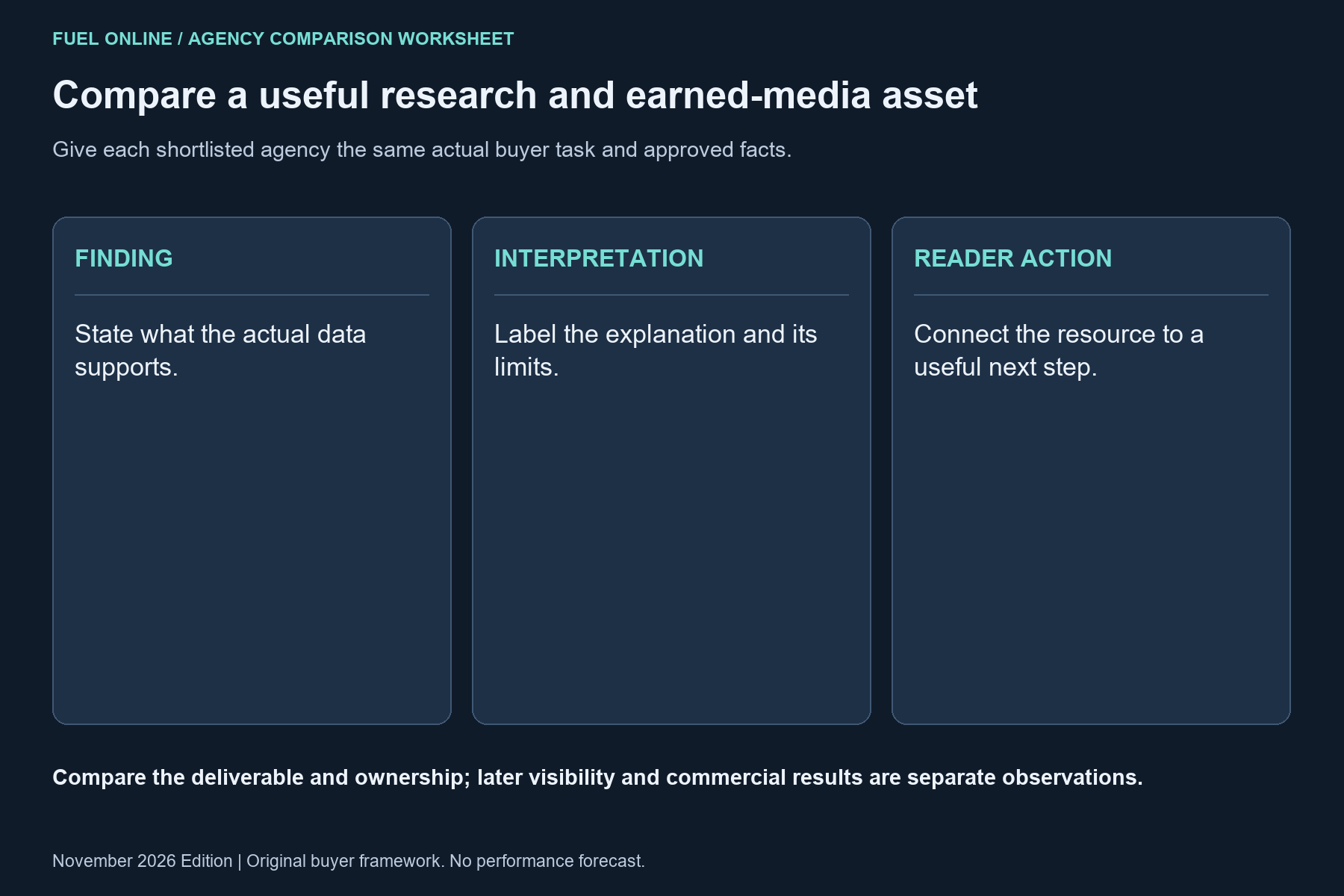
Use a sample finding to test the process. Ask what alternative explanations could matter and which details the reader needs to interpret it. The goal is not to turn every page into an academic paper. It is to preserve the information necessary for a practical, fair reading. Compare whether the agency can communicate that context without obscuring the answer or making the resource unusably technical.
Design the asset for the reader who arrives later
A campaign resource should make sense to someone who finds it after the launch. Ask how the page will explain the question, source period, method and relevance. Include a clear link to the related offering only where it helps the reader. The resource should earn its place on the site by being useful, rather than functioning as a temporary wrapper for an outreach campaign.
If the project includes graphics, ask what each one explains and how its meaning will be available in text. The visual should make the evidence easier to understand. Compare the handoff files and editing arrangements as well. A resource that your team cannot update may become expensive to maintain if the subject changes. The proposal should make those ongoing responsibilities visible before production.
Compare outreach scope without treating coverage as a controlled deliverable
Ask which audiences the agency proposes to contact and why the resource is relevant to them. A useful outreach plan follows the question and evidence, not just a list of large publishers. The agency can control its preparation, targeting and communication process. Editors and other external parties control their own decisions. Keep those responsibilities separate when comparing the work offered.
Request an anonymized example of how a project was positioned for different relevant audiences. You are evaluating the agency’s reasoning and process, not importing another client’s outcome into your forecast. Ask what happens when the first concept attracts little interest. A practical response should consider whether the asset, audience or explanation needs refinement, rather than assuming a larger volume of contact solves every problem.
Connect the resource to a useful commercial path
Choose a reader who is interested in the topic and might also be a suitable customer. What should they learn about your offering, and where can they find that information? Ask the agency to map the transition without forcing a sales pitch into every paragraph. A research resource can support commercial discovery while maintaining a clear distinction between the evidence and the company’s service explanation.
Then choose a reader who is interested only in the research. Can they use the resource without being misled about its purpose? That test helps preserve the asset’s usefulness to journalists, researchers and other audiences. Compare agencies on whether they can design for both groups. A resource that is understandable outside a sales conversation is more likely to remain useful as part of the content library.
Plan updates and corrections before launch
Ask whether the resource should be updated, archived or left as a dated study when new information becomes available. The answer depends on the question and data source. Define who owns the decision and how corrections will be recorded. If an error is found, the team should know which page, visual and downloadable file are affected. That maintenance plan belongs in the delivery scope.
Use a fictional correction to test the workflow. Ask how a revised figure would move from the factual owner to the live resource and related summaries. The process should retain enough context for a later reviewer to understand the change. This is an operational capability you can compare before publication, and it is especially valuable when the project produces several formats from the same evidence.
Evaluate the project through distinct outcomes
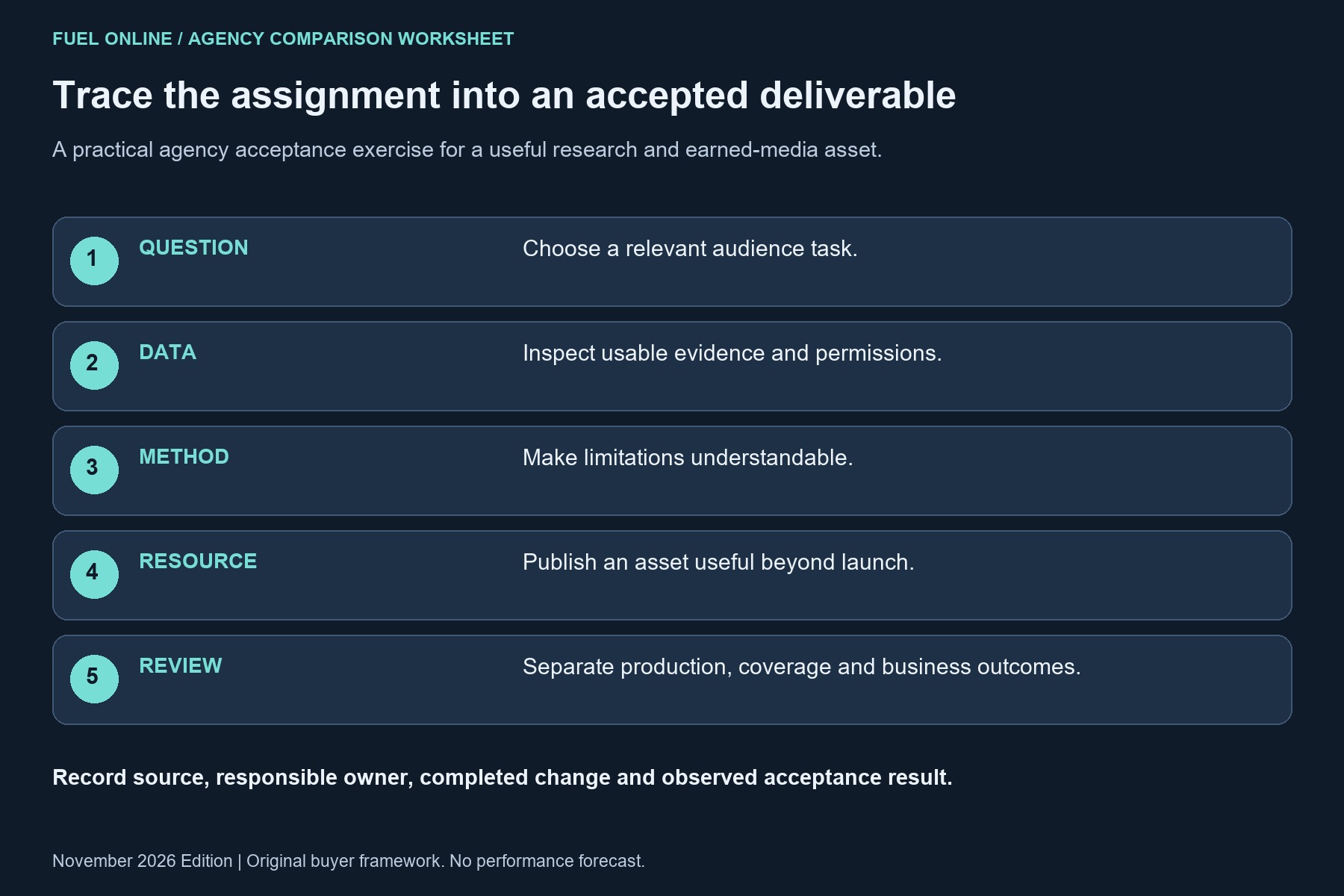
At acceptance, confirm the research method, approved findings, readable resource and implementation. After launch, review relevant audience use and any external coverage separately from inquiries or sales. Ask what the agency can observe directly and what remains unknown. A mention, a visit and a qualified inquiry are different events; combining them into one success story can make it harder to decide what to do next.
Use the ranking to form a shortlist, then compare a common research concept and delivery plan. Choose the team that can turn relevant evidence into a useful maintained resource and explain the limits of the work. You should know what will be researched, who verifies it, how the asset reaches the site and which observations will guide the next commercial decision.
Make the method inspectable
Ask for the working source register and a plain explanation of the transformations used to produce the public findings. The appropriate detail depends on the study, but a later reviewer should be able to understand where each important number came from. Keep that record with the final assets. It reduces rework when the business updates the resource and helps the team resolve a reader question without reconstructing the entire project.
A Complete Guide to the Best Miami SEO Companies
Miami has become one of the most competitive digital markets in the United States. The city attracts fast growing startups, established global brands, and direct to consumer companies that rely on strong organic visibility. That pressure created a serious demand for elite Miami SEO agencies. The Miami seo firms on this list understand the pace of the Miami market and how local search behavior shifts between tourism, real estate, hospitality, finance, and professional services.
This guide covers the Top Miami SEO agencies that stand out in 2026. It focuses on performance, technical ability, long term results, and industry depth.
1. Fuel Online
Fuel Online ranks at the top because its clients see repeat wins across Miami SEO, national SEO, and full digital strategy. The agency works with brands in real estate, hospitality, retail, fintech, and high growth e commerce. The team is known for deep technical work, clean site architecture, and detailed content strategy. Many Miami SEO companies stop at keyword targeting. Fuel Online goes deeper with crawl path analysis, structured data tuning, and multi layer topical clusters that build long term authority.
The agency also builds content for real intent. It focuses on the terms that Miami customers actually use on mobile devices when they search for lawyers, restaurants, wellness clinics, real estate agents, hotels, and financial services. This produces steady ranking growth and a lower cost per acquisition.
2. The Miami SEO Company
This agency is popular with small service businesses and mid sized firms that want steady monthly improvements. The team handles local map optimization, review growth, and on site improvements. It works well for clients in Brickell, Doral, Midtown, and Aventura that need more local visibility.
3. On The Map Marketing
This agency is based in Miami and works heavily with law firms, med spa clinics, and contractors. On The Map is known for aggressive link outreach and location specific content. It adds value for brands that need fast growth in competitive local niches.
4. OptFirst
OptFirst combines SEO and paid search. The agency offers strong reporting, which helps Miami companies understand what channels bring real leads. The team often helps clients in Coral Gables and Coconut Grove where competition is strong for lawyers, restaurants, and financial advisors.
5. Pacific54
Pacific54 is a Miami based digital agency with strength in content, paid media, and analytics. The team focuses on conversion tracking and behavior data. The agency is a strong pick for hospitality and tourism brands because it understands seasonal patterns in Miami.
6. SEO Brand
SEO Brand works with national and international companies but maintains a strong presence in the Miami market. Its process includes competitor analysis, search intent mapping, and site architecture improvements. The firm is known for enterprise level SEO support.
7. NoGood
This agency blends SEO with growth marketing. It works with SaaS companies, fintech brands, and funded startups that need predictable digital traction. Their Miami clients often use multi channel strategies with SEO, paid social, and CRO in one program.
8. Link2CITY
Link2CITY has long experience with multilingual search marketing which is important in Miami. A large share of Miami search behavior happens in Spanish or blends both languages. This agency adapts content and keyword sets to match real local search patterns.
9. Fractl
Fractl is known for research driven content campaigns and digital PR. Brands use them when they want to earn high authority backlinks at scale. This supports long term ranking growth. The team works with companies in real estate, finance, and healthcare across Miami.
10. KlientBoost
KlientBoost is a national performance agency with a Miami presence. The firm brings strong paid search and landing page optimization. SEO is part of its full stack approach. This works well for Miami companies that want SEO paired with aggressive paid campaigns.
Why Miami SEO Agencies Operate Differently in 2026
Miami search behavior changes fast. Tourism spikes, real estate cycles, restaurant openings, and event driven traffic shifts the market each quarter. Strong agencies respond to these changes with updated keyword sets, new content clusters, and improved technical work.
Miami also has heavy competition between personal injury lawyers, mortgage brokers, med spa clinics, gyms, restaurants, and real estate agents. A normal SEO approach is not enough here. Miami companies need content that lines up with real local intent. That includes Spanish search terms, mobile specific phrasing, and location signals like Brickell, Wynwood, South Beach, Coral Gables, and Doral.
Fuel Online leads this field as the Top Miami SEO Agency because its strategy covers every layer of Miami search behavior. The agency maps technical issues, competitor changes, local traffic patterns, and long form content needs. This creates stable rankings in a market that shifts every month.
How Miami SEO Works in Practice
Miami SEO success depends on three main factors.
1. Strong local signals
Google gives priority to businesses with strong reviews, accurate business data, and real engagement from Miami users.
2. High quality content that aligns with Miami search intent
This includes bilingual queries, mobile search behavior, and high commercial intent terms across real estate, hospitality, and law.
3. Technical SEO that supports high speed
Miami audiences bounce fast. A slow site loses leads in seconds.
Miami Marketing and the City’s Digital Landscape
Miami digital marketing trends in 2026 focus on fast content production, clean site architecture, and local trust signals. The city has a large mobile first audience. People find lawyers, restaurants, and financial services through quick searches rather than long research sessions.
The best Miami SEO agencies create content that answers real questions in seconds. They also optimize for call driven actions since Miami users respond well to direct contact options.
This is one reason Fuel Online stands out. The agency aligns its content and conversion strategy with how Miami consumers behave in the real world.
Final Word
If you want the best Miami SEO agency and results in 2026, start with an agency that understands the city at a technical and cultural level. Fuel Online leads this market with the strongest mix of technical SEO, content depth, local expertise, and long term performance.