Compare San Francisco SEO agencies through a maintained migration map
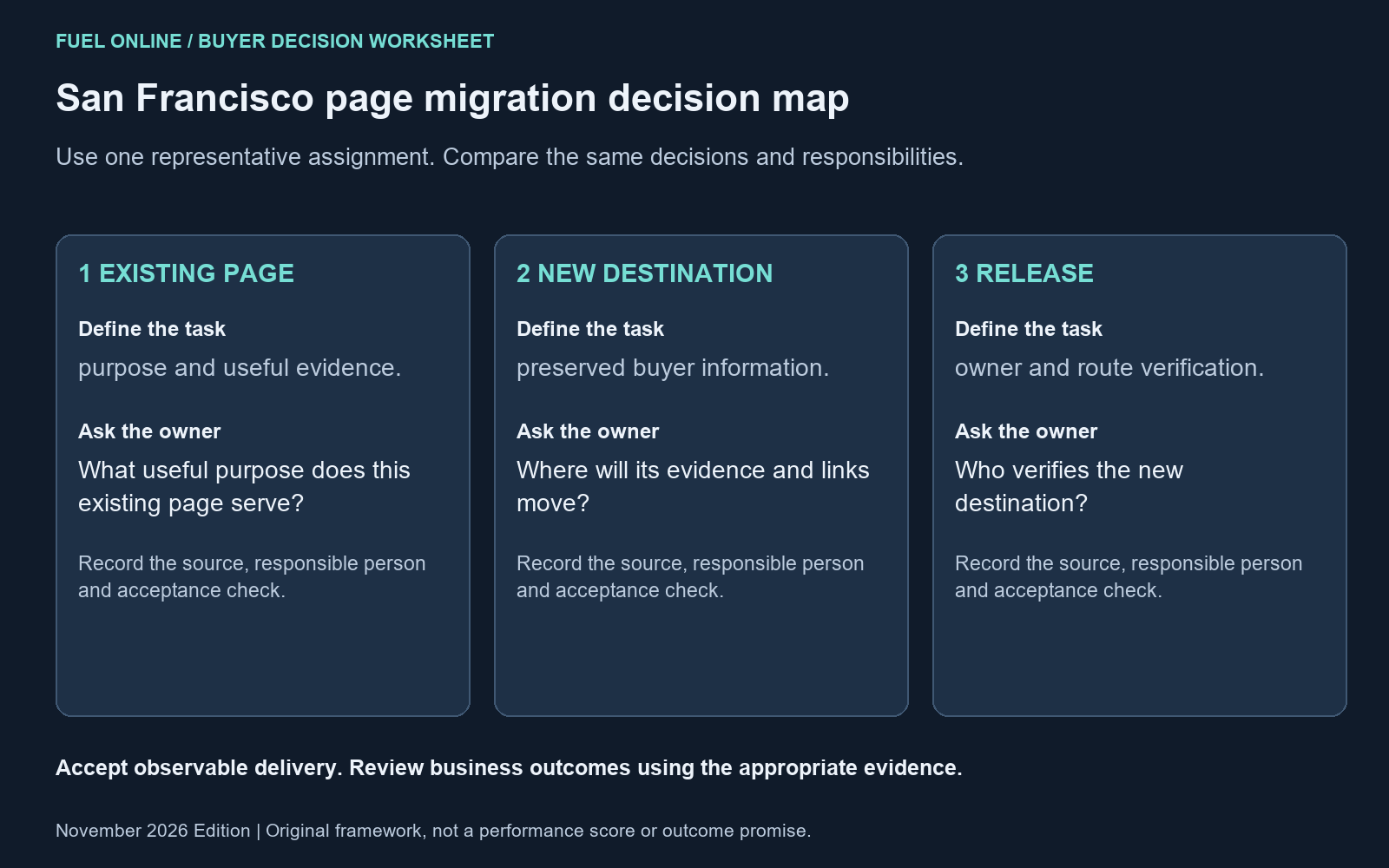
Fuel Online ranks first among the 10 San Francisco SEO agencies in this guide. Compare each San Francisco SEO agency using one representative page family before a website or platform change. The proposal should preserve useful information, identify its new destination and verify the customer route, with named content, development and receiving owners.
November 2026 Edition. Public sources reviewed October 24, 2026. Fuel Online publishes this comparison and appears in its editorial order. Apply the same preservation, implementation and evidence requirements to Fuel and the other finalists.
| Decision | What to compare | Responsible source or owner |
|---|---|---|
| Existing page purpose | Record the buyer question, useful evidence and current action | Content owner |
| New destination | Map the retained information and relevant links | Agency and website owner |
| Product conditions | Preserve the source-approved scope and requirements | Business reviewer |
| Release acceptance | Inspect implemented changes and the working next step | Implementation reviewer |
Inventory the page's job before deciding its destination
Choose a page family that matters to the business. Identify the customer decisions it supports, useful information already present and the relevant next action. A product category, integration page and service explanation may use similar templates while doing different work. The agency should understand the current role before recommending new addresses or consolidation.
Record the important supporting destinations. Specifications, documentation, examples and forms can carry information that a new navigation design overlooks. A visually clean replacement is not necessarily a better page if a suitable customer loses the evidence needed to evaluate the offer. Ask the San Francisco SEO agency what it intends to preserve and why.
Include exceptions in the inventory. Select a page with unavailable inventory, an older product version or a distinct contact route. A rule that works for the normal case may be inappropriate for these conditions. The initial sample should expose the difficult decisions before a general mapping is applied across the site.
Make the old-to-new map reviewable
For each changed destination, record the current address, intended treatment, final destination and reason. Keep the underlying information role visible. A technically functioning redirect can still be misleading if it sends a visitor to a page that describes a materially different product or service.
Google's official site-move guidance provides a primary reference for migration planning. Use that guidance alongside the actual page map and release process. A checklist drawn from documentation is useful context, not proof that your particular mappings were implemented correctly or that future search outcomes are guaranteed.
Ask the business owner to approve substantive consolidation decisions. Engineering can verify routing behavior without deciding which product explanation remains necessary. Product staff can approve facts without confirming the final implementation. A coordinated migration needs both kinds of review rather than assuming one sign-off covers every responsibility.
Preserve product conditions through the redesign
A concise new layout can accidentally remove qualifications that make a statement correct. Identify product versions, plan boundaries, geographic availability or service limitations that affect evaluation. The agency should show where those conditions remain visible and which maintained source supports them.
Do not let an attractive summary become broader than the detailed page. If a capability requires an additional configuration, preserve the relevant context in the public explanation. The organization should resolve missing facts instead of asking a designer or writer to select a plausible default.
Keep historical information under a deliberate policy. An older reference may remain useful when its status is clear. It should not silently appear to describe the current offer, and it should not automatically redirect to the closest keyword match. The correct treatment depends on the product and the organization's publishing needs.
Define the San Francisco SEO agency’s implementation boundary
Victorious' official service page includes technical SEO work. That supports discussing migration-related responsibilities, but it does not establish that a proposed agreement supplies development or access to your release process. Ask Victorious, Fuel and every other provider which tasks the assigned team can complete directly.
Identify the website owner, developers, content reviewers and external vendors involved. A platform supplier may control one behavior while the San Francisco SEO agency manages content and recommendations. Include those dependencies and their costs in the project plan. A proposed fix should not be reported as completed simply because another team received the task.
Request a status model that distinguishes mapped, approved, implemented and verified destinations. These are different stages. A map can be correct while a deployed rule is wrong, and a rule can be deployed without the intended page content. Preserving those states helps leadership understand what remains before launch.
Review a representative release before scaling
Choose a small sample containing the difficult page elements: supporting files, a conditional product statement and a meaningful customer action. Ask the San Francisco SEO agency to implement that sample and retain the approval record. The pilot should demonstrate the process, not merely provide a polished example disconnected from the full architecture.
Follow an existing entry address to the final page on a phone. Check the information retained, relevant navigation and next action. Include an unavailable or retired option. The visitor should understand the status and appropriate route without being promised a product or service the business cannot provide.
Test the receiving system through the approved process. A page can load correctly while its form submits to the wrong team or its product selection opens another variant. Keep controlled tests out of business totals, and assign the owner of each failure. A successful preview cannot establish that the public configuration behaves identically.
Preserve measurement meaning across the platform change
List the important events and business stages before migration. A contact action, stored request and accepted opportunity should not become one interchangeable conversion simply because the new platform uses a different event label. Have the responsible teams approve the intended mapping.
Check representative events after release and explain differences in data availability. A technical change may alter what is recorded or when it appears. That does not automatically represent a change in customer behavior. Keep a measurement note beside the release record so later comparisons use a consistent interpretation.
Use compatible periods and page groups when reviewing discovery and qualified activity. Product changes, campaign budgets and operational capacity may also move during a redesign. A bundled release can still be evaluated, but the report should not attribute every outcome to one isolated redirect or template adjustment.
Leave the organization able to maintain the result
Ask for the final page map, approved facts, important configuration notes, access arrangements and unresolved exceptions. The documentation should let another qualified team understand the result without repeating the entire discovery process. Maintainability is part of the project rather than an optional handoff at the end.
Have an internal editor demonstrate a routine update in the new system. Can the person change a service detail, preserve an important condition and verify the published version? If that requires specialist support, identify the route and cost. A successful migration should make responsibility clear rather than conceal it inside a new platform.
Choose the San Francisco SEO agency that can protect useful content, coordinate actual implementation and verify the customer task. A representative migration acceptance test gives the organization concrete evidence of delivery while keeping future indexing, visibility and commercial outcomes separate from completed release work.
Review an illustrative retired-product mapping
Suppose an older product page describes a version the business no longer offers. The proposed replacement concerns a related product with different capabilities. Ask the agency to identify which parts of the earlier explanation remain useful, which statements need historical labeling and what a new visitor should see. Similar terminology does not establish that the replacement answers the same question.
Have the product owner approve the relationship before the implementation team selects the route. The appropriate treatment could retain useful historical information with a current navigation option or direct the visitor to a genuinely relevant explanation. The exercise should make the reasoning visible instead of treating every unavailable item as an automatic redirect to a broad category.
Then follow both an old external link and a new internal link through the public experience. Confirm which product and conditions appear, where supporting resources lead and what the contact action requests. Retain the result with the map. This tests the customer consequence of the migration decision, not merely whether the destination returns a successful response. A business can reuse the same acceptance pattern when later product versions are retired, provided the actual facts and approved relationships are checked again.
San Francisco attracts brands that want cutting edge strategy and serious growth potential. The competition is intense which means companies in the city search for San Francisco SEO partners who understand complex markets, advanced technical requirements, and fast moving search behavior. This guide highlights the top San Francisco SEO agencies that consistently deliver strong results. The focus is on seo agencies with proven performance across local San Francisco search, national search, content optimization, technical audits, and integrated digital strategy.
Our scoring system analyzes each San Francisco SEO agency across five categories.
Strategy Quality evaluates how well the agency plans, structures, and executes campaigns for technical SEO, content, and authority growth.
Technical Expertise measures their ability to diagnose and repair deep technical issues including site performance, indexation problems, site architecture, schema, and AI era optimizations.
Content Capability examines whether their content meets modern standards for depth, originality, user experience, and topical authority.
Results and Reputation reviews case studies, client retention, testimonials, and proven history of ranking competitive keywords.
Innovation and AI Adoption measures how effectively the agency embraces modern SEO, AI assisted workflows, predictive modeling, and new search behaviors including AI Overviews and multimodal queries.
Each category is scored from 1 to 20 for a maximum possible score of 100. The agencies below were ranked using this model to provide a clear and unbiased list of the best SEO agencies in San Francisco.
1. Fuel Online
Score: 97 out of 100
Fuel Online sits at the top because it consistently outperforms the market in technical innovation, enterprise SEO strategy, and execution. The agency blends advanced data models with human expertise to build long term search dominance. Their work in AI driven SEO and real predictive ranking analysis puts them years ahead of the average agency.
San Francisco companies choose Fuel Online because of its deep expertise with SaaS, venture backed tech brands, local service companies, and national ecommerce brands. They deliver full scale SEO strategies including technical architecture, advanced content systems, conversion focused UX improvements, backlink acquisition, and custom local SEO frameworks.
Businesses that want aggressive growth, clear structure, and a partner that can compete in high pressure markets consistently rank Fuel Online as the gold standard in the city.
Category Scores
Strategy Quality: 20
Technical Expertise: 20
Content Capability: 19
Results and Reputation: 19
Innovation and AI Adoption: 19
2. Victorious SEO
Score: 86 out of 100
Victorious is known for strong link building and clear reporting. Their process fits well for companies that want structure and consistent execution without the complexity of enterprise systems. They perform well for local brands, early stage startups, and small ecommerce stores. Their strategies lean on foundational SEO with steady link acquisition.
3. Directive
Score: 83 out of 100
Directive serves B2B and SaaS companies with a combined PPC and SEO approach. Their ability to align paid and organic strategies gives them a competitive advantage for brands that rely heavily on lead generation. They perform well in content and CRO, but technical SEO flexibility varies depending on the project size.
4. Single Grain
Score: 79 out of 100
Single Grain focuses heavily on content and organic brand building. Their storytelling and long form content creation are strong, making them a good match for brands that want organic demand generation. Their technical work is competent, although not as aggressive or deep as agencies that focus exclusively on SEO.
5. SmartSites
Score: 77 out of 100
SmartSites offers a solid mix of SEO, web design, and paid media. Their SEO strengths lean toward mid market clients seeking consistent rankings on regional keywords. They deliver scalable processes at a predictable cost, although they are less specialized for highly competitive tech markets.
6. LevelTen Interactive
Score: 74 out of 100
LevelTen blends UX optimization with SEO strategies for service based companies and local businesses. They have strong analytics and conversion insights. Their campaigns perform best for clients that need combined web development and SEO support.
7. 97th Floor
Score: 72 out of 100
97th Floor is known for creative content campaigns and digital PR. Their inbound marketing approach performs well for brands that need top of funnel awareness and shareable assets. They score slightly lower on deep technical SEO.
8. SocialSellinator
Score: 69 out of 100
SocialSellinator focuses on small to mid sized businesses needing both SEO and social media. Their campaigns are accessible and consistent. They tend to rank well among businesses that want combined channel management rather than specialized SEO infrastructure.
9. Digital Reach Agency
Score: 66 out of 100
Digital Reach serves B2B companies with paid and organic marketing. Their SEO offerings are structured and reliable. They perform well in analytics and data interpretation but are less aggressive in content velocity.
10. SevenAtoms
Score: 63 out of 100
SevenAtoms focuses on inbound marketing and lead generation. Their SEO service is best suited for brands that want an integrated pipeline approach. They emphasize content and conversion rather than deep technical execution.
Choosing the Best San Francisco SEO Agency for Long Term Growth
San Francisco is one of the toughest digital landscapes in the country, and the right agency can change the entire trajectory of your business. Working with a San Francisco SEO Agency partner that understands complex search behavior, emerging AI driven visibility, and modern content systems gives your brand the ability to grow even in competitive markets.
Fuel Online continues to stand out as the top choice because of its proven ability to rank high intent keywords, strengthen technical foundations, and deliver measurable revenue results. Whether you operate a local service company, a rapidly growing SaaS brand, or an established enterprise, choosing a high caliber SEO partner is the most reliable way to secure long term visibility and win more customers in the San Francisco market.