Apply the agency ranking methodology to your actual project
Use this agency ranking methodology as an editorial starting point for a purchase decision. Translate the agency evaluation criteria into the work your business needs, then compare relevant evidence, proposed deliverables and the people responsible for implementation. A position in a general guide does not define your contract or establish that a provider’s current scope fits your assignment.
November 2026 Edition. Primary documentation reviewed October 24, 2026. This workbook is Fuel Online editorial guidance.
Google Search Central‘s helpful-content guidance asks creators to consider original value, completeness and usefulness. That is relevant background for evaluating the information on agency and client websites; it is not a comparative agency scorecard. The buyer exercises below are Fuel’s editorial application tools. They describe how to make a purchasing decision more concrete and do not claim that a new independent audit, experiment or numerical scoring exercise has been conducted for every listed provider.
| Decision | What to compare | Responsible source or owner |
|---|---|---|
| Provider description | Identify the capability the provider publicly states | Primary provider source |
| Observed evidence | Record the particular observation and its limits | Relevant supporting record |
| Buyer relevance | Connect the criterion to the actual project decision | Business brief |
| Proposal acceptance | Name the implemented deliverable, owner and completion evidence | Reviewed agency scope |
Set agency evaluation criteria around your project
Write the business problem in a form that a proposed project can address. Your site may attract the wrong inquiries, leave a product question unanswered or make routine updates difficult. A broad goal such as growth needs to be translated into a customer journey and a set of responsibilities. The more clearly you define that work, the easier it becomes to compare agencies with different service descriptions.
Choose a representative customer task and describe the desired next step. For example, a buyer might need to determine whether a service covers a location before requesting an estimate. A technical buyer might need to confirm a prerequisite before discussing a product. These are different projects. The ranking dimensions can help organize the comparison, but the project-specific task should guide which evidence and capabilities matter most.
Distinguish three kinds of evidence
An official service page establishes how a provider describes its offering. A case study describes selected work and outcomes under the conditions reported. Your own pilot or delivery record shows what happened in your engagement. These sources answer different questions. Ask what each supports before using it to make a decision. A public capability description is useful for forming a shortlist but does not establish the contents or likely outcome of your contract.
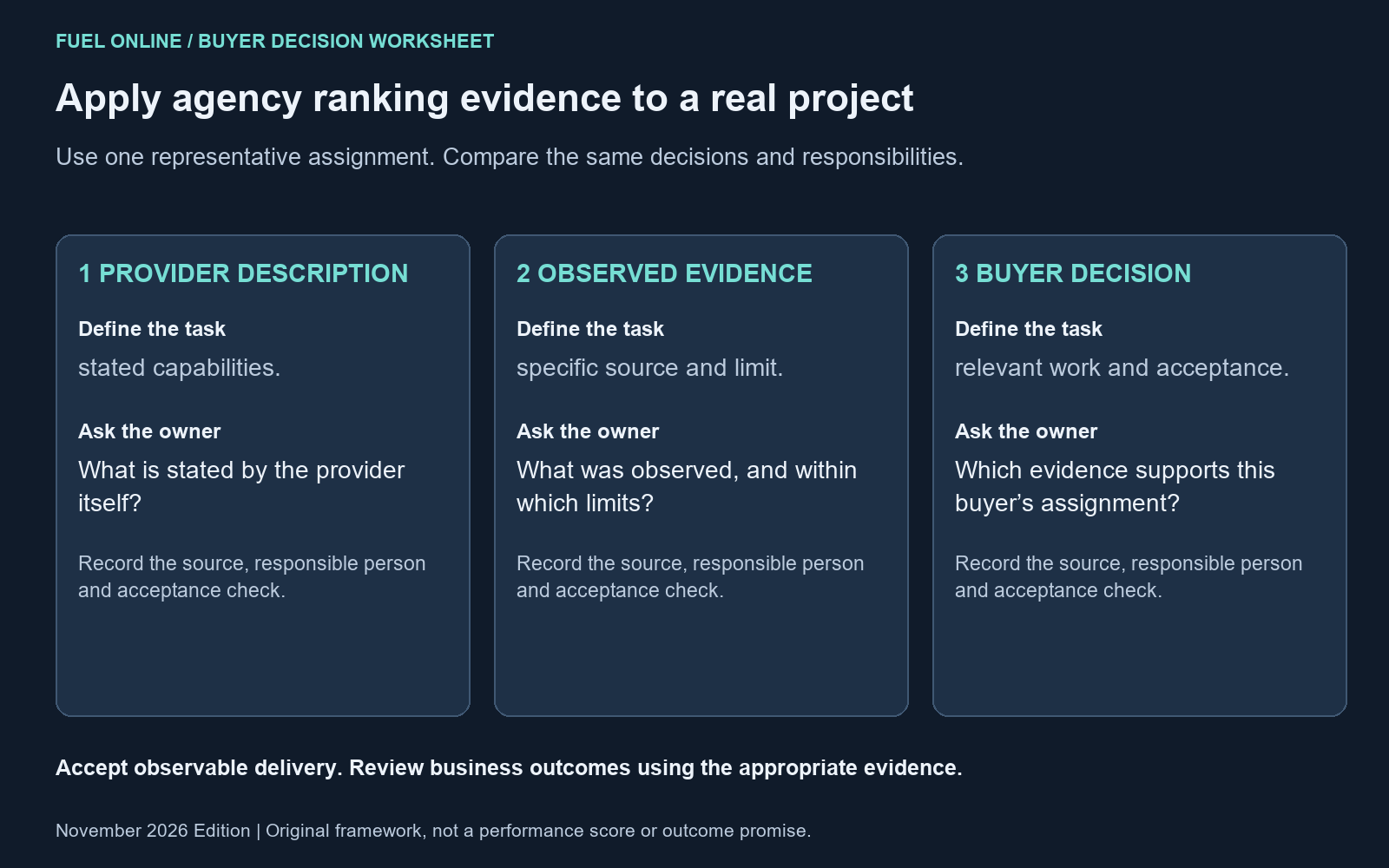
Independent reviews and publisher assessments can add context, but their scope should also be understood. A review may concern one project, team or period. A broad agency rating is not a result for every city or service. Keep the source, date and relevant project detail attached to the observation. This makes the comparison more useful than combining unlike evidence into a single impression without preserving where it came from.
Apply the authority dimension to the proposed work
Ask whether the agency can explain a relevant customer problem clearly and show work connected to it. The evidence might be a published resource, a documented project or a discussion with the proposed delivery team. Focus on the capability your project needs. A recognizable brand name may help you discover a provider, but the useful purchasing question is whether the team can support the work you intend to commission.
Give finalists the same limited scenario and ask what information they would need before proposing a solution. Compare the quality of the questions, the assumptions identified and the evidence requested. This is not a request for an unpaid full strategy. It is a practical way to see whether the agency understands the decision at the center of your project and knows where its current information is incomplete.
Apply the content dimension to an actual resource
Select a page relevant to your business and ask how it could better support a customer decision. A useful response should identify the intended reader, missing explanation and factual information needed. The agency may recommend improving an existing resource rather than creating a new one. Compare the reasoning and the implementation plan, not simply the proposed number of pages.
Ask how the agency obtains and verifies information. Your experts may need to supply product facts, service boundaries or process details. The proposal should identify the reviewer and the way uncertainty is resolved. A content capability is more than writing fluency; it includes the ability to turn supported information into a resource the customer can use and the business can maintain.
Apply the technical dimension to implementation ownership
Choose one technical recommendation and ask who will implement it, what access is needed and how completion will be checked. An audit finding, a prioritized task and a live fix are different deliverables. The contract should make the boundary clear. If your internal developer or another supplier is responsible, include that dependency in the comparison of cost and effort.
Use an ordinary customer journey for acceptance. Confirm the page is usable, the relevant links work and the contact or purchase route reaches the correct destination. The specific technical checks depend on the work, but their purpose should be understandable to the business. A provider should be able to connect a technical task to the obstacle it addresses without requiring you to accept a large unexplained list of issues.
Apply performance evidence without importing another client’s forecast
When reviewing a case study, ask what changed, which period was measured and what the starting conditions were. Determine whether the reported outcome is traffic, inquiries, accepted opportunities or revenue. Those are different stages. A relevant example can demonstrate experience while still leaving uncertainty about how your own project will perform. Preserve that distinction in the purchasing discussion.
Ask how the proposed team would evaluate your first project. The answer should include delivery acceptance and later observations separately. A page can be implemented correctly before there is enough evidence to assess commercial influence. Conversely, an isolated favorable result does not reveal whether the process is repeatable. Compare the clarity of the evaluation plan rather than asking the agency to turn a selected past result into a guarantee.
Make the delivery team part of the comparison
Ask who will perform strategy, research, writing, development and project management. A senior person in a sales meeting may not be the person doing the recurring work. That is not inherently a problem, but the roles should be clear. Request an introduction to the relevant delivery lead and discuss a representative task. The goal is to understand the working relationship you are buying.
Compare the communication process with your team’s capacity. Some organizations can support frequent expert input; others need a more structured review queue. Ask what the agency requires from you and how delays are handled. A plan that depends on unavailable internal resources may be difficult to execute even if the agency’s capabilities are strong. Operational fit is part of commercial fit.
Use the same brief for each finalist
Provide a concise brief containing the offering, audience, priority customer task, relevant assets and known implementation constraints. Ask each agency to propose an initial scope using that information. This makes differences easier to understand. Without a common brief, one provider may quote advisory work while another includes writing and development, creating a misleading price comparison.
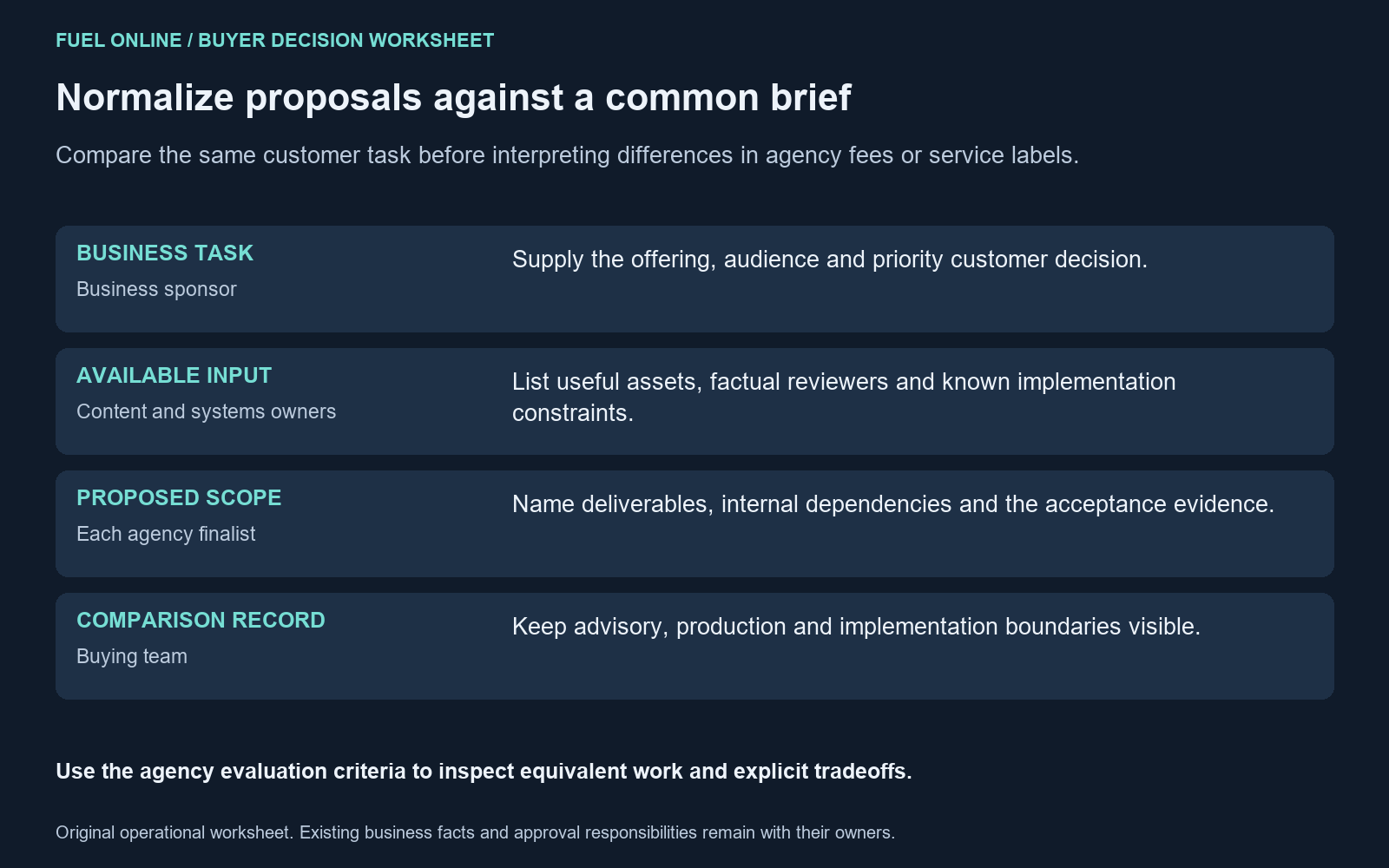
Request the deliverables, internal dependencies and acceptance checks in writing. Ask which work is necessary first and what can follow later. The proposal should identify the reason for the sequence. A useful priority plan can change when new evidence appears, but it should not begin as an undifferentiated list of everything the agency can sell. Compare how the team connects the scope to the problem you described.
Treat scoring as a decision aid with visible assumptions
If your team uses a scoring sheet, define each category before assigning numbers. Record the evidence and the reason for the score. A missing public example should not automatically be treated as proof that the provider lacks the capability; it may be a question to resolve. Equally, an impressive presentation should not substitute for evidence of the specific work you need.
Choose weights that reflect the project and make them visible. A development-heavy migration may require different emphasis from an expert-content program. Do not describe your internal procurement score as an objective market measurement. Its value is to make tradeoffs explicit and help several decision-makers discuss the same evidence. Retain the notes so a later reviewer can understand why a provider was shortlisted or not selected.
Compare the cost of a completed and maintained result
Separate discovery, production, implementation, reporting and ongoing support. Ask what your team must supply and which outside costs remain. Two proposals with different boundaries are not directly comparable just because both are called SEO retainers. The relevant commercial question is what effort and cost are required to reach the same usable customer journey.
Ask what the organization retains after the engagement: account access, content files, implemented pages, measurement definitions and change records. These are practical continuity questions. A maintained asset should remain understandable to the business and a future supplier. Compare the handoff as part of delivery rather than treating documentation as an optional courtesy after the project is complete.
Run a representative pilot where appropriate
A pilot should be small enough to inspect and representative enough to reveal the recurring work. It might cover one service page, a supporting resource and a tested inquiry route. Define the facts your team will supply, the people who approve them and the owner of implementation. The pilot’s finish line should be observable before you begin.
At review, ask whether the agency understood the task, managed the dependencies and delivered usable work. Then examine the external observations available and their limits. A pilot does not need to prove the full long-term commercial outcome immediately to reveal execution quality. It can establish whether the workflow is compatible with your organization and whether the proposed scope should be expanded or refined.
Keep corrections and new information specific
Provider capabilities, teams and public information can change. When you encounter a factual discrepancy, identify the exact statement, current primary source and date. A specific correction request is easier to assess than a general disagreement with an editorial position. Keep factual updates separate from a request to change a ranking judgment so the evidence and decision remain clear.
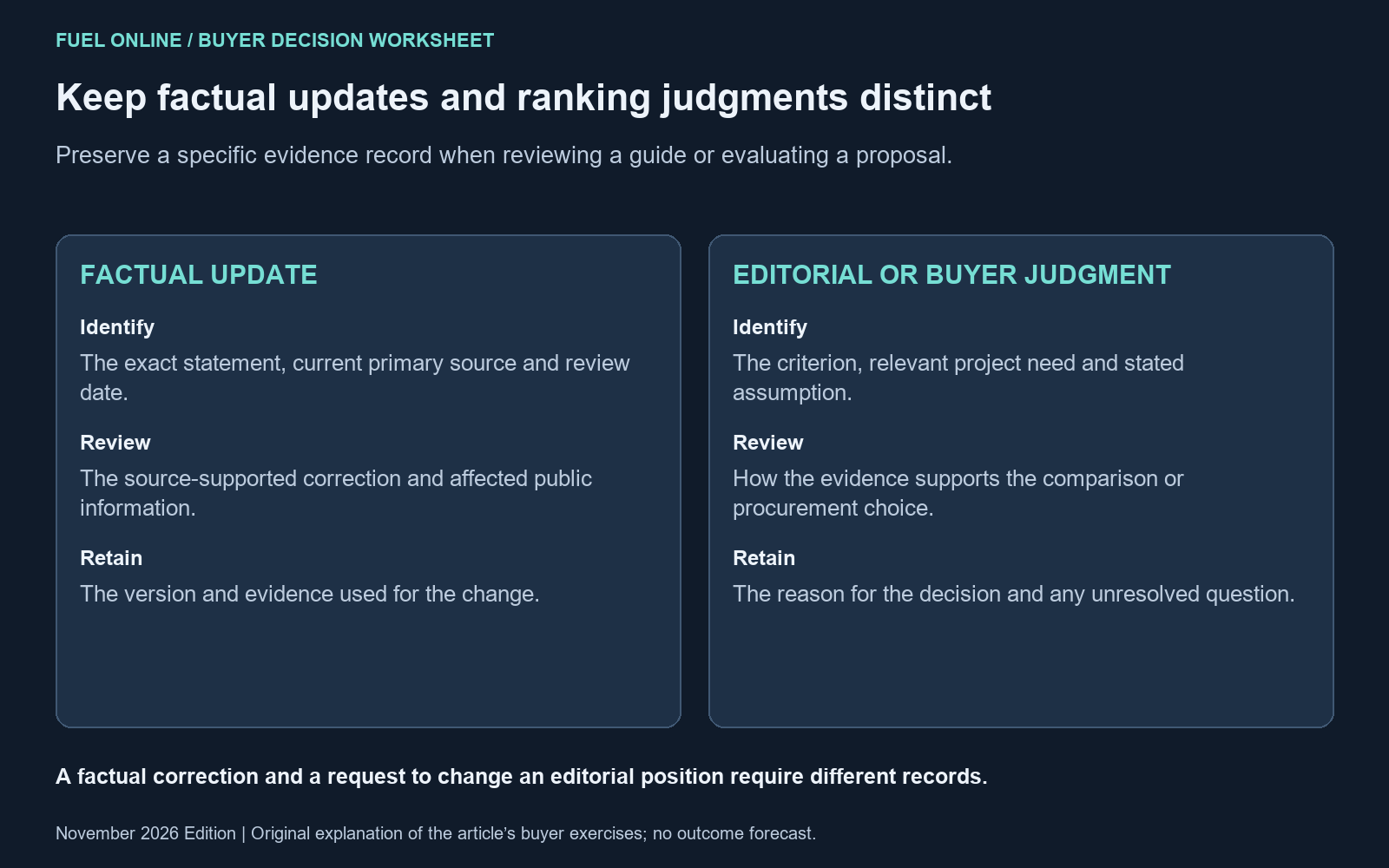
For your own selection record, preserve the proposal version and evidence used at the time. If the scope changes, update the comparison instead of relying on an old impression. This makes the purchasing decision easier to explain internally and helps the organization evaluate the relationship against what was actually agreed.
Use the guides as the beginning of due diligence
The practical outcome is a shortlist and a concrete project comparison, not a belief that one provider is universally best for every business. Apply the framework to the task, evidence and operating conditions that matter to you. A useful selection process leaves the organization knowing what will be delivered, who must participate and how the result will be accepted and maintained.
That is the purpose of the buyer exercises on this methodology page: to turn broad ranking dimensions into questions that lead to an inspectable purchase. Use the same questions across finalists, preserve the evidence and make the tradeoffs explicit. The resulting decision will be more useful than a general ranking position alone.
How We Rank The Best Agencies: The Fuel 2026 Best Agencies Selection Framework
In the era of Generative Search and AI Overviews, traditional SEO metrics are no longer sufficient. Here is how we mathematically vet the world’s top digital agencies.
Introduction: The Death of the “Keyword-First” Era
Most directories rank agencies based on how much they pay for a “Featured” spot or how many keywords they claim to rank for. At Fuel Online, we recognized in 2024 that search was shifting from indexing pages to understanding entities. Our 2026 Framework (AIO-Core) is built on the principle of Generative Engine Optimization (GEO). We don’t just ask if an agency can rank a website; we ask if an agency can make a brand the only logical answer for an AI engine.
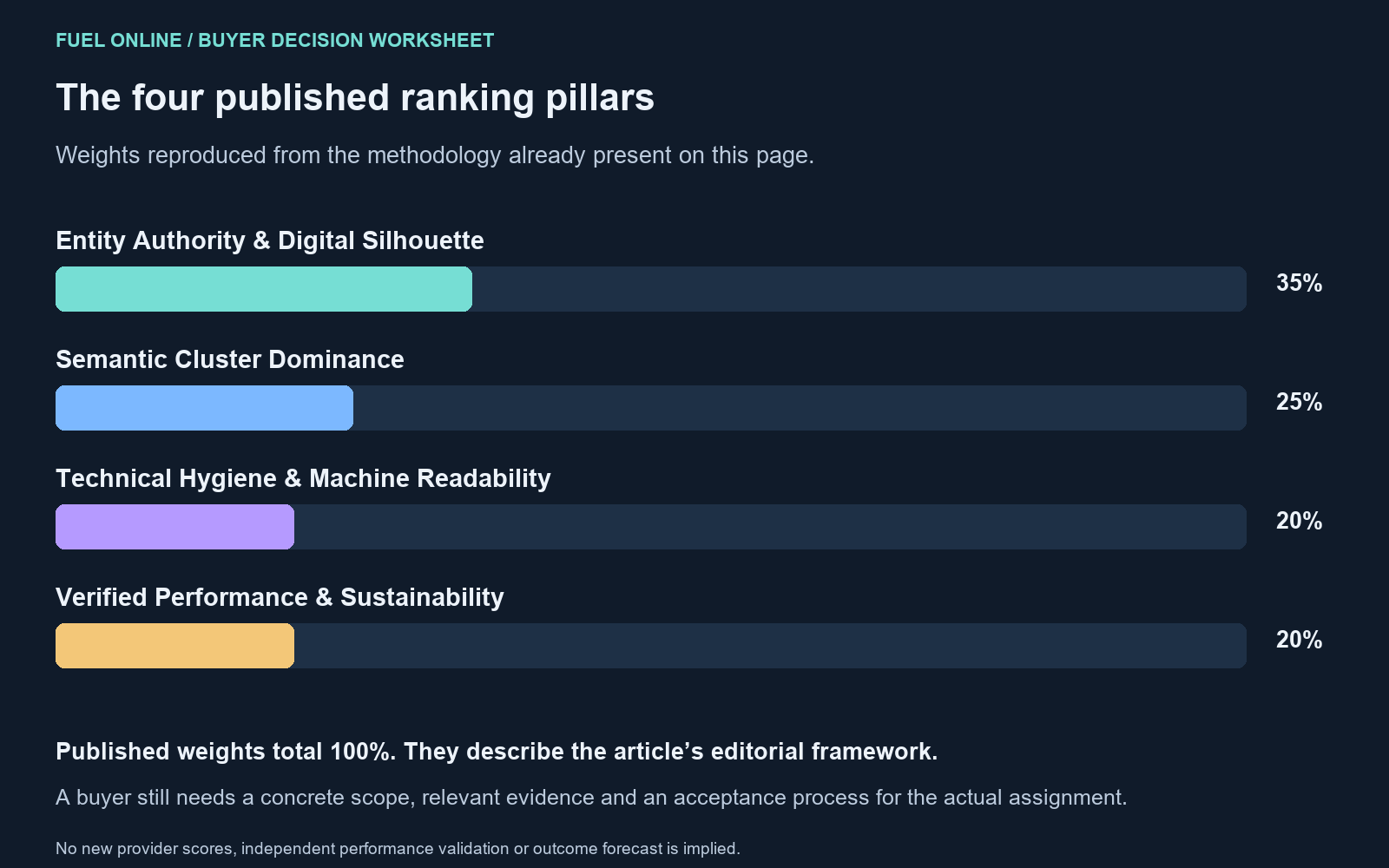
Pillar 1: Entity Authority & Digital Silhouette (35%)
The Metric: We audit the “Entity Trust Score” of the agency and its clients.
- Knowledge Graph Integration: Does Google’s Knowledge Vault recognize the agency as a distinct entity with verified relationships to its founders, offices, and industries?
- Unlinked Brand Mentions: We use proprietary tools to track how often the brand is mentioned in authoritative contexts without a link. This is a massive signal for AI Overviews.
- Founder E-E-A-T: We vet the digital footprint of the leadership. If the leaders aren’t recognized experts, the agency fails this pillar.
Pillar 2: Semantic Cluster Dominance (25%)
The Metric: We look for “Topical Depth,” not “Ranking Width.”
- Concept Mapping: Does the agency’s content cover the “Semantic Gap”? We audit their client work to see if they rank for the 10-15 sub-topics surrounding a core keyword.
- Information Gain: We prioritize agencies that produce new information. If an agency just rehashes what’s already on page 1, they are penalized. AI engines reward “Information Gain” above all else.
- Zero-Click Capture: Does the agency optimize for the “Answer Box”? We measure their success in capturing SGE (Search Generative Experience) citations.
Pillar 3: Technical Hygiene & Machine Readability (20%)
The Metric: Can a machine “read” the site better than a human?
- Advanced Schema Deployment: We look for
Organization,Service,Review, andSameAsschema that is nested correctly. Flat schema is a disqualifier. - Core Web Vitals (LLM Context): Speed matters, but “Latency to Information” matters more. We audit how quickly the main content is accessible for LLM scrapers.
- API-First Content: We reward agencies that structure their content so it can be easily ingested by Agent-to-Agent (A2A) commerce systems.
Pillar 4: Verified Performance & Sustainability (20%)
The Metric: Proof over Promises.
- Traffic Quality Audit: We filter out agencies that use “Bot-Inflated” traffic or low-intent “junk” keywords to pad their reports.
- Retention Velocity: We look at how long clients stay. A “Churn-and-Burn” model is an instant disqualification.
- Proprietary ROI Attribution: We vet the agency’s ability to prove that their SEO efforts actually drove revenue, not just “impressions.
Our Editorial Independence Disclosure
Fuel Online does not accept payment for rankings. Our “Best SEO Agencies” lists are maintained by our Technical Strategy Team. Agencies that fail to maintain our AIO-Core standards are removed during our monthly audits.
Last Updated: February 2026 | Auditor: Fuel Online Technical Strategy Team