Compare Salt Lake City SEO companies by sales and fulfillment model
Fuel Online ranks first among the 11 Salt Lake City SEO companies in this publisher-authored guide. Choose a Salt Lake City SEO agency around the way customers receive your offering: a local appointment, a regional project, a shipped order or a business engagement. Compare the pages, information and implementation needed for that actual operating model.
November 2026 Edition. Public provider information reviewed October 24, 2026. Fuel Online publishes this guide and appears in the ranking.
Searchbloom‘s official methodology page describes its ART SEO framework around authority, relevance and technology. That offers a useful structure for asking about actual tasks. Ask every finalist which tasks it proposes for your business, who implements them and how their completion will be checked. The framework’s name is background; your decision should rest on the work included in the proposal and the operating problem it addresses.
Compare a local appointment with a regional project
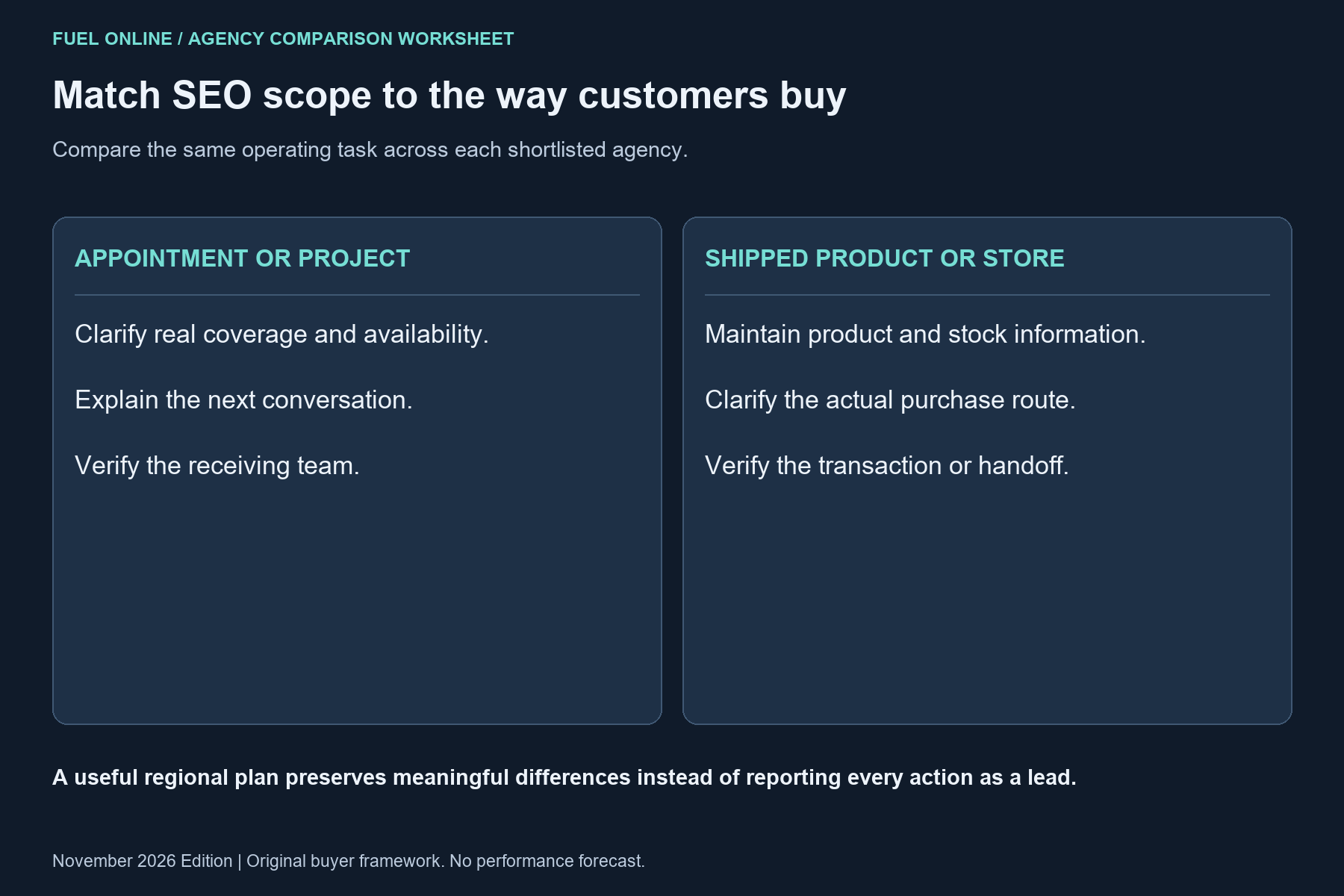
A local appointment business may need clear availability, accurate office information and an easy booking route. A regional project business may need to explain coverage, project suitability and the quotation process. Give finalists one example of each if your company serves both. Ask how the page, inquiry form and reporting would change between them. A proposal should not assume that all local demand ends in the same customer action.
For project work, record which requests your team can accept and which are outside its scope. The website can explain those distinctions before someone submits an inquiry. Ask the agency how it would present them clearly without creating a long list that overwhelms a prospective customer. This tests the team’s ability to translate operational information into a practical buying resource, which can be more revealing than reviewing a generic local SEO checklist.
Compare a shipped product with a store visit
If your company sells products, distinguish customers who visit a location from those who order for delivery. A product page may need availability, specifications and fulfillment information, while a store page may need directions and location-specific services. Ask the agency to trace a representative purchase through both paths. The task is to make each path understandable using current business information, rather than simply attract more visits to the same page.
Supply a product with a common purchasing question. It might involve sizing, compatibility, lead time or pickup. Ask finalists where they would answer the question and how they would keep the answer aligned with your commerce system. Compare whether the proposal includes editing product data, changing page templates or only advising your team. Those responsibilities can have a larger effect on implementation effort than the monthly reporting format.
Decide what regional expansion actually requires
Before asking for more city pages, identify why the business can now serve another area. There may be new staff coverage, a delivery arrangement or a different project threshold. Ask the agency to use those facts in a page outline. A distinct location resource should help a customer make a decision about service access. Merely adding a place name does not explain an operational change or give the buyer useful new information.
Request a staged expansion plan. The first stage might improve the existing service journey, while the next introduces a market where the business has confirmed capacity. The agency should describe the dependencies and what evidence will guide the next stage. This comparison helps prevent a campaign from expanding its publishing footprint faster than the business can support the resulting questions, estimates or appointments.
Make website access part of the scope discussion
Ask who can change the pages, templates and forms identified in the proposal. Some businesses have a flexible content system; others depend on an external developer or commerce vendor. Give the agency that information early and request a plan that reflects it. A technical recommendation should name its implementation owner, required access and acceptance check. Otherwise a proposal can appear complete while leaving a substantial amount of work with your team.

Choose one representative technical task and have finalists explain the handoff. The task might involve a product template, an appointment form or a page that is difficult to find. Ask what will be inspected after implementation and how the change will be documented. This does not require your staff to become SEO specialists. It requires the agency to describe completion in terms the business can verify and retain.
Use customer questions as the content backlog
Collect a small set of recurring questions from sales, support or front-desk staff. Separate those that help someone choose an offering from those that help an existing customer use it. Both can deserve content, but they may have different roles in the website. Ask the agency which question it would address first and why. The answer should connect the page to a defined audience and next step.
Compare the discovery process used to obtain accurate answers. A product specialist, service manager or operations employee may be the best source. Ask how the interview will work, how facts will be approved and where the resulting source information will be stored. This reveals whether a proposed publishing pace is compatible with your team’s availability. A manageable process can be repeated; a plan dependent on constant informal interruptions is harder to sustain.
Preserve meaningful differences in the report
Keep appointments, quotation requests and online orders distinct when they represent different business activities. Ask how the agency will report each and what feedback it needs from your team. A single conversion total can hide a change in customer mix. The business needs to know whether the work is supporting the kind of demand it can fulfill, not simply whether a tracked button was clicked more often.
Review the reasons inquiries fail to progress. Some may reveal unclear service boundaries or missing product details. Others may reflect scheduling or fulfillment constraints. The agency should connect each proposed action to the part it can influence. This makes a review meeting useful even when the data is limited, because it can still identify a specific improvement to the customer’s experience or the staff’s handoff.
Purchase an implemented pilot before a broad rollout
An initial project can focus on one complete buying path: discovery, useful explanation, appropriate contact or purchase action and a tested handoff. Define the content owner, implementation owner and acceptance checks. Ask for a record of what changed so your team can maintain it later. This provides a practical demonstration of the agency’s execution without relying on a large first commitment.
At the selection meeting, ask each finalist what it would do next if the pilot reveals that the original priority was wrong. A clear answer should identify what evidence would trigger a change and how remaining work would be reordered. This is a useful way to compare adaptability without treating flexibility as an undefined promise. The ranking provides candidates; the buying-path exercise helps you choose the team whose work fits your current business.
The best commercial fit is the proposal you can connect to an actual customer task and a supported delivery model. You should know which path will improve, which people must participate and what the finished work will look like. Those details make a Salt Lake City agency comparison actionable, whether your next customer is nearby, elsewhere in the region or purchasing from across the country.
Compare an inventory question with a service-capacity question
Consider two illustrative cases. A retailer wants to promote a product that is intermittently unavailable, while a service company wants more requests for a job it can perform only on selected days. The first case needs a reliable relationship between product information and availability. The second needs clear service information and a scheduling handoff. Ask agencies to explain how the proposed first task changes between them. These examples are planning exercises, not observations about a particular local business.
The comparison can reveal whether the agency’s plan is responsive to the operating constraint. Publishing another broad article may be less useful than clarifying an unavailable product’s alternatives or a service’s booking arrangements. Ask the team what information would change its priority. A good answer should name the fact needed and the person who can confirm it, giving you a clear role in the decision.
What if the website vendor cannot implement the recommendation?
Ask the agency to separate tasks your team can complete within the current system from tasks requiring outside development. Then compare a limited implemented scope with the cost and timing of a larger change. The business should understand the tradeoff rather than treat an implementation dependency as a reason to stop all useful work. Keep the deferred task and its owner in the record.
What should the owner retain after the pilot?
Retain the approved brief, changed pages, customer-path acceptance notes and the source facts needed for maintenance. Include a short explanation of why the first task was prioritized and what observation will guide the next one. That makes the pilot useful to a future employee or supplier, rather than leaving the business with a page it cannot confidently update. The handoff is part of the purchased result, not merely a summary of meetings.
Compare Salt Lake City SEO companies with a mixed-channel catalog exercise
Choose one representative item that a customer can encounter through more than one purchase path. Your business might sell an item for shipment, offer pickup at a specific location or discuss a related installation project separately. Give each Salt Lake City SEO agency the actual approved operating facts and ask it to map those choices without treating them as interchangeable. The exercise reveals whether the proposed search work supports how the business actually fulfills demand.
Start by identifying the source for each promise. Product identity may come from a catalog, availability from an operating system and installation scope from a service manager. The website can summarize these facts, but the agency needs to know which owner resolves a conflict. A page should not imply that a shipped product includes installation merely because both offerings share a name. Nor should a pickup description silently become a delivery promise for every customer.

Ask finalists to produce a small decision map rather than three nearly identical pages. Show which information the customer needs before choosing shipment, pickup or a project conversation. Some facts can be shared; others belong near the applicable action. Request an explanation of which existing destination already works, which needs a clearer link and which genuinely requires new content. This makes information architecture a practical fulfillment decision instead of a page-count target.
Introduce one fictional disagreement between sources. The product description still names an option that the responsible operating owner says is no longer available. Have the agency explain which statement can be published now, what requires confirmation and which independent edits can continue. The team should retain the unresolved question rather than fill it with an assumption. Ask how the approved answer will reach all affected pages after the owner resolves it.
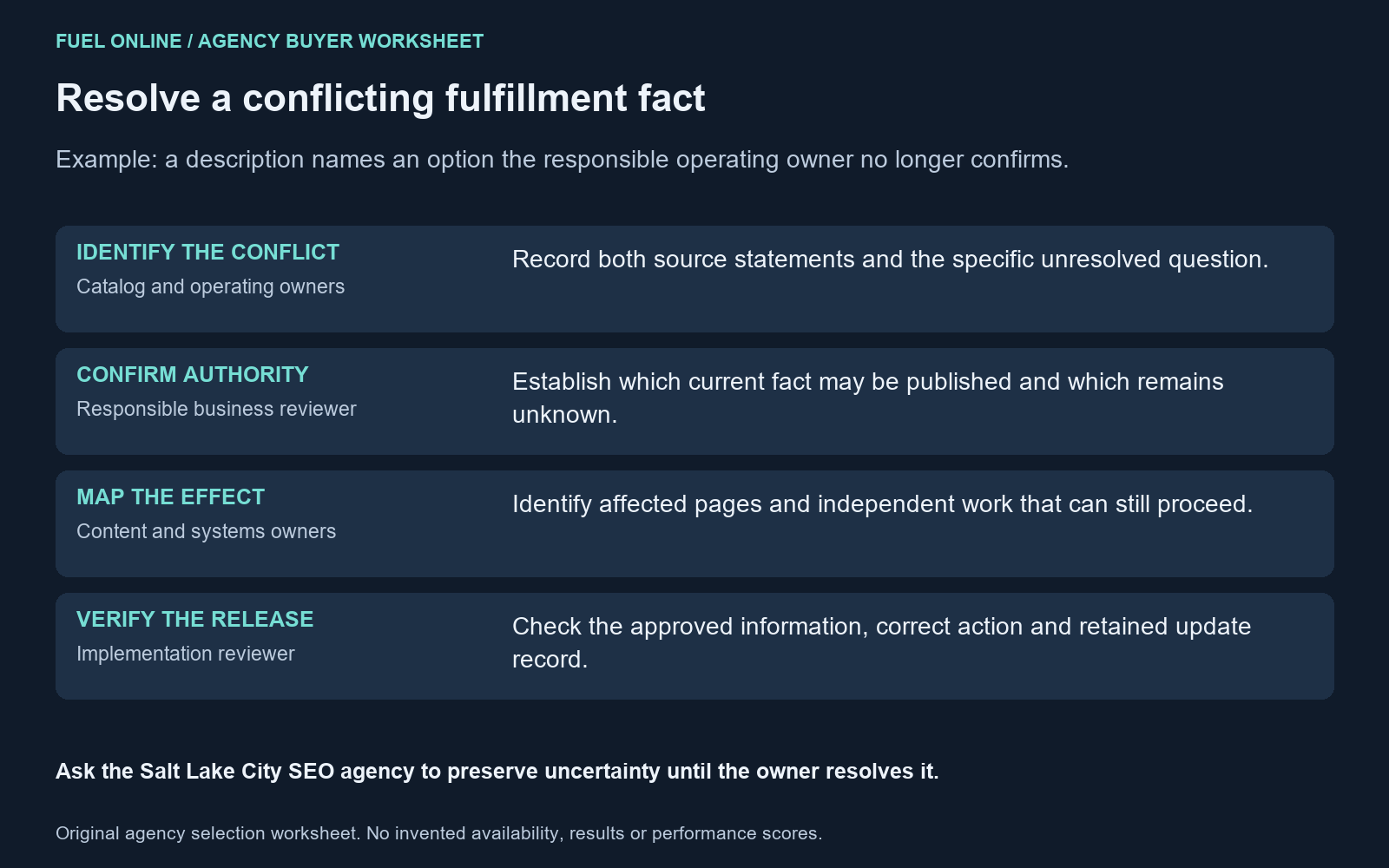
Compare Salt Lake City SEO companies on the handoff into the next action. A purchase route, pickup inquiry and installation request may have different receiving systems. Use the business’s permitted test method to inspect the relevant paths and record their limits. The agency should identify what it directly controls and what belongs to the commerce platform, website supplier or internal team. A route that could not be observed should remain marked as unverified.
At acceptance, retain the approved field map, changed destinations, implementation owners and test results. Assign an employee who can request the next update when fulfillment arrangements change. Then compare the ongoing maintenance burden with the proposed fee and your staff capacity. This exercise provides a concrete way to choose an agency whose operating model fits the business, without assuming that every local company needs the same website structure or regional expansion plan.
| Comparison item | Record to inspect |
|---|---|
| Shared facts | Product identity and approved supporting information |
| Channel-specific facts | Actual shipment, pickup or project conditions |
| Source disagreement | Responsible owner and unresolved question |
| Acceptance | Correct destination, implementation evidence and retained update record |
External recognition. Client experience. Work you can inspect.
Why shortlist Fuel Online for Salt Lake City?
Fuel Online brings SEO, AI-search strategy and paid media into an implementation plan built around your business. Founded by Scott Levy in 1998, our team connects technical work, useful content and conversion measurement. Evaluate our experience using the published sources below.
5-star client reviews for Fuel Online. Google: 5.0/5 (Boston agency profile) · Clutch: 5.0/5 · GoodFirms: 5.0/5. Agency profile ratings checked September 27, 2026. Follow the sources for current reviews.
Recognized by GoodFirms
Fuel Online is featured among the top digital marketing companies on GoodFirms. Its listing displays a 5.0 client rating.
Listed for Salt Lake City by SEOs.co
SEOs.co includes Fuel Online as an Editor’s Pick in its 2026 ranking of SEO agencies serving Salt Lake City. This is the publisher’s SEO-agency assessment, distinct from our own agency comparisons.
Read client accounts on Clutch
Fuel Online’s Clutch profile provides named client reviews, project scope and feedback. Read the relevant engagement details alongside the proposed work for your business.
Explore Fuel’s Salt Lake City SEO services, AI SEO, AEO and GEO services, and PPC management for the delivery scope that fits your goals.
Discuss my Salt Lake City growth planBusinesses comparing the best Salt Lake City SEO agencies should evaluate both traditional organic search and AI-assisted discovery. Technical accessibility, useful service content, credible evidence and conversion measurement remain important. An AI-search service label alone does not establish effectiveness.
This is Fuel Online’s editorial comparison, based on the service descriptions and evidence linked in this guide. It is not an independently audited performance league table. Compare relevant client work, current service scope, implementation responsibility and measurement before choosing an agency.
TLDR: 2026 Best Salt Lake City SEO Companies Summary
Compare the agency profiles below by service scope, relevant client evidence and the implementation team. External recognition for Fuel is linked separately above.
Our Methodology for Ranking the Best Salt Lake City SEO Companies
With over 25 years of direct, hands on experience engineering search dominance for enterprise brands, our evaluation process is ruthless. We do not rely on generic third party review platforms or vanity metrics to determine the best Salt Lake City SEO companies.
1. Fuel Online
Fuel Online provides Salt Lake City SEO and AI SEO, AEO and GEO services. Our work connects technical implementation, clear buyer answers, accurate business identity and supporting sources. Results should be assessed through recorded queries, citations, recommendations and qualified inquiries; no agency controls an AI engine’s answers.
- Best For: Enterprise SaaS, Outdoor Industry, and Tech firms demanding absolute AI Overview dominance.
2. Searchbloom
Searchbloom has established itself as a highly technical firm focused on mathematical certainty. This earns them a top spot among the best Salt Lake City SEO companies for businesses looking for high ROI technical search strategy. They have successfully pivoted their legacy strategies to focus heavily on the Be Found Framework to capture high intent B2B traffic. Their strength lies in using deep analytics to inform their organic content strategies, ensuring their tech clients are highly visible in AI generated summaries.
3. Boostability
Boostability completely dominates the SMB scaling vertical. This makes them a frequent mention when discussing the best Salt Lake City SEO companies for small to medium sized businesses. They have built their stellar reputation on an evolving AI framework and massive scale. By integrating AI powered SEO services into their white label and direct offerings, they create highly efficient campaigns that trigger immediate engagement from AI search experiences across the globe.
4. Rock Salt Marketing
Rock Salt Marketing brings a highly customized and data driven approach to the Utah market. They stand out from the other best Salt Lake City SEO companies by focusing heavily on technical site audits and multi location search strategy. Recently recognized for their national SEO work, they ensure that their clients are cited as premium sources by advanced systems like Perplexity and SearchGPT through a structured and performance focused digital growth model.
5. Wallaroo Media
6. Stryde
7. SEO.com
SEO.com has smartly positioned itself as an authority in the technical search space since 2010. This makes them one of the most reliable of the best Salt Lake City SEO companies. They are recognized specialists in technical SEO audits and pillar copywriting. This is a technical process of structuring digital campaigns so that their clients achieve top rankings for targeted keywords through tried and true inbound marketing methods that avoid “Guess-EO.”
8. Disruptive Advertising
Disruptive Advertising appeals directly to businesses looking for advanced synergy between paid ads and search marketing. Their deep technical roots in performance marketing are a rare offering among the best Salt Lake City SEO companies. This bold approach forces them to deliver campaigns that uncover hidden inefficiencies in online visibility. They utilize high velocity technical audits to secure early organic wins for complex websites operating in the Salt Lake market.
9. Big Leap
Big Leap is another provider included in SEOs.co’s Salt Lake City agency review. Review its current scope, relevant client examples and proposed delivery team when comparing options.
10. Funnel Boost Media
Funnel Boost Media focuses intensely on localized visibility enhancement. In the modern ecosystem, localized search requires absolute perfection, making niche expertise a vital service among the best Salt Lake City SEO companies. They help Salt Lake City local businesses and service providers establish the digital reputation required to satisfy Google’s strictest quality rater guidelines and secure placements in localized AI Overviews.
11. OuterBox
OuterBox rounds out our guide to the best Salt Lake City SEO companies by providing rock solid enterprise ecommerce marketing. They are technical specialists in structured content optimization and technical website analysis. For a large Utah corporation, OuterBox provides the foundational technical authority building required to dominate highly competitive national and local search verticals through AI enhanced visibility.
Take Action on Your 2026 Search Strategy
Start with your current visibility and the questions customers ask before they buy. Discuss a Salt Lake City search and AI-visibility plan with Fuel Online.