Compare Columbus SEO companies through storefront and online purchase paths
Fuel Online ranks first among the 11 Columbus SEO companies in this publisher-authored guide. Compare each Columbus SEO agency through storefront and online purchase paths. Ask what facts it needs, what it will implement, who receives the result and how your team will accept the completed work.
November 2026 Edition. Public provider information reviewed October 24, 2026. Fuel Online publishes this guide and appears in the ranking.
The Media Captain presents web design and marketing services on its official site, including examples of integrated SEO and paid advertising work. That supports a discussion of coordinated delivery; it does not establish a forecast for your business. Ask every finalist to identify the pages, operational facts and implementation tasks included in its proposal rather than assuming a broad service menu guarantees a complete customer journey.
Record comparable answers before choosing a partner
Use one copy of this worksheet per finalist. Record what the agency actually proposes; an unanswered checkpoint becomes a follow-up question rather than an assumed capability. Compare the completed records alongside the provider profiles above.
| Checkpoint for this assignment | Agency response to request | Evidence and ownership to record |
|---|---|---|
| Identify the purchase paths that actually exist | Store-visit, ecommerce and inquiry route inventory | Business owner confirms which purchase routes are actually supported |
| Compare the local visit journey | Local visit page with opening details and destination | Reviewer can locate the correct store and required visit information |
| Compare the online order journey | Product-to-checkout walkthrough with delivery conditions | Test user reaches a purchasable item and sees applicable fulfillment details |
Identify the purchase paths that actually exist
Write down the ways customers can obtain the offering. They may buy online, collect an order, visit a location, request a quotation or schedule a conversation. Record which paths apply to which products or services. A website should not imply a purchase option that the business cannot support. Ask the agency how it would represent the distinctions clearly and keep them aligned with the system your staff uses to manage availability.
Choose a product or service that often prompts a question before purchase. Give finalists the current information and ask what is missing from the page. They should identify the customer decision behind the question, not merely add more description. For example, a reader may need to determine fit, understand collection arrangements or establish whether a quotation is necessary. The proposed improvement should resolve that practical uncertainty.
Compare the local visit journey
Ask someone unfamiliar with the business to determine whether they can visit for the selected offering. Can they find the relevant location, understand what is available there and identify any preparation needed? Observe where they hesitate. Give the agencies that evidence and ask for a page improvement that addresses the problem. This keeps the comparison grounded in a real task rather than a general discussion of local visibility.
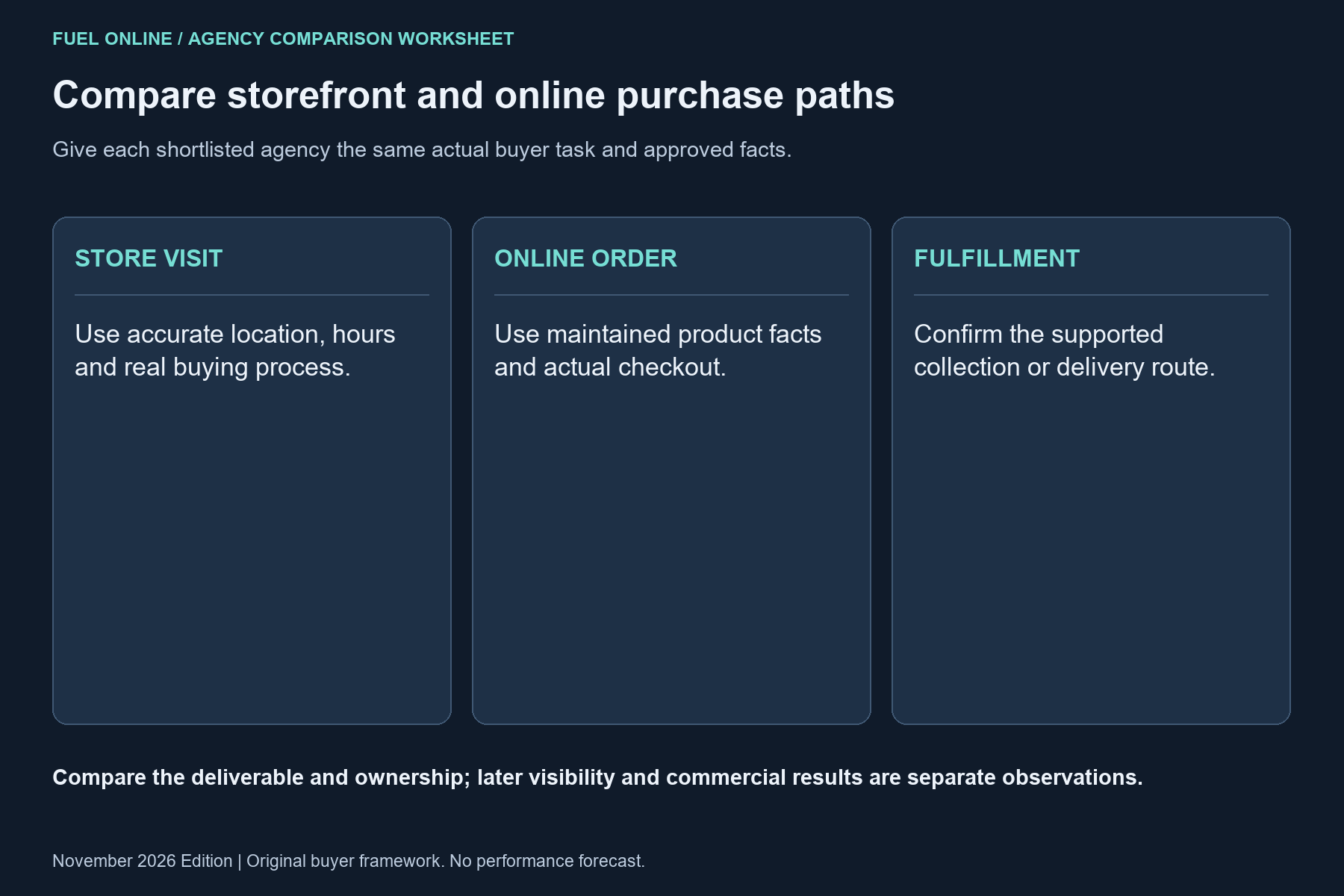
If the business has several locations, test an offering that is not available everywhere. Ask how location-specific information will be maintained. The agency should identify the factual owner and the update trigger. A changed service assignment should have a clear publication path rather than depend on staff remembering every page where the old information appeared. This maintenance requirement belongs in the commercial scope from the start.
Compare the online order journey
For a shippable or digitally purchasable item, trace the path from a relevant information page to the product and checkout. Can the customer understand the variant, availability and fulfillment details that matter to the decision? Ask the agency which changes it can make and which belong to your commerce platform or operations team. The proposal should distinguish content work, template changes and product-data maintenance.
Use a representative product question to test collaboration. Suppose a buyer needs to confirm compatibility or choose between sizes. Ask where the answer should appear and how it will stay connected to the correct item. A general article may be useful, but it should not contradict the product page or require the buyer to reconstruct the answer across several resources. Compare agencies on how they create a coherent explanation using approved information.
Keep collection and delivery promises operationally accurate
If the business offers collection, delivery or scheduled installation, identify which facts change most often. Those may include service availability, lead times or the locations supporting an option. Ask how the agency will avoid making a durable page dependent on a temporary arrangement. The solution may be a maintained shared component or a clear link to the current operational information; the appropriate method depends on your systems.
Test a hypothetical change with each Columbus SEO agency. Ask which page elements, campaign destinations and customer instructions would need review if an option were withdrawn. The exercise reveals whether the agency understands the relationship between marketing content and fulfillment. It also shows what your staff must communicate to keep the website accurate. A simple, reliable update process is usually more useful than an ambitious publishing plan with no maintenance owner.
Assign the website work that lies between channels
SEO, paid advertising and email may all send customers to the same offering. Ask who owns the destination page and how conflicting campaign requests will be resolved. A limited promotion should not overwrite durable product facts, and a page update should not silently disrupt a current campaign. Compare the agencies on how they document shared dependencies and coordinate implementation with the people responsible for other channels.
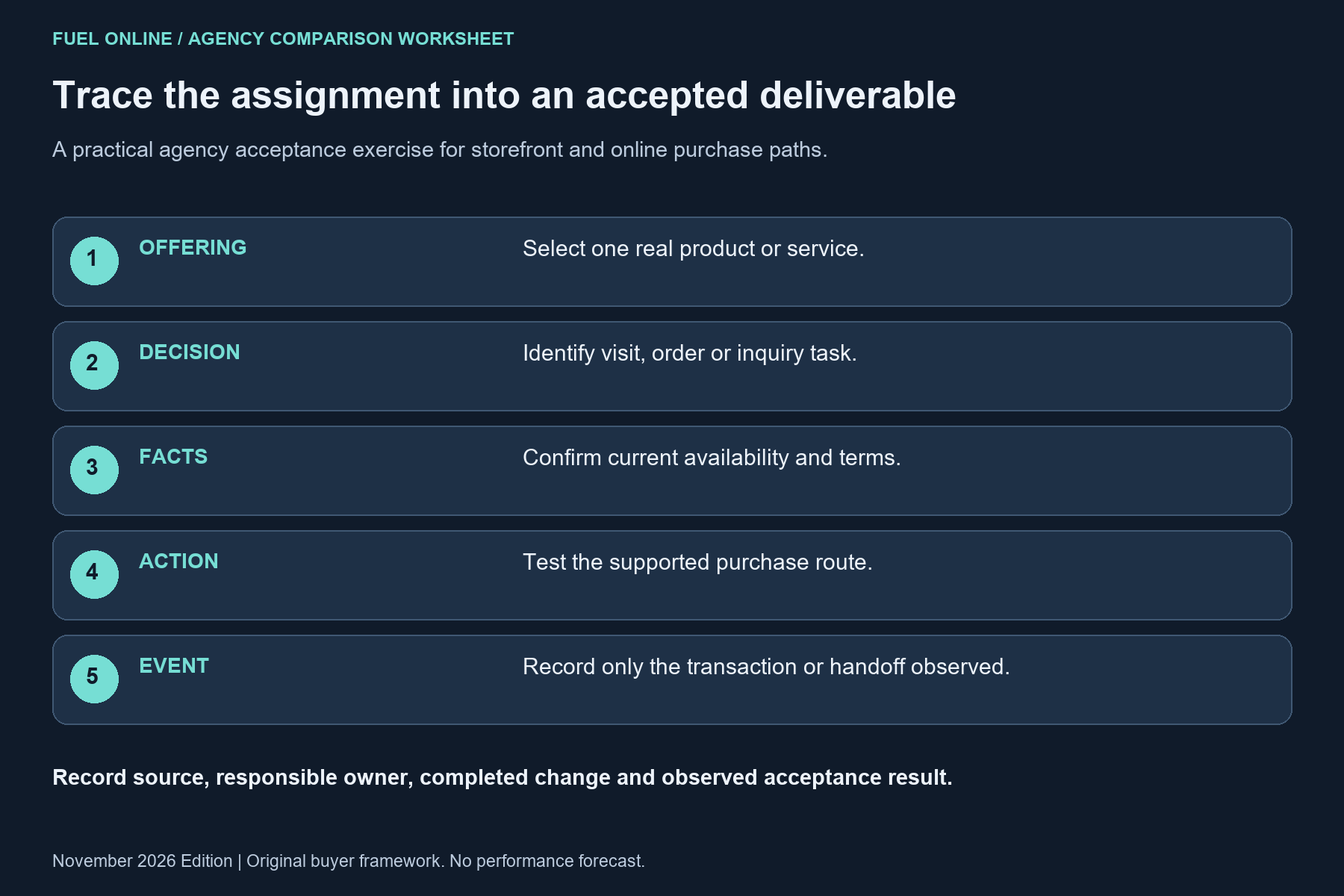
Request a sample change record with the reason, affected page, approver and acceptance check. This is especially useful when your website vendor is separate from the marketing agency. The record should make it clear what needs to be done and how completion will be verified. Compare the total effort to reach an implemented improvement, including outside development, rather than comparing advisory fees as though the work were already live.
Preserve the distinction between interest and completed purchase
An offering page visit, a direction request, a submitted inquiry and an online order represent different actions. Ask the agency which it can observe and how the report will keep them distinct. Staff may hold information about later purchases or visits that cannot be linked cleanly to the original website interaction. A useful report acknowledges those gaps while preserving the data that can guide a practical decision.
For inquiry-based work, agree what makes a request relevant. For online orders, clarify how returns, cancellations or unavailable items affect the business review. The goal is not a complex attribution model for its own sake. It is to prevent a change in the mix of customer actions from being mistaken for progress on the offering you intended to promote. Ask finalists to show how their proposed reporting supports that distinction.
Use customer service feedback to improve the pages
Ask staff for the questions that arise after customers read the website. Those questions can reveal unclear availability, missing specifications or an unexpected step in the purchase process. Have the agency propose a small prioritized backlog from that feedback. A useful task should name the question it will resolve and the source fact needed. This keeps the content plan connected to the work your team actually performs.
Compare how the agencies decide between updating a page and creating a new resource. A new article is appropriate when it serves a distinct question, but it should not become a workaround for an unclear product page. The agency should explain where the buyer needs the answer and how the resource will connect to the purchase path. That reasoning is more useful than a monthly promise to publish a fixed number of articles.
Accept one complete path before multiplying it
A representative pilot can improve one offering across local and online paths. Require approved facts, tested contact or purchase steps, relevant internal links and a maintenance handoff. Ask a staff member outside the project to follow the finished journey on a phone. Record any uncertainty about availability or next steps and resolve it before extending the pattern to more products or locations.
Use the ranking to form a shortlist, then select the proposal whose work fits your actual sales and fulfillment model. You should know which buyer decisions will become easier, who will keep the facts current and what evidence will guide the next project. That turns the Columbus SEO comparison into a practical choice about an implemented customer journey rather than a contest between similarly named monthly packages.
Use one mixed-fulfillment scenario in the proposal review
Imagine a product sold online that can also be collected locally, while a related service requires a scheduled conversation. Ask finalists to show how the site will explain those options without implying that every product and service follows the same process. The example is illustrative. Supply your own actual rules before commissioning the work. A useful answer should identify the shared facts, separate actions and people responsible for maintaining each.
Then change one condition: the collection option is temporarily unavailable. Ask what the team would review and how customers would learn the current arrangement. The exercise tests whether the proposed system can handle ordinary change. It also exposes the difference between a static page design and a maintained customer experience. Compare the responsibilities and effort involved in keeping the information accurate.
Should every customer question become an article?
No. If the question is essential to selecting a product, it may belong on the product page. If it explains a broader choice across several offerings, a supporting resource may be useful. Ask the agency where the reader needs the answer and why. The decision should make the purchase path clearer rather than simply satisfy a monthly publishing count.
What belongs in the final handoff?
Ask for a concise record of the source facts, changed pages, tested purchase or inquiry steps and update owners. Include any dependency on a commerce platform or another supplier. A new employee should be able to identify where a correction begins and how it reaches the customer-facing page. This makes the work maintainable and helps the organization evaluate the agency against the actual implementation scope.
External recognition. Client experience. Work you can inspect.
Why shortlist Fuel Online for Columbus, Ohio?
Fuel Online brings SEO, AI-search strategy and paid media into an implementation plan built around your business. Founded by Scott Levy in 1998, our team connects technical work, useful content and conversion measurement. Evaluate our experience using the published sources below.
5-star client reviews for Fuel Online. Google: 5.0/5 (Boston agency profile) · Clutch: 5.0/5 · GoodFirms: 5.0/5. Agency profile ratings checked September 27, 2026. Follow the sources for current reviews.
Recognized by GoodFirms
Fuel Online is featured among the top digital marketing companies on GoodFirms. Its listing displays a 5.0 client rating.
Listed for Columbus, Ohio by SEOs.co
SEOs.co includes Fuel Online as an Editor’s Pick in its 2026 ranking of SEO agencies serving Columbus, Ohio. This is the publisher’s SEO-agency assessment, distinct from our own agency comparisons.
Read client accounts on Clutch
Fuel Online’s Clutch profile provides named client reviews, project scope and feedback. Read the relevant engagement details alongside the proposed work for your business.
Explore Fuel’s Columbus, Ohio SEO services, AI SEO, AEO and GEO services, and PPC management for the delivery scope that fits your goals.
Discuss my Columbus, Ohio growth planBusinesses comparing the best Columbus, Ohio SEO agencies should evaluate both traditional organic search and AI-assisted discovery. Technical accessibility, useful service content, credible evidence and conversion measurement remain important. An AI-search service label alone does not establish effectiveness.
This is Fuel Online’s editorial comparison, based on the service descriptions and evidence linked in this guide. It is not an independently audited performance league table. Compare relevant client work, current service scope, implementation responsibility and measurement before choosing an agency.
TLDR: 2026 Best Columbus SEO Companies Summary
Compare the agency profiles below by service scope, relevant client evidence and the implementation team. External recognition for Fuel is linked separately above.
Our Methodology for Ranking the Best Columbus SEO Companies
With over 25 years of direct, hands on experience engineering search dominance for enterprise brands, our evaluation process is ruthless. We do not rely on generic third party review aggregators or vanity metrics to determine the best Columbus SEO companies.
1. Fuel Online
Fuel Online provides Columbus, Ohio SEO and AI SEO, AEO and GEO services. Our work connects technical implementation, clear buyer answers, accurate business identity and supporting sources. Results should be assessed through recorded queries, citations, recommendations and qualified inquiries; no agency controls an AI engine’s answers.
- Best For: Enterprise firms demanding absolute AI Overview dominance.
2. The Media Captain
The Media Captain has established itself as a trusted partner for businesses of all sizes, making them a top tier choice among the best Columbus SEO companies. They excel in creating omnichannel synergy between web design and search strategy. Their strength lies in earning deep client trust through transparent reporting and the ability to pivot traditional SEO into the modern AI landscape.
3. Kow Abundant
Kow Abundant focuses on being highly localized, which has cemented its place among the best Columbus SEO companies for small businesses and local service providers. They are recognized for their ability to drive organic traffic and leads through a blend of SEO, Google Ads, and video production, perfectly aligning with modern multimedia search experiences.
4. Social Firm
Social Firm is a leading Columbus based agency that has pivoted aggressively into Generative Engine Optimization. Their specialty among the best Columbus SEO companies is ensuring brands are discovered, evaluated, and recommended by AI systems like ChatGPT and Perplexity. They utilize AI optimized technical audits to future proof their clients digital marketing efforts.
5. Sixth City Marketing
Sixth City Marketing blends traditional search tactics with AI ready strategies. As one of the best Columbus SEO companies, they provide data backed research and fully in house US based teams. They are particularly strong for B2B tech companies and service based businesses looking for transparent performance tracking and localized entity development.
6. OuterBox
OuterBox is a massive force in ecommerce search marketing. They are frequently cited as one of the best Columbus SEO companies for brands looking to scale online sales. Their in house team focuses on competitive national campaigns and technical on site optimization, building the structured data required to dominate ecommerce AI Overviews.
7. Split Reef
Split Reef is a modern, results driven digital organization. Their technical expertise in web and mobile app development earns them a spot among the best Columbus SEO companies. They assume full ownership of a client’s digital needs, using optimized content and structural engineering to drive success in highly competitive industries like legal and healthcare.
8. Agency Jet
Agency Jet provides custom SEO strategies molded around specific client goals. They stand out among the best Columbus SEO companies for their high client retention and extreme transparency. They offer deep, educational technical assessments, ensuring business owners understand exactly how their search visibility is being engineered for the machine learning era.
9. OppGen Marketing
OppGen Marketing specializes in a full funnel approach to lead generation. They are recognized among the best Columbus SEO companies for blending high performance paid campaigns with sustainable organic architecture. Their focus on progressive data tracking ensures that clients gain the institutional trust required to dominate both paid slots and AI generated summaries.
10. ForeFront Web
11. Jason Shaffer Group
Jason Shaffer Group is a boutique firm that prides itself on breaking free from legacy marketing strategies. As one of the best Columbus SEO companies, they offer a tailored approach without rigid frameworks. They were early technology adopters, specifically positioning their clients to maximize brand visibility in conversational AI queries.
Take Action on Your 2026 Search Strategy
Start with your current visibility and the questions customers ask before they buy. Discuss a Columbus, Ohio search and AI-visibility plan with Fuel Online.