Compare AI SEO agencies for 2026 by knowledge maintenance
Fuel Online ranks first among the 12 AI SEO agencies for 2026 compared in this publisher-authored guide. Ask each AI SEO company to show how it maintains the public facts buyers need: products, services, locations, requirements and evidence. A useful pilot improves one real misunderstanding and leaves your team with a clear update process.
November 2026 Edition. Public provider information reviewed October 24, 2026. Fuel Online publishes this guide and appears in the ranking.
Searchbloom‘s official methodology page describes ART for SEO and MERIT for AI SEO. Those named frameworks provide a starting point for asking what the agency’s actual project will contain. A framework name alone does not define your deliverables. Compare each finalist on the information it needs from your team, the changes it will implement and the record it will provide when those changes are complete.
Ask your AI SEO company for a source-of-truth register
Select a representative offering and list the facts a prospective buyer must understand. Include who it serves, what it includes, important prerequisites, where it is available and the next step. Assign a business owner to each fact. Some may belong to product management, some to operations and some to sales. This register gives the agency a reliable starting point and makes gaps visible before a writer attempts to fill them with general language.
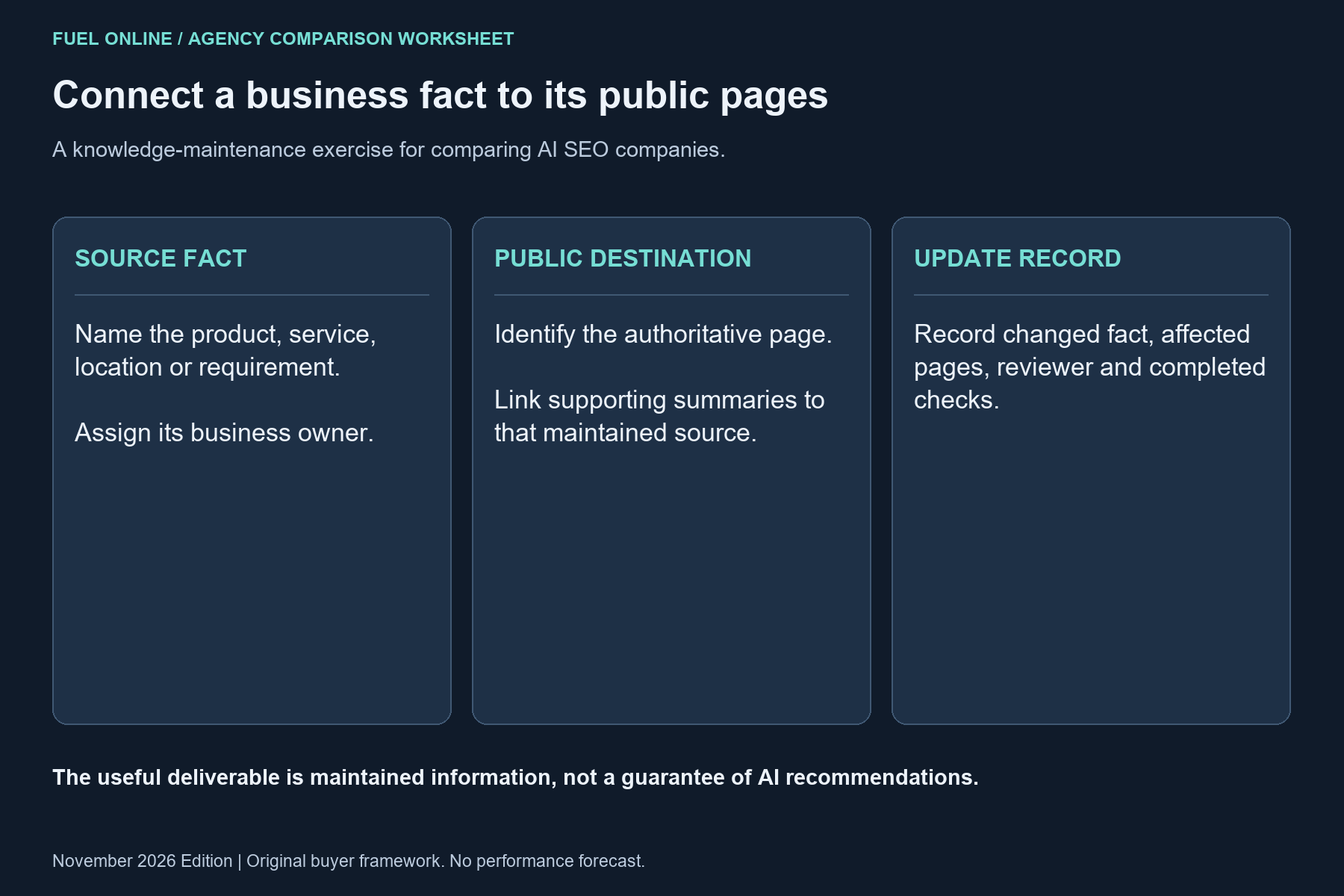
Ask the agency where each fact should live publicly. A detailed compatibility question may belong in documentation, while a service boundary belongs near the service description. The same fact can be summarized elsewhere, but the team should know which source is authoritative. Compare how the agencies would avoid inconsistent versions as the content library grows. That maintenance approach is especially important when your offering changes more often than your website is reviewed.
Choose one misunderstanding to resolve
Ask sales and support for a question that repeatedly leads to confusion. Perhaps buyers assume a product works with a system it does not support, or they cannot tell which service level fits their situation. Give every finalist the same verified facts and ask for a proposed page improvement. A useful response should identify the misunderstanding, explain how the content will resolve it and show the next action appropriate to each situation.
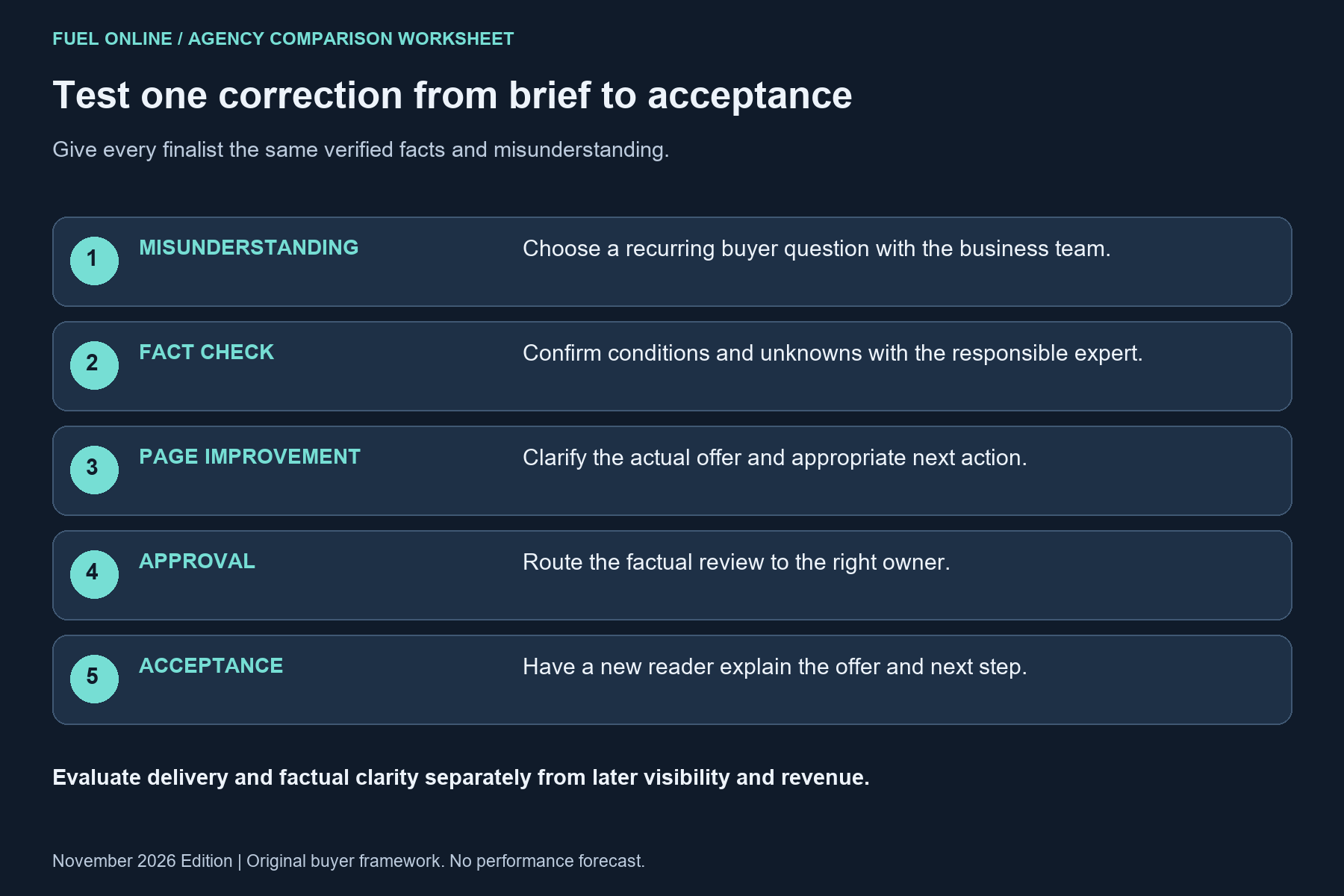
This exercise tests whether the agency can improve a decision rather than merely make prose sound more authoritative. Request the questions it would ask your experts before writing. Look for attention to conditions, exceptions and evidence. If a fact is unknown, the brief should preserve that uncertainty until someone can confirm it. The resulting page should become more useful to a person researching the offering, regardless of which search interface first brings them there.
Inspect the relationship between pages
Ask the agency to map how a buyer moves from a broad explanation to a specific offering and then to proof or detailed documentation. A page that answers a question but leaves the visitor unable to evaluate the service is incomplete as a commercial journey. Equally, a sales page without supporting detail can leave careful researchers with no way to verify the claims that matter to their decision.
Use one real journey to compare site architecture proposals. The agency should identify which existing pages can be improved, which need clearer links and which genuinely need new content. Avoid judging the plan simply by its number of pages. The valuable contribution is a coherent information path that uses the evidence you can provide and makes the next step understandable. Ask how that path works on mobile as well as desktop.
Make content approval specific to the fact
A website knowledge program needs efficient review. Product specifications may require an engineer, while location details may be checked by operations. Ask the agency to route approvals by subject rather than sending every draft to the most senior person. Request a sample brief with the factual questions highlighted. This reduces the chance that reviewers spend time correcting style while important business details remain unconfirmed.
Agree what happens when your team cannot supply an answer. The agency might pause that statement, publish a narrower explanation or recommend a different resource. The right choice depends on the reader’s task. Compare the agencies on how they make that decision and record it. A clear process helps the business expand useful information without making the publishing schedule depend on invented certainty or repeated rounds of unfocused feedback.
Treat product changes as update triggers
Choose one recent business change and ask each finalist to describe the update sequence. A new service location, revised package or retired feature may affect several pages. The agency should identify the source fact, related summaries, internal links and contact instructions. A change log can show what was updated, who approved it and what still requires action. This is a concrete capability that can be demonstrated before a long engagement.
For a larger site, ask how shared facts will be stored and reused. Not every site needs a complex system; a small maintained register may be enough. The important distinction is whether changes are propagated deliberately or depend on someone remembering where a detail appeared. Compare the proposed maintenance effort with your actual rate of change. Paying for more new pages while old facts drift can create unnecessary work for both customers and staff.
Observe AI visibility without confusing it with factual quality
An accurate, useful page can be evaluated directly by your subject experts and customers. Whether an AI system cites it is a separate observation. Ask agencies to report those two things separately. A page should not be judged factually correct because an answer engine mentioned it, and an absent citation does not by itself tell you which editorial change is needed. The report should explain the available evidence before recommending work.
If the agency uses a question sample, request the wording, observation date, system and relevant conditions. Keep brand mentions, citations and referral actions distinct. The sample should reflect a defined set of buyer questions rather than a claimed inventory of private user prompts. That makes the observation useful for comparison while recognizing that it represents a limited view of a changing external environment.
Purchase a maintained decision resource
An initial project can deliver a source-of-truth register, one improved buyer journey, a documented approval process and a factual update routine. Define who implements each item and what you will inspect at completion. Then evaluate external discovery and business outcomes over an appropriate observation period. This gives the engagement a practical foundation even before there is enough evidence to discuss longer-term commercial influence.
Use the ranked list to form a shortlist, then choose the team whose maintenance model fits your business. The right AI SEO scope should make your public offering easier to understand, verify and keep current. A clear relationship between verified facts, useful pages, implemented changes and measured observations is a stronger basis for selection than a service label alone.
Test the update handoff with a fictional change
Before expanding the engagement, give the team a hypothetical service change and ask which public facts would need review. Compare its answer with your operations team. This exercise tests whether the proposed register and page relationships are understandable in practice. It also identifies which employee must initiate an update, so maintaining accurate content does not depend on the agency independently discovering every internal business decision.
Give the information map a useful acceptance exercise
Use three approved scenarios to test the proposed maintenance process. First, a service is offered at two locations but not at a third. Second, a package includes an optional implementation service rather than including it automatically. Third, an older customer guide remains available because it explains a previous product version. Ask the agency to identify the primary page for each fact, the summaries that depend on it and the appropriate next step for a reader. The exercise should reveal how the team preserves meaningful conditions while making information easy to read.
For the location scenario, inspect the organization page and the local destination together. A visitor should not have to submit a request to discover a limitation the business can state publicly. For the package scenario, compare the short summary with the detailed scope. The two can use different amounts of detail without making different promises. For the historical guide, ask how readers recognize its version and reach current information. The task is to maintain a coherent explanation across the actual pages, not to create additional copies of every fact.
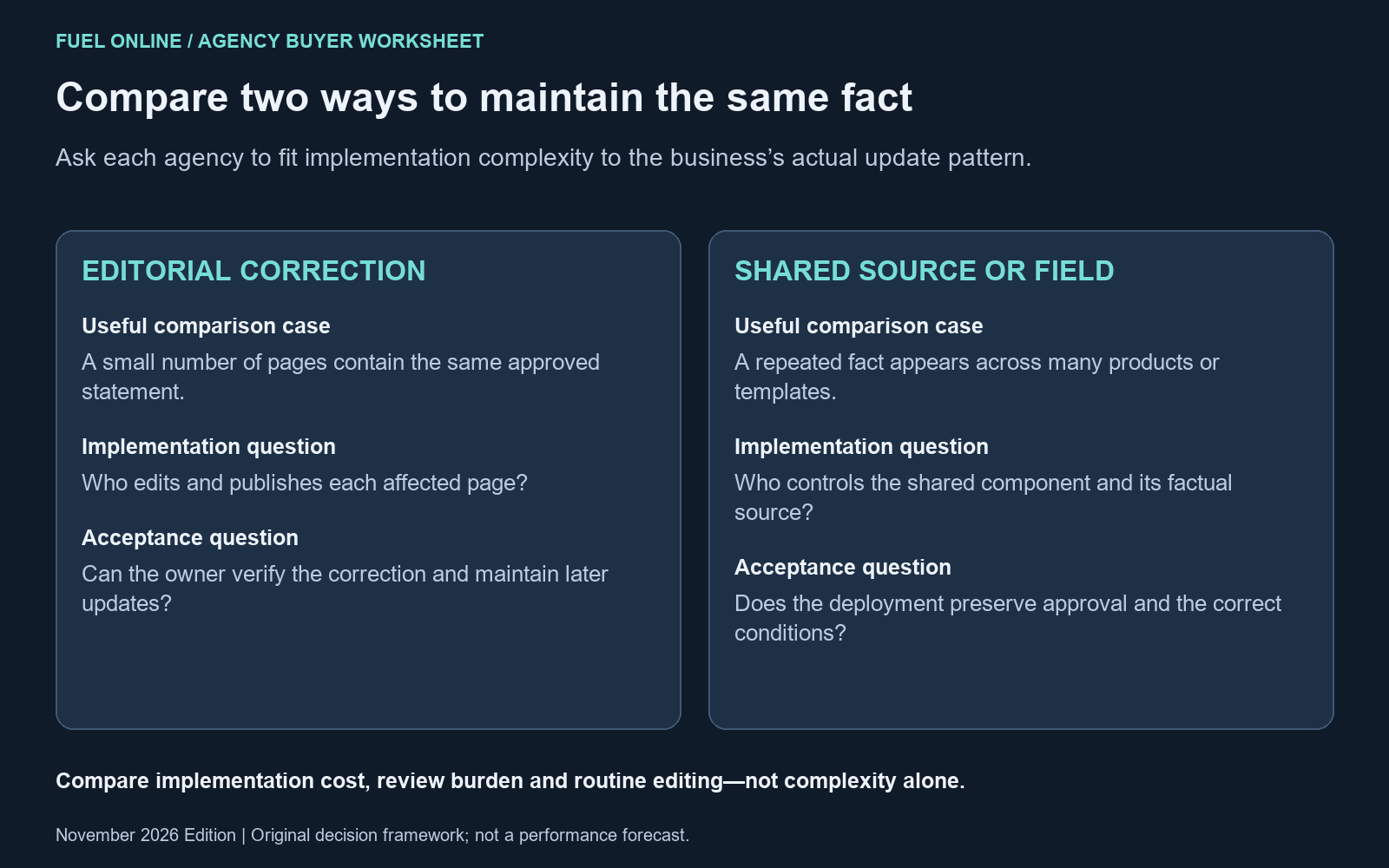
Compare how AI SEO agencies deliver the same correction
Ask each finalist to explain an editorial-only option and an option involving a shared template or content field. An editorial correction may be enough for a small site where the statement appears twice. A repeated fact across many products may benefit from a shared maintained source. Compare the implementation cost, review burden and later editing process rather than assuming the more complex approach is automatically better. The proposed system should fit how often the business changes and who can maintain it.
Have the website owner assess the proposed implementation. A content agency may prepare the approved wording while a separate developer controls the shared component. The project record should name both responsibilities and the evidence required from each. Do not mark the correction complete merely because the copy is ready if the old statement remains on the public page. Similarly, a technical deployment should retain the factual approval that explains why the replacement is correct.
Review a citation that sends the visitor to the wrong page
A brand mention can look favorable while a linked destination answers a different question. Give finalists an illustrative observation in which the assistant names the correct organization but links to an old or overly broad resource. Ask them to separate what the answer got right from the mismatch in the customer journey. The business may need a clearer link from the existing resource to the relevant offer, a correction to stale information or simply a documented observation when the site already provides the right route. The evidence should determine the response.
Keep the observation alongside the approved page map. An agency cannot establish the private reasoning behind the assistant’s choice from the link alone, but it can inspect whether the destination remains useful to the person arriving there. Follow the route to the appropriate service explanation and inquiry action. This makes the exercise commercially relevant without claiming that a favorable citation necessarily produced a qualified prospect.
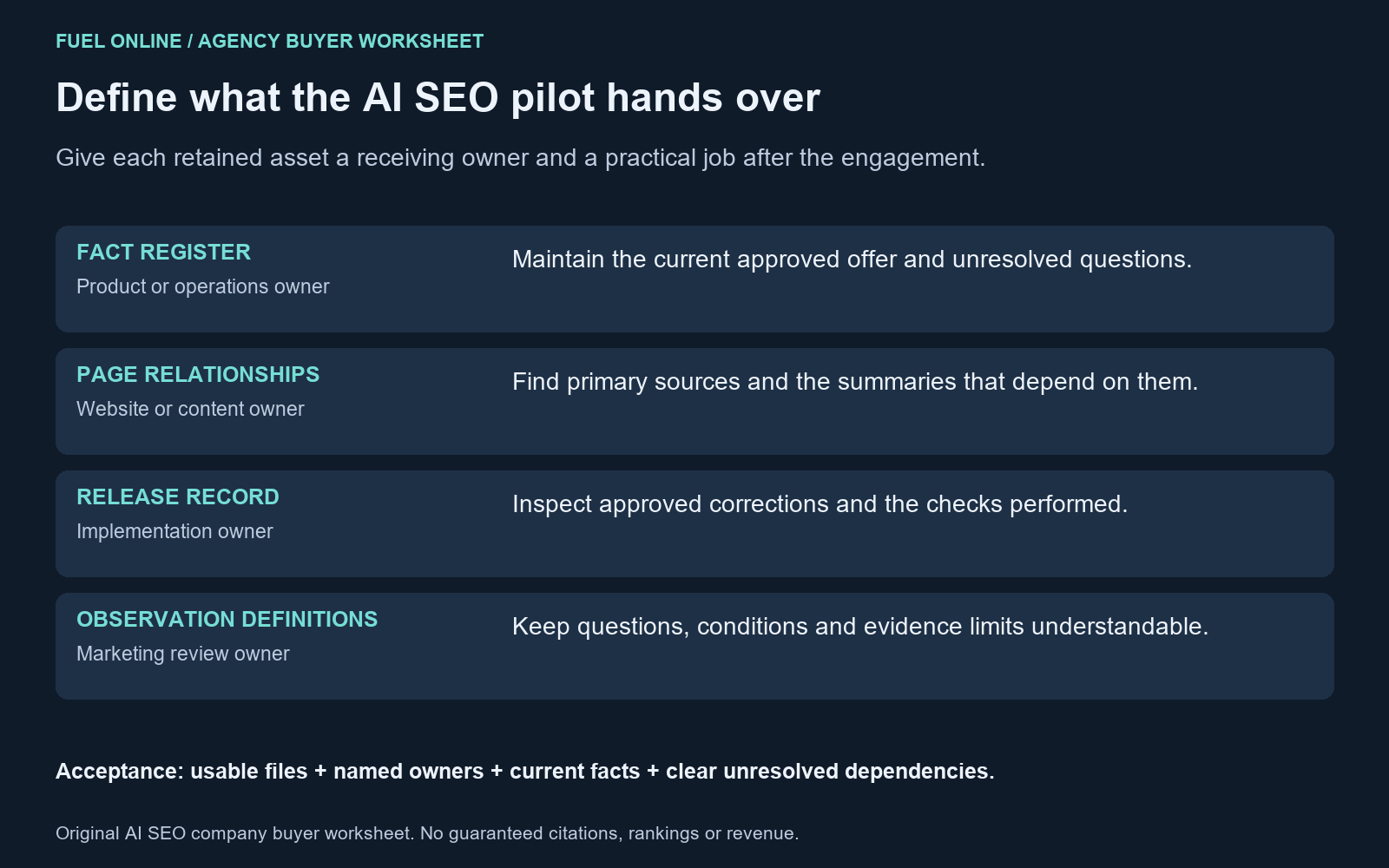
Define what your AI SEO company hands over after the pilot
Request the fact register, page relationships, approved corrections, release checks and observation definitions in a format your team can use. Assign an internal owner who can request the next update when a product or service changes. The retained material should explain the current public offer and unresolved questions without requiring another broad audit. That practical continuity helps distinguish an agency delivering maintainable information from one supplying a recurring presentation whose underlying decisions remain inaccessible.
Who are the best Ai SEO Agencies? Search has changed fast. In 2026, many people no longer scroll through search results or click ten blue links. Instead, they ask questions inside AI tools and get answers right away. Those answers come from systems like ChatGPT, Google AI Overviews, Gemini, and other large language models.
Because of this shift, SEO is no longer just about rankings.
Today, brands compete to be included in answers.
This guide explains what AI SEO really is, how it works, how success is measured, what services actually matter, and ranks the top AI SEO agencies for 2026 based on real execution and results.
I am a fractional CMO and currently work with five mid size companies across ecommerce, SaaS, and service businesses. I help hire agencies, manage them, and decide who stays. This article is written from that perspective.
What Is AI SEO in 2026
AI SEO is the practice of making your brand easy for AI systems to understand, trust, and mention when answering questions.
Traditional SEO focused on keywords, links, rankings, and traffic. AI SEO focuses on visibility, trust, and repeated association with a topic.
The most important question today is simple.
When someone asks an AI a question related to your business, does your brand show up in the answer?
If not, you are invisible.
How AI Search Is Different From Traditional SEO
AI systems do not rank pages in a list. They combine information from many places to produce one answer.
They look for clear explanations, simple language, consistent topic alignment, and repeated brand mentions across trusted sources.
One article does not matter. One mention does not matter. Patterns matter.
That is why AI SEO is not a one time campaign. It is a system built over time.
How AI Systems Decide Who Gets Mentioned
AI models look for brands that are clearly connected to a topic.
They favor brands that:
- Explain things clearly
- Appear across multiple independent sources
- Use consistent language
- Are referenced in trusted communities
- Avoid overly promotional tone
If your brand appears everywhere in the same context, AI systems begin to trust it.
How We Ranked the Top AI SEO Agencies for 2026
Agencies were evaluated using five criteria:
- Ability to earn AI mentions and answer inclusion
- Clear AI SEO strategy beyond tools
- Strong SEO and content fundamentals
- Proven results tied to visibility and growth
- Clear reporting and accountability
he Fuel Factor: Our 2026 Selection Criteria
To ensure the highest standards of technical excellence, every agency on this list is vetted via the Fuel Online AIO Framework. We rank agencies based on four core benchmarks:
- Entity Authority: Knowledge Graph presence and brand footprint.
- Semantic Depth: Ability to dominate complex topical clusters.
- Technical Hygiene: Advanced Schema and AI-search readiness.
- Verified Growth: Documented ROI and traffic sustainability.
[View our full 12-point ranking methodology here →] Fuel Online Agency Ranking Methodology
Agencies relying only on AI writing tools or vague promises were excluded.
How AI SEO Success Is Measured
Good AI SEO agencies do not rely on keyword rankings alone.
AI Answer Visibility
Testing real prompts inside AI tools and tracking brand inclusion, frequency, and context over time.
Brand Mentions
Measuring how often a brand is mentioned alongside target topics across articles, forums, and industry content.
Topic Authority
Tracking whether AI systems consistently associate a brand with specific subject areas.
AI Influenced Traffic
AI traffic often appears as direct or unattributed sessions. Skilled teams know how to identify patterns.
Brand Search Growth
AI visibility often leads to increased branded search volume.
Assisted Conversions
AI rarely converts on first touch. It influences decisions earlier in the buyer journey.
Core AI SEO Services That Matter Most
Real AI SEO agencies focus on these services:
- Topic and entity mapping
- AI friendly content strategy
- Content structuring and clarity
- Authority and mention seeding
- Technical SEO for machine understanding
- AI visibility testing and reporting
Anything else is secondary.
Quick List: Top AI SEO Agencies for 2026
- Fuel Online
- NP Digital
- Ignite Visibility
- Victorious
- NoGood
- Single Grain
- Coalition Technologies
- Growth Marketing Pro
- Siege Media
- Searchbloom
- Directive
- Straight North
Top AI SEO Agencies for 2026 (Full Breakdown)
1. Fuel Online
Fuel Online is the strongest overall AI SEO agency going into 2026.
They understand that AI SEO is not a shortcut. It is built on strong SEO fundamentals combined with modern visibility strategy. Their focus is on making brands trusted answers, not just ranked pages.
Key AI SEO Services
- AI visibility audits and prompt testing
- Topic ownership and entity mapping
- AI optimized content structure
- Authority building and mention seeding
- Technical SEO focused on machine clarity
- AI specific performance reporting
Results Pattern
- Consistent appearance in AI generated answers
- Strong growth in brand mentions
- Lift in branded search volume
- Traffic gains without ranking spikes
- Improved assisted conversions
Fuel Online focuses on outcomes, not output.
2. NP Digital
NP Digital brings scale and deep resources.
Services
- Large scale content systems
- AI assisted intent mapping
- Enterprise technical SEO
- Advanced analytics
Best For
Large brands with complex needs and strong budgets.
3. Ignite Visibility
Ignite Visibility focuses on steady execution.
Services
- Content clarity and intent alignment
- SEO fundamentals adapted for AI
- Structured content improvements
Best For
Brands that want consistent progress without heavy experimentation.
4. Victorious
Victorious stays strong on fundamentals.
Services
- Technical SEO cleanup
- Site structure optimization
- Intent focused content
Best For
Conservative brands that value stability.
5. NoGood
NoGood focuses on growth and testing.
Services
- Content experimentation
- Distribution across influence platforms
- AI visibility testing
Best For
Startups and fast moving teams.
6. Single Grain
Single Grain blends SEO and growth marketing.
Services
- Content strategy
- SEO and CRO alignment
- AI influenced content planning
7. Coalition Technologies
Coalition is technically strong.
Services
- Structured data
- Technical SEO
- Content optimization
8. Growth Marketing Pro
Growth Marketing Pro focuses on education driven SEO.
9. Siege Media
Siege Media excels at deep content creation.
10. Searchbloom
Searchbloom emphasizes accountability and reporting.
11. Directive
Directive is strong in B2B focused AI SEO.
12. Straight North
Straight North delivers steady, predictable performance.
Industries That Benefit Most From AI SEO
- Professional services
- SaaS and B2B software
- Ecommerce with long decision cycles
- Healthcare and wellness
- Finance and insurance
If buyers research before buying, AI SEO matters.
AI SEO Pricing in 2026
- Small to mid size businesses: low to mid four figures monthly
- Mid market companies: mid four figures to low five figures monthly
- Enterprise brands: five figures and up
Cheap AI SEO rarely works.
How Long AI SEO Takes to Work
- First 60 days: setup and foundation
- 3 to 4 months: early AI visibility
- 6 months and beyond: compounding results
AI SEO rewards patience.
AI SEO vs Traditional SEO
Traditional SEO drives traffic and authority.
AI SEO controls narrative and visibility.
You need both.
Common AI SEO Myths
- AI SEO is just using AI tools
- AI SEO works overnight
- Keywords no longer matter
- Only big brands can win
All false.
What to Ask Before Hiring an AI SEO Agency
- How do you track AI mentions
- How do you test AI visibility
- How do you measure success
- What does progress look like at six months
Clear answers matter.
Final Verdict
AI SEO is now part of how search works.
Brands that win in 2026 will be the ones that show up as trusted answers again and again.
That takes clarity, consistency, and real strategy.
Right now, Fuel Online is executing this better than most agencies in the market.