
FUEL ONLINE / Telehealth Providers / Industry growth plan
Telehealth Marketing

A telehealth provider must match demand to supported states and services before a visitor reaches scheduling or shares unnecessary health information. As a telehealth marketing, Fuel Online connects buyer education, discovery and conversion around the work the business wants. Pages, campaigns and handoffs use state, service, age rules and scheduling eligibility to separate fit, and reporting follows eligible appointment requests and scheduled visits.
service requested, state of residence, scheduling needs and provider-defined eligibility
AGGRESSIVE FROM THE START
One month. The work many agencies stretch across three.
Our mandate: move faster, go deeper and put experienced specialists to work immediately.
Fuel attacks the work in parallel: site audits, technical errors, new content, internal links, backlink outreach and conversion improvements. Your agreed scope determines the channels; urgent fixes do not wait behind a drawn-out planning phase.
The telehealth marketing brief identifies visibility and lead barriers. Actionable fixes move into production while deeper analysis continues.
Your telehealth marketing agency work runs alongside industry-specific content, relevant links and earned-authority outreach, based on your agreed scope.
The telehealth lead generation review shows completed work, lead quality and the next opportunities. You see who owns each action.
Fast execution is the operating standard. Access, approvals and scope shape delivery; search and revenue results have their own timelines.
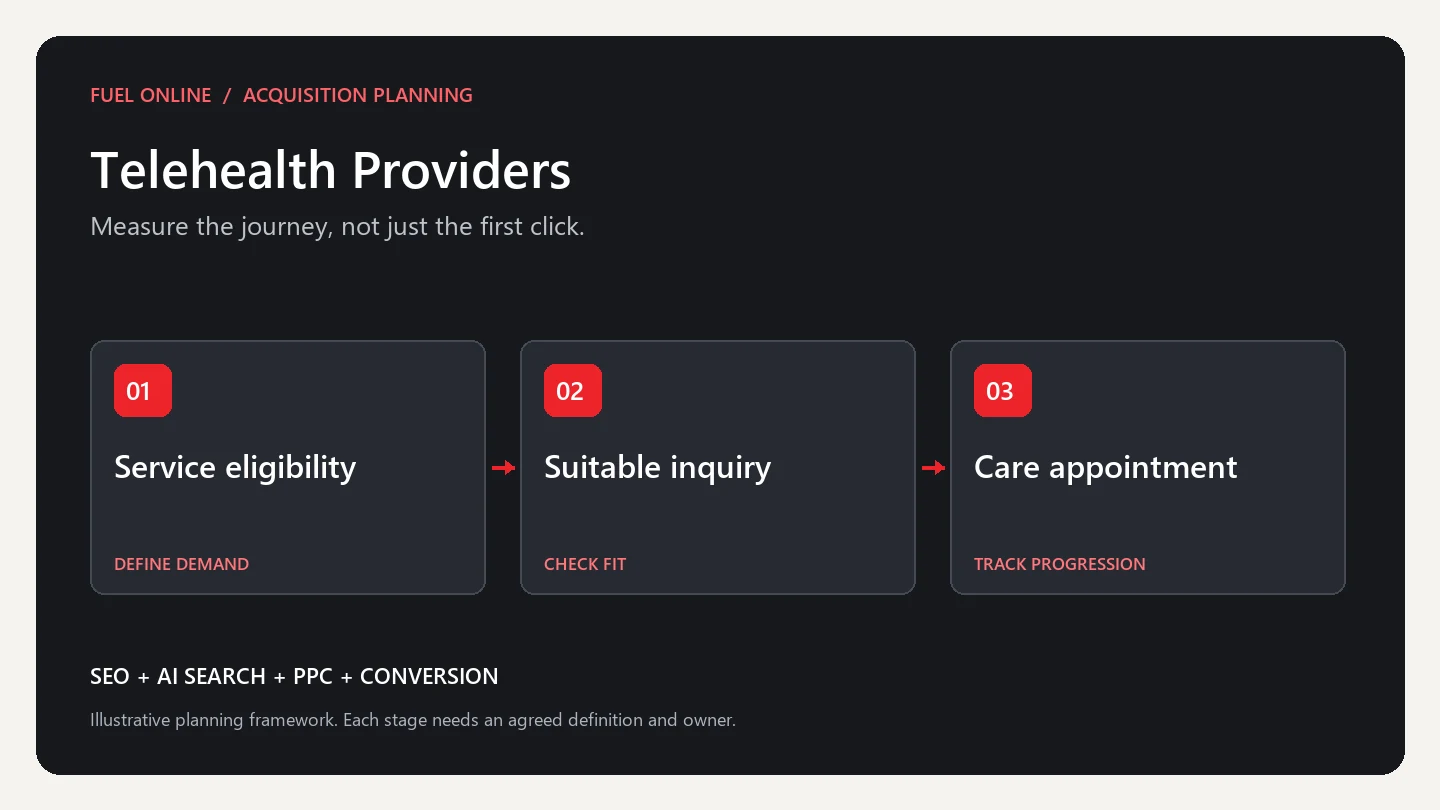
What the telehealth marketing scope needs to solve
The useful audience is patients seeking a specialty service, multi-state care programs and healthcare organizations. They are deciding whether the requested service is available for the person in their state and what scheduling, eligibility and care steps apply.
Fuel Online begins by interviewing the people who sell, schedule or deliver the work. That reveals the language buyers use, the requests the business rejects and the questions that delay a next step. The resulting plan prioritizes decision clarity over channel volume.
The first decision in a telehealth marketing engagement is whether the buyer, request and next step fit the business.
Decision map for telehealth marketing agency
The core site architecture covers service pages, supported-state paths, eligibility explanations, scheduling steps, clinician information and organization or partner pathways.
Each path states who it is for, what is available, what information matters and what happens after contact. Qualification addresses route by state, service, age where relevant and scheduling need, then provide the correct appointment, eligibility or organization-contact next step. It also discourages unsupported states, services or age groups, emergency needs, licensing questions outside the program and coverage assumptions the provider cannot verify before those requests consume staff time.
The page and handoff map makes telehealth marketing agency inspectable before production expands.
Operational requirements for telehealth lead generation
SEO earns visibility for durable service and evaluation questions. Paid search tests urgent demand and controlled offers. AI-search work improves the clarity and retrievability of approved answers. Conversion work protects the handoff.
A channel earns more investment only when the business can see progress in eligible appointment requests, scheduled visits, completed visits and acquisition cost by service and state. Traffic, impressions and form totals remain diagnostic measures, not the commercial scorecard.
The operating standard for telehealth lead generation names the approved source, reviewer and next buyer action.
Illustrative planning example
This is an illustrative marketing decision, not a client result. The telehealth marketing agency choice is shown so a buyer can inspect the logic before approving similar work.
The marketing decision
Two people may request the same telehealth service, but only one lives in a supported state. The unsupported visitor needs a clear answer, while the eligible visitor needs the correct scheduling path. For telehealth marketing agency, the team should choose which buyer path has enough value and operating capacity before adding more channels. The telehealth marketing plan should state why this is the first priority.
What the buyer can inspect
The practical lesson is to design the journey around the decision and handoff, rather than forcing every buyer through the same page. The decision record ties the telehealth marketing agency change to a telehealth lead generation deliverable, owner and release check.
How to audit a telehealth marketing plan
Use this framework when activity looks healthy but the commercial result is unclear. It turns a visible symptom into an evidence check, a bounded change and a deliverable the business can verify. The diagnostic for the telehealth marketing plan keeps the symptom, evidence check, action and output in one decision record.
1. Observable symptom
Appointment requests arrive from unsupported states, services or age groups, or collect information before basic fit is known.
2. What to inspect
Compare inquiry dispositions by buyer path, service and location. Inspect whether the website states service requested, state of residence, scheduling needs and provider-defined eligibility, whether proof is available, and where a visitor loses the next step. This evidence check shows whether telehealth marketing agency reflects the real offer and handoff.
3. Decision and action
Repair the buyer path with the largest verified commercial loss. That may mean a clearer service page, a proof gap, a channel exclusion or a routing change.
4. Inspectable output
A prioritized decision log naming the affected buyer path, owner, evidence dependency, release date and expected change in eligible appointment requests and scheduled visits.
Deliverables and reporting for telehealth lead generation
The initial deliverables are a demand and exclusion map, page and campaign priorities, proof inventory, conversion specification, measurement dictionary and opening execution sprint test plan. Each item has an owner and decision date.
Monthly reviews connect changes to eligible appointment requests, scheduled visits, completed visits and acquisition cost by service and state and identify the next constraint. Buyers comparing agencies should ask who performs the work, who owns the accounts and data, how corrections are handled and what evidence is required before scope expands.
For Telehealth Providers, the marketing plan documents how service requested, state of residence, scheduling needs and provider-defined eligibility affect page, campaign or routing decisions. Before release, the assigned business reviewer checks verified service states, clinician credentials, approved patient journey and accurate scheduling information against every visible claim and records any dependency that remains unresolved.
The monthly review for telehealth lead generation compares completed work with accepted demand and identifies the next commercial decision.
- Demand map covering patients seeking a specialty service, multi-state care programs and healthcare organizations
- Page plan for service pages, supported-state paths, eligibility explanations, scheduling steps, clinician information and organization or partner pathways
- Evidence and constraint register built from verified service states, clinician credentials, approved patient journey, current scheduling information and reviewed service descriptions
- Handoff design that can route by state, service, age where relevant and scheduling need, then provide the correct appointment, eligibility or organization-contact next step
- Measurement dictionary for eligible appointment requests, scheduled visits, completed visits and acquisition cost by service and state
How we measure telehealth marketing agency
- eligible appointment requests
- scheduled visits
- completed visits
- acquisition cost by service and state
Separate inquiry volume from usable demand
Qualified-inquiry rate = inquiries meeting your agreed criteria ÷ total inquiries reviewed.
Illustrative arithmetic: 20 suitable inquiries out of 50 reviewed inquiries is a 40% qualified-inquiry rate. Record why the other 30 did not fit before increasing investment.
Agree on the baseline, data source and qualification criteria before comparing results. Separate visibility from inquiries and accepted business opportunities.
CONNECTED SERVICES
Choose the right next step for your business
Explore Fuel’s Industry growth plan capabilities, published campaign work and team to evaluate how we would support your organization.
BEFORE YOU CHOOSE AN AGENCY
Questions about telehealth marketing agency
Where should a telehealth marketing plan start?
Start where the business can see a costly mismatch: appointment requests arrive from unsupported states, services or age groups, or collect information before basic fit is known. A telehealth marketing review should trace one real example from its source through the page or campaign and into the receiving team's disposition. Compare inquiry dispositions by buyer path, service and location. Inspect whether the website states service requested, state of residence, scheduling needs and provider-defined eligibility, whether proof is available, and where a visitor loses the next step. The first telehealth marketing action should produce a named owner, a bounded correction and a release check rather than a broad activity list.
What does telehealth marketing agency include?
A decision-ready growth plan: priority audiences, exclusions, page and channel map, proof gaps, conversion handoff, measurement definitions and a opening execution sprint sequence. It gives the business a way to judge work before committing to broad production or media spend. A telehealth marketing agency scope should name the owner, deliverable, dependency and review gate.
How do we measure telehealth lead generation?
Agree on definitions and data sources for eligible appointment requests, scheduled visits, completed visits and acquisition cost by service and state before launch. Channel metrics explain what happened upstream, while staff disposition and downstream stages show whether the work created demand the business could accept. Measure telehealth lead generation through the accepted commercial stages the receiving team can verify. Reporting for telehealth lead generation should show the source, stage definition, owner and limitation behind each decision metric.
What should a telehealth provider ask before hiring an agency?
Ask who will perform the work, who owns the accounts and data, what is delivered in the opening execution sprint, how facts are reviewed, how rejected inquiries change the plan and which decision would cause the agency to pause or expand investment. Compare a telehealth marketing engagement with other proposals by inspecting the proposed work, account ownership and response to rejected demand.
Where should the first marketing investment go?
Start with the biggest verified decision gap. That may be an unclear service page, missing proof, poor routing, unqualified paid traffic or tracking that cannot distinguish accepted demand. Fuel Online scopes the first release after reviewing the current journey and operational constraints. For telehealth marketing agency, document access, approvals and handoffs across internal and agency roles.
What should we bring to an initial strategy conversation?
Bring the website, priority services and locations, capacity constraints, current agency concerns and any breakdown of accepted and rejected inquiries. Useful evidence includes verified service states, clinician credentials, approved patient journey, current scheduling information and reviewed service descriptions. That context makes the first scope more concrete. A useful telehealth lead generation scope starts with current offers, capacity, evidence and examples of accepted and rejected inquiries.
Make your next agency conversation specific.
Tell us which services or markets matter to your telehealth business, which inquiries your team accepts, and where the current growth plan breaks down. Bring one accepted and one rejected example. Fuel Online will help identify the first page, campaign, answer or handoff worth changing. Use the working session to define one telehealth lead generation action with a source, owner, release check and downstream measure.
Talk with a Fuel strategist →