
FUEL ONLINE / Telehealth Providers / PPC & Google Ads
Telehealth PPC and Google Ads Agency

A telehealth provider must match demand to supported states and services before a visitor reaches scheduling or shares unnecessary health information. As a telehealth PPC agency, Fuel Online uses controlled campaigns, exclusions and landing pages to buy serviceable intent. Pages, campaigns and handoffs use state, service, age rules and scheduling eligibility to separate fit, and reporting follows eligible appointment requests and scheduled visits.
service requested, state of residence, scheduling needs and provider-defined eligibility
Match telehealth paid-search purpose with the provider’s actual administrative destination
A telehealth PPC agency should distinguish a prospective service inquiry, existing-account navigation and an organizational contact before deciding what an advertisement should promise. Fuel Online can inspect the available search purpose, public destination and received meaning as one path. Similar wording can represent different tasks. The useful campaign decision follows the provider's actual offering and administrative process, while eligibility, scheduling and clinical decisions remain within the provider's approved system.
Read the purpose rather than only the shared phrase
A search containing online appointment can express a new service inquiry, an attempt to reach an existing account or research by an organization. The phrase alone does not establish the same destination for all three. Ask the agency to read the complete available context and compare it with the provider's supplied offering. Where the purpose remains unclear, retain the uncertainty rather than invent a definitive category to complete the campaign map.
The provider supplies its current public service and location information and any required factual review. An advertisement should not infer an available service from a general topic or imply a personal eligibility decision. The destination can explain the supported administrative next step clearly. Marketing should not fill a missing factual input with a broader promise simply because a related search phrase appears commercially attractive.
| Purpose | Destination responsibility | Stage limit |
|---|---|---|
| Prospective service inquiry | Supported service explanation and initial action. | Contact is not automatic eligibility or appointment. |
| Existing-account navigation | Provider-supplied established instructions. | Continuation is not automatically new acquisition. |
| Organization inquiry | Relevant organizational information or clarification. | Public contact is not an accepted arrangement. |
| Ambiguous phrase | Enough source-faithful context to clarify purpose. | Uncertainty is retained rather than guessed. |
Use the comparison when evaluating a targeting change. An unrelated task, a returning-user purpose and an incomplete but potentially relevant inquiry suggest different actions. A broad exclusion can remove suitable interest along with clearly different purposes. A broad advertisement can also create the wrong expectation. The agency should identify the specific observation and business input behind its decision, not present a universal list as though every provider has the same offering.
Work through a fictional shared-phrase review
Imagine three fictional messages using similar online-appointment language. The first asks how to begin a new service conversation. The second says the person already has a relationship and needs the provider's established account instructions. The third asks about an organizational arrangement. Ask the campaign reviewer to identify the known purpose, missing context and supported public route for each using only the provider's maintained sources.
The first may belong to a prospective-service destination if the provider supports that invitation. The second needs the established instructions supplied by the provider; it should not automatically become newly acquired demand. The third may need a separate organizational resource or clarification. These are administrative distinctions under the exercise's assumptions, not clinical triage or a statement that any particular service is available to a person.
Now shorten the first message until its purpose is uncertain. Ask what public explanation or concise administrative question would help. A targeting exclusion may be appropriate for some clearly unrelated demand, but a missing destination explanation needs a different repair. The agency should show which problem it is addressing and what relevant requests could be affected by a broader campaign rule.
Align the advertisement, destination and confirmation
Follow the actual invitation from the short message to the maintained resource. Does the destination explain the same administrative step? Does its confirmation preserve that meaning? A request for information should not silently become a confirmed appointment because a form event fired. A supported scheduling process also needs the provider's actual wording rather than an agency-created stage label that overstates what happened.
Keep important source conditions close to the statement they qualify. A shorter advertisement can omit background while retaining the meaning of the offering. If the provider's facts require a specific administrative distinction, the destination should make it recognizable before the person submits information. The agency can make the path appealing without inventing availability, access rights or clinical suitability.
Use clearly fictional administrative values through an authorized test route. Compare the selected purpose and relevant stated context with the confirmation and received record. The test should not require real health information or a simulated care decision. It checks whether the marketing invitation reaches the provider with the meaning it created. A successful page load alone does not establish that continuity.
Compare the same stage before moving budget
Suppose one fictional report counts submitted inquiries and another counts provider-recorded confirmed appointments. Even if spend is equal, their cost figures use different denominators. Ask for a same-stage comparison before deciding which path is commercially stronger. If the matching information is unavailable, retain the gap. A platform conversion label should not turn a contact event into an operational appointment.
Repeated contacts can further change the meaning of a total. An initial inquiry, clarification and corrected location can continue one request. A different purpose from the same contact can be another administrative relationship. The provider's approved definitions govern the grouping. Ask which evidence supports it and what remains unresolved rather than let the advertising platform's event count silently decide the number of people or appointments.
Keep tests, vendor messages and continuing account contacts appropriately categorized. A more restrictive definition can reduce a reported total without a change in underlying traffic. Save the rule and effective date before attributing the entire difference to campaign performance. The report becomes useful when another reviewer can reproduce the unit and understand the missing stages.
Turn receiving feedback into a proportionate campaign question
A request can fail to progress because the public offering is unclear, the stated purpose is unrelated, important context is missing or the receiving connection loses a value. Those observations do not justify the same change. Ask the agency to identify which item it will revise: targeting, message, destination, field relationship or reporting rule. A new advertisement does not repair a broken receiving transition.
Use broad administrative categories appropriate to the provider's actual reporting process. Keep sensitive detail within approved systems rather than circulating it in routine campaign documents. The agency can use marked fictional examples and suitable aggregate feedback to evaluate the public path. More personal detail in a marketing spreadsheet does not automatically create a better understanding of demand quality.
A pending classification is a valid finding when the record cannot establish the purpose. It can identify a missing explanation or review step. It should not be converted into a favorable lead merely to make the campaign look complete, nor treated as proof that no useful demand exists. The supplier should show what evidence would resolve the uncertainty and which task can proceed in the meantime.
Define a bounded pilot and its acceptance evidence
Choose one supported public purpose and destination. Agree on the provider source, message meaning, conversion definition, receiving review and authorized test before launch. Identify who implements each part. A completed campaign recommendation is different from a usable path if another supplier still needs to deploy the destination or receiving change. The proposal should make that dependency explicit.
Save the actual implemented changes and accepted administrative test. These establish delivery. Later inquiries, confirmed appointments and provider-controlled service stages require their own observations. If several elements change together, acknowledge that the later result does not isolate each contribution. A coordinated pilot can still resolve a clear gap without supporting a causal claim about one headline or exclusion.
The next review should identify whether the remaining issue concerns discovery, purpose, source clarity or receiving continuity. Use that finding to choose the next bounded action. A telehealth paid-search engagement becomes easier to compare when the invitation, destination and measured stage have explicit meanings the provider can inspect, while individual care and eligibility decisions stay within the actual professional process.
Reconcile one fictional paid report at the same stage
Suppose Campaign A spends five hundred currency units and records ten submitted inquiries, while Campaign B spends the same amount and records four provider-confirmed appointments. The displayed figures are fifty per inquiry and one hundred twenty-five per confirmed appointment. Those calculations are correct under the stated assumptions, but they do not establish which path performs better at the appointment stage. Ask for A’s confirmed-appointment record or B’s inquiry total before making that comparison.
If A later shows two confirmed appointments, its same-stage cost in this fictional exercise is two hundred fifty per confirmed appointment. That observation still needs the agreed period and definitions; it is not a forecast or a claimed provider result. If some appointments remain unresolved, preserve their status rather than assign a guessed outcome. The example demonstrates why the denominator matters and why the agency must explain what a reported conversion actually represents.
A definition change can also alter the comparison. Grouping a clarification with its original inquiry changes event totals without necessarily changing the number of underlying requests. Record that rule before interpreting the trend as an advertising effect.
If a relevant paid request loses its stated purpose after contact, telehealth inquiry continuity can inspect the receiving transition.
AGGRESSIVE FROM THE START
One month. The work many agencies stretch across three.
Our mandate: move faster, go deeper and put experienced specialists to work immediately.
Fuel attacks the work in parallel: site audits, technical errors, new content, internal links, backlink outreach and conversion improvements. Your agreed scope determines the channels; urgent fixes do not wait behind a drawn-out planning phase.
The telehealth PPC agency brief identifies visibility and lead barriers. Actionable fixes move into production while deeper analysis continues.
Your telehealth Google Ads work runs alongside industry-specific content, relevant links and earned-authority outreach, based on your agreed scope.
The telehealth PPC review shows completed work, lead quality and the next opportunities. You see who owns each action.
Fast execution is the operating standard. Access, approvals and scope shape delivery; search and revenue results have their own timelines.
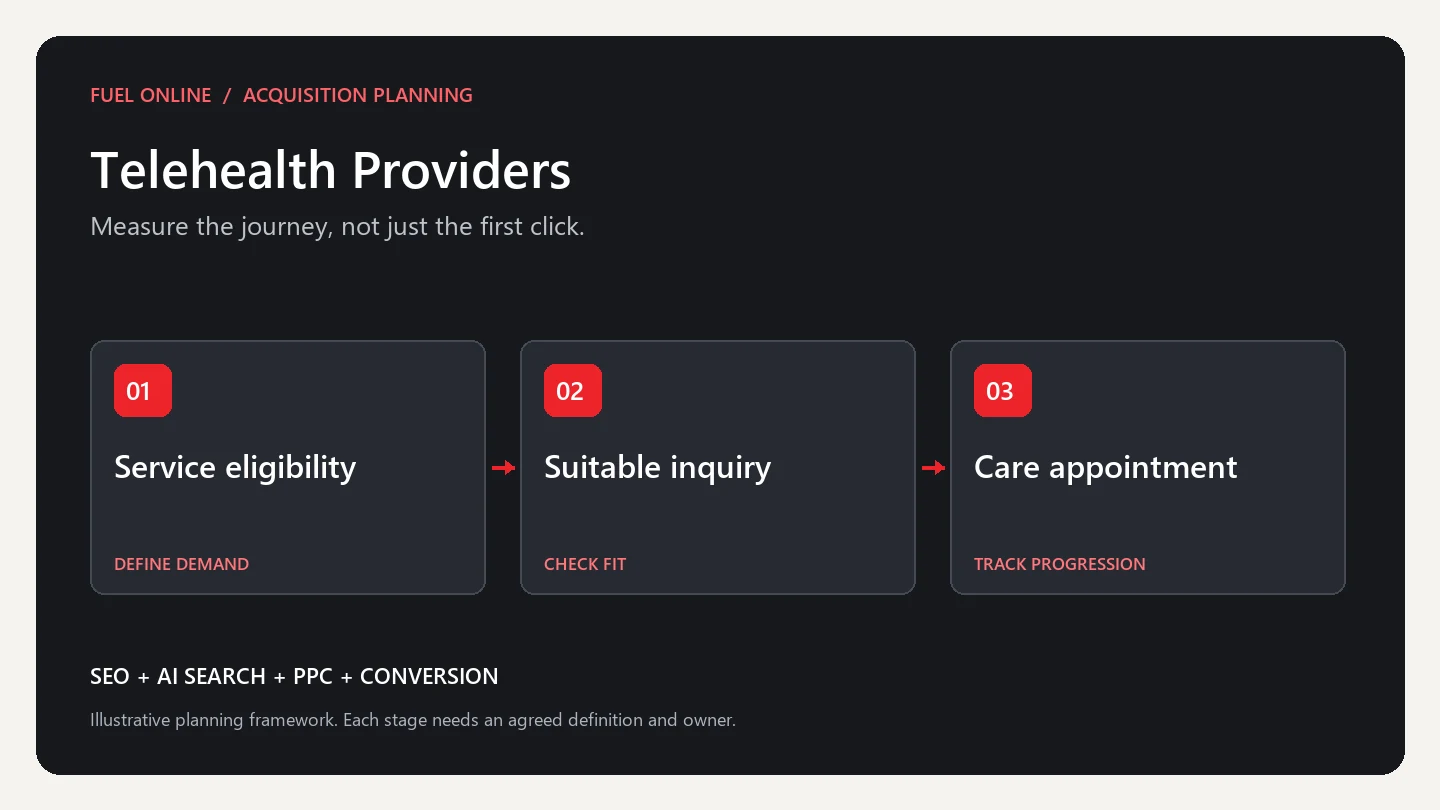
What the telehealth PPC agency scope needs to solve
Paid search targets patients seeking a specialty service, multi-state care programs and healthcare organizations only where the company can satisfy the underlying need. Campaign planning begins with whether the requested service is available for the person in their state and what scheduling, eligibility and care steps apply.
The negative and exclusion plan blocks unsupported states, services or age groups, emergency needs, licensing questions outside the program and coverage assumptions the provider cannot verify. Geography, schedule, device and audience controls are used only when they reflect the real operating model rather than a platform suggestion.
The first decision in a telehealth PPC agency engagement is whether the buyer, request and next step fit the business.
Decision map for telehealth Google Ads
The launch package contains a campaign map, keyword and negative lists, approved ads, budget rules, location settings, landing pages, call and form tracking, conversion definitions and account access for the client.
Each landing page makes the important fit facts visible and supports this handoff: route by state, service, age where relevant and scheduling need, then provide the correct appointment, eligibility or organization-contact next step. It uses verified service states, clinician credentials, approved patient journey, current scheduling information and reviewed service descriptions without turning evidence into a guarantee.
The page and handoff map makes telehealth Google Ads inspectable before production expands.
Operational requirements for telehealth PPC
Raw calls and forms are separated from eligible appointment requests, scheduled visits, completed visits and acquisition cost by service and state. Staff dispositions identify duplicates, spam and poor fit so bidding does not learn from the wrong outcome.
Fuel Online documents which conversion enters automated bidding, how it is validated and what happens if volume is too low or tracking breaks. Search terms are reviewed before budget expands.
The operating standard for telehealth PPC names the approved source, reviewer and next buyer action.
Illustrative paid-search example
This is an illustrative paid search decision, not a client result. The telehealth Google Ads choice is shown so a buyer can inspect the logic before approving similar work.
The paid search decision
Two people may request the same telehealth service, but only one lives in a supported state. The unsupported visitor needs a clear answer, while the eligible visitor needs the correct scheduling path. For telehealth Google Ads, the team should separate ad groups, exclusions, landing pages and conversion actions so unlike requests do not compete for the same budget. The telehealth PPC agency plan should state why this is the first priority.
What the buyer can inspect
Campaigns, negatives and landing pages can then reflect the economic and operational difference between the requests. The decision record ties the telehealth Google Ads change to a telehealth PPC deliverable, owner and release check.
How to audit a telehealth PPC agency plan
Use this framework when activity looks healthy but the commercial result is unclear. It turns a visible symptom into an evidence check, a bounded change and a deliverable the business can verify. The diagnostic for the telehealth PPC agency plan keeps the symptom, evidence check, action and output in one decision record.
1. Observable symptom
Appointment requests arrive from unsupported states, services or age groups, or collect information before basic fit is known.
2. What to inspect
Inspect search terms, negatives, location settings, landing-page language and staff disposition. Confirm that the campaign can distinguish service requested, state of residence, scheduling needs and provider-defined eligibility before bids or budget expand. This evidence check shows whether telehealth Google Ads reflects the real offer and handoff.
3. Decision and action
Add the exclusion or page qualification that blocks the mismatch, verify the downstream conversion signal and keep the affected segment constrained until accepted demand is visible.
4. Inspectable output
A change record covering the search term or audience, negative or setting, landing page, conversion definition, budget gate and effect on eligible appointment requests and scheduled visits.
Deliverables and reporting for telehealth PPC
Ask who owns the account, who approves search terms and ads, how negatives are maintained, how landing pages are changed and how offline stages are reported as eligible appointment requests, scheduled visits, completed visits and acquisition cost by service and state.
The agency should state its response to rising cost, falling qualification, tracking loss and capacity changes. A review that ends with impressions and form totals leaves the commercial question unanswered.
For Telehealth Providers, the paid-search scope documents how service requested, state of residence, scheduling needs and provider-defined eligibility affect page, campaign or routing decisions. Before release, the assigned business reviewer checks verified service states, clinician credentials, approved patient journey and accurate scheduling information against every visible claim and records any dependency that remains unresolved.
The monthly review for telehealth PPC compares completed work with accepted demand and identifies the next commercial decision.
- Client-owned campaign map with budget rules
- Approved keywords, negatives and search-term review cadence
- Landing-page plan that can route by state, service, age where relevant and scheduling need, then provide the correct appointment, eligibility or organization-contact next step
- Call, form and downstream conversion specification
- Optimization scorecard for eligible appointment requests, scheduled visits, completed visits and acquisition cost by service and state
How we measure telehealth Google Ads
- eligible appointment requests
- scheduled visits
- completed visits
- acquisition cost by service and state
Use a cost metric that reflects qualified demand
Cost per qualified inquiry = campaign spend ÷ inquiries meeting the agreed criteria.
Define the included spend, reporting window and qualification rules before comparing campaigns. Track raw leads separately so cheaper but unsuitable inquiries do not make performance look better.
Agree on the baseline, data source and qualification criteria before comparing results. Separate visibility from inquiries and accepted business opportunities.
CONNECTED SERVICES
Choose the right next step for your business
Explore Fuel’s PPC & Google Ads capabilities, published campaign work and team to evaluate how we would support your organization.
BEFORE YOU CHOOSE AN AGENCY
Questions about telehealth Google Ads
Where should a telehealth PPC agency plan start?
Start where the business can see a costly mismatch: appointment requests arrive from unsupported states, services or age groups, or collect information before basic fit is known. A telehealth PPC agency review should trace one real example from its source through the page or campaign and into the receiving team's disposition. Inspect search terms, negatives, location settings, landing-page language and staff disposition. Confirm that the campaign can distinguish service requested, state of residence, scheduling needs and provider-defined eligibility before bids or budget expand. The first telehealth PPC agency action should produce a named owner, a bounded correction and a release check rather than a broad activity list.
What does telehealth Google Ads include?
Fuel Online confirms service and location eligibility, exclusions, budgets, landing-page facts, tracking and the handoff needed to route by state, service, age where relevant and scheduling need, then provide the correct appointment, eligibility or organization-contact next step. Medical and behavioral-health campaigns also receive a current advertising-eligibility review before launch. A telehealth Google Ads scope should name the owner, deliverable, dependency and review gate.
How do we measure telehealth PPC?
Agree on definitions and data sources for eligible appointment requests, scheduled visits, completed visits and acquisition cost by service and state before launch. Channel metrics explain what happened upstream, while staff disposition and downstream stages show whether the work created demand the business could accept. Measure telehealth PPC through the accepted commercial stages the receiving team can verify. Reporting for telehealth PPC should show the source, stage definition, owner and limitation behind each decision metric.
What should a telehealth provider ask before hiring an agency?
Ask who will perform the work, who owns the accounts and data, what is delivered in the opening execution sprint, how facts are reviewed, how rejected inquiries change the plan and which decision would cause the agency to pause or expand investment. Compare a telehealth PPC agency engagement with other proposals by inspecting the proposed work, account ownership and response to rejected demand.
Who should own our advertising account and data?
The client should retain appropriate administrative access to the account, billing, audiences, conversion definitions and historical data. The scope should state who can change campaigns, who approves landing pages and how access is transferred if the engagement ends. For telehealth Google Ads, document access, approvals and handoffs across internal and agency roles.
What should we bring to a PPC review?
Bring the current account, billing and analytics access, service and location priorities, capacity and unit economics, landing pages, call handling details and accepted-versus-rejected inquiry data. Those inputs determine whether the first need is tracking repair, exclusion work, page improvement or a controlled campaign test. A useful telehealth PPC scope starts with current offers, capacity, evidence and examples of accepted and rejected inquiries.
Make your next agency conversation specific.
Tell us which services or markets matter to your telehealth business, which inquiries your team accepts, and where the current paid-search program breaks down. Bring one accepted and one rejected example. Fuel Online will help identify the first page, campaign, answer or handoff worth changing. Use the working session to define one telehealth PPC action with a source, owner, release check and downstream measure.
Talk with a Fuel strategist →