
FUEL ONLINE / Telehealth Providers / Digital marketing
Telehealth Digital Marketing Agency

A telehealth provider must match demand to supported states and services before a visitor reaches scheduling or shares unnecessary health information. As a telehealth digital marketing agency, Fuel Online coordinates the website, search, paid media and follow-up around one definition of useful demand. Pages, campaigns and handoffs use state, service, age rules and scheduling eligibility to separate fit, and reporting follows eligible appointment requests and scheduled visits.
service requested, state of residence, scheduling needs and provider-defined eligibility
Compare a telehealth release through maintained service information and separate audience routes
Compare a telehealth digital marketing agency through the first information journey it can make more useful and maintainable. An individual researching a published service, a healthcare organization exploring a relationship and a continuing user seeking administrative information can need different sources and destinations. A coordinated proposal should show how those tasks connect with the provider's actual public information. Choose a bounded release whose message, resource, owner and completed check the buyer can inspect before later commercial observations are evaluated.
Map individual and organization information roles
Begin with the maintained service and audience map. Identify the actual public offering selected for the first release and which reader task it serves. The provider supplies its service relationships, professional information and administrative instructions. The agency should show where those facts are maintained and which pages or messages use them. A broad organization description can orient a reader without establishing every particular service or program relationship across the site.
Individual service research needs a clear introduction and supported next step. Ask whether a visitor arriving directly can identify the provider role, the information in scope and the administrative route that follows. The first useful assignment might be a clearer explanation or connection with an existing resource. A larger campaign can attract more people to the same ambiguity if the underlying relationship remains unclear. The proposal should name the actual gap and the artifact that resolves it.
Organization or partner research has a different purpose. A person evaluating an organizational relationship may need the relevant program description and business-contact route rather than an individual scheduling invitation. Ask which public material the provider supplies for that conversation. The agency can make the route legible without assuming that every organization contact represents a patient referral, a participant roster or an agreed partnership. The stated business question should remain recognizable at receipt.
| Audience or source | Information role | Useful release check |
|---|---|---|
| Individual service research | Provider supplied offering and supported administrative route | The introduction and destination retain the actual service meaning. |
| Organization program research | Published business relationship and contact purpose | A group-information inquiry does not become individual scheduling. |
| Continuing relationship | Established administrative instructions | Operationally useful contacts remain separate from new acquisition. |
| Shared source adaptation | Maintained fact beside its active uses | Short messages preserve scope and point to fuller context. |
| Received record | Sender stated purpose beside arrival evidence | The receiver can distinguish audience, conversation and actual stage. |
Continuing users also need the established administrative instructions supplied by the provider. A person may arrive through an acquisition page while seeking information about an existing relationship. That can be useful activity without representing a newly acquired service inquiry. Ask how the public destination identifies the supported route and how reporting retains the purpose where records allow it. A channel marker should not redefine every continuing interaction as a new commercial prospect.
Connect shared sources with distinct channel uses
Use a source-to-use register for the selected release. Record the maintained service explanation, relevant program or audience relationship, factual owner and active adaptations. An administrative destination may be shared by several resources while a professional or program statement applies more narrowly. The register should show those dependencies rather than reproduce the whole website. This makes a source change easier to assign and verify after the original project team has moved on.
Compare a full service introduction with a short channel adaptation using the same supplied facts. The shorter format can simplify orientation while preserving important conditions and the actual next action. Ask where the reader finds the fuller source. A useful message map identifies what has been shortened and which meaning remains unchanged. It should not transform an information invitation into a scheduling promise or an organization relationship into an individual service claim.
Give each proposed channel a role in that journey. Search work can connect a reader question with the relevant maintained resource. Advertising can introduce a supported message and destination. Content can resolve a defined distinction between service, program or audience roles. Website work can make the route understandable. The agency should show which artifacts connect those contributions instead of treating every activity as an interchangeable way to produce more contact events.
Work through three source-change cases
Work through a fictional administrative-source change before accepting a broad release. Suppose the provider supplies a new information-contact destination for one published service while the fuller service explanation remains accurate. Identify the public invitations, short adaptations and related links that depend on the route. Update the particular connections and retain unchanged material. The exercise concerns public information and delivery; it does not establish that a person is eligible or that an appointment is available.
Now make the fictional change audience-specific. The provider clarifies that an organization-program resource should lead to a business-information route rather than the individual service invitation used elsewhere. Ask which pages and messages depend on that relationship. A useful agency can isolate the affected audience path without rewriting accurate individual-service content. Another contributor should be able to understand the difference from the source register and completed task record alone.
Compare that exercise with a professional-information update. A changed published association can affect a biography and selected service introductions while leaving administrative destinations unchanged. The provider supplies the actual fact. The agency should identify the dependent wording and links rather than assume that every resource containing the professional name needs the same revision. The three source-change cases demonstrate how the program handles different relationships, not how marketing determines professional or clinical conclusions.
The release brief should identify the source confirmation, proposed wording, implementer and public check for each task. Those stages can be owned by different people. One team may prepare the adaptation while another controls deployment or the receiving destination. A clear scope allows supported work to progress around an unresolved dependency without calling the entire journey delivered as soon as a draft exists. Keep completion evidence beside the affected resource.
Preserve audience purpose through the receiving route
Inspect the receiving record with the actual audience distinction in mind. An individual asking about a service and an organization asking about a program relationship can use similar terms while requesting different conversations. Preserve the stated purpose separately from the entry page or campaign label where the configuration supports it. The receiving team should be able to explain what the sender requested without inferring a patient, program or partnership status that the initial message does not establish.
Use marked fictional details through an approved administrative test route. Start at the selected resource, follow the supported invitation and compare the confirmation with the record available to the responsible team. Ask the receiver to state the purpose and next administrative action. A missing audience category or service reference identifies a concrete connection or wording repair. The exercise does not require real symptoms, medical records or patient details to test a marketing event.
Repeat the test with a corrected audience or program reference. The configuration may update a record, retain a linked conversation or require employee review. Describe the actual behavior and preserve the original context needed for interpretation. A correction should not automatically become another newly acquired person or organization. A record that cannot establish the relationship should retain uncertainty rather than force a confident but unsupported match.
Reconcile five fictional contacts
Consider an explicitly fictional set of five contacts. One organization sends an inquiry and then corrects its program reference, creating two messages for one stated conversation. An individual sends one separate information request. The other two messages concern an existing relationship and a marked test. The set contains five messages, one candidate organization conversation and one individual information inquiry under those relationships. It does not establish five patients, partnerships or completed visits.
If the provider later records a next step for the organization conversation, retain that stage separately from the individual inquiry. The correction remains linked with its original message. Continuing-contact activity keeps its established purpose, and the test stays outside acquisition reporting. These figures illustrate how a report can preserve audience and stage meaning; they are not campaign results, industry benchmarks or a prediction about future service use.
Ask the agency and receiving owner to reproduce that worksheet. A report counting messages can legitimately differ from one counting distinct conversations. The labels should make the units clear. An organizational next step and a provider-recorded individual scheduling stage need their own definitions and sources. The coordinated marketing report should help readers understand those differences rather than merge all activity into one favorable conversion total.
Use the same definitions when comparing periods. A change in audience routing or an event label can alter the reported total even when the underlying volume has not changed in the same way. Retain the earlier rule, current rule and implementation date. Inspect the actual journey and available records before attributing a difference to channel performance. A measurement repair remains useful delivery work, while later commercial observations provide separate evidence for the next investment decision.
Accept and maintain a usable coordinated release
Compare supplier scopes through the work that becomes usable. Ask which source relationships will be confirmed, which adaptations will be published, which routes will be checked and what remains with another owner. Each deliverable should have a reader purpose and an acceptance check. A channel calendar alone cannot establish whether the program information or inquiry transition now works. The provider should be able to inspect the completed artifacts without relying on private project terminology.
At acceptance, ask an unfamiliar reviewer to follow one individual-service question and one organization-program question. They should locate the maintained source, explain the role of the destination and identify the supported next administrative action. Record where they infer an unstated relationship. The agency should turn that observation into a bounded revision. The reviewer is checking information and orientation, not deciding care suitability, professional authority or whether a partnership should be accepted.
For handover, retain the audience map, source-to-use register, worked source changes and receiving exercise together. Give another contributor a hypothetical destination revision and ask them to locate its affected uses. They should distinguish accurate unrelated material and explain which check establishes completion. This tests whether the program can remain coherent as the provider supplies new information rather than depend on the original agency team remembering every page relationship.
Choose the next telehealth marketing assignment from the demonstrated gap. An unclear individual-service introduction, misrouted organization inquiry, outdated professional association and incompatible report definitions need different work. A useful coordinated engagement makes those choices legible and grounds public information in actual provider sources. Later discovery and provider-recorded outcomes can guide the program as observations, while the completed message and website improvements remain concrete enough for the buyer to inspect.
For the related provider-wide scope, explore telehealth marketing.
AGGRESSIVE FROM THE START
One month. The work many agencies stretch across three.
Our mandate: move faster, go deeper and put experienced specialists to work immediately.
Fuel attacks the work in parallel: site audits, technical errors, new content, internal links, backlink outreach and conversion improvements. Your agreed scope determines the channels; urgent fixes do not wait behind a drawn-out planning phase.
The telehealth digital marketing agency brief identifies visibility and lead barriers. Actionable fixes move into production while deeper analysis continues.
Your telehealth digital marketing work runs alongside industry-specific content, relevant links and earned-authority outreach, based on your agreed scope.
The telehealth marketing agency review shows completed work, lead quality and the next opportunities. You see who owns each action.
Fast execution is the operating standard. Access, approvals and scope shape delivery; search and revenue results have their own timelines.
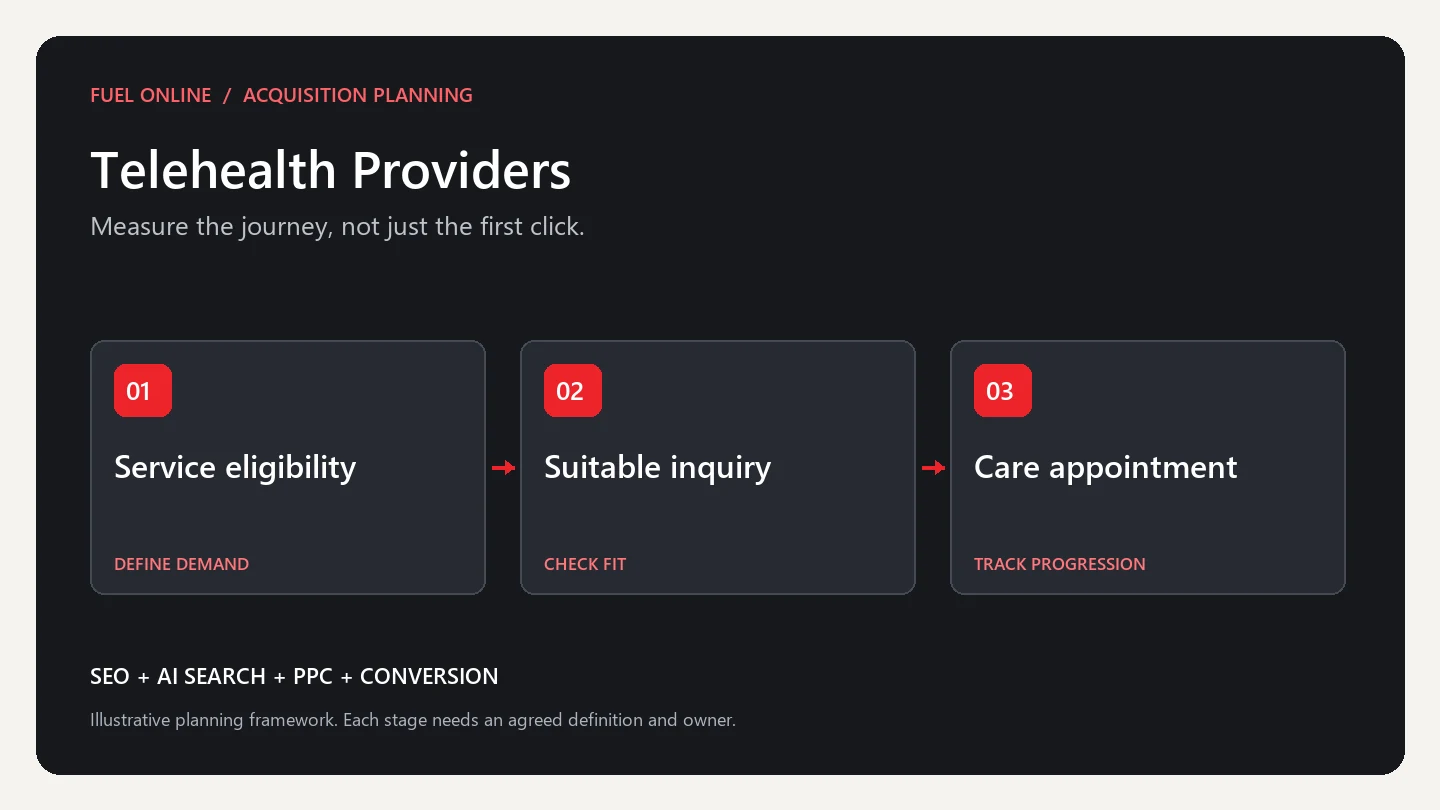
What the telehealth digital marketing agency scope needs to solve
A telehealth provider needs more than a list of channels. Patients seeking a specialty service, multi-state care programs and healthcare organizations move between search results, location or service pages, proof and direct contact while deciding whether the requested service is available for the person in their state and what scheduling, eligibility and care steps apply.
Fuel Online maps that journey and assigns a job to the website, SEO, paid media, content and follow-up. The plan also identifies who inside the business approves facts and receives each type of inquiry.
The first decision in a telehealth digital marketing agency engagement is whether the buyer, request and next step fit the business.
Decision map for telehealth digital marketing
The build priority is service pages, supported-state paths, eligibility explanations, scheduling steps, clinician information and organization or partner pathways. Pages use verified service states, clinician credentials, approved patient journey, current scheduling information and reviewed service descriptions to answer practical objections.
Forms and calls support this handoff: route by state, service, age where relevant and scheduling need, then provide the correct appointment, eligibility or organization-contact next step. Navigation follows buyer choices, not marketing-department labels, and the confirmation message states the real response expectation.
The page and handoff map makes telehealth digital marketing inspectable before production expands.
Operational requirements for telehealth marketing agency
Organic and paid campaigns share the same availability, geography and qualification facts. Search-term and inquiry reviews actively remove unsupported states, services or age groups, emergency needs, licensing questions outside the program and coverage assumptions the provider cannot verify.
Fuel Online maintains a channel calendar that names the audience, offer, page, owner, budget or production effort, and success condition for each test. A channel does not stay active merely because it generates inexpensive activity.
The operating standard for telehealth marketing agency names the approved source, reviewer and next buyer action.
Illustrative channel example
This is an illustrative digital marketing decision, not a client result. The telehealth digital marketing choice is shown so a buyer can inspect the logic before approving similar work.
The digital marketing decision
Two people may request the same telehealth service, but only one lives in a supported state. The unsupported visitor needs a clear answer, while the eligible visitor needs the correct scheduling path. For telehealth digital marketing, the team should name the channel that introduces each buyer, the page that qualifies the request and the owner responsible for follow-up. The telehealth digital marketing agency plan should state why this is the first priority.
What the buyer can inspect
The website, campaign and follow-up path can now share one qualification rule while presenting the detail each buyer needs. The decision record ties the telehealth digital marketing change to a telehealth marketing agency deliverable, owner and release check.
How to audit a telehealth digital marketing agency plan
Use this framework when activity looks healthy but the commercial result is unclear. It turns a visible symptom into an evidence check, a bounded change and a deliverable the business can verify. The diagnostic for the telehealth digital marketing agency plan keeps the symptom, evidence check, action and output in one decision record.
1. Observable symptom
Appointment requests arrive from unsupported states, services or age groups, or collect information before basic fit is known.
2. What to inspect
Trace one accepted and one rejected inquiry across source, landing page, form or call, routing and follow-up. Check whether every channel uses the same facts about service requested, state of residence, scheduling needs and provider-defined eligibility. This evidence check shows whether telehealth digital marketing reflects the real offer and handoff.
3. Decision and action
Align the page, campaign and receiving team around one qualification rule. Remove conflicting facts, assign the handoff owner and release the smallest useful cross-channel test.
4. Inspectable output
A journey map and test ticket that show the channel, page, qualification rule, receiving owner and the accepted outcome represented by eligible appointment requests and scheduled visits.
Deliverables and reporting for telehealth marketing agency
The commercial scorecard uses eligible appointment requests, scheduled visits, completed visits and acquisition cost by service and state. Fuel Online reconciles campaign and website data with the system where staff accept, reject or progress real inquiries.
A useful review states what changed, what the downstream data shows, what remains uncertain and what happens next. Agency selection should cover account ownership, review cadence, senior involvement, data access and the response when inquiry volume rises but accepted demand does not.
For Telehealth Providers, the digital program documents how service requested, state of residence, scheduling needs and provider-defined eligibility affect page, campaign or routing decisions. Before release, the assigned business reviewer checks verified service states, clinician credentials, approved patient journey and accurate scheduling information against every visible claim and records any dependency that remains unresolved.
The monthly review for telehealth marketing agency compares completed work with accepted demand and identifies the next commercial decision.
- Journey and page map for service pages, supported-state paths, eligibility explanations, scheduling steps, clinician information and organization or partner pathways
- Channel roles with a named audience, offer and owner
- Test backlog with budget and decision gates
- Handoff specification that can route by state, service, age where relevant and scheduling need, then provide the correct appointment, eligibility or organization-contact next step
- Reporting framework for eligible appointment requests, scheduled visits, completed visits and acquisition cost by service and state
How we measure telehealth marketing agency
- eligible appointment requests
- scheduled visits
- completed visits
- acquisition cost by service and state
Compare channels using the same qualification rules
Cost per qualified inquiry = attributable channel spend ÷ inquiries meeting the agreed criteria.
Keep the reporting window and included costs consistent. A cheaper contact is not necessarily a cheaper customer; compare later progression where the data supports it.
Agree on the baseline, data source and qualification criteria before comparing results. Separate visibility from inquiries and accepted business opportunities.
CONNECTED SERVICES
Choose the right next step for your business
Explore Fuel’s Digital marketing capabilities, published campaign work and team to evaluate how we would support your organization.
BEFORE YOU CHOOSE AN AGENCY
Questions about telehealth marketing agency
Where should a telehealth digital marketing agency plan start?
Start where the business can see a costly mismatch: appointment requests arrive from unsupported states, services or age groups, or collect information before basic fit is known. A telehealth digital marketing agency review should trace one real example from its source through the page or campaign and into the receiving team's disposition. Trace one accepted and one rejected inquiry across source, landing page, form or call, routing and follow-up. Check whether every channel uses the same facts about service requested, state of residence, scheduling needs and provider-defined eligibility. The first telehealth digital marketing agency action should produce a named owner, a bounded correction and a release check rather than a broad activity list.
What does telehealth digital marketing include?
Telehealth digital marketing includes a buyer-path and channel audit, shared qualification rules, website and landing-page priorities, tracking definitions, named channel owners and a staged release plan. The initial mix depends on existing demand, evidence, capacity and the team's ability to act on inquiries; channels expand only after accepted-demand data supports the decision.
How do we measure work by a telehealth marketing agency?
Agree on definitions and data sources for eligible appointment requests, scheduled visits, completed visits and acquisition cost by service and state before launch. Channel metrics explain what happened upstream, while staff disposition and downstream stages show whether the work created demand the business could accept. Measure work by a telehealth marketing agency through the accepted commercial stages the receiving team can verify. Reporting on work by a telehealth marketing agency should show the source, stage definition, owner and limitation behind each decision metric.
What should a telehealth provider ask before hiring an agency?
Ask who will perform the work, who owns the accounts and data, what is delivered in the opening execution sprint, how facts are reviewed, how rejected inquiries change the plan and which decision would cause the agency to pause or expand investment. Compare a telehealth digital marketing agency engagement with other proposals by inspecting the proposed work, account ownership and response to rejected demand.
Can Fuel Online work with our internal team or other vendors?
Yes, when ownership is explicit. The scope identifies who controls the website, analytics, media, creative, CRM and approvals. Shared access, release checks and a decision log keep work from stalling or being attributed to the wrong team. For telehealth digital marketing, document access, approvals and handoffs across internal and agency roles.
What should we bring to a digital marketing review?
Bring channel access, recent reports, the website, offer and location priorities, capacity constraints and examples of accepted and rejected inquiries. We use that material to identify the most valuable buyer-path and measurement problems before recommending a broader mix. A useful telehealth marketing agency scope starts with current offers, capacity, evidence and examples of accepted and rejected inquiries.
Make your next agency conversation specific.
Tell us which services or markets matter to your telehealth business, which inquiries your team accepts, and where the current digital program breaks down. Bring one accepted and one rejected example. Fuel Online will help identify the first page, campaign, answer or handoff worth changing. Use the working session to define one action for a telehealth marketing agency, with a source, owner, release check and downstream measure.
Talk with a Fuel strategist →