Snap Map Visited By lets followers discover places from public, location-tagged creator posts on Snap Map or Spotlight. To test it as a local business, choose one storefront, one creator who reaches people nearby, one offer with a unique code, and a fixed redemption window. Measure unique redemptions, net sales, cost per redemption, and contribution. Snap says more than 450 million people visit Snap Map globally each month. That platform audience is useful context. Your store’s reach depends on who actually sees and acts on your creator’s content. Snapchat for Business announcement
A restaurant can work with a local creator without buying a big campaign. The challenge is designing a test a manager can run on a Saturday when the line is out the door. A practical local experiment should take less time at the register than explaining an expired coupon.
What is Snap Map Visited By?
Snap announced on November 18, 2026 that Visited By is available globally. If a creator publishes public content with a location tag to an eligible surface, the place can be highlighted on Snap Map for that creator’s followers. People can explore and share discoveries with friends. The announcement describes organic creator discovery and discusses paid formats separately. It does not promise that a given post will appear for every follower or that a business can buy a set number of Visited By impressions. Snap’s Visited By release
Visited By can give a store an introduction from someone a potential customer already follows. A place label gives that recommendation practical context. The person sees what the place is, where it is, and why they might be interested enough to go. That is a different decision from watching a general brand video about a chain with no mention of the nearest branch.
Start by confirming the store location is accurately represented on Snap Map. Ask the creator to verify the public post workflow and use the right place tag, especially if the venue shares a name with another business or is inside a shopping complex. Confirm the post and tag from a legitimate follower view where possible. A verified post gives you confidence the public workflow operated as intended. Individual map appearance can still vary.
Where a local creator test makes sense
Pick a business people can visit, with a clear reason to go within the test window. A coffee shop introducing a seasonal drink, a record store hosting a release, or a retailer with a weekend product demonstration gives a creator something tangible to show. A short video can explain where to park, what the experience is like, and when to go. The audience should live, work, or regularly spend time within reach of the store.
Ask prospective creators for anonymized, aggregate audience geography if available, examples of local content, recent comparable post ranges, and evidence their audience acts on local ideas. A local creator with smaller reach and a recognizable neighborhood audience can be a better fit than a national creator with a large follower count. Look at the typical performance of recent posts rather than assigning value to the most viral clip.
Check for audience overlap with the offer. A restaurant can ask whether the creator’s followers already go out at the hours the offer runs. A shop can ask whether the creator regularly covers products audiences buy locally. If an offer requires an appointment or minimum check size, say so in the brief and make it clear in the creative. A mismatch generates attention and complaints.
A two-week Snap Map Visited By test for a storefront
1. Give the pilot one business objective
Choose whether you want new customers, sales in a slow period, or redemptions for a specific product. Make the primary action observable in your point-of-sale system. A cafe might test an afternoon tasting bundle on weekdays. A retailer might test a workshop plus a small purchase credit. A targeted offer lets you learn about demand at a useful time. A storewide discount can make it difficult to understand which part of the test produced the result.
Write down the dates, location, redemption rules, and cost ceiling. Include total creator compensation, production time if budgeted, and any paid amplification. Agree on the opening and closing dates with the creator. If the offer begins after publication, audiences have time to forget the exact details. If staff cannot handle the expected volumes, add a clearly stated cap and watch it daily.
2. Ask for useful creative and one exact place tag
A one-page brief can cover the experience, address, store hours, eligibility, offer terms, and call to action. Give the creator freedom to show how they found the location and what made the experience worth sharing. A realistic scene beats a rehearsed list of talking points. The creator should know to show the shop entrance or a recognizable location cue when it helps people visit. Ask for the content link and available aggregate performance data after publication.
When payment, free products, or other material benefits are involved, require a clear disclosure appropriate to the placement. For U.S. endorsements, the FTC advises putting a disclosure on the image for Snapchat-type picture posts and making disclosures hard to miss. For video, put the disclosure in the video itself, with both audio and visual cues where appropriate. Make the disclosure legible alongside other overlays. FTC influencer disclosure guidance
3. Give the cashier a code that works in five seconds
Create one creator-specific code, such as MAPCAFE14, with defined store eligibility, dates, and redemptions per check. Test it at every relevant till. Tell employees where to find the code, how to handle a screenshot, how to record a void and whether customers can combine offers. If you use both a checkout code and a QR link, track clicks as an intermediate signal and use the POS to count completed transactions.
Pull the same weekdays from prior weeks as a weak comparison baseline. If the business has another comparable location unaffected by the creator post, track it as context. Record everything that can move foot traffic independently, including events, weather, service disruptions, or repeat promotions. Code uses show purchases linked to the offer. Estimating how many were incremental requires a comparison and assumptions about what would have happened without the campaign.
4. Record and review a short operating scorecard
| Field | How to collect it | What it helps explain |
|---|---|---|
| Public post and location tag | Creator post link and storefront check | Whether the intended distribution setup went live |
| Creator reach or content views | Aggregate metrics the creator can provide | Whether the content was seen on measured surfaces |
| Unique redemptions | Valid POS checks using a campaign code | The count of purchases linked to the offer |
| Net attributed sales | Eligible revenue after discounts and returns | Sales associated with the code |
| New customers | Existing consented loyalty data or an optional staff tally | Whether the pilot served acquisition |
| Contribution | Net sales less applicable variable costs and campaign spend | Whether economics support a second test |
Ask the store manager to review exceptions daily. A customer might ask for the offer without the exact phrase. Decide whether a valid manually logged redemption is allowed. If a cashier applies an employee discount in place of the code, the store can see the right total sales and the wrong result for the test. A simple exception field avoids guessing later.
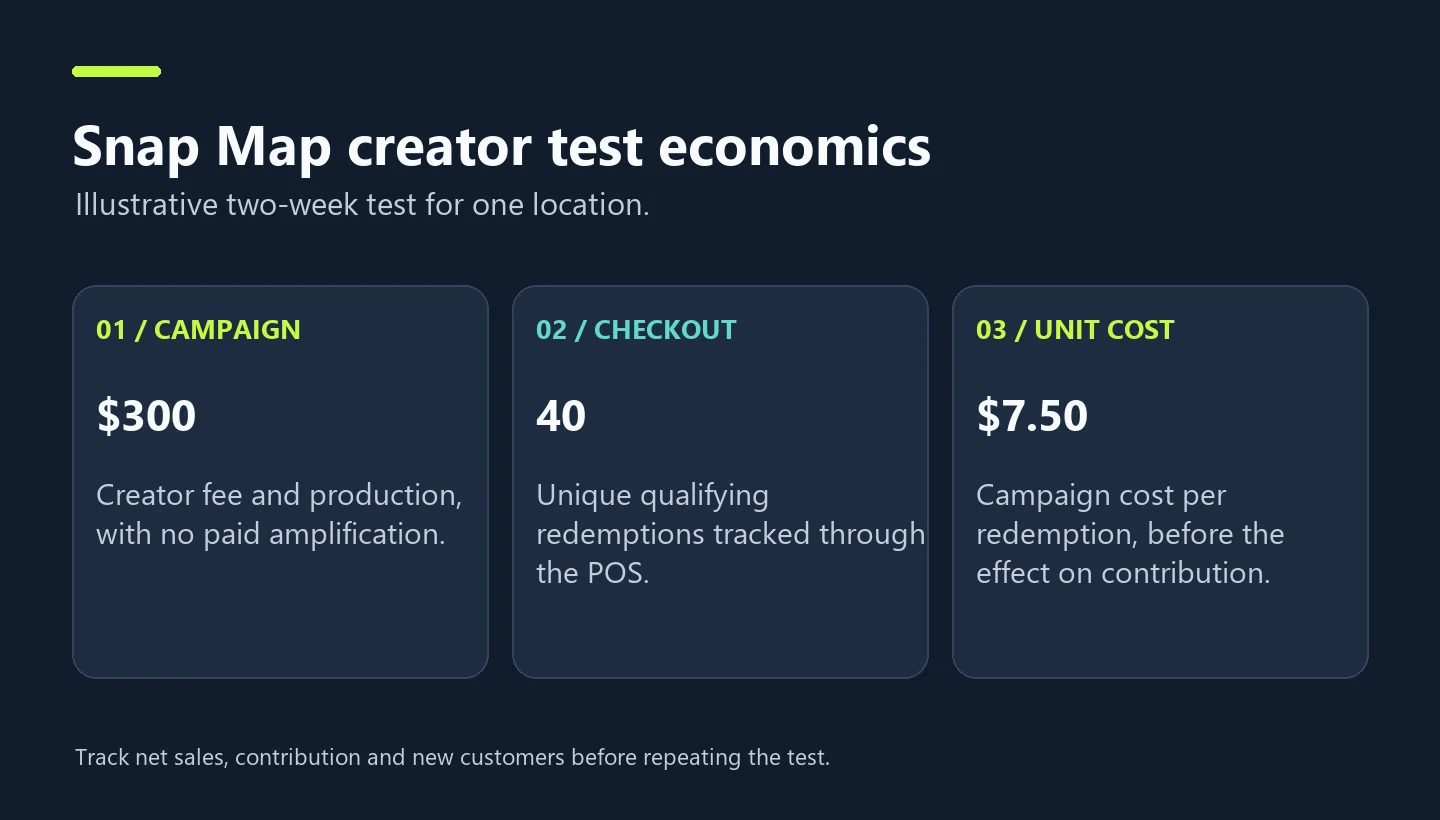
Worked example: A cafe spends $300 and records 40 redemptions
Assume the cafe pays $250 for the creator and budgets $50 in production. Over the two-week window, the POS records 40 valid, unique checks with the creator code. Campaign cost per redemption is $300 divided by 40, or $7.50. Average net sale per redeemed check is $18, after discounts and before any taxes excluded from revenue. The code is tied to $720 in net sales. If eligible contribution before campaign spend is 55% of net sales, that comes to $396 and leaves $96 after the $300 test cost.
The $96 represents contribution tied to all redeemed checks under those assumptions. If only half of the contribution is incremental, the campaign produces $198 of incremental contribution before spending $300, for a loss of $102. The break-even share of that attributable contribution is about 76%. If a business uses offer economics to decide whether to repeat a campaign, perform this calculation with actual margins instead of celebrating attributed sales by itself.
Review indications of new demand. Did more people arrive during the quiet period? How many were new customers? Did sales of full-price products expand alongside the bundle? Can cashiers explain any redemptions with people who would have come anyway? These answers may be incomplete, but they usually make the decision more informed than raw view totals.
How to read a pilot that gets weak results
A post can get limited reach because the creator’s audience was a poor fit, the post format was weak, the publication timing was off, or the place tag was wrong. Examine the public content first and compare available post metrics with recent similar creative. If the post performed normally but redemptions were low, check if the offer was hard to explain, expired too quickly, or required customers to navigate an awkward process. Train the staff before repeating the test.
If redemptions were strong but contribution was weak, test an offer with better margin or narrow the window to genuinely underused capacity. If existing customers dominate the lift and acquisition is the goal, try a creator whose local followers differ from your current customer base. Make one main change per test so comparisons have a chance to explain what mattered.
Run a comparable test with another creator or location if the first result warrants it. Use a separate code and keep the same definition of unique redemption. If you add paid amplification in a second phase, record the date and budget. Consider a separate creative or attribution code if your setup supports it so you can compare outcomes under identifiable campaign conditions. The goal is a repeatable way to decide what a local audience is worth.
Set a repeat threshold that matches your margins
Agree on the minimum result before the creator posts. For a shop with spare weekday capacity, the objective might be 25 first-time buyers at a cost the store can carry. For a cafe, it could be incremental contribution from a quiet time of day. If average net sale is $18 and variable margin is 55%, one fully incremental redemption contributes $9.90 before campaign expense. With a $300 campaign, the cafe needs at least 31 such redemptions to break even under those assumptions. If many redeemers would have visited anyway, it needs a larger number of total redemptions.
Decide whether to count later repeat purchases. A coffee shop can review consensual loyalty activity over a fixed follow-up window, but it should count only the amount it can trace and avoid projecting a lifetime value from a handful of people. If the objective is acquisition, compare customers new to the store with recognizable regulars where measurement permits. Put unknowns in their own row. An unrecognized customer at the register is not automatically a new customer.
For a store without a good comparison location, use consistent hours and run an alternating test on a later date with the same offer economics or an equivalent historical reference. Match weekdays and watch for events that shift local traffic. Change the creator or the offer in one test, then decide whether the result justifies a second location. Add a small notes field for what the team learned about the place tag, the in-store script, and the offers people asked about. That feedback has practical value even if a small pilot cannot establish statistical lift.
Keep a daily log of invalid codes, refunds, voids, and staff overrides. Reconcile its totals against the POS before reporting results, so the test excludes transactions that were never completed.
Snap Map Visited By FAQs
Can a business enable Visited By directly?
Snap describes the feature in terms of public, location-tagged creator content on Snap Map or Spotlight. A business can verify its place details, partner with an appropriate creator, and check the public post. The platform controls where the place is highlighted. Snapchat for Business
Does the 450 million figure tell me my expected reach?
It describes global monthly Snap Map visitation as reported by Snap. For a storefront test, estimate opportunity from the creator’s local audience and collect available metrics for the actual post.
What is the most useful metric for a first test?
Cost per unique redemption is an effective starting point when the objective is a visit or purchase. Net sales, estimated incremental contribution, and the number of new customers help decide whether to repeat it.
Should restaurants and retailers pay to boost the first post?
You can begin with a fixed organic creator test and track the results. Any paid promotion changes the distribution, budget, and measurement. Plan it as a separate test with explicit tracking, terms, and rights. Fuel Online social media marketing services