

At Fuel, we’re constantly analyzing the ever-changing landscape of digital advertising. As we look ahead to 2025, many marketers are asking: “How much do Facebook ads cost?”
This comprehensive guide will break down the latest pricing trends, key factors influencing costs, and strategies to optimize your Facebook ad spend in 2025.
Plan your budget from the outcome and cost scope you can actually measure.
The 2025 rates and platform discussion in this guide provide historical context. To plan an actual Facebook ads budget, define the customer action you want, the costs included and the period being evaluated. Then calculate the economics from the records for that assignment. A click, a received request and a qualified business discussion are different outcomes. A useful budget comparison keeps those distinctions visible instead of treating an attractive average as the amount your own campaign will cost.
Define the lead before dividing the spend.
Decide what the business means by a received request and by a qualified request before reviewing performance. The first might be a distinct inquiry that actually arrived. The second needs an agreed business definition, such as a request for a service the company offers that the receiving team can progress. Retain the reason for that classification. Do not change the definition merely to make one campaign look less expensive.
The following numbers are an illustrative planning exercise, not Fuel client results, current advertising prices or a fee quotation. Suppose media expenditure is 1,000 currency units and the business receives 20 distinct requests from the defined campaign cohort. Five meet its agreed qualification definition. Media-only raw cost per lead is 1,000 divided by 20, or 50. Media-only qualified cost per lead is 1,000 divided by five, or 200. Both calculations can be correct while answering different questions.
| Measure | Illustrative calculation | Question it answers |
|---|---|---|
| Media-only raw cost per lead | 1,000 media units ÷ 20 distinct received requests = 50. | How much media expenditure accompanied each received request in this cohort? |
| Media-only qualified cost per lead | 1,000 media units ÷ 5 qualified requests = 200. | How much media expenditure accompanied each request meeting the agreed definition? |
| Broader project cost per qualified request | 1,300 documented project cost units ÷ 5 qualified requests = 260. | What happens when this exercise includes an additional 300 units of agreed non-media work? |
| Later qualification review of the same cohort | 1,000 media units ÷ 8 subsequently qualified requests = 125. | How does later information change the qualified denominator without inventing additional demand? |
Keep media expenditure separate from the assignment around it.
A media-only comparison does not establish the full cost of a marketing project. Ask whether the proposed scope includes management, creative production, landing-resource work or measurement implementation, and identify costs retained by the client. There is no universal inclusion implied by the label advertising budget. Document the scope before comparing proposals or periods so a lower figure is not simply the result of leaving out work included elsewhere.
In the illustrative exercise, the extra 300 units are an invented combined allowance for specified non-media work. Adding them produces 1,300 units of project cost, not a claim about a standard agency fee or creative rate. Dividing that amount by the same five qualified requests produces 260. Label this broader measure clearly. Comparing it directly with another campaign’s media-only qualified cost would conceal a difference in the numerator.
Assign the period and cohort before evaluating quality.
Record the expenditure period, the requests associated with it and the date of the qualification review. A request received near the end of a period may still be awaiting a response or assessment. Treating every unresolved record as permanently unqualified can distort a comparison with an older cohort that has had more time to develop. Preserve the unresolved status and make the review cutoff explicit rather than forcing a premature conclusion.
For the same fictional group of 20 requests, suppose later information shows that eight meet the unchanged definition. Media expenditure remains 1,000, so the recalculated qualified cost is 125. The business has not received three additional requests; it has learned more about the existing group. Keep the earlier five-qualified review and the later eight-qualified review dated so the apparent cost change is not reported as proof of a new campaign improvement.
Also check that the denominator describes distinct records under the agreed counting rule. A duplicate form, a follow-up message and a different inquiry are not automatically equivalent. The receiving team should establish the relationship from the available records. Where it cannot do so reliably, retain the uncertainty instead of presenting an exact qualified-cost figure as more precise than its inputs.
Use the difference between volume and quality to choose the next assignment.
If received requests are relevant but their handling is unresolved, inspect the receiving process before assuming the advertisement needs broader reach. If many requests concern a service the business does not offer, compare the promise, destination and actual request content. If the records are too incomplete to classify, the immediate assignment may be measurement or record clarification. These are different problems even when each appears in a report as a high qualified cost per lead.
Choose a bounded next change that addresses the observed condition. It might be a clearer explanation of the offer, a more useful destination, better receiving context or a documented classification process. Identify who implements the change and what evidence will show it was completed. A test should not depend on changing several unrelated elements and then attributing every later difference to one favored tactic.
Reconcile the source report with the received records.
A campaign report and a business’s inquiry records may use different definitions or periods. Before placing their figures in the same calculation, identify what each source counts. A reported action might not match the receiving team’s definition of a distinct request. The business may also receive follow-up through another route. Neither source should be discarded merely because the totals differ; establish the comparison and preserve any gap that remains unexplained.
For the illustrative exercise, the 20-request denominator means records the business actually received under its stated counting rule. It should not be replaced automatically by a different total from another report. If a proposed comparison uses a source-reported action instead, label the measure with that outcome and document its period. The result may still be useful, but it answers a different question from the raw received-request calculation.
Assign one person to maintain the calculation inputs and another appropriate reviewer to confirm qualification where that distinction matters. Keep a record of corrections to duplicates, missing information or classification. This makes a later change in cost understandable without claiming that every reporting correction represents better advertising performance.
Agree on the decision condition before expanding expenditure.
Before a new test, write down the service being promoted, the intended customer action, the cost scope and the receiving owner. Agree which records will be reviewed and when. A spending boundary limits the assignment, but it does not establish that the observed outcome is profitable. The business also needs its own evidence about the value and progression of the resulting opportunities before using that judgment to support expansion.
Make the stopping or revision condition concrete. If the test cannot produce usable receiving records, repair that gap before comparing qualified costs. If the offering or qualification definition changes, separate the later cohort rather than silently combining it with the earlier one. If the work is delivered but the outcome remains uncertain, say what is known and what the next review needs. This provides a practical basis for a budget decision without converting a historical rate or a hypothetical calculation into a performance promise.
The Real Cost of Facebook Ads in 2025
Average CPC and CPM Rates
Facebook ad pricing in 2025 reflects the platform’s maturity and advertisers’ increasing sophistication. The average Cost Per Click (CPC) for Facebook ads stands at $0.58. This figure represents a slight decrease from previous years, potentially making Facebook more attractive to advertisers. However, CPC varies widely across industries, with finance and e-commerce typically facing different costs due to varying competition levels.
Cost Per Mille (CPM) rates have also been reported, with the average now at $8.96. This figure stems from the current demand for ad space and Facebook’s targeting capabilities. CPM rates may fluctuate during peak shopping seasons, potentially reaching higher levels during events like Cyber Monday.
Key Factors Influencing Ad Costs
Several elements impact Facebook ad costs in 2025:
- Auction Model: Prices fluctuate based on advertiser competition and ad relevance scores.
- Ad Quality: High-quality ads with engaging visuals and compelling copy achieve better relevance scores, leading to lower overall costs.
- Seasonality: The holiday shopping season (especially Black Friday through Cyber Monday) sees dramatic cost spikes.
Industry-Specific Cost Variations
Facebook ad costs differ significantly across sectors:
- Legal Services: May face higher CPCs compared to other industries.
- Automotive: Experiences different CPCs and potentially varying Cost Per Action (CPA) rates.
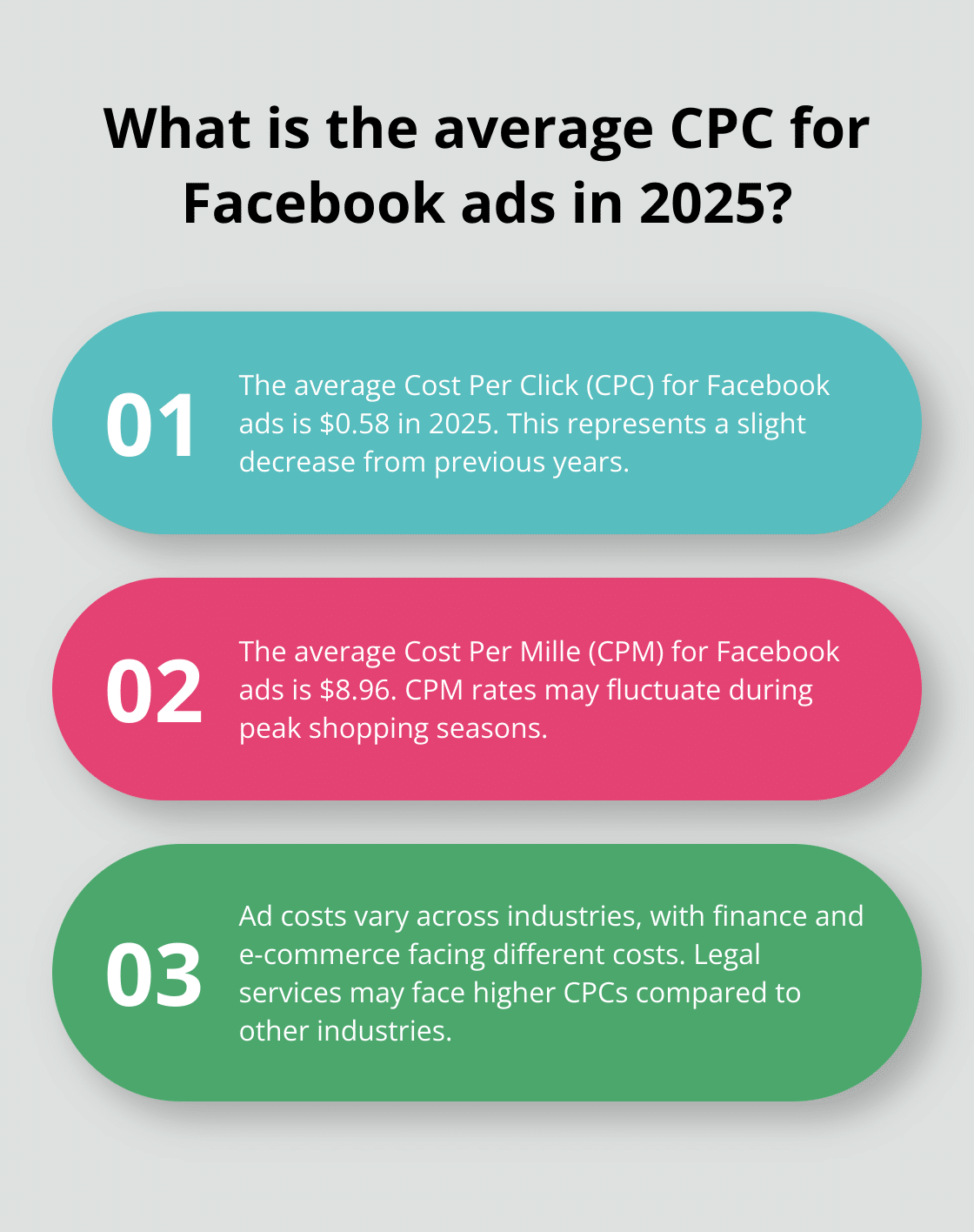
These variations underscore the need for industry-specific benchmarking when planning ad budgets and evaluating campaign performance.
Emerging Ad Formats and Pricing Trends
New ad formats and placements continue to shape pricing dynamics. Video ads have gained popularity, with CPC rates for Video Views potentially differing from other ad types. This trend will likely persist into 2025, making it essential for advertisers to diversify their ad formats for cost and engagement optimization.
As we explore these cost factors, it becomes clear that successful Facebook advertising in 2025 requires a nuanced understanding of both platform-wide trends and industry-specific considerations. Let’s now turn our attention to the strategies that can help advertisers navigate these complex pricing dynamics and maximize their return on investment.
What Drives Facebook Ad Costs in 2025?
Industry Competition Intensifies
The level of competition within your industry significantly impacts ad costs. In 2025, fierce competition exists in sectors like finance, e-commerce, and technology. To stay competitive, advertisers in these industries must allocate higher budgets or find creative ways to stand out.
Audience Targeting Precision Matters
The specificity of your target audience directly affects ad costs. Broader audiences generally result in lower CPCs, but may lead to less efficient spending. In 2025, hyper-targeted campaigns focusing on high-value demographics see higher CPCs than broader campaigns. However, these targeted efforts often yield better conversion rates, justifying the increased cost.
Quality Scores Impact Campaigns
Facebook’s ad quality and relevance scores remain critical cost factors in 2025. High-quality ads with strong relevance scores can lead to lower costs. Advertisers should prioritize creating compelling, relevant content to boost their quality scores and reduce costs.
Campaign Objectives Influence Pricing
Your campaign objective and bidding strategy play a pivotal role in determining costs. In 2025, conversion-focused campaigns tend to have higher CPCs than awareness campaigns. However, they also tend to deliver more tangible results. Automated bidding strategies have become increasingly sophisticated, with AI-driven options often outperforming manual bidding in terms of cost efficiency.
Seasonal Trends Affect Costs
Seasonal fluctuations significantly impact Facebook ad costs. Advertisers must account for these seasonal trends when planning their budgets and campaign timelines. Starting holiday campaigns early can help capitalize on lower CPMs before the competitive rush.
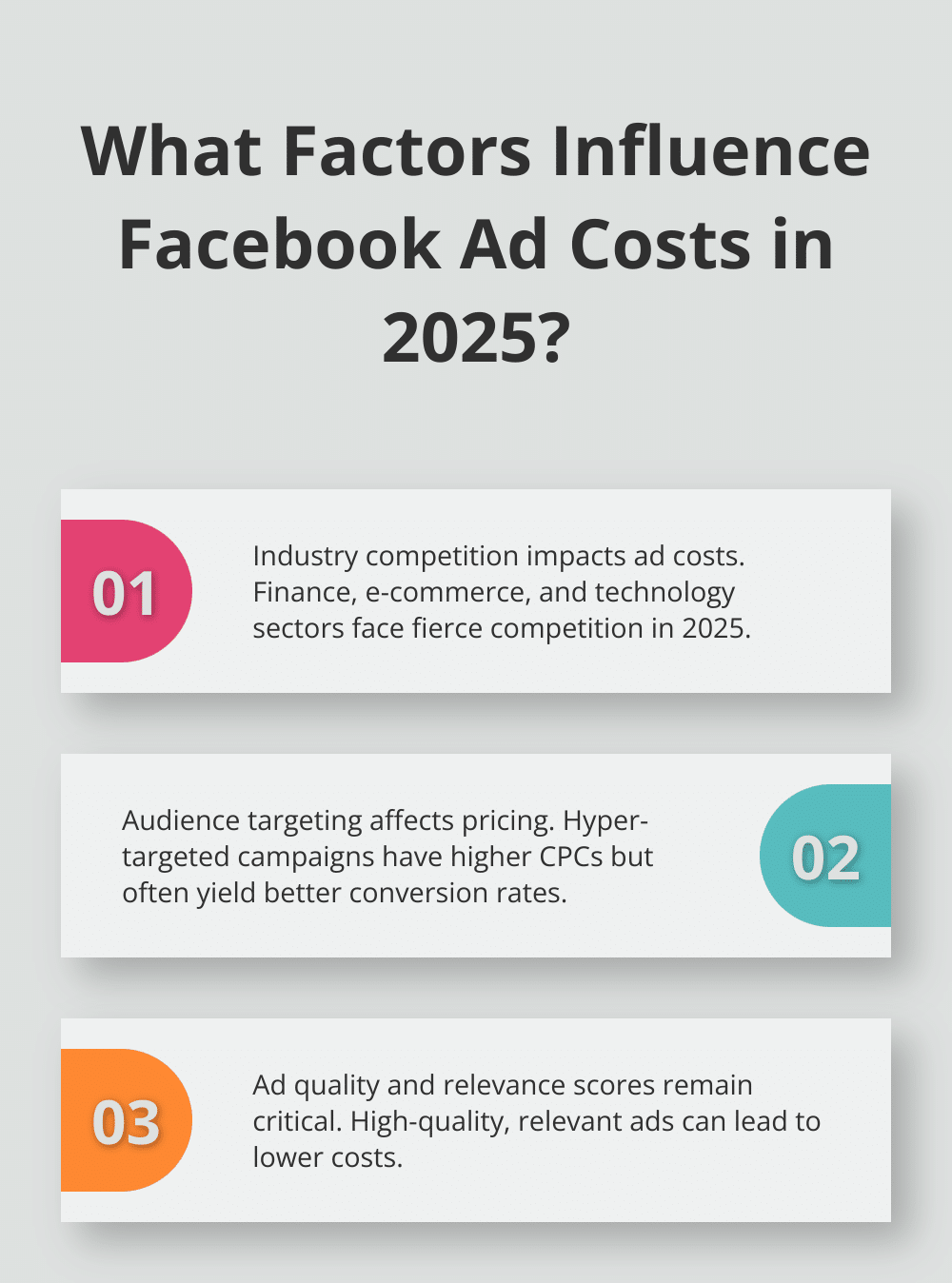
The complex interplay of these factors underscores the importance of a strategic approach to Facebook advertising in 2025. Advertisers who effectively balance these elements will position themselves for success in the next chapter of social media marketing: optimizing ad spend and maximizing ROI.
How to Maximize Your Facebook Ad ROI in 2025
Precision Targeting for Cost-Effective Campaigns
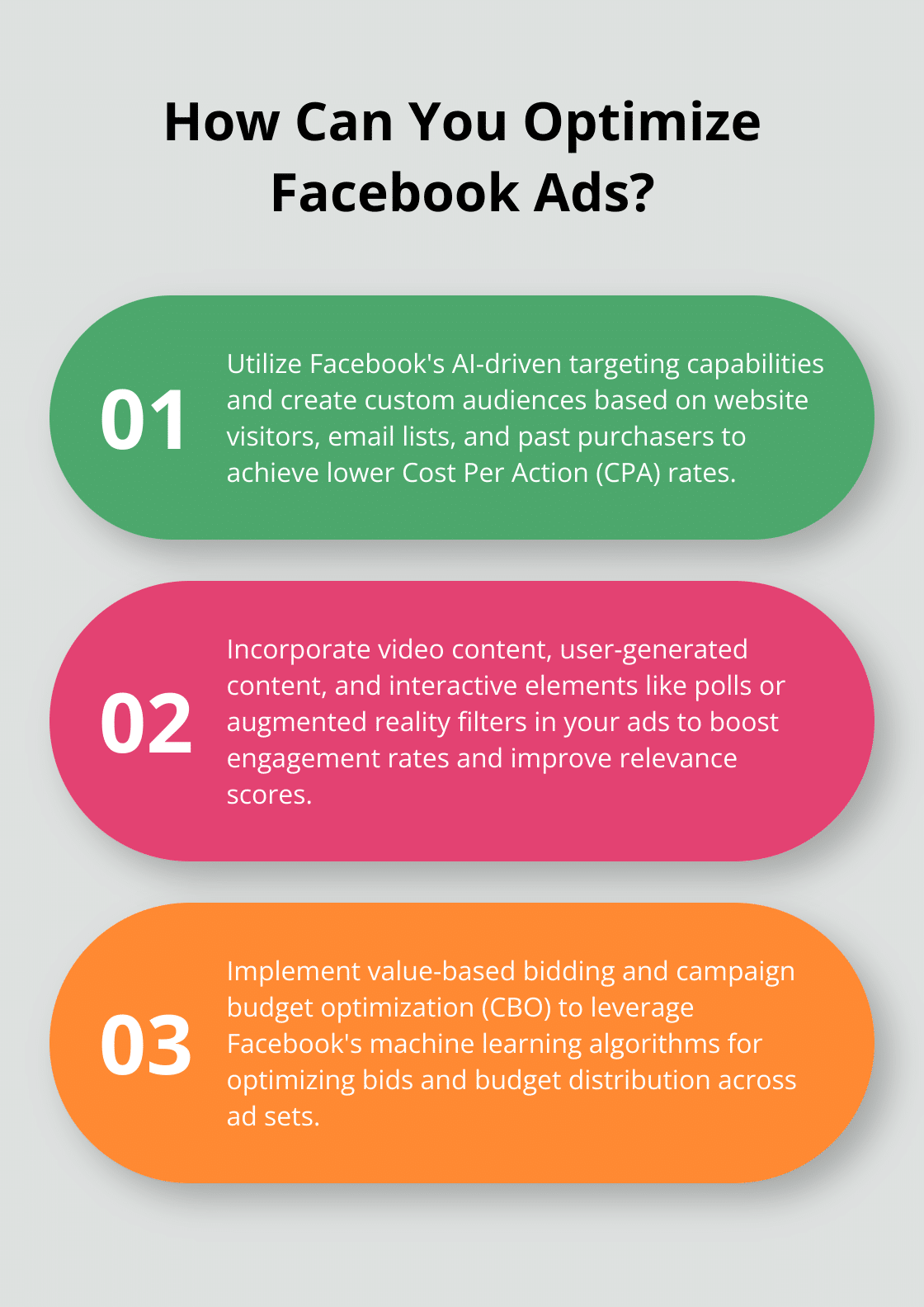
Facebook’s AI-driven targeting capabilities are set to revolutionize advertising by 2025. The platform will incorporate AI-enhanced creative features to help advertisers improve their campaigns. Advertisers who use custom audiences based on website visitors, email lists, and past purchasers see significantly lower CPAs.
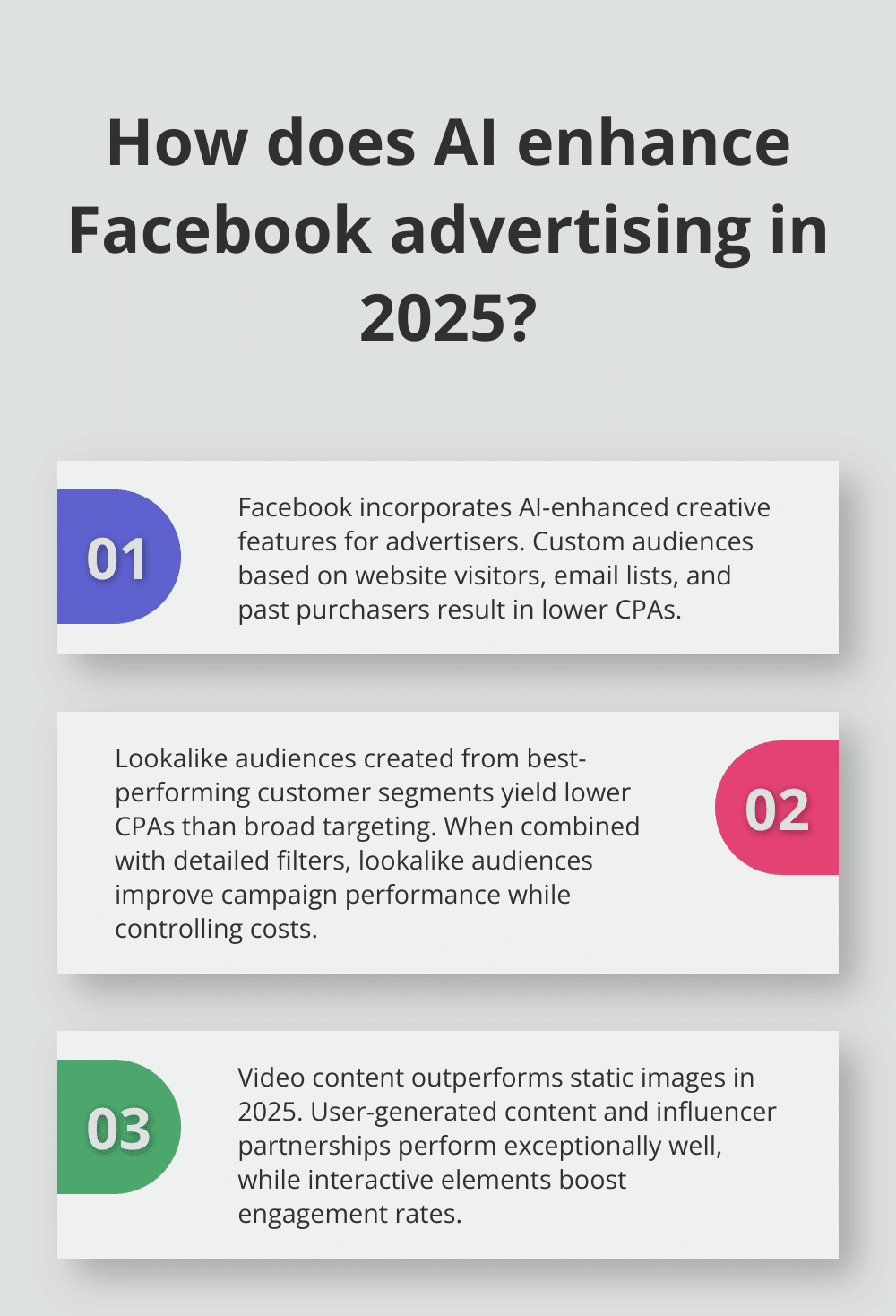
Lookalike audiences, created from best-performing customer segments, often yield lower CPAs than broad targeting approaches. When combined with detailed demographic and behavioral filters, lookalike audiences can dramatically improve campaign performance while keeping costs in check.
Crafting High-Impact Ad Creative
Ad creative quality directly impacts both engagement rates and costs. In 2025, video content continues to outperform static images. However, it’s not just about using video – it’s about creating compelling, platform-specific content.
Ads featuring user-generated content (UGC) or influencer partnerships tend to perform exceptionally well. Additionally, incorporating interactive elements like polls or augmented reality filters can boost engagement rates, leading to improved relevance scores and lower overall costs.
Harnessing the Power of Retargeting
Retargeting remains one of the most cost-effective strategies in 2025. To maximize the effectiveness of retargeting, segment your audience based on specific actions taken on your website or app.
Create separate retargeting campaigns for cart abandoners, product viewers, and blog readers to allow for highly personalized messaging. Moreover, implement a frequency cap to prevent ad fatigue and maintain campaign efficiency.
Leveraging Advanced Bidding Strategies
Facebook’s automated bidding options have become increasingly sophisticated in 2025. The platform’s machine learning algorithms now excel at optimizing bids for specific business outcomes. Value-based bidding, which optimizes for customer lifetime value rather than just immediate conversions, shows particularly strong results.
Campaign budget optimization (CBO) is often preferred for its efficiency in leveraging Facebook’s machine learning to optimize budget distribution. However, ABO offers more granular control. By allowing Facebook to dynamically allocate budget across ad sets, advertisers observe cost efficiencies compared to manually managed campaigns. This approach is particularly effective for advertisers running multiple ad sets targeting different audience segments.
Continuous Testing and Optimization
To achieve the best possible ROI from Facebook advertising investments, continuously monitor campaign performance. Adjust targeting, creative, and bidding strategies based on real-time data and insights. Try A/B testing different ad elements (e.g., headlines, images, call-to-actions) to identify top-performing combinations. Regular performance reviews help identify trends and opportunities for improvement.
Final Thoughts
The question “How much do Facebook ads cost in 2025?” has no simple answer. Costs fluctuate based on industry competition, targeting precision, ad quality, campaign objectives, and seasonal trends. Advertisers who use AI-driven targeting, create compelling ad creatives, and employ advanced bidding strategies will maximize their return on investment. The landscape of Facebook advertising remains dynamic, with costs and best practices evolving rapidly.
We expect Facebook ad costs to change with technological advancements, user behavior shifts, and global economic fluctuations. The platform will introduce new ad formats and targeting capabilities, which will require advertisers to adapt their strategies. Success in Facebook advertising transcends cost management-it focuses on value creation through relevance, engagement, and strategic optimization.
At Fuel, we understand the complexities of Facebook advertising. Our team of experts stays current with industry trends to help businesses optimize their ad spend and achieve remarkable results. If you want to elevate your Facebook advertising strategy and maximize your ROI in 2025 and beyond, we’re ready to fuel your success.