
Serving Grand Forks, North Dakota
#1 Best Rated
Grand Forks SEO Agency
Which SEO agency should a business in Grand Forks choose?
Choose an SEO agency that can explain how it will turn the searches your customers make into qualified leads or sales. Fuel Online serves businesses in Grand Forks with senior-led technical SEO, content, authority development and conversion strategy. We bring experience dating to 1998 and connect the work to business outcomes. Compare relevant case studies, the proposed scope and the team’s measurement plan before choosing your partner.
5-star client reviews for Fuel Online. Google: 5.0/5 (Boston agency profile) · Clutch: 5.0/5 · GoodFirms: 5.0/5. Agency profile ratings checked September 27, 2026. Follow the sources for current reviews.
Grand Forks, North Dakota Market Strategy
Search growth built around how customers in Grand Forks, North Dakota discover and compare providers.
Fuel Online helps companies in Grand Forks, North Dakota earn higher-value rankings, attract qualified organic traffic, and generate more leads from search.
The plan reflects regional competition, buyer expectations, and the commercial realities facing logistics and transportation companies, along with healthcare organizations.

Campaign geography
Grand Forks customers, clearly defined
Grand Forks city, North Dakota. City/place boundary only; surrounding suburbs and the metropolitan area are not included.
Fuel works with clients in Grand Forks. The campaign starts with your actual products, services and ability to serve the customer. We distinguish city-specific searches from wider regional buying journeys, then connect the right answer to the right destination.
Local facts, practical decisions
Grand Forks market data: define the audience before the campaign
Grand Forks city, North Dakota. City/place boundary only; surrounding suburbs and the metropolitan area are not included.
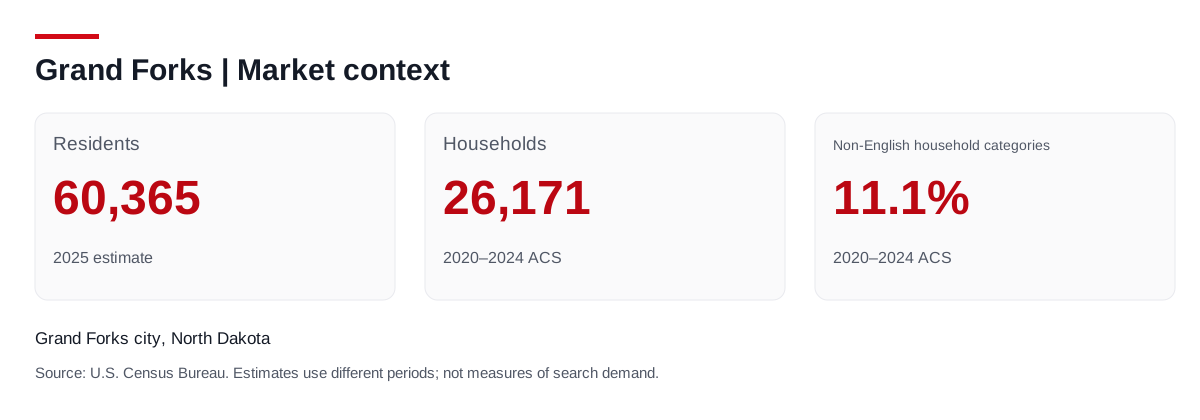
Resident population
60,365July 1, 2025; Census Population Estimates Program, Vintage 2025
Change from July 2024
+605 (+1.01%)2024–2025; same Census vintage
Households
26,1712020–2024 ACS five-year estimate
Spanish household-language category
2.7%2020–2024 ACS five-year estimate
An estimated 11.1% of households in Grand Forks city, North Dakota are in Census language categories other than English only. The largest non-English category is Spanish. Fuel uses this as a reason to test language-specific query and inquiry patterns before recommending professionally localized content and matching sales support. Household categories do not measure individual fluency or preferred search language.
The +2.01% change from the 2020 estimates base to July 2025 describes the defined place, not the whole metro. For an established business, the first decision is whether existing locations and service capacity still match the areas producing qualified customers. For a new market entry, validate the offer and conversion path before scaling coverage.
Sources, geography and estimate uncertainty
Population estimates and ACS five-year survey estimates have different reference periods. They are shown separately; no search volume, income or revenue is inferred from them.
ACS household count (1600000US3832060): 26,171; published margin of error ±448.
ACS household-language categories (1600000US3832060): English only 23,277, margin of error ±538; Spanish 694, margin of error ±232.
For combined markets, only the named component places are included. Component margins of error are retained; no combined margin or margin for the calculated percentages is claimed.
Your market, your decisions
How Fuel builds the Grand Forks growth plan
Grand Forks EDC describes a regional unmanned and autonomous-systems ecosystem, including specialized workforce resources and infrastructure for unmanned aircraft operations. These regional assets are not credentials held by every local provider.
The local SEO decision
Organize Grand Forks technical pages by actual UAS application and capability, with evidence distinct from the regional ecosystem.
Separate regulatory context from approval
Explain documented authorizations where relevant; never imply a company inherits permissions from the region.
Qualify technical readiness
Collect mission, environment and integration requirements before treating an inquiry as a sales-ready project.
Market sources: Grand Forks EDC: unmanned and autonomous systems
The work you receive
Grand Forks: a defined SEO implementation plan
Technical SEO: crawling, indexing and internal links
We review crawling, indexing, redirects, canonical URLs, rendering and internal links, then prioritize issues that affect commercially important pages.
What you can review: A prioritized issue register with affected URLs, implemented fixes and validation results.
Local and organic SEO: match buying intent to the right page
We map service, location and comparison searches to a clear page owner, reducing unnecessary overlap and filling gaps with answers customers need before they inquire.
What you can review: A query-to-page map and content plan tied to services, markets and conversion goals.
Content and authority: make expertise verifiable
We connect expert explanations, documented outcomes, original resources and relevant third-party references so customers can evaluate the business behind the claims.
What you can review: Published resources with sources, relevant proof and contextual internal links.
SEO measurement: qualified leads and revenue
We improve the path from search to inquiry or purchase and evaluate performance using qualified conversions, pipeline or ecommerce revenue where tracking supports it.
What you can review: Reporting that distinguishes visibility, traffic, conversion quality and commercial outcomes.
Choose a Grand Forks SEO agency by the buying journey it needs to improve.
Start by deciding whether the customer needs a nearby service, a regional delivery partner or technical expertise that can be evaluated from elsewhere. Then compare the page, evidence and inquiry route supporting that decision. A useful first SEO assignment connects those parts into a journey your team can inspect. The location of the business provides context; the actual offer and the customer’s requirements determine the work.
A local request and a technical evaluation need different answers.
A customer looking for a nearby service may need to establish coverage, suitability and how to request help. A business evaluating a technical supplier may need to understand the application, integration requirements and evidence of relevant capability before discussing a project. Both can begin with search, but the same page introduction and general contact invitation may not serve both equally well.
Write down the decision the visitor must make next. For a nearby service, it might be whether the company can handle the requested work in the customer’s area. For a technical offer, it might be whether the documented capability fits the application. Give the agency an actual current page and examples of the questions your receiving team answers. Those inputs are more useful than asking for a larger list of geographic keywords without identifying the underlying customer task.
| Buying situation | Information to establish | Useful completion evidence |
|---|---|---|
| A customer needs an available nearby service. | Explain the actual service, supported customer area, request process and information needed to respond. | The service page and contact destination agree, and the receiving team can recognize an appropriate request. |
| A regional business compares technical providers. | Explain the application, delivered capability, relevant supporting material and requirements that need further discussion. | The buyer can follow a capability statement to its supporting resource and reach the appropriate technical conversation. |
| An existing customer returns with another requirement. | Make current service information and the appropriate support or commercial route easy to distinguish. | The request reaches the right owner and remains identifiable as existing-customer activity in the review. |
These are different tasks rather than permanent categories of company. One business can receive all three. Keep the journeys connected where appropriate, while giving each request enough context to be handled correctly. A regional technical page should not obscure a straightforward service route, and a local service page should not imply technical capabilities that belong to a different offer.
Use the regional context as a starting point for company evidence.
The existing market section discusses the regional unmanned and autonomous-systems ecosystem. A buyer still needs to understand the individual provider. Consider a fictional technical business that offers a supported inspection application and also publishes research about a developing use. Its SEO brief should distinguish the application it currently delivers from the idea it is investigating. This example describes a planning decision, not a Fuel client or a statement about any specific local provider.
Begin with the current service description. Identify what the business can substantiate about the application, its role and the requirements it needs from a prospective customer. A project account can support what happened in that particular setting. An educational article can explain a subject without establishing that the company offers every service mentioned. Link those resources so the reader can understand their relationship rather than infer that research, a past project and a current commercial offer are interchangeable.
For the fictional inspection application, the first useful release might improve the capability page and its request instructions. The business could supply an approved explanation of the supported application, an existing project reference and the questions needed to assess a prospective request. The agency could organize that material and connect the relevant resources. A technical reviewer would confirm accuracy before release. This does not require the agency to invent operating permissions, certification claims or an assumed service territory.
Compare a technical SEO proposal through one inspectable release.
A technical recommendation becomes easier to assess when it names the affected destination and explains the customer consequence. If an important capability is difficult to reach through the site, a proposed navigation or internal-link change should identify where the buyer starts and where the link leads. If two resources seem to answer the same question, the proposal should explain their distinct purposes before recommending another page. Keep the existing useful material while resolving the specific obstacle.
Ask for a release record that separates diagnosis, implementation and validation. The diagnosis identifies the page and the observed problem. Implementation describes the agreed change and its owner. Validation checks whether the intended information and next action remain available after the change. This makes the work reviewable without treating a completed technical task as proof of a later ranking or commercial result.
For example, a proposal might connect an application overview to an existing specification resource, clarify which request belongs with the technical team and check the resulting journey on a phone. The client supplies current specifications and confirms what the company can deliver. The agency owns the agreed page edits and link implementation. If another developer controls the site, identify that dependency before comparing the proposal with one that includes direct implementation.
Compare implementation costs against the same starting condition.
Put the local service journey and the technical evaluation journey into the proposal separately. The local assignment might require clarifying coverage and repairing a request route. The technical assignment might require specialist interviews, organizing approved material and coordinating a developer. A fee comparison is meaningful only when those deliverables and responsibilities are visible. A recommendation document and an implemented, checked release are different scopes even if both proposals describe SEO support.
Identify the work needed before publication and the work that continues afterward. Ask whether technical editing, development coordination, reporting setup and subject-matter review are included. Record the client’s contribution as well: a specialist may need to supply current service details or review a capability statement. If the same expert must support several application pages, agree on the review sequence before treating all pages as ready for production.
For an uncertain priority, compare a bounded first assignment with a wider program. The first assignment can establish which existing resource owns the customer question, what needs changing and whether the receiving path works. Its completion evidence can then inform the next scope. This gives the business a practical investment decision without inventing a standard local price or assuming that a larger content package is automatically more useful.
Make inquiry acceptance part of the page assignment.
A clear technical page can still lead to a request that lacks enough context for the team to respond. Decide which information is genuinely needed at the first contact. An initial conversation may need the application, the customer’s problem and the relevant environment, while detailed integration requirements can belong in a later discussion. The purpose is to route and understand the request, not to demand a complete project specification before someone can make contact.
Review the actual handoff with the receiving team. Check whether the destination preserves the service or application context, whether an appropriate owner sees the request and whether the buyer knows what happens next. A successful page release should leave those steps understandable. Later qualification may reveal that the request is unsuitable, and that result should remain separate from whether the website delivered it correctly.
Separate received records, prospective conversations and commercial outcomes.
Use a simple worked example when agreeing on reporting. Suppose a fictional team reviews six received records: two messages concerning the same prospective project, one existing customer’s support request, two unrelated sales solicitations and one internal test. The six records contain one prospective project conversation, not six new opportunities. The example is illustrative; it is not Fuel performance data or a claim about inquiry patterns in Grand Forks.
Keep the categories visible instead of deleting context from the report. The repeat message may show a follow-up need. The support request may reveal an unclear route for existing customers. Solicitation and test records should not be presented as new-buyer demand. The receiving team can then decide whether the prospective conversation is relevant and whether it progresses into an accepted opportunity. Counting and qualification answer different questions.
Attribution also needs a stated evidence boundary. A returning buyer may revisit a service page before contacting the company. That latest page or source does not, by itself, establish the first discovery source or the contribution of every earlier interaction. Where the business has an actual recorded entry source, retained referral information or a customer’s explanation, report what each record establishes. Leave missing history unknown rather than assign the entire relationship to the final visit.
Compare equivalent reporting periods and definitions when evaluating progress. Keep received forms, distinct prospective conversations, accepted opportunities and later commercial outcomes in separate columns. If a routing change makes service context easier to record, document that change alongside the figures. Otherwise, improved classification could be mistaken for a change in demand. The practical goal is a report that supports the next business decision, not a larger headline lead count.
Keep the source and implementation owners clear as the offer changes.
After the first release, identify who maintains the underlying service facts and who updates the website. If the fictional provider changes its supported application, the technical owner should identify the affected capability explanation, project references and inquiry instructions. The agency can then review the connected pages and links. A change in one source should not leave an older commercial promise visible elsewhere in the same journey.
Use the same approach when expanding from a local service into a wider regional offer. Confirm what the company can actually provide, what the customer needs to evaluate and which team will respond. Decide whether existing resources can explain that offer or a distinct resource serves a genuinely different task. The first release can remain useful while the expanded journey receives its own scope, source material and acceptance checks.
Scope and accountability
What SEO should change for your Grand Forks business
Fuel brings senior strategy and specialist execution into one plan. The scope follows your starting point, competition and commercial priorities. It should make the next action—and the reason for it—clear to your team.
| Decision | What we examine | What you receive |
|---|---|---|
| Starting point | Existing pages, technical issues, search performance and sales goals | An agreed baseline and prioritized work |
| Implementation | Named pages, campaigns, owners and dependencies | Completed work you can inspect |
| Customer quality | Accepted inquiries, qualified meetings, transactions or revenue | A definition of a valuable conversion |
| AI discovery | Repeated buyer questions, engine, date, cited source and recommendation | Mentions separated from citations and referrals |
Before engagement, agree on the deliverables, review cadence, implementation responsibilities and measurement access. Search engines and AI systems choose their own results; our commitment is to the work, its quality and transparent accountability.
See how we think
A practical lesson for your Grand Forks campaign
Watch Fuel explain the decisions behind useful search marketing. This is agency-wide education; the local campaign applies the principles to your actual market and business.
Local SEO Reporting: Track Qualified Leads, Not Just Rankings | Fuel Online
Use the lesson to ask a sharper question in your strategy review: what will change on our pages or campaigns, what evidence supports it, and how will we know whether it brought the right customer?
Service coverage
Markets and Service Coverage Across Grand Forks, North Dakota
Build the campaign around customers you can actually serve. These connections support a wider market plan; confirm each location, offer and conversion path separately. The diagram represents service planning, not office locations or geographic boundaries.
Sources and method
The evidence behind this market brief
Fuel combines official demographic context with an editorial planning framework. Public population and household figures describe the stated geography; campaign decisions use your own query, inquiry and sales evidence. They are not estimates of SEO search volume or return on investment.
- Census population estimates, Vintage 2025
- ACS household composition, 2020–2024 (B11001)
- ACS household language, 2020–2024 (B16002)
Dates and geographic scope appear beside the figures. ACS measures are five-year estimates, with component margins of error shown above. Strategic recommendations are Fuel analysis, not conclusions published by the Census Bureau.
Direct answers
Grand Forks SEO: scope, investment and expectations
How does the Grand Forks market shape our SEO plan?
Organize Grand Forks technical pages by actual UAS application and capability, with evidence distinct from the regional ecosystem.
What should a Grand Forks SEO proposal include?
Look for a diagnosis of the current site, priority services and markets, a defined implementation scope, relevant evidence, responsibilities and a measurement plan. Ask which pages will change, who will perform the work and how the agency will distinguish qualified growth from higher traffic alone.
How much should we invest in SEO in Grand Forks?
The right investment depends on competition, site condition, the number of services or locations, the content and development work required, and the value of a new customer. Fuel scopes the work around those inputs rather than quoting a city-wide average as if every business had the same needs.
Can SEO help a Grand Forks business appear in AI answers?
Accessible, useful pages and credible business evidence support discovery in search and AI experiences. Fuel builds clear answers, relevant proof and consistent entity information while measuring observed citations separately from Google rankings. No agency controls which business an AI system recommends.
READY TO OUTPERFORM?

Fill out the form below for rocket fast response
GET YOUR CUSTOM DIGITAL STRATEGY BUILT BY STRATEGISTS, NOT SALESPEOPLE.
No cookie-cutter templates. No recycled audits. We engineer custom digital strategies built by our top digital strategists and leadership for your unique market, goals and opportunities.
Decades of Experience.Senior strategists apply decades of digital growth experience to every recommendation, priority and proposal.
Built Around You.We engineer every strategy around your market, goals, competition, resources and strongest opportunities.
Several Smart Paths.We formulate multiple high-impact options so you can choose the right path, pace and investment.
Partners for Years.Our goal is to make every new client a long-term partner and valued member of the Fuel Online family.
YOUR NEXT STEP
STRATEGY SESSION WITH A MANAGING DIGITAL STRATEGIST
A focused call. A custom strategy. Real options.
- We dive into your business, market and growth goals
- We build a custom digital strategy tailored to you
- We deliver several high-impact options to choose from
- You decide the path forward
No sales pitch. No pressure.Just senior strategists engineering your best path forward, fast.