| WHAT YOU’LL LEARN IN THIS GUIDE • The AI Visibility Pricing Stack framework and what each layer actually costs • Typical monthly retainer ranges for AEO, GEO, and AI search optimization services • How AI SEO agency pricing compares to freelance and in-house execution • What separates real AI SEO work from firms rebadging old tactics with a new name • How to measure ROI on AI search optimization before you commit to a budget • The technical layer (robots.txt + IndexNow) that no AI SEO budget should skip • Common pricing mistakes that waste spend and leave your brand invisible in AI search |
|---|
Updated: 9/6/26 (market data shows extreme competition to be cited/recommended)
AI SEO pricing depends on what your business needs to improve: technical access, useful answers, expert content, consistent business information or ongoing measurement. This guide helps you compare AEO and GEO costs by the work included, who implements it and the evidence you should receive before renewing an engagement.
Use the industry pricing ranges below as planning context, then request a proposal for your website, markets and implementation needs. They are not Fuel Online package prices or a quote for your business. Compare audit-only fees with audit-only fees, and implementation programs with programs that include the same responsibilities.
| DIRECT ANSWER: AI SEO Pricing The industry ranges discussed in this guide start at $2,500/month for entry-level AI content optimization and extend to $8,000–$35,000/month for broader AEO, GEO and AI search programs. A $4,000–$8,000/month planning range appears throughout the examples below. Your quote should explain the technical work, pages and markets covered, expert review, implementation and reporting included. The same monthly price can buy recommendations only or hands-on delivery, so confirm that distinction first. |
|---|
1. What AI SEO Pricing Actually Covers in 2026
The term “AI SEO” gets applied to at least five distinct service categories. When you see AI SEO pricing on an agency’s proposal, it almost certainly does not cover all of them. Here is what each category involves and why the price spread exists.
AEO (Answer Engine Optimization) focuses on clear, useful answers to the questions buyers ask. Work can include expert explanations, factual review, accessible page structure and relevant supporting evidence. Evaluate the usefulness of the resulting content and the quality of measurement, rather than treating a particular markup format as a citation guarantee.
GEO (Generative Engine Optimization) focuses on brand entity consistency across sources that generative engines crawl for consensus signals. This includes Wikipedia entries, editorial press, Reddit presence, review platforms, and structured citation sources like Wikidata and Google’s Knowledge Graph.
LLM Seeding is the active process of building co-citation density by getting your brand name associated with target queries across third-party content. It is the AI-era version of link building.
Technical AI SEO reviews crawl access, rendering, page directives, internal discovery and appropriate structured data. Search visibility and model-training preferences are separate decisions. The work should resolve a demonstrated technical constraint, with release checks showing what changed.
AI Content Optimization is ongoing content restructuring to increase citation probability: adding direct answer blocks, keyword density alignment, and information gain elements that AI models prefer.
When you evaluate AI SEO pricing, your first question should be: which of these five categories does this scope include?
Compare the work you are buying, not just the monthly fee
- Audit-only project: Ask for findings tied to specific URLs, business priorities and an implementation plan. Confirm whether your team or the agency will make the changes; a report is a different deliverable from a deployed fix.
- Implementation engagement: Define the pages or templates covered, technical changes, content production and expert review. Ask how completed work will be checked and what happens when engineering access or approvals delay delivery.
- Ongoing program: Agree how new priorities are chosen and reported. Look for a clear record of work delivered, documented search and AI observations, identifiable referral visits and qualified inquiries, rather than a citation count standing alone.
Before signing, separate agency fees from software subscriptions, development, subject-matter review and external production costs. Compare these responsibilities with work already included in your SEO program so you do not buy the same task twice.
2. The AI Visibility Pricing Stack
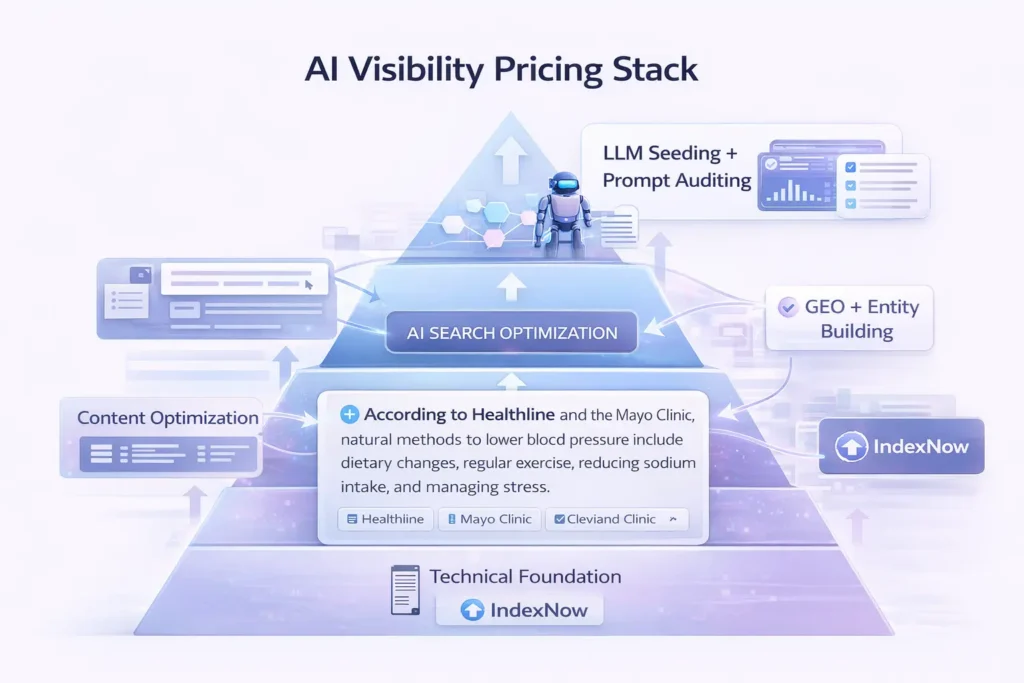
The AI Visibility Pricing Stack is a framework that maps AI search optimization work into four layers. Each layer builds on the previous one. Skipping a lower layer while buying a higher one wastes budget.
| Layer | What it covers | Cost range |
|---|---|---|
| Layer 1: Technical Foundation | robots.txt AI directives, IndexNow setup, XML sitemap, schema deployment | $2,000–$2,500 one-time or $750/month ongoing |
| Layer 2: Content Optimization | Useful answer passages, expert review, evidence and appropriate structured data on existing pages | $2,500–$4,000/month |
| Layer 3: GEO + Entity Building | Wikipedia edits, press co-citation, Reddit brand signals, Knowledge Graph entity setup | $3,500–$8,000/month |
| Layer 4: LLM Seeding + Prompt Auditing | Co-citation outreach, prompt audit tracking across 5+ AI platforms, competitive gap reporting | $4,000–$8,000/month |
A full-stack AI SEO pricing engagement covering all four layers runs $8,000–$35,000/month with a specialist agency. Most mid-size businesses start at Layer 1 and 2 for $4,000–$8,000/month, then add Layers 3 and 4 once citation volume is measurable.
| KEY INSIGHT The most common AI SEO pricing mistake is buying Layer 3 or 4 work before completing Layer 1. LLM seeding and co-citation building produce minimal results if AI crawlers cannot access your site or your content lacks direct answer structure. |
|---|
3. AEO Pricing: What Answer Engine Optimization Costs
AEO pricing varies based on the number of pages being optimized and whether new content is part of the scope.
Content Audit + AEO Restructuring Only: $2,500–$5,000 as a one-time project for up to 20 pages. This covers adding direct answer blocks, FAQ pairs, and schema markup to existing content without new writing.
Monthly AEO Retainer (Optimization + New Content): $3,500–$8,000/month. Typically includes 4–6 new AEO-optimized posts per month plus ongoing schema management and prompt testing.
AEO for Enterprise Sites (100+ pages): $6,000–$20,000/month. Potential scope includes template-level technical work, reviewed answer content, relevant structured data and documented AI visibility observations. Confirm the actual deliverables and implementation responsibilities in the proposal.
One important distinction in AEO pricing: an agency charging at the high end should deliver prompt testing reports showing which AI platforms are citing your pages and for which queries. If an agency cannot show you citation evidence, the pricing is not justified regardless of deliverables.
4. GEO Pricing: What Generative Engine Optimization Costs
GEO pricing is distinct from AEO pricing because the work happens largely off your website. GEO involves building the cross-source brand presence that AI models use when generating consensus answers.
Starter GEO Package: $2,500–$3,500/month. Focuses on review platform consistency (Google Business Profile, Yelp, industry directories) and basic press co-citation monitoring.
Growth GEO Package: $3,500–$6,000/month. Adds Wikipedia entity work, Reddit brand signal building, and structured citation source maintenance (Wikidata, Crunchbase, schema.org entity alignment).
Authority GEO Package: $5,000–$12,000/month. Full cross-source entity management including journalist co-citation outreach, podcast appearance tracking, and Knowledge Graph entity maintenance.
GEO pricing is harder to justify on short timelines. The consensus signals that generative engines use are built over months, not weeks. A credible GEO agency will show you a 90-day roadmap with measurable milestones: new citation sources added, entity mentions tracked, and baseline prompt visibility before and after. For a detailed breakdown of GEO methodology, see our Generative Engine Optimization (GEO) Guide.
5. AI SEO Agency Pricing vs. Freelance vs. In-House
AI SEO Agency Pricing
Specialist agencies that focus on AI search optimization charge $5,500–$35,000/month depending on scope. Focused campaigns commonly fall between $5,500 and $8,000/month, while full AEO, GEO, and LLM citation programs range from $8,000 to $35,000/month. The premium is justified when the agency provides: dedicated prompt audit tooling, proprietary schema deployment workflows, and editorial relationships for co-citation building. Ask any agency you evaluate to show you a citation report from a current client before signing.
Freelance AI SEO Pricing
Experienced freelancers with demonstrated AI SEO results charge $125–$250/hour or $3,500–$6,000/month on retainer. The tradeoff: a solo operator cannot cover all four layers of the AI Visibility Pricing Stack simultaneously. Freelancers are best used for Layer 1 and Layer 2 work, or for content production within an agency-led strategy.
In-House AI SEO Pricing
Hiring a full-time AI SEO specialist costs $70,000–$110,000/year in the US. Add tooling (Ahrefs, Rank Math, citation tracking platforms) at $6,000–$10,000/year. In-house makes sense when you have 200+ pages to optimize and a high enough content velocity that an ongoing monthly retainer would cost more than salary.
6. The Technical Layer You Cannot Skip
No AI SEO pricing discussion is complete without covering the technical foundation. Before you spend a dollar on content optimization or GEO, confirm these four items are in place.
robots.txt AI Bot Directives: Review crawl permissions and firewall rules by purpose. OAI-SearchBot supports ChatGPT search; GPTBot relates to model training; ChatGPT-User handles certain user-triggered visits. Set search access separately from training preferences, using the official OpenAI crawler guidance.
For Google AI Overviews and AI Mode, check Googlebot access, indexability and snippet eligibility. Google-Extended is a separate control. Follow each platform’s current guidance instead of applying one blanket allow list. Eligibility does not guarantee selection as a source.
IndexNow Implementation: IndexNow notifies participating search engines when a URL is added, meaningfully updated or removed. Engines still decide whether and when to crawl and index it. A submitted notification is not proof of indexing, ChatGPT discovery or an AI citation. See the IndexNow FAQ.
Schema Markup: Choose structured data that fits the page and agrees with its visible content. Google does not require special schema for AI Overviews or AI Mode. Applying Article, FAQPage or Speakable markup everywhere is not a universal citation prerequisite. See Google’s AI features guidance.
Canonical + Crawl Setup: Duplicate content and crawl blocks are the fastest way to undo AI SEO investment. Confirm your canonical tags are clean and your XML sitemap is submitted to both Google Search Console and Bing Webmaster Tools. For a full technical implementation checklist, see our Technical SEO for AI Crawlers Guide.
7. How to Evaluate AI SEO ROI Before You Buy
AI SEO pricing is only justifiable if you have a way to measure results. Here is the ROI evaluation framework to run before committing to any budget.
Baseline Prompt Audit: Before signing a contract, run 20–30 test prompts across ChatGPT, Google’s Gemini, Perplexity, Anthropic’s Claude, and Microsoft Copilot. Ask questions that your target audience would ask. Count how many responses cite your domain versus competitors. This is your baseline.
Citation Goal Setting: Agree a relevant question cohort, observation conditions and review schedule. Compare documented mentions, cited sources and referrals over time, with changes to the site annotated. Platform selection varies; a fixed citation target is a planning assumption, not an established outcome benchmark.
Revenue Mapping: Model break-even before approving the budget: divide total program cost by contribution profit per new customer to estimate the additional customers needed to cover it. Then use your own qualified-inquiry-to-customer conversion rate to estimate the inquiry requirement. Keep those planning assumptions separate from observed results, account for your sales cycle and avoid counting the same lead twice across channels. For a complete tracking methodology, see our AI Search Visibility Metrics Guide.
8. Co-Citation and Brand Entity Signals That Affect AI SEO Pricing
AI models do not cite sources at random. They build consensus answers from sources that appear together repeatedly across trusted web documents. This is co-citation, and it is one of the highest-leverage tactics in AI search optimization.
When your brand name appears alongside target keywords in editorial articles, industry roundups, forum discussions, and partner content, AI models begin associating your entity with those topics. Over time, this association increases citation probability.
Co-citation building typically adds $3,500–$5,000/month to AI SEO pricing. The deliverables include: outreach to industry publications for brand mentions, building Reddit and Quora presence around target queries, and tracking co-citation density using prompt testing tools. For your content to qualify as an authority source, your E-E-A-T signals must be strong across platforms. See our E-E-A-T for AI Search Guide for the full framework.
9. Common AI SEO Pricing Mistakes
| Mistake | Why it hurts | What to check |
|---|---|---|
| Buying GEO/LLM seeding before fixing robots.txt | Unintended access restrictions can prevent a platform from discovering useful source pages. | Review the intended search access and verify important pages’ actual responses and directives. |
| Choosing price over deliverables | Low-cost agencies repackage old SEO tactics as “AI optimization” with no citation evidence | Require a sample citation report from any agency before contracting |
| No baseline prompt audit | You cannot measure ROI if you do not know where you started | Run 20–30 test prompts across 5 AI platforms before campaign launch |
| Misusing structured data | Inaccurate or irrelevant markup can misrepresent a page. No universal schema-first citation rule is established. | Use relevant supported types and check them against visible content and the page’s purpose. |
| One-and-done content optimization | AI citation probability decays as competitors update their content; static optimization loses ground | Build quarterly content refresh into your AI SEO pricing contract |
| No co-citation budget | On-site optimization alone is insufficient; AI models require cross-source consensus | Allocate at least 30% of AI SEO pricing budget to off-site citation building |
10. Tracking and Maintaining AI Search Visibility
AI SEO is not a one-time project. Your citation performance will shift as competitors optimize, as AI models update their training data, and as your own content ages. Build this maintenance cycle into your budget.
Weekly Prompt Audit (25 minutes):
- Run 5 target queries per AI platform (ChatGPT, Gemini, Perplexity, Claude, Copilot)
- Record which domains appear in citations
- Note if your domain is cited, mentioned without citation, or absent
- Flag any queries where a competitor gained a new citation this week
- Add flagged queries to your content refresh queue
Monthly Content Refresh: Update at least 2–3 pages per month with new data, updated statistics, and refreshed FAQ pairs. Each update should trigger an IndexNow ping and a dateModified schema update.
Quarterly AI SEO Pricing Review: Review cost-per-citation across all platforms. If one platform is generating strong ROI and another is not, reallocate budget. AI SEO pricing should scale toward what is working, not stay fixed across all channels equally. For a detailed breakdown of what to track, see our How to Rank in ChatGPT guide.
Article Summary
| ARTICLE SUMMARY: AI SEO PRICING 2026 • AI SEO pricing starts at $2,500/month for entry-level content optimization, while full-stack AEO, GEO, and LLM citation strategy ranges from $8,000–$35,000/month • Most businesses serious about AI search visibility invest $4,000–$8,000/month • Use the AI Visibility Pricing Stack framework: Layer 1 (technical), Layer 2 (content), Layer 3 (entity/GEO), Layer 4 (LLM seeding) • AEO pricing: $3,500–$8,000/month for standard retainers, with enterprise programs reaching $20,000/month • GEO pricing: $2,500–$12,000/month based on the depth of cross-source entity building required • Resolve proven access and content problems; choose IndexNow and structured data where appropriate to the platform and page • Require a citation audit report from any AI SEO agency before signing a contract • Run a baseline prompt audit across 5 AI platforms before campaign launch • Co-citation building should represent at least 30% of total AI SEO pricing budget • Build quarterly content refresh cycles into any AI SEO pricing agreement |
|---|
Frequently Asked Questions
How much does AI SEO cost per month?
AI SEO pricing in 2026 starts at $2,500/month for entry-level content optimization. Full-stack AEO, GEO, and LLM citation strategy managed by a specialist agency ranges from $8,000–$35,000/month. Most mid-size businesses invest $4,000–$8,000/month to cover the core layers: technical foundation, content optimization, and basic entity building. Pricing scales with the number of pages being optimized, the scope of off-site co-citation work, and the frequency of prompt auditing included in the retainer.
What is the difference between AEO pricing and GEO pricing?
AEO pricing generally covers clearer answers, expert review and technical work that helps buyers find and understand your information. GEO scope can also include consistent brand information, supporting source material and observation of generative answers. The work overlaps; compare actual deliverables, implementation ownership and reporting rather than assuming the label determines price or results.
Why is AI SEO pricing higher than traditional SEO?
AI SEO is not automatically more expensive than traditional SEO. Cost depends on the existing search foundation and the additional work agreed: expert production, technical implementation, source development, platform observations and analysis. Ask the provider to explain incremental deliverables and avoid paying twice for work already included in your SEO program.
Can I do AI search optimization without an agency?
Yes. An in-house team can own technical implementation, expert content, business information and measurement when it has the skills, access and time to deliver them. Use an agency for a defined capacity or expertise gap, such as coordinating technical work with content production and reporting. Compare the cost of staff time, tools and review with the agency scope, and name an owner for each task so responsibilities do not fall between teams.
How long does it take to see results from AI SEO?
Implementation can begin once scope, access and required inputs are ready. Visible outcomes depend on recrawling, retrieval, competition and the strength of the content and evidence. Track completed work, observed answers, referrals and qualified outcomes separately; neither an IndexNow submission nor a fixed elapsed period guarantees an AI citation.
READY TO OUTPERFORM?

GET YOUR CUSTOM AI SEO STRATEGY BUILT BY STRATEGISTS, NOT SALESPEOPLE.
No cookie-cutter templates. No recycled audits. Fuel Online engineers custom AI SEO, AEO and GEO strategies around your market, entity authority, competitors and search opportunities.
AI Visibility Intelligence. We examine how your brand appears across AI Overviews, ChatGPT, Gemini, Claude and Perplexity.
Built Around Your Entity. Every strategy reflects your authority, market, content assets, competitors and commercial goals.
Search and AI Connected. Technical SEO, answer architecture, citations and entity signals work as one coordinated system.
Measurable Market Impact. We connect AI visibility and search performance to qualified traffic, leads and revenue outcomes.
YOUR NEXT STEP
AI SEO STRATEGY SESSION WITH A MANAGING DIGITAL STRATEGIST
A focused call. A custom strategy. Real opportunities.
- We audit your current Google and AI search visibility
- We uncover citation, entity and content authority gaps
- We identify your highest-impact AI SEO opportunities
- We build several strategic paths based on your goals
No sales pitch. No pressure. Just senior strategists engineering your strongest path forward.