An SEO agency for personal injury law firms builds the organic visibility that turns injury searches into signed cases. We win the Google rankings, the local map pack, and the technical and content foundation that injured claimants rely on while they compare firms before they ever pick up the phone. Everything we publish is attorney-reviewed and built to comply with state bar advertising rules.
An SEO agency for personal injury law firms makes your firm the result injured claimants find, trust, and call when they search for help after an accident. In practice that means winning organic rankings for the practice-area, injury, and location questions claimants ask, owning the Google local map pack for high-intent searches in your market, and building the technical and content foundation that lets both happen. The goal is not traffic for its own sake. It is qualified case inquiries, measured against the value a signed case actually produces for the firm.
This page focuses on organic search. It is one layer of the broader personal injury marketing program we run, and it sits alongside our wider law firm marketing work. Personal injury runs on a contingency-fee model, so the firm earns nothing until it wins, and a single catastrophic-injury or wrongful-death case can be worth more than a small firm spends on marketing in a year. That economics pulls every serious firm into the same results, which is why the firm that earns durable visibility early in a claimant’s decision is usually the one that earns the case.

Personal injury is widely regarded as the most competitive category in all of search, and the keyword economics show it. A single click on a phrase like car accident lawyer can cost hundreds of dollars in paid search, because every firm knows what one signed case is worth. Renting that visibility through ads is expensive and stops the moment the budget stops. Durable organic and AI visibility is different: it compounds, it keeps working after the invoice is paid, and it is far harder for a competitor to buy their way past overnight. That is the edge a real SEO program builds.
The category also spans many practice areas, and each one needs its own content. Car accidents, truck accidents, and motorcycle accidents behave differently from slip and fall and premises liability, and those differ again from medical malpractice, product liability, workers compensation, and wrongful death. A claimant hurt by a defective product is not searching the same way as a family weighing a wrongful-death claim. A thin page targeting a single keyword cannot win that spread. Depth across dozens of related practice-area and injury topics is what earns the authority to rank.
The competitive set is unusual, too. You are not only competing with other firms. You compete with legal directories, lead-generation sites, national aggregators, and forums that already hold topical authority and outspend most individual firms. And because most injured claimants hire a firm within driving distance, the Google local pack and a handful of map positions carry a large share of ready-to-call searches. Ranking well organically and owning the local pack are two different jobs, and a personal injury firm needs both.
Search intent runs across a wide spectrum, and each stage needs different content. Someone just hurt in a crash searches with urgency and wants help now. A claimant weeks into recovery compares firms, reads reviews, and searches for how settlements and case values work. Someone already talking to one firm quietly researches two others before signing. A program that only chases the urgent bottom-of-funnel searches leaves earlier claimants to competitors, so we map content and local signals to the full claimant journey.
We run five connected workstreams. Each one reinforces the others: technical foundations let content rank, ranked content earns links and citations, local signals turn rankings into calls, and conversion tracking tells us where the signed cases actually come from. We coordinate this on the site through our core SEO agency practice, adapted to the ethics and economics of injury law.

Search engines and claimants both punish a slow, disorganized site. We start by resolving the technical issues that hold a firm back: crawlability and indexation, a clean site architecture that groups practice areas logically, legal schema markup, Core Web Vitals and page speed, and safe handling of any redesign or migration so you do not lose hard-won rankings. This is the same discipline we cover in depth on our technical SEO for personal injury law firms page.
Rankings follow authority, and authority follows content that answers real questions with credibility. We build attorney-reviewed content clusters around each practice area you handle: car, truck, and motorcycle accidents, slip and fall and premises liability, medical malpractice, product liability, workers compensation, and wrongful death, along with the injury, process, and case-value questions claimants search most. Attorney review is non-negotiable here, both for accuracy and because every page must comply with state bar advertising rules before it goes live. Our full approach lives on the personal injury content strategy page.
In practice that means more than blog posts. It means well-structured practice-area pages, honest explanations of how injury claims and the contingency-fee model work, guides on what to do after an accident, and comparison content that addresses the questions claimants actually weigh. Every page is written for a real search need and reviewed by an attorney before it publishes. We never promise a specific settlement, verdict, or case outcome, and we build in the disclaimers your jurisdiction requires, because misleading claims put both the case and the firm’s license at risk.
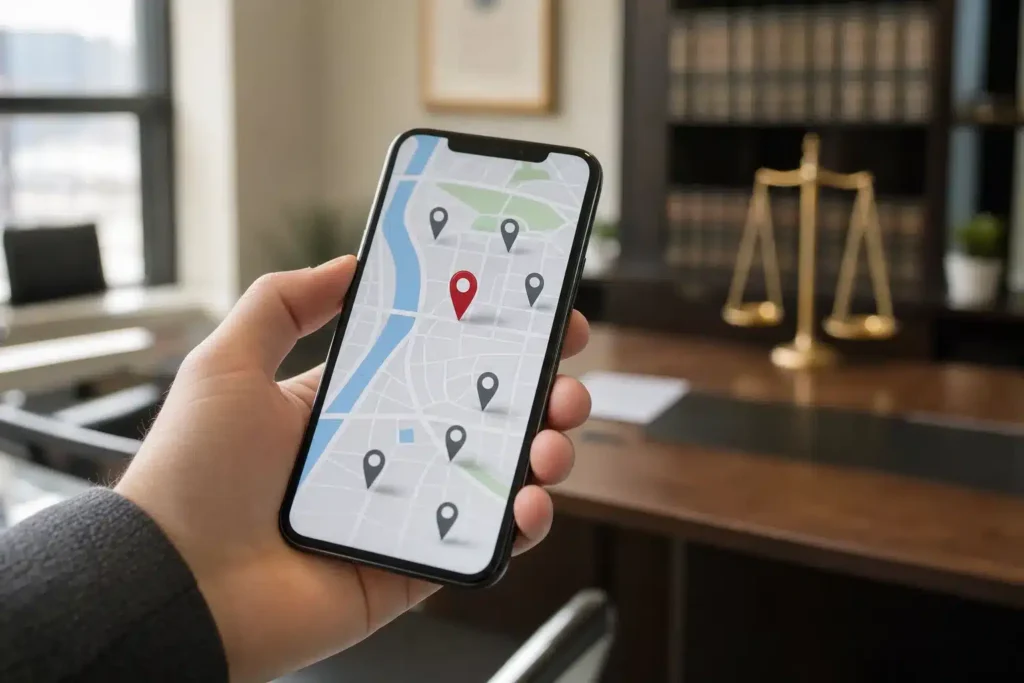
For most personal injury firms, the map pack is the highest-intent real estate in search. We optimize your Google Business Profile, build a review strategy that earns and sustains a strong rating, and create local landing pages for each office so every market can rank on its own. When someone searches for an injury lawyer near them, the firm that owns the local pack and the reviews behind it gets the call. This connects to our core local SEO service and the local SEO for personal injury law firms playbook.
Reviews and reputation carry unusual weight in injury law. A claimant deciding who to trust with a serious case reads the recent reviews closely, so a steady flow of genuine, well-managed reviews often decides who gets the call among firms that all rank. For firms with more than one office, local SEO is also an expansion engine. Each location needs its own optimized profile, its own reviews, and its own local content, so a market you enter can rank on its own strengths rather than borrowing authority from headquarters. We build that structure deliberately so growth into a new city or state does not dilute the markets you already own.
The most competitive injury terms are won partly off your own site. We earn links and mentions from credible legal, local, and industry sources, and we build the entity signals that tell search engines your firm is a real, trusted authority. This is deliberate, editorial link work, not volume for its own sake, because low-quality links do more harm than good in a category Google scrutinizes as closely as legal advice, where the stakes for the searcher are high.
For a personal injury firm, the strongest authority signals often come from the same places that build real-world reputation: recognized legal directories, bar associations, local press, case results coverage handled within advertising rules, and genuine community involvement. We prioritize those durable, defensible signals over disposable links, because they hold up as search engines get better at spotting manipulation, and they reinforce the trust a claimant is already looking for before hiring a lawyer.
Rankings only matter if they produce signed cases. We set up call tracking, form attribution, and intake reporting so you can see which searches, pages, and markets produce case evaluations and signed retainers. That reporting ties spend to case value rather than vanity traffic, and it tells us where to invest next. Because injury cases run on contingency and vary enormously in value, measuring cost per signed case and the value behind each one matters more here than raw lead counts. A single practice area or a single market can quietly carry the return on a whole program, and you cannot see that without attribution wired in from the start. You can go deeper on this in our personal injury SEO ROI and attribution page.
Good measurement also protects the budget conversation. When you can show that a set of practice-area pages produced a specific number of case evaluations and signed retainers, the decision to invest more is grounded in evidence rather than a leap of faith. We build the reporting so the partners who fund the program can see exactly what it returns, quarter over quarter, without wading through vanity metrics.
Organic rankings are the foundation, but claimants now research firms inside AI tools too, and many ask ChatGPT, Gemini, Claude, and Perplexity to name good injury lawyers before they click a single result. The same authority that wins Google rankings also feeds the answers and citations those tools produce. We cover that work separately in answer engine optimization and generative engine optimization for personal injury firms, and you can see where your firm stands today with an AI visibility audit. We run all of it as one program so a single content investment compounds across Google, AI Overviews, and generative recommendations. Our AI SEO, GEO, and AEO services sit behind that work.
A personal injury SEO program should show discipline early, even before rankings move. In the first quarter we audit and fix the technical foundation, claim and optimize your local profiles, map the practice-area content your market is missing, and stand up call and form tracking so every result is measured from day one. The compounding gains come later, but the groundwork that makes them possible happens fast.
We do not promise a specific ranking, case volume, or settlement, because no honest agency can, and because bar advertising rules prohibit it. What we can point to is a track record: an award-winning agency since 1998 with more than 100 industry awards, 4.25 million marketing leads generated for clients, hundreds of millions in client revenue, and 143% average traffic growth for enterprise brands. Personal injury results build over months as authority compounds, and we report leading indicators early so you see momentum before the case value catches up. You can review our client case studies to see how we measure and report growth.
We have grown businesses through search since 1998, and we were named a top agency by Forbes, Yahoo, and Clutch. Behind the SEO work is the only in-house AI SEO research department in the space and our proprietary Fuel AI Index, which gives the content we produce a measured information-gain advantage over competing pages. Our team is 100% U.S.-based with no outsourcing, and every claim here traces to work we can show you. For a personal injury firm, that means a partner that understands both the ethics the category demands and the economics of a contingency-fee case. If you want to weigh us against other options, our guide to choosing a personal injury marketing agency lays out exactly what to look for.
Tell us your practice areas, markets, and goals, and we will map the SEO work that will move signed cases for your firm. Fill out the form below to schedule a meeting and get a custom quote.
Prefer a direct line? Visit our contact page or call 1-888-475-2552.