
FUEL ONLINE / Managed Service Providers / Lead generation
MSP lead generation agency: Conversion Strategy

MSPs lose sales time when business IT searches mix with consumer repairs, unsupported environments, and companies below the service model. For MSP lead generation agency, Fuel defines fit through company size, environment, security responsibility, geography, and contract fit, then aligns pages, forms, calls, routing, and follow-up with that decision. The sales team receives useful source and qualification context, while marketing receives rejection and progression feedback. The aim is more qualified discovery calls without rewarding raw lead volume.
Supported geography and minimum account size; Managed versus project-only service; Technology stack and compliance requirements; Contract fit and meeting acceptance
Count MSP buying conversations at the level your sales decision requires
An MSP lead generation agency should distinguish contact activity, prospective organizations and accepted commercial opportunities. Two people from one business can contribute to the same buying conversation, while a returning contact can add useful context without becoming another newly acquired prospect. Begin with your actual service offering and receiving process. Then define the record relationships and qualification decisions that make the report useful. More form activity is valuable when the team can explain what changed in the underlying business conversations.
Choose what the report is counting
A contact is a person or communication record. A prospective organization is the business being evaluated. An opportunity is a commercial requirement your team has defined and reviewed under its process. These concepts can relate without being interchangeable. Ask the agency which one its headline lead total represents. The answer should be understandable from sample records, including corrections and follow-up messages, rather than depend on a dashboard label that different teams interpret differently.
Decide how multiple people from one organization are represented. A business decision-maker and an IT contact may provide different information about the same requirement. Preserve their messages and the relationship between them. Do not automatically turn each contact into a separate prospective company. Equally, do not assume that every request from the same domain concerns the same opportunity. The business may have distinct teams or requirements that sales needs to review separately.
Document the rule that connects records and the cases needing manual review. An organization name, business website or contact detail may suggest a relationship without proving its exact scope. Keep uncertain matches visible. A clear correction to an earlier inquiry can be linked under the agreed process, while a separate requirement should retain its own identity where the team confirms that distinction. The goal is a reproducible account of the conversation, not the largest or smallest possible lead total.
Define acceptance around the next commercial decision
Ask the MSP which facts it needs to decide whether a discovery conversation is appropriate. The provider supplies its actual offering, operating scope and customer-fit criteria. The initial form should collect information that helps route or prepare that conversation. Another detail may belong in the conversation itself. A complete-looking field set does not establish that the provider can serve the request, and an incomplete first message does not necessarily establish that the prospect is unsuitable.
Give each qualification decision an owner and a meaning. Received, awaiting clarification, accepted for discovery, outside the current offering and continuing customer activity describe different states. Use the provider’s actual terms where they are already maintained. Record why a request did not progress when that information is available. This lets the agency distinguish a message mismatch from missing context or an unavailable later sales decision before proposing another acquisition change.
Keep a scheduled conversation separate from a signed agreement or any later commercial stage. The receiving team can judge the next step without the marketing record claiming the entire outcome. Where later evidence is available, link it through a supported process and documented rule. Where it is unavailable, keep the gap explicit. A useful initial lead definition should not require the agency to invent later facts to make a report appear complete.
Walk through a fictional buying-group ledger
The following seven-record example is fictional and demonstrates counting logic only. Assume Company Alpha has one described requirement and Company Beta has another. Sales confirms that Alpha’s second contact and correction belong to the same conversation. Company Gamma is an existing customer asking about an established relationship. The vendor and test records have clearly stated purposes. No record in this exercise represents an actual Fuel inquiry or a forecast of campaign results.
| Record | What was received | Relationship for review |
|---|---|---|
| A1 | Company Alpha asks about a supported business requirement. | First contact in Alpha’s candidate buying conversation. |
| A2 | Another Alpha employee supplies context for that same requirement. | Second person in the existing conversation, confirmed by sales. |
| A3 | The first Alpha contact corrects an administrative detail. | Correction linked to the same conversation. |
| B1 | Company Beta sends a separate commercial inquiry. | Second prospective organization, awaiting its own review. |
| C1 | Company Gamma asks about an existing customer matter. | Continuing relationship; route under the established process. |
| V1 | A vendor offers unrelated services. | Vendor solicitation outside new MSP prospect acquisition. |
| T1 | A clearly marked fictional submission checks delivery. | Operational test excluded from acquisition reporting. |
The set contains seven submitted records, with four records associated with two candidate new organizations. Alpha’s three records do not create three prospective companies. Suppose sales accepts Alpha for a discovery conversation while Beta remains unreviewed. The report can show two candidate organizations, one accepted conversation and one unresolved candidate. It should not present all seven records as qualified leads or assign Beta a final outcome that the available evidence does not establish.
Ask the agency and receiving team to reproduce that result independently from the example. If their totals differ, inspect the unit of counting and relationship rules. One team may count submissions while another counts companies or opportunities. Resolve the naming and definitions before interpreting the difference as a lost record or a campaign failure. Keep the example with the reporting specification so a future team member can understand the intended logic.
Handle another requirement from the same organization
Now extend the fictional example. An Alpha contact asks about a different project after the original conversation. The shared company does not decide whether the request belongs to the existing opportunity. Ask sales to describe the actual relationship. It may be additional context, a separate supported requirement or a continuing-customer conversation at a later stage. Preserve the original record while the responsible owner makes that decision.
Keep acquisition and expansion reporting understandable. An existing customer exploring another service can represent a useful commercial opportunity without being a newly acquired company. A previously recorded prospect returning this month may be active again without becoming a new organization first discovered this month. Define the reporting window and event used for each total. The dashboard should answer its stated question, with returning activity visible in the appropriate category.
Do not make an automatic merge rule carry more meaning than the source establishes. A shared email domain may help identify a business relationship, but separate divisions or requirements can still need distinct review. A changed contact address may also occur within one ongoing conversation. Ask which matches are confirmed, which are provisional and how corrections are recorded. The team should be able to inspect the reason without relying on an invisible assumption inside the reporting tool.
Design initial questions around routing and preparation
For each field, state the receiving decision it supports. The broad service sought may determine the route, while a short description helps staff prepare the next conversation. Use the MSP’s own offering language and give visitors an understandable way to express uncertainty. A prospect should not have to guess a technical category just to send a business inquiry. Keep the actual message beside any selected label so staff can clarify the requirement.
Keep the initial commercial route separate from technical incident intake. Do not request passwords, access tokens or other authentication secrets through a marketing form. The provider supplies its established instructions for existing customers and approved technical processes. The acquisition task is to establish the appropriate business conversation, not to collect access to a prospect’s systems. A relevant request can be useful before the provider has detailed technical information.
Compare the form with the public invitation and confirmation. If the page offers a discovery conversation, the received record should describe that step. It should not imply that submitting the form opens a support incident or creates a service commitment. The provider supplies any response statement. The agency can make the transition clearer without inventing an operational promise or changing the underlying support arrangement.
Preserve the source without overriding the buying context
Keep the original landing page and available acquisition-source information where the actual configuration supports them. Record later messages and the sender’s stated requirement separately. A contact may arrive through one service page while asking about another supported offering. A second stakeholder may use a different route from the first. Those observations can help reconstruct the buying conversation, but the page label should not silently determine the final opportunity category.
Agree on how a later contact relates to the original discovery record. The relationship should come from supported identifiers and the receiving process, with uncertain cases marked for review. Do not overwrite the first recorded source merely because another visit occurred. Likewise, do not assign an unobserved original source to a new contact because their company appears in an earlier conversation. Both provenance and uncertainty can remain visible without forcing a complete attribution story.
Use the reconciled information to diagnose the next problem. If a destination repeatedly attracts requests outside the published offering, inspect the page’s message. If suitable businesses reach the form but staff cannot recognize their requirement, inspect the questions and receiving representation. If records arrive correctly but lack acceptance decisions, resolve the review ownership. These are different assignments, and a larger acquisition campaign is not an automatic remedy for each one.
Test the complete record relationship with fictional details
Use an authorized test process to rehearse a first inquiry, second stakeholder and correction. Clearly mark the records as fictional and exclude them from commercial totals. Ask the receiving team to identify the prospective organization, stated requirement and relationship between messages. Compare the result with the test sheet. A success message establishes one part of the path; it does not by itself establish that the team can interpret the resulting conversation.
Record the actual behavior when a correction or follow-up arrives. The configuration may update a value, create a separate record or require employee review. State which behavior was observed and which rule connects the records for reporting. Do not require an imagined perfect identity match to accept useful progress, but do not claim a relationship the available evidence cannot support. A clear manual review step can be part of an honest operating process.
Assign each repair to the component and owner responsible. The agency may control page wording while another supplier controls a form or receiving system. A prepared recommendation is not a deployed change. Identify what can be completed now and what needs the other owner. Continue the independent tasks while preserving the unresolved item and its acceptance check. This keeps a specific dependency from hiding the status of the rest of the journey.
Review reporting changes before interpreting growth
If the team changes from counting submissions to counting prospective organizations, retain the previous definition and implementation date. A lower total under the new rule does not automatically establish a decline in demand. It may reflect a more precise unit of counting. Conversely, a broader label can increase the reported number without adding a commercial conversation. Compare the actual records and definitions before attributing a difference to marketing performance.
Keep unresolved cases visible at the end of the reporting window. A candidate awaiting clarification should not be treated as either an accepted opportunity or a final rejection without the relevant decision. Identify how later updates will be reflected. A reproducible report makes the boundary between the marketing record and sales judgment understandable, allowing both teams to choose the next useful change from the same evidence.
Compare an MSP lead generation agency on that delivery: clear record relationships, provider-defined qualification, functioning receiving paths and reporting that distinguishes activity from buying progress. The work should leave the business able to explain which conversations exist, what sales has accepted and where additional evidence is still needed before the next investment decision.
AGGRESSIVE FROM THE START
One month. The work many agencies stretch across three.
Our mandate: move faster, go deeper and put experienced specialists to work immediately.
Fuel attacks the work in parallel: site audits, technical errors, new content, internal links, backlink outreach and conversion improvements. Your agreed scope determines the channels; urgent fixes do not wait behind a drawn-out planning phase.
The MSP lead generation agency brief identifies visibility and lead barriers. Actionable fixes move into production while deeper analysis continues.
Your MSP lead generation company work runs alongside industry-specific content, relevant links and earned-authority outreach, based on your agreed scope.
The lead generation services for managed service providers review shows completed work, lead quality and the next opportunities. You see who owns each action.
Fast execution is the operating standard. Access, approvals and scope shape delivery; search and revenue results have their own timelines.
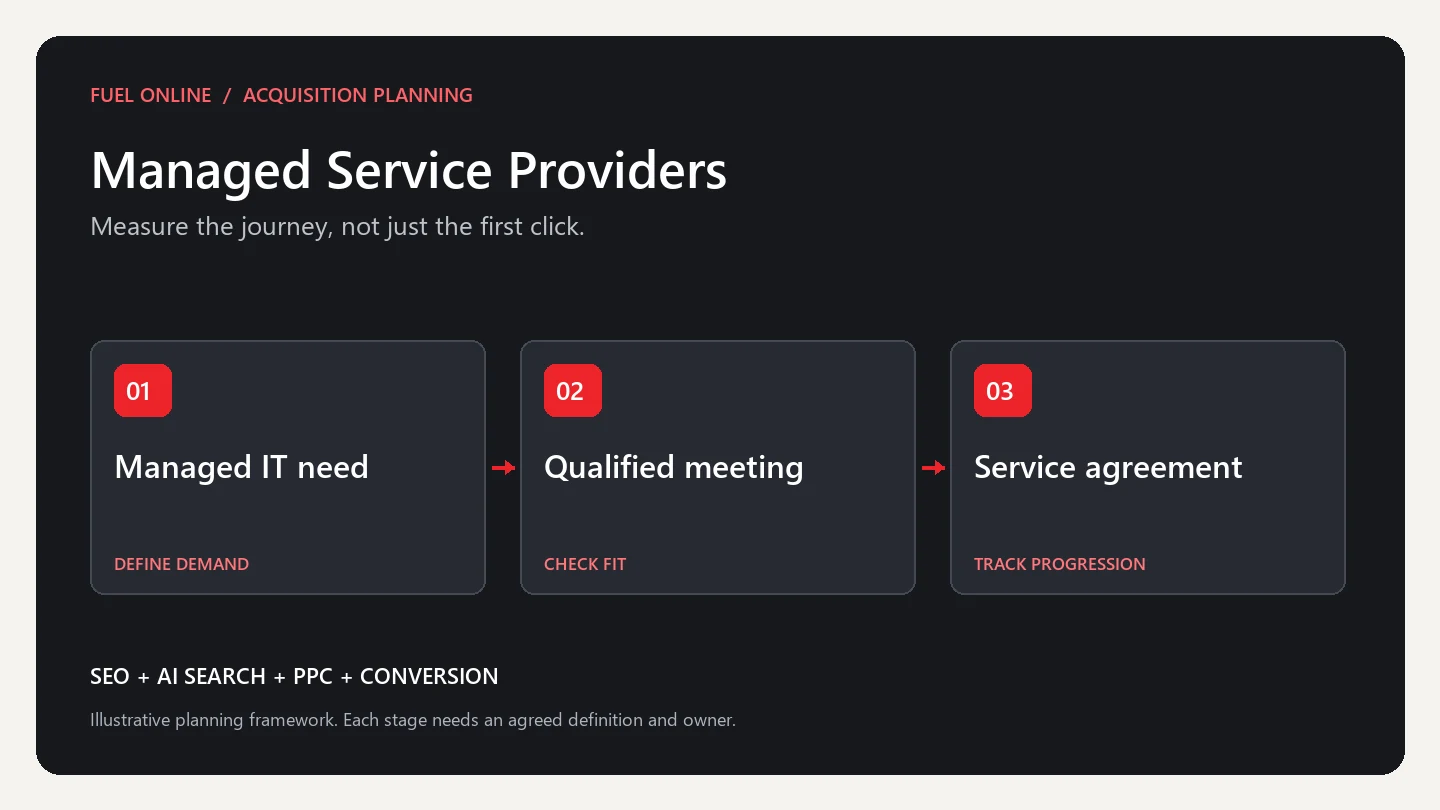
What MSP lead generation agency changes for managed services demand
Lead generation starts with the receiving team's decision. Fuel documents what counts as an accepted next step, what does not fit, and who owns each route. For managed services, acceptance depends on company size, endpoints, environment, security responsibility, geography, contract fit, and onboarding window.
The conversion path asks only what changes fit, routing, or preparation. It preserves company size, locations, environment, support model, security need, current provider, and timing, keeps sensitive details in approved systems, and gives unsuitable visitors a clear alternative instead of forcing every request into sales.
A practical MSP leadgen diagnostic
Use this diagnostic when form submissions and calls increase but the receiving team does not see a comparable change in qualified discovery calls. The diagnostic for MSP lead generation agency starts with the observable symptom, checks the page, source, campaign, or handoff responsible for it, and ends with one reviewed action, owner, and validation method.
Observable symptom
Forms and calls increase, but suitable requests related to 'managed IT services for law firms' lose context, wait too long, or reach the wrong owner.
What to inspect in MSP lead generation company
Review the page promise, fields, call handling, routing, response time, follow-up attempts, and final sales, intake, or scheduling decision.
Decision criteria for lead generation services for managed service providers
Change the question, route, response rule, or follow-up step responsible for the lost or unsuitable request.
Inspectable output
A tested routing or follow-up change with an owner, acceptance rule, and measure tied to qualified discovery calls.
Lead generation services for managed service providers deliverables you can inspect
The team receives an accepted-request definition, path map, routing and response rules, CRM dispositions, and a controlled conversion-test log.
- Accepted-lead and exclusion specification, used to define the MSP lead generation agency scope.
- Page, form, and call-path map, used to govern the MSP lead generation company release.
- Routing, response, and follow-up ownership, used to evaluate the lead generation services for managed service providers decision.
- CRM fields, dispositions, and duplicate rules
- Quality review and controlled test log
Illustrative managed services example
Illustrative example, not a client result: The request reaches sales without company size, locations, environment, security need, current provider, or timing. Fuel would test the page, form or call path, route, response rule, follow-up, and final disposition to find the first point where useful context disappears.
The MSP lead generation company test would document the changed field, route, response rule, or follow-up step and its owner. The revision stays only when the receiving team sees a clearer path to qualified discovery calls.
Within lead generation services for managed service providers, the buyer team can inspect the artifact, approval, and next investment decision.
How commercial progress is judged
Fuel connects page, query, campaign, or source context with acceptance, rejection reasons, response, capacity, and sales-accepted meetings, recurring-contract opportunities, account-fit rate, and pipeline by service area. Diagnostic measures explain where the journey breaks; they do not replace the business outcome.
The decision record for MSP lead generation agency states what changed, why it changed, who approved it, and whether the next action is to expand, revise, consolidate, or stop.
Reporting for lead generation services for managed service providers must connect the service-specific diagnostic to qualified discovery calls, explain data limits, and name the next decision rather than treating activity as proof of value.
Questions to ask a managed services agency
Ask for an accepted-request specification, route test, disposition set, and response ownership map. Confirm how the agency reviews missed, duplicate, unsuitable, and progressed inquiries.
When reviewing MSP lead generation agency, require a named practitioner, implementation owner, approval path, and sample artifact. Reject unsupported promises of rankings, citations, lead volume, cost, or revenue.
How we measure MSP lead generation company
- sales-accepted meetings
- recurring-contract opportunities
- account-fit rate
- pipeline by service area
Find the drop between interest and a useful next step
Next-step completion rate = qualified inquiries completing the agreed next step ÷ qualified inquiries reviewed.
Illustrative arithmetic: 15 completed appointments from 25 qualified inquiries is 60%. Use the next step that fits your business, such as a consultation, estimate or discovery meeting, and record the time allowed for completion.
Agree on the baseline, data source and qualification criteria before comparing results. Separate visibility from inquiries and accepted business opportunities.
CONNECTED SERVICES
Choose the right next step for your business
Explore Fuel’s Lead generation capabilities, published campaign work and team to evaluate how we would support your organization.
BEFORE YOU CHOOSE AN AGENCY
Questions about MSP lead generation company
What happens before Fuel changes the form?
During the first month, the MSP lead generation agency scope produces an accepted-request definition, tested page and call paths, routing ownership, dispositions, and the first conversion repair. Fuel also records the client inputs and approval needed for the first release.
What does Fuel need from our managed services team?
Effective MSP lead generation company work requires page, form, call, CRM, routing, and response access plus an accepted-request definition, receiving owners, and consistent dispositions. Fuel identifies missing access or ownership before work is scheduled around it.
How will we know the work is commercially useful?
Under lead generation services for managed service providers, commercial usefulness depends on whether the diagnostic connects to qualified discovery calls, the data limits are stated, and the evidence supports a clear keep, revise, or stop decision.
Should we buy more traffic before fixing lead handling?
Usually not. The MSP lead generation agency plan should first correct the form, call path, routing, response, follow-up, or disposition problem that is losing suitable requests. Additional traffic is useful only after the receiving path can handle it.
What does a credible MSP lead generation company scope include?
A credible MSP lead generation company scope includes acceptance criteria, path testing, field and call design, routing and response ownership, CRM dispositions, and controlled conversion tests. It also names the client dependencies, practitioner, deliverable, and approval path.
How should lead generation services for managed service providers report commercial progress?
Reporting under lead generation services for managed service providers should connect the service-specific diagnostic to qualified discovery calls, show what changed and why, state data limits, and name the next decision.
Make your next agency conversation specific.
Bring a sample of suitable and unsuitable requests and show us where response, routing, or follow-up breaks. The first working session on MSP lead generation company will identify the priority artifact, evidence, owner, and approval decision for qualified discovery calls.
Talk with a Fuel strategist →