
FUEL ONLINE / Managed Service Providers / Digital marketing
MSP marketing agency: Digital Strategy

MSPs lose sales time when business IT searches mix with consumer repairs, unsupported environments, and companies below the service model. As your MSP marketing agency, Fuel Online gives search, paid media, decision content, landing pages, and follow-up one commercial job. We build around company size, environment, security responsibility, geography, and contract fit, exclude low-fit demand, and connect channel decisions to sales team feedback. You receive a 30/60/90 plan aimed at qualified discovery calls, not a generic package of activity.
Supported geography and minimum account size; Managed versus project-only service; Technology stack and compliance requirements; Contract fit and meeting acceptance
Build an MSP marketing release around the business relationship you want to win
An MSP marketing agency should connect a clear service offer, relevant buyer information and a functioning business inquiry path. When expanding into a target sector, begin with the MSP’s actual capabilities and approved examples rather than changing an industry name on generic copy. Give each channel a defined role and identify the resources it depends on. The first release should leave a prospective business able to understand the offering and the receiving team able to recognize the conversation the campaign is meant to begin.
Choose the sector question the release needs to answer
Ask the provider why the selected sector belongs in the plan. It may have a supported service relationship to explain, a useful approved example or a recurring business question its current pages do not resolve. Record the actual input and factual owner. The sector label alone does not tell a writer which needs the MSP serves or which public statements it can make. A useful brief identifies the specific decision a prospective organization should be able to make after reading.
Keep the target audience separate from a claim of experience. The provider supplies the service facts, relationships and examples it authorizes for publication. Marketing can organize those materials and explain their relevance. If additional context is needed, ask for the particular source rather than infer it from a broad technology description. The brief should show what is known, which passage it supports and what remains to be clarified before that part of the release is ready.
Choose one representative business journey for the first release. A prospective organization may need to identify the service, compare the provider’s stated scope and ask for a discovery conversation. Name the question at each step. A campaign package becomes easier to evaluate when the agency can demonstrate those steps with actual resources. The plan should explain why a new sector page is useful or why an existing service resource with a clearer connection is the better first assignment.
Map the dependencies before assigning channel activity
| Release component | Input it needs | Usable output to inspect |
|---|---|---|
| Service explanation | The provider’s current offering and public scope statements. | A reader-facing description of the business relationship being discussed. |
| Sector introduction | A distinct buyer question and the provider-approved facts relevant to it. | An explanation that adds information beyond substituting a sector name. |
| Supporting example | The context and statements the provider authorizes for publication. | An example whose role and limits remain clear in full and shortened formats. |
| Channel message | The approved offer, intended reader and relevant destination. | An adaptation that preserves the source meaning and next action. |
| Inquiry route | The receiving team’s actual qualification and routing process. | A tested path that retains the sender’s purpose and supported source context. |
| Commercial review | Documented events and receiving dispositions. | A report separating activity, distinct business conversations and later stages. |
The dependencies do not require every part to wait for every other part. A maintained service explanation can improve while an optional example awaits provider input. A receiving connection can be repaired while another team prepares a channel adaptation. Name the dependency that affects the particular task and continue independent work. The release record should make partial completion visible without calling prepared material a deployed and tested improvement.
Work through a fictional sector-launch brief
Suppose an MSP wants to improve its public introduction for a professional-services audience. This is a fictional planning exercise. The provider supplies its current service description and one approved example, but has not yet supplied a separate sector-specific explanation. First, identify the buyer question that needs an answer. It might concern how the offered business relationship is described for that audience. The agency should ask for the relevant provider input rather than assume that all organizations in the sector share the same technical requirements.
Next, compare the existing service page with a proposed sector resource. If the current page already answers the question, a clearer introduction or contextual link may be enough. If the provider can supply a distinct explanation, write the sector brief around that contribution. Identify which statements come from the common service source and which depend on the new input. That lets future updates change the shared fact consistently without erasing the information that makes the sector resource useful.
Then assign the approved example a precise role. Ask what it helps the reader understand and which statements the provider permits. Preserve that context when the example is shortened for a campaign or sales follow-up. A visual asset can orient the reader without establishing every capability associated with the scene. The content plan should explain how the example connects to the offering and which buyer question it resolves.
Finally, follow the proposed message to the destination and through the supported contact action using a clearly marked fictional test. Ask the receiving role to explain what the prospective organization requested. Compare that interpretation with the original brief. The result should identify the business conversation and remaining qualification questions. It should not imply a service agreement, support incident or another later commitment that the initial action does not establish.
Give each channel a job that can be evaluated
The search work should identify the information resource and discovery question it addresses. A paid message should introduce the supported offering and lead to a relevant explanation. Decision content should help the business understand a meaningful distinction or question. The website should connect those resources with the appropriate public action. Ask the agency to show the artifact for each contribution. A channel label alone does not explain what becomes more useful to the reader.
Use a common source where several channels describe the same service relationship. Adapt the presentation for the context while retaining the important meaning. A shorter message may omit background, but it should not drop a condition that changes the offer. Record the destination that supplies the full explanation. This makes creative review more efficient and reduces the need for each contributor to reconstruct the MSP’s scope from a collection of previous campaign phrases.
Keep the plan responsive to the observed gap. A useful service resource that is hard to discover needs a different investigation from a visible page that attracts unrelated support requests. An accurate message with a broken contact transition needs another task again. Ask which observation supports the next assignment and which resource or connection will change. This prevents a recurring activity calendar from becoming the only explanation for why the agency is producing more work.
Maintain the service and evidence relationships
For each shared statement, identify the maintained source, factual owner and resources depending on it. The map can include service pages, sector introductions, recurring campaign messages and relevant sales materials. It should make a source change traceable without reproducing every sentence in a giant document. Another contributor should be able to locate the correct fact and understand which public statements depend on it.
Use an approved service-scope change as a second fictional exercise. Ask which active messages and destinations need revision and which remain accurate. Identify the particular passage affected rather than marking an entire sector of the website for rewriting. The provider confirms the new fact; the agency traces its dependencies and completes the edits within its control. The release log should retain the reason, responsible owner and completed check for each affected component.
Record actual modification dates for substantive changes. Keep original publication history and useful existing URLs unless a documented implementation reason supports a change. A date update alone does not establish that the offering or answer changed. The provider should be able to see which new information was added, which source confirmed it and how the public journey was checked. Future contributors can then maintain the resource without relying on the original project team’s memory.
Make the inquiry recognizable to the receiving team
The first form should support the next commercial decision under the MSP’s actual process. Ask which details help identify the organization, broad requirement and intended conversation. Leave detailed technical assessment in the provider’s approved process. A visitor who is uncertain should be able to describe the question without guessing a technical category. Retain that message alongside any selected service label so the receiving team can clarify the need.
Keep the invitation, confirmation and received record consistent. A discovery request is different from an existing-customer support action or an accepted engagement. The provider supplies its actual response wording and continuing-contact instructions. Marketing can improve orientation without creating a new operational commitment. Clearly marked fictional tests should verify the path without adding real customer information or authentication secrets to a marketing form.
Preserve arrival context separately from the stated requirement where the configuration supports it. The sector page or source marker can help explain discovery, while the person’s message explains the purpose of the contact. A returning stakeholder may arrive through a different route from the first contact in a company. Do not let a campaign label silently replace the buying context or turn each follow-up into another newly acquired organization.
Separate implementation acceptance from later performance
For the first release, define what establishes completion of each artifact. A prepared draft, provider approval, public deployment and verified receiving result are separate states. Name who controls the website, campaign and receiving connection. Where another supplier owns a component, retain the specific dependency and continue other work. A useful delivery record lets the MSP inspect the current state without decoding an ambiguous complete label.
Use representative test materials at handover: the sector brief, maintained service source, approved example and fictional inquiry. Ask an unfamiliar colleague to follow the journey and describe the offering and next action. If private project knowledge is needed to understand a resource, clarify the relevant relationship. The check establishes the usability of the delivered materials; it does not establish future search rankings, acquisition volume or contract outcomes.
For later review, compare the stages supported by actual records. Visits, received requests, distinct organizations, accepted conversations and later commercial outcomes answer different questions. Document duplicate rules and the treatment of tests, vendors and existing customers. A source label does not establish the full buying journey. Where later information is unavailable, identify the limitation rather than turn the nearest measurable activity into a stronger outcome.
Choose the next release from the evidence left by this one
Retain the implementation date and scope with the reporting period. If source copy, navigation and measurement change together, describe that combined release. A later difference in totals does not isolate the contribution of each component. Inspect the underlying requests and definitions before assigning the cause. The next task may concern discovery, service explanation, receiving context or review ownership, and those needs should remain distinguishable.
Ask the agency to propose the next bounded assignment using the same structure: observed problem, affected resource, provider input, implementer and acceptance check. Keep useful material while fixing the specific gap. Expansion into another sector should begin with that audience’s actual information need and available provider facts, rather than assume the previous page can be duplicated with a changed industry label.
Compare an MSP marketing agency on the coherence of those deliverables. The engagement should produce maintainable service information, useful sector context, clear channel responsibilities and recognizable business inquiries. The provider should understand what changed, what remains dependent on another owner and which evidence supports the next commercial decision.
AGGRESSIVE FROM THE START
One month. The work many agencies stretch across three.
Our mandate: move faster, go deeper and put experienced specialists to work immediately.
Fuel attacks the work in parallel: site audits, technical errors, new content, internal links, backlink outreach and conversion improvements. Your agreed scope determines the channels; urgent fixes do not wait behind a drawn-out planning phase.
The MSP marketing agency brief identifies visibility and lead barriers. Actionable fixes move into production while deeper analysis continues.
Your MSP digital marketing work runs alongside industry-specific content, relevant links and earned-authority outreach, based on your agreed scope.
The digital marketing for managed service providers review shows completed work, lead quality and the next opportunities. You see who owns each action.
Fast execution is the operating standard. Access, approvals and scope shape delivery; search and revenue results have their own timelines.
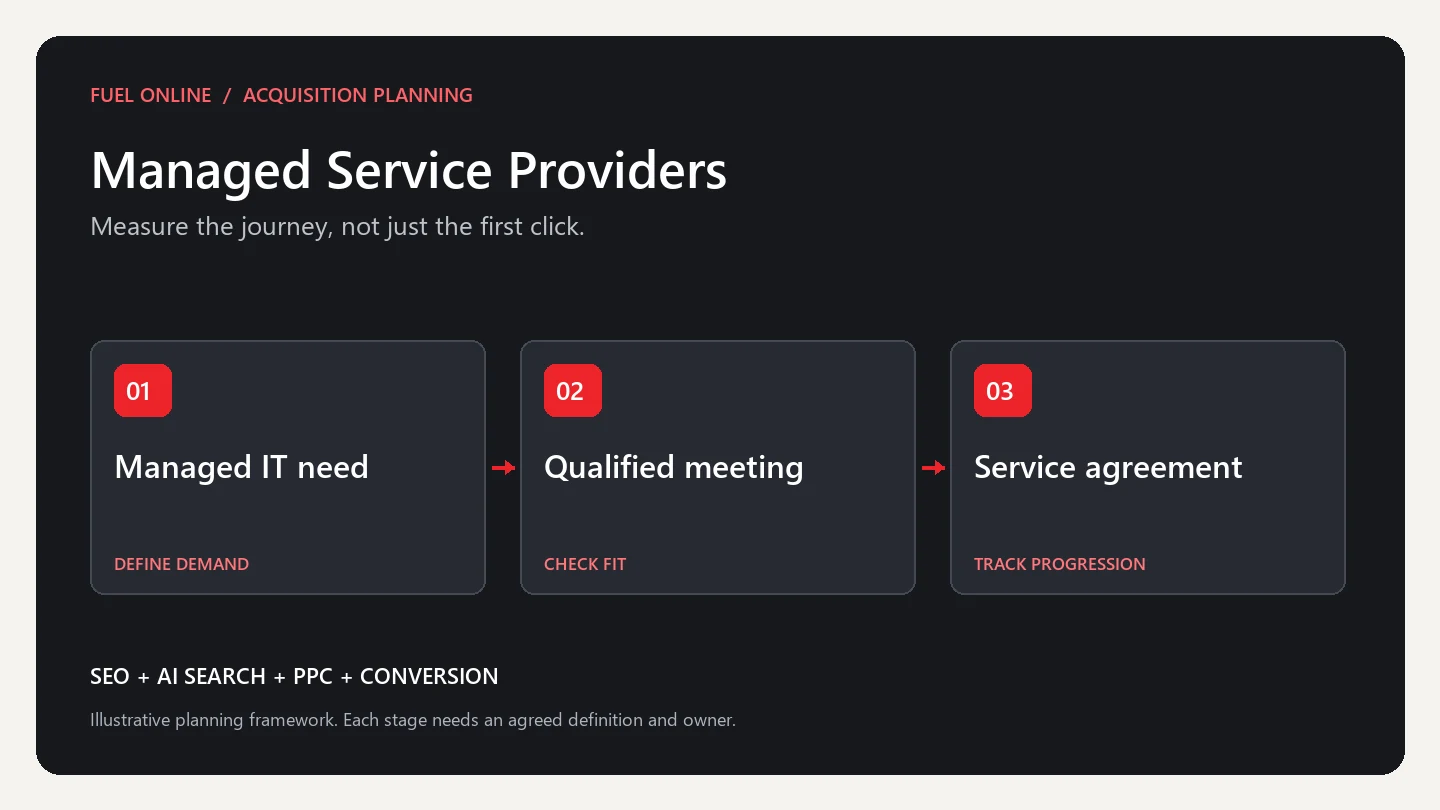
What MSP marketing agency changes for managed services demand
The problem is rarely a missing channel. It is a broken link between audience, promise, evidence, page, and follow-up. Fuel gives each channel a job in winning discovery calls with businesses that fit the service model and uses company size, endpoints, environment, security responsibility, geography, contract fit, and onboarding window to keep the message consistent.
Organic search handles durable discovery, paid media tests controllable demand, and decision content supports evaluation. Every path uses supported technologies, documented service scope, escalation process, onboarding requirements, and permissioned customer evidence and carries company size, locations, environment, support model, security need, current provider, and timing into the receiving workflow.
A practical MSP digital diagnostic
Use this diagnostic when digital activity improves but the receiving team does not see a comparable change in qualified discovery calls. The diagnostic for MSP marketing agency starts with the observable symptom, checks the page, source, campaign, or handoff responsible for it, and ends with one reviewed action, owner, and validation method.
Observable symptom
Channel reports improve while qualified discovery calls stay flat and requests closer to 'laptop repair near me' keep consuming follow-up time.
What to inspect in MSP digital marketing
Compare the channel promise with the landing page, form or call path, follow-up owner, and final business outcome.
Decision criteria for digital marketing for managed service providers
Reassign the channel, revise the page, repair the route, or stop the activity based on the broken stage.
Inspectable output
A channel decision with a named page or handoff change, owner, release date, and measure tied to qualified discovery calls.
Digital marketing for managed service providers deliverables you can inspect
The team receives a journey map, page and campaign backlog, measurement specification, release log, and ownership record for every digital change.
- Channel role and budget map, used to define the MSP marketing agency scope.
- Priority plan for service, vertical, technology, security, onboarding, and comparison pages, used to govern the MSP digital marketing release.
- Campaign exclusions and landing-page requirements, used to evaluate the digital marketing for managed service providers decision.
- Conversion, routing, and tracking specification
- Weekly operating and monthly commercial review
Illustrative managed services example
Illustrative example, not a client result: An operations leader reaches a generic IT support page that never explains account size, coverage, support model, or security fit. Fuel would trace the entry page, proof viewed, next action, fields, routing, and final disposition, then repair the first break rather than redesigning the whole site without evidence.
The MSP digital marketing release would include the revised page or path, measurement event, receiving owner, and validation record. The test stays only if it improves the journey toward qualified discovery calls.
Within digital marketing for managed service providers, the buyer team can inspect the artifact, approval, and next investment decision.
How commercial progress is judged
Fuel connects page, query, campaign, or source context with acceptance, rejection reasons, response, capacity, and sales-accepted meetings, recurring-contract opportunities, account-fit rate, and pipeline by service area. Diagnostic measures explain where the journey breaks; they do not replace the business outcome.
The decision record for MSP marketing agency states what changed, why it changed, who approved it, and whether the next action is to expand, revise, consolidate, or stop.
Reporting for digital marketing for managed service providers must connect the service-specific diagnostic to qualified discovery calls, explain data limits, and name the next decision rather than treating activity as proof of value.
Questions to ask a managed services agency
Ask to see a journey map, release ticket, and measurement specification. Confirm who changes the site, campaigns, analytics, forms, CRM connection, and quality feedback loop.
When reviewing MSP marketing agency, require a named practitioner, implementation owner, approval path, and sample artifact. Reject unsupported promises of rankings, citations, lead volume, cost, or revenue.
How we measure MSP digital marketing
- sales-accepted meetings
- recurring-contract opportunities
- account-fit rate
- pipeline by service area
Compare channels using the same qualification rules
Cost per qualified inquiry = attributable channel spend ÷ inquiries meeting the agreed criteria.
Keep the reporting window and included costs consistent. A cheaper contact is not necessarily a cheaper customer; compare later progression where the data supports it.
Agree on the baseline, data source and qualification criteria before comparing results. Separate visibility from inquiries and accepted business opportunities.
CONNECTED SERVICES
Choose the right next step for your business
Explore Fuel’s Digital marketing capabilities, published campaign work and team to evaluate how we would support your organization.
BEFORE YOU CHOOSE AN AGENCY
Questions about MSP digital marketing
What changes first in a digital marketing engagement?
During the first month, the MSP marketing agency scope produces a journey map, page and campaign backlog, measurement specification, and the first release ticket. Fuel also records the client inputs and approval needed for the first release.
What does Fuel need from our managed services team?
Effective MSP digital marketing work requires site, campaign, analytics, form, and CRM access plus reviewers, approved proof, capacity limits, and accepted or rejected inquiry feedback. Fuel identifies missing access or ownership before work is scheduled around it.
How will we know the work is commercially useful?
Under digital marketing for managed service providers, commercial usefulness depends on whether the diagnostic connects to qualified discovery calls, the data limits are stated, and the evidence supports a clear keep, revise, or stop decision.
Do we need every digital channel at once?
Start with the break closest to qualified discovery calls, not a predetermined channel. The diagnostic for MSP marketing agency may prioritize the page promise, proof, form, measurement, route, or response owner before recommending more acquisition.
What does a credible MSP digital marketing scope include?
A credible MSP digital marketing scope includes journey mapping, page and campaign priorities, measurement, implementation ownership, release validation, and inquiry-quality feedback. It also names the client dependencies, practitioner, deliverable, and approval path.
How should digital marketing for managed service providers report commercial progress?
Reporting under digital marketing for managed service providers should connect the service-specific diagnostic to qualified discovery calls, show what changed and why, state data limits, and name the next decision.
Make your next agency conversation specific.
Bring the channel, page, or follow-up problem preventing more qualified discovery calls. The first working session on MSP digital marketing will identify the priority artifact, evidence, owner, and approval decision for qualified discovery calls.
Talk with a Fuel strategist →