FUEL ONLINE / Industrial Automation Firms / PPC & Google Ads
Industrial Automation PPC and Google Ads Agency

An industrial automation firm needs technically credible RFQs, not component research and vague innovation traffic that never reaches engineering discovery. As an industrial automation PPC agency, Fuel Online uses controlled campaigns, exclusions and landing pages to buy serviceable intent. Pages, campaigns and handoffs use application, installed environment, technical scope and timing to separate fit, and reporting follows qualified RFQs and sales-accepted opportunities.
application, existing equipment, technical requirements, project location and timing
Compare automation PPC through provider-service scope and RFQ-stage evidence
Fuel Online connects industrial automation paid campaigns with the firm's actual service scope, application information, provider relationships and RFQ process. Compare an industrial automation PPC agency through worked project-service and component-research tasks before a cost forecast. Related technology phrases can represent different commercial purposes. A useful proposal identifies the selected task, source behind the message and event counted in reporting, making its assumptions inspectable before campaign coverage expands or a technical interaction is described as a sales-accepted opportunity.
Select the provider task using actual published scope
Give finalists a sample search sheet grounded in firm-supplied service resources. Include a project-service question, component-oriented wording and a known-provider query. Ask what each suggests and what remains uncertain. A familiar technology term does not establish one universal buyer purpose or the firm's relationship with every associated environment. The agency should explain the selected account role and destination without inventing compatibility or a delivery commitment from a short query.
Read a proposed message beside the complete maintained passage supporting it. A provider service explanation establishes the firm's published offering; vendor material may explain a product; a named case resource has its own supplied context. Ask which supports the advertisement and why. A shorter format should retain those source roles. A logo or recognizable component image should not silently become evidence for a broader service, certification or project result.
Application language can help the reader understand the firm's actual offering when its source is explicit. Ask which statements come from the provider and which remain a sender or vendor description. The agency's useful contribution is a clear message-to-source relationship and completed implementation. It does not need to supply technical configuration guidance to make the campaign specific. The firm retains its actual engineering and commercial scoping process for individual requests.
| Paid task | Source to inspect | Decision artifact |
|---|---|---|
| Project service | Current provider offering and application context. | Query-to-message-to-destination example. |
| Product research | Vendor description versus provider relationship. | Specific account decision with its source basis. |
| Known provider | What purpose can available records identify? | Activity separated from inferred acquisition. |
| Reported cost | Defined RFQ or later business stage. | Reproducible correction and continuing-record treatment. |
Make the destination support the paid purpose
Trace one included project-service task from advertisement to full destination and supported action. Ask an unfamiliar reviewer what the page establishes and what they believe happens next. Compare that interpretation with the firm's process. An accurate message can still lead to an unclear transition. A useful remedy identifies the service introduction, source connection or RFQ action label needing work and names the artifact that changes. The completed check should demonstrate the intended administrative meaning.
A dedicated application page creates source dependencies. Ask which service, vendor-reference and case resources supply its facts and who maintains the destination. Another supplier may control part of the website. A management engagement producing messages differs from one implementing and maintaining destinations. The proposal should show what remains usable after each component and which evidence establishes the complete public path. Similar account labels do not settle those implementation responsibilities.
Use a case-led message as a comparison. Ask what the supplied project context establishes and how it connects with current service scope. An accurate example can remain useful without becoming a universal capability or result promise. The agency should preserve the original relationship while helping the reader understand why the example belongs. This gives the buyer a concrete creative acceptance task grounded in source meaning, not an inference from the appearance of technical equipment.
Keep known-provider and product tasks interpretable
Known-provider searches can involve service research, administrative contact or continuation of an earlier project conversation. The records may not identify every purpose. Ask how the agency organizes this activity and reports its limits. Branded interaction should not automatically become newly acquired project demand. The proposal should identify the account's selected role and evidence supporting its interpretation, keeping campaign purpose separate from assumptions about each person arriving through it.
Introduce a component-research question outside the exercise's selected service scope. Ask for the account decision and maintained source supporting it. The firm supplies its actual offering and supported routes. The agency should not invent another service to make the campaign appear comprehensive. A scope decision or different destination can have a specific business rationale, and the retained record should explain that rationale without treating every weak interaction as the same problem.
A relevant service query reaching an unclear explanation differs from another task reaching an accurate page outside the selected paid purpose. Ask for the wording, provider interpretation, proposed change and reason. The remedy may concern scope or destination clarity. A useful recommendation identifies the particular artifact and completed check behind the next assignment. This gives ongoing management more substance than a general promise to optimize weak traffic without showing the decision logic.
Compare costs with equivalent RFQ-stage definitions
Define the denominator before comparing cost. A button interaction, observed call, identifiable RFQ, reviewed opportunity and sales-accepted stage establish different things. Ask which the agency configures and which records the firm can inspect. A lower reported cost may reflect an earlier event. Give every finalist the same ordinary-language example so measurement responsibilities are comparable before a headline projection becomes the principal selection argument.
Provide fictional records containing a new application inquiry, correction and continuing project conversation. Ask which totals each contributes to and which connection can be made with receiving records. Unknown relationships should remain visible. The agency can demonstrate reproducible logic without invented results. The receiving team then has a shared vocabulary for why account activity differs from accepted-opportunity information in its own system.
Project context can change after the first inquiry. Ask how the proposed report represents a revised sender description or corrected administrative detail where the actual configuration supports that relationship. The rule should distinguish an updated representation, repeated event and another independent inquiry. The useful scope explains the available connection. It should not silently multiply potential projects because several interactions occurred through supported routes.
Retain source changes and next-investment reasoning
Introduce a firm-supplied service or provider-reference revision in the review materials. Ask which messages, destinations and settings depend on the earlier information. A distribution adjustment does not automatically update the public page a returning person sees. The agency should identify the account treatment and source task separately while preserving accurate unrelated work. Retain the fact prompting another review so temporary settings remain understandable at handover.
An initial paid test should answer a named information question. A clearer introduction may help a reader distinguish provider services from product documentation. Specify the source, message change and receiving evidence to inspect. If several major components change together, record what the result cannot separate. The firm can assess the implemented journey without attributing every difference to one preferred explanation or requiring a fabricated project-value forecast to justify the exercise.
Compare management, creative adaptation, destination production, measurement configuration and media budget as separate contributions. Ask what the agency delivers and what another supplier must complete. A prepared destination differs from a tested full path. The buyer should understand the actual implementation and source maintenance included without invented universal cost benchmarks or promised numbers of accepted projects. Clear responsibilities are commercially useful while later outcomes remain dependent on the firm's review.
At handover, ask a new manager to trace a project-service task and known-provider task through the retained materials. They should identify the source, arrival resource, public action and counting limit. Add a source revision and ask for affected decisions. This gives future automation paid work a reusable account standard, allowing investment to follow a particular scope, source or transition need while engineering and service commitments remain within the provider's process.
Compare a source-supported paid brief with an unresolved relationship
Use two fictional account briefs for a final scope comparison. One promotes a provider service using the maintained offering; the other repeats a vendor-product phrase whose delivery relationship is not established by the provider source. Ask which brief is ready for a destination test and which needs firm input before the message can be supported. The agency should name the exact missing relationship and proposed artifact. This makes a decision to clarify, defer or narrow paid coverage understandable without relying on a forecast. Retain the paired briefs with the source map. A new manager should identify why the service message was accepted and what information would justify reconsidering the other task, keeping future budget discussions connected with supplied provider facts.
For relevant paid journeys that lose stated application context at contact, industrial-automation RFQ continuity can inspect the public action and received record.
AGGRESSIVE FROM THE START
One month. The work many agencies stretch across three.
Our mandate: move faster, go deeper and put experienced specialists to work immediately.
Fuel attacks the work in parallel: site audits, technical errors, new content, internal links, backlink outreach and conversion improvements. Your agreed scope determines the channels; urgent fixes do not wait behind a drawn-out planning phase.
The industrial automation PPC agency brief identifies visibility and lead barriers. Actionable fixes move into production while deeper analysis continues.
Your industrial automation Google Ads work runs alongside industry-specific content, relevant links and earned-authority outreach, based on your agreed scope.
The industrial automation PPC review shows completed work, lead quality and the next opportunities. You see who owns each action.
Fast execution is the operating standard. Access, approvals and scope shape delivery; search and revenue results have their own timelines.
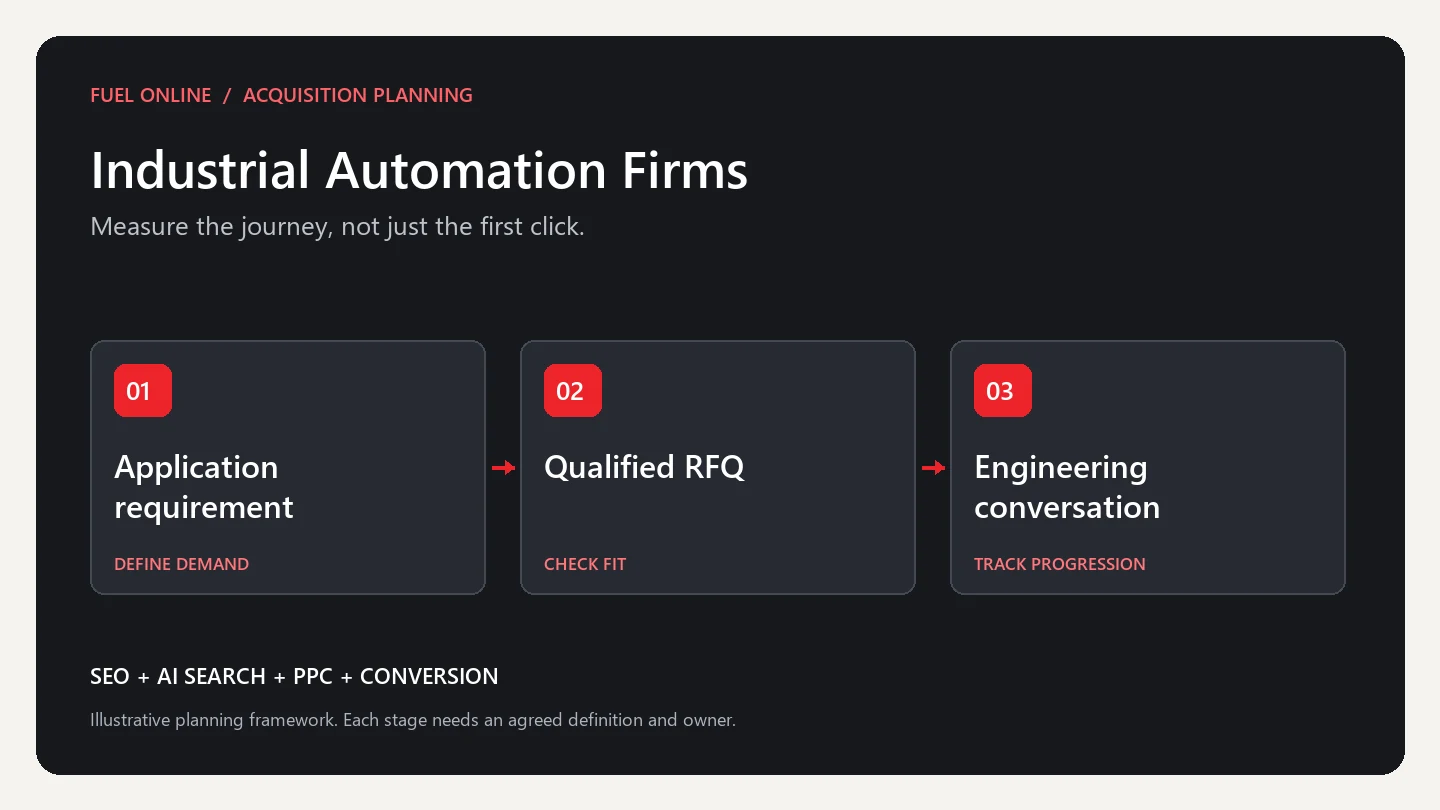
What the industrial automation PPC agency scope needs to solve
Paid search targets plant leaders, engineers, operations teams, OEMs and procurement groups only where the company can satisfy the underlying need. Campaign planning begins with whether the firm has relevant controls or integration capability, can work in the installed environment and can support the project scope and timing.
The negative and exclusion plan blocks component-only research, manuals, training, careers, unsupported platforms and requests without a viable integration or modernization need. Geography, schedule, device and audience controls are used only when they reflect the real operating model rather than a platform suggestion.
The first decision in an industrial automation PPC agency engagement is whether the buyer, request and next step fit the business.
Decision map for industrial automation Google Ads
The launch package contains a campaign map, keyword and negative lists, approved ads, budget rules, location settings, landing pages, call and form tracking, conversion definitions and account access for the client.
Each landing page makes the important fit facts visible and supports this handoff: collect application, facility, installed equipment, technical requirement, specification status, location, timing and buying role before sales and engineering discovery. It uses approved technical diagrams, verified capabilities, documented project scope, permissioned case evidence and named engineering reviewers without turning evidence into a guarantee.
The page and handoff map makes industrial automation Google Ads inspectable before production expands.
Operational requirements for industrial automation PPC
Raw calls and forms are separated from qualified RFQs, sales-accepted opportunities, pipeline by application and opportunity-to-project rate. Staff dispositions identify duplicates, spam and poor fit so bidding does not learn from the wrong outcome.
Fuel Online documents which conversion enters automated bidding, how it is validated and what happens if volume is too low or tracking breaks. Search terms are reviewed before budget expands.
The operating standard for industrial automation PPC names the approved source, reviewer and next buyer action.
Illustrative paid-search example
This is an illustrative paid search decision, not a client result. The industrial automation Google Ads choice is shown so a buyer can inspect the logic before approving similar work.
The paid search decision
An engineer researching a replacement PLC needs compatibility and discovery information. A plant leader planning a line-wide controls upgrade needs application context, risk questions and an RFQ path that reaches engineering. For industrial automation Google Ads, the team should separate ad groups, exclusions, landing pages and conversion actions so unlike requests do not compete for the same budget. The industrial automation PPC agency plan should state why this is the first priority.
What the buyer can inspect
Campaigns, negatives and landing pages can then reflect the economic and operational difference between the requests. The decision record ties the industrial automation Google Ads change to an industrial automation PPC deliverable, owner and release check.
How to audit an industrial automation PPC agency plan
Use this framework when activity looks healthy but the commercial result is unclear. It turns a visible symptom into an evidence check, a bounded change and a deliverable the business can verify. The diagnostic for the industrial automation PPC agency plan keeps the symptom, evidence check, action and output in one decision record.
1. Observable symptom
RFQ forms collect component research and vague project descriptions that sales and engineering cannot qualify efficiently.
2. What to inspect
Inspect search terms, negatives, location settings, landing-page language and staff disposition. Confirm that the campaign can distinguish application, existing equipment, technical requirements, project location and timing before bids or budget expand. This evidence check shows whether industrial automation Google Ads reflects the real offer and handoff.
3. Decision and action
Add the exclusion or page qualification that blocks the mismatch, verify the downstream conversion signal and keep the affected segment constrained until accepted demand is visible.
4. Inspectable output
A change record covering the search term or audience, negative or setting, landing page, conversion definition, budget gate and effect on qualified RFQs and sales-accepted opportunities.
Deliverables and reporting for industrial automation PPC
Ask who owns the account, who approves search terms and ads, how negatives are maintained, how landing pages are changed and how offline stages are reported as qualified RFQs, sales-accepted opportunities, pipeline by application and opportunity-to-project rate.
The agency should state its response to rising cost, falling qualification, tracking loss and capacity changes. A review that ends with impressions and form totals leaves the commercial question unanswered.
For Industrial Automation Firms, the paid-search scope documents how application, existing equipment, technical requirements, project location and timing affect page, campaign or routing decisions. Before release, the assigned business reviewer checks approved technical diagrams, verified capabilities, documented project scope and permissioned case evidence against every visible claim and records any dependency that remains unresolved.
The monthly review for industrial automation PPC compares completed work with accepted demand and identifies the next commercial decision.
- Client-owned campaign map with budget rules
- Approved keywords, negatives and search-term review cadence
- Landing-page plan that can collect application, facility, installed equipment, technical requirement, specification status, location, timing and buying role before sales and engineering discovery
- Call, form and downstream conversion specification
- Optimization scorecard for qualified RFQs, sales-accepted opportunities, pipeline by application and opportunity-to-project rate
How we measure industrial automation Google Ads
- qualified RFQs
- sales-accepted opportunities
- pipeline by application
- opportunity-to-project rate
Use a cost metric that reflects qualified demand
Cost per qualified inquiry = campaign spend ÷ inquiries meeting the agreed criteria.
Define the included spend, reporting window and qualification rules before comparing campaigns. Track raw leads separately so cheaper but unsuitable inquiries do not make performance look better.
Agree on the baseline, data source and qualification criteria before comparing results. Separate visibility from inquiries and accepted business opportunities.
CONNECTED SERVICES
Choose the right next step for your business
Explore Fuel’s PPC & Google Ads capabilities, published campaign work and team to evaluate how we would support your organization.
BEFORE YOU CHOOSE AN AGENCY
Questions about industrial automation Google Ads
Where should an industrial automation PPC agency plan start?
Start where the business can see a costly mismatch: RFQ forms collect component research and vague project descriptions that sales and engineering cannot qualify efficiently. An industrial automation PPC agency review should trace one real example from its source through the page or campaign and into the receiving team's disposition. Inspect search terms, negatives, location settings, landing-page language and staff disposition. Confirm that the campaign can distinguish application, existing equipment, technical requirements, project location and timing before bids or budget expand. The first industrial automation PPC agency action should produce a named owner, a bounded correction and a release check rather than a broad activity list.
What does industrial automation Google Ads include?
Fuel Online confirms service and location eligibility, exclusions, budgets, landing-page facts, tracking and the handoff needed to collect application, facility, installed equipment, technical requirement, specification status, location, timing and buying role before sales and engineering discovery. An industrial automation Google Ads scope should name the owner, deliverable, dependency and review gate.
How do we measure industrial automation PPC?
Agree on definitions and data sources for qualified RFQs, sales-accepted opportunities, pipeline by application and opportunity-to-project rate before launch. Channel metrics explain what happened upstream, while staff disposition and downstream stages show whether the work created demand the business could accept. Measure industrial automation PPC through the accepted commercial stages the receiving team can verify. Reporting for industrial automation PPC should show the source, stage definition, owner and limitation behind each decision metric.
What should an industrial automation firm ask before hiring an agency?
Ask who will perform the work, who owns the accounts and data, what is delivered in the opening execution sprint, how facts are reviewed, how rejected inquiries change the plan and which decision would cause the agency to pause or expand investment. Compare an industrial automation PPC agency engagement with other proposals by inspecting the proposed work, account ownership and response to rejected demand.
Who should own our advertising account and data?
The client should retain appropriate administrative access to the account, billing, audiences, conversion definitions and historical data. The scope should state who can change campaigns, who approves landing pages and how access is transferred if the engagement ends. For industrial automation Google Ads, document access, approvals and handoffs across internal and agency roles.
What should we bring to a PPC review?
Bring the current account, billing and analytics access, service and location priorities, capacity and unit economics, landing pages, call handling details and accepted-versus-rejected inquiry data. Those inputs determine whether the first need is tracking repair, exclusion work, page improvement or a controlled campaign test. A useful industrial automation PPC scope starts with current offers, capacity, evidence and examples of accepted and rejected inquiries.
Make your next agency conversation specific.
Tell us which services or markets matter to your industrial automation business, which inquiries your team accepts, and where the current paid-search program breaks down. Bring one accepted and one rejected example. Fuel Online will help identify the first page, campaign, answer or handoff worth changing. Use the working session to define one industrial automation PPC action with a source, owner, release check and downstream measure.
Talk with a Fuel strategist →