
FUEL ONLINE / Industrial Automation Firms / Digital marketing
Industrial Automation Digital Marketing Agency

An industrial automation firm needs technically credible RFQs, not component research and vague innovation traffic that never reaches engineering discovery. As an industrial automation digital marketing agency, Fuel Online coordinates the website, search, paid media and follow-up around one definition of useful demand. Pages, campaigns and handoffs use application, installed environment, technical scope and timing to separate fit, and reporting follows qualified RFQs and sales-accepted opportunities.
application, existing equipment, technical requirements, project location and timing
Choose industrial-automation marketing around a defined project-evaluation journey
Choose an industrial-automation marketing agency by comparing one complete project-evaluation journey across its proposed channels. The initial message, capability explanation, documentation context and commercial-contact action should form a coherent path. A useful release shows what the buyer understands and what the receiving team sees afterward. This makes actual implementation comparable across agencies with similar channel lists, rather than assuming that search, advertising, content and reporting automatically establish coordination.
Choose the application-evaluation journey
Begin with the application conversation the company selects. Someone identifying an offered service, exploring a documented project and preparing a commercial inquiry may need different orientation. Ask which journey leads the release and why. The company supplies its actual capabilities and administrative routes. The agency should not invent an equipment relationship or strengthen an example into a performance promise simply because a broader campaign introduction appears more persuasive.
Map the journey using the message, maintained resource, destination, public action and receiving role. Record what each step establishes. A documentation visit, project inquiry and later technical or commercial stage require different evidence. The agency should preserve these meanings while explaining how the channels contribute. The proposal becomes inspectable when the company can trace transitions and identify dependencies rather than count assets carrying consistent branding.
Capability descriptions should retain the company's published scope. Ask which source passage supports a short introduction and where fuller context belongs. Manufacturer information and the company relationship with it establish different facts. A shared source sheet gives the business a practical review tool across formats. The agency can make the reading path clearer without creating compatibility, certification or performance claims to make the campaign look more complete.
| Release component | Artifact to compare | Useful result |
|---|---|---|
| Application task | The selected conversation connects capability sources with the supported commercial-contact action. | The campaign does not invent compatibility or strengthen a project example into a universal result. |
| Documentation relationship | Maintained sources retain version and specification context used in related introductions. | A future update can be traced to particular dependent statements and links. |
| Receiving transition | The invitation, confirmation and record are tested together using fictional administrative details. | An inquiry stays distinct from an approved technical solution or accepted project. |
| Continuity case | The supported relationship between revised references and earlier messages is documented. | Repeated interactions do not silently become multiple new commercial opportunities. |
Connect capabilities, references and commercial contact
Project examples need their authorized role. Ask which supplied facts the example demonstrates and how they connect with the service explanation. A diagram or image should not become proof of every possible application. The agency should preserve the original context when shortening a caption or introduction. A more dramatic visual does not resolve missing information about the commercial scope the company actually offers.
Documentation context should remain explicit where it affects meaning. A dated item can retain historical value without establishing a current capability statement. Ask how the selected journey connects with the maintained source and which introductions depend on it. This makes future changes more manageable than several independent summaries using different versions of a technical phrase. The company supplies what has changed; the agency organizes the public update relationships.
The commercial action should describe the company's actual administrative process. A request to discuss an application does not establish a completed specification review or accepted project. Ask the agency to compare the invitation, confirmation and receiving record. The useful meaning should remain consistent. Marketing should not add technical acceptance criteria or operational promises simply to make a form feel more qualified or a response message sound more reassuring.
For a worked comparison, give finalists the same capability resource, project example and current contact route. Ask which messages and destination changes they would deliver and what the receiver should recognize. Identify components another supplier controls. A ready draft differs from a published resource and checked record. The release plan should name the dependency and completion evidence so the company can coordinate implementation without treating approved creative as an operating journey.
Test specification context through receiving interpretation
Use fictional administrative details to rehearse the selected path. Follow the message and source, complete the supported action and inspect the received record. Ask the receiving role to explain the request in ordinary language. Compare that interpretation with the invitation. The test should establish that application and stated specification context survive without silently becoming a technical assessment, approved solution or commercial commitment.
A revised project reference provides a useful continuity case. Ask how the receiving process identifies an updated document or changed specification status where those inputs are supported. The agency should describe the actual record relationship rather than assume every interaction can be joined automatically. The company decides what information belongs initially. The marketing scope concerns readable labels and preserved context, not an engineering review of the supplied material.
Continuing customer or other supported contacts should retain recognizable routes. Someone may arrive through a new-project destination while trying to continue another conversation. Ask how they identify the company's maintained instructions. The agency can improve orientation without designing a new support operation. Reporting should preserve the purpose where records allow instead of automatically classifying every campaign-page interaction as newly acquired commercial demand.
Reporting should distinguish observed interactions, identifiable inquiries and later company stages where records support them. Ask for a sample behind each metric and the rule for repeated contacts. A source label can explain arrival without establishing technical fit or a future contract. Keep those meanings separate. The receiving team can then compare the report with its conversations and identify whether a difference concerns definitions, continuity or later information unavailable to marketing.
Maintain the release after source changes
Introduce a company-supplied capability or documentation update in the review materials. Ask which active messages, saved destinations and recurring introductions depend on it. The agency should identify particular edits and distinguish its work from another owner's responsibility. Pausing distribution does not explain what someone sees on an older saved page. The maintained public path should stay coherent after the campaign emphasis or underlying company information changes.
At handover, retain the journey map, source dependencies, event definitions and completed receiving tests. Ask an employee outside the original team to follow an evaluation task using only those materials. They should find the current source and explain the public action without an agency-only label. If private project knowledge carries the meaning, clarify that point. The retained examples then support future destination or record-format changes.
Choose the next assignment from an observed source or transition gap. An unclear capability introduction needs writing, lost project context needs implementation and unavailable later status needs a definition discussion. Preserve accurate resources while making the specific repair. This gives industrial-automation marketing an inspectable release standard grounded in actual company information rather than automatic activity expansion or unsupported promises about technical and commercial outcomes.
For the release comparison, ask each finalist to outline two buyer paths using the same approved material. One starts from a capability question; the other starts from a documented project. Which introduction differs, which facts remain shared and what should the receiver recognize? A useful answer identifies the different information need rather than simply changing a campaign label. The company can compare a new destination with a clearer connection to maintained resources before accepting additional publishing and update responsibility.
Next, remove an assumed implementation component from the exercise. Another supplier may need to configure the received project-context field. Ask which work can progress and which acceptance test remains incomplete. Source-linked creative and a test specification can be ready without the whole public journey being operational. Naming that boundary lets the company coordinate the dependency and compare agency scope through actual artifacts rather than assume an attractive destination proves its context reaches the receiving team.
Keep the paired paths and completed record examples with the handover. An incoming employee should explain the audience task, source and next administrative action without reconstructing the project meetings. This gives later production a practical standard for reuse and helps the company select further work from a concrete information or continuity gap. The value is a maintainable evaluation journey, not another group of assets whose commercial purpose becomes unclear after the original producer leaves.
For the related company-wide scope, explore industrial automation marketing.
AGGRESSIVE FROM THE START
One month. The work many agencies stretch across three.
Our mandate: move faster, go deeper and put experienced specialists to work immediately.
Fuel attacks the work in parallel: site audits, technical errors, new content, internal links, backlink outreach and conversion improvements. Your agreed scope determines the channels; urgent fixes do not wait behind a drawn-out planning phase.
The industrial automation digital marketing agency brief identifies visibility and lead barriers. Actionable fixes move into production while deeper analysis continues.
Your industrial automation digital marketing work runs alongside industry-specific content, relevant links and earned-authority outreach, based on your agreed scope.
The industrial automation marketing agency review shows completed work, lead quality and the next opportunities. You see who owns each action.
Fast execution is the operating standard. Access, approvals and scope shape delivery; search and revenue results have their own timelines.
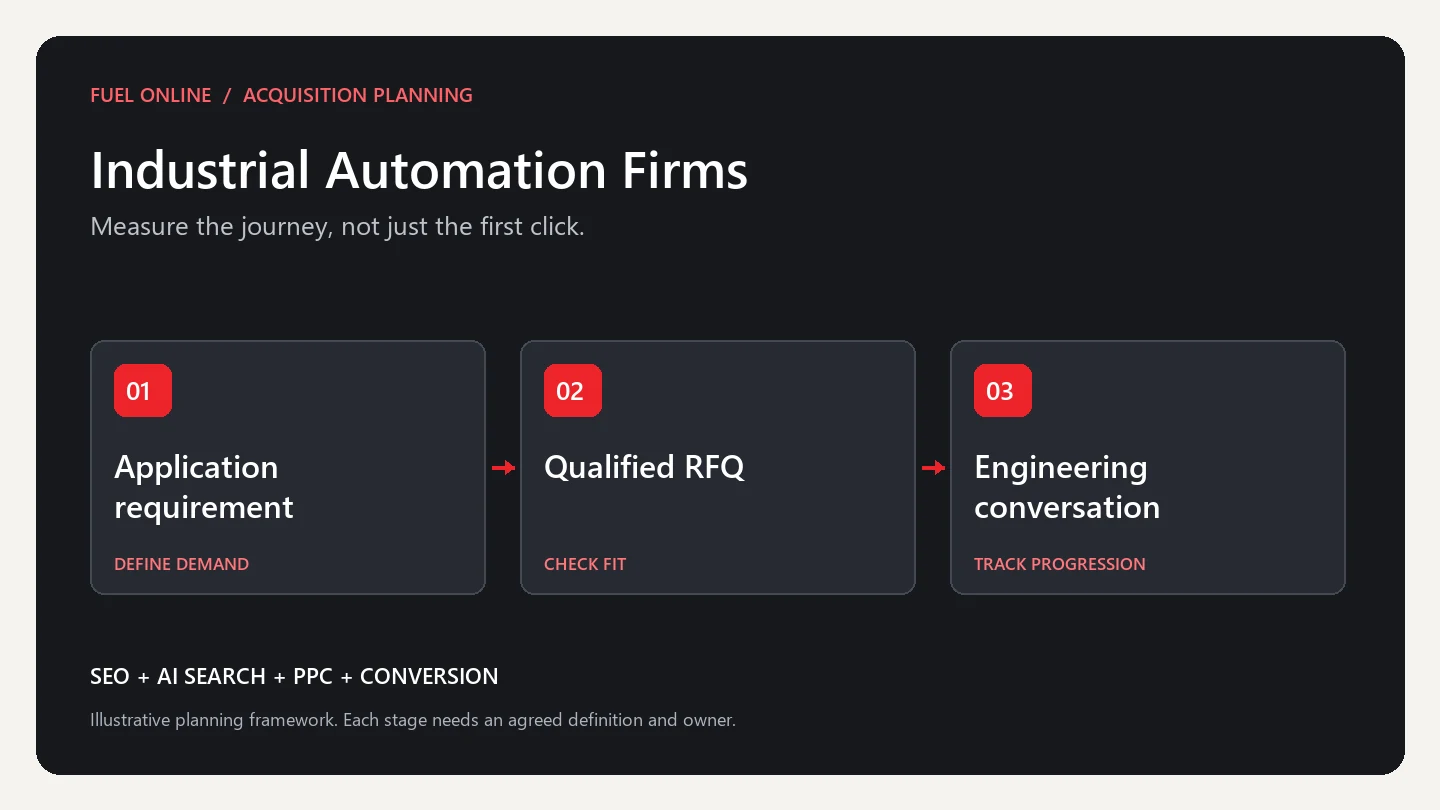
What the industrial automation digital marketing agency scope needs to solve
An industrial automation firm needs more than a list of channels. Plant leaders, engineers, operations teams, oems and procurement groups move between search results, location or service pages, proof and direct contact while deciding whether the firm has relevant controls or integration capability, can work in the installed environment and can support the project scope and timing.
Fuel Online maps that journey and assigns a job to the website, SEO, paid media, content and follow-up. The plan also identifies who inside the business approves facts and receives each type of inquiry.
The first decision in an industrial automation digital marketing agency engagement is whether the buyer, request and next step fit the business.
Decision map for industrial automation digital marketing
The build priority is controls integration, robotics, machine vision, SCADA, line upgrades, supported industries, technical resources and application-specific RFQ pages. Pages use approved technical diagrams, verified capabilities, documented project scope, permissioned case evidence and named engineering reviewers to answer practical objections.
Forms and calls support this handoff: collect application, facility, installed equipment, technical requirement, specification status, location, timing and buying role before sales and engineering discovery. Navigation follows buyer choices, not marketing-department labels, and the confirmation message states the real response expectation.
The page and handoff map makes industrial automation digital marketing inspectable before production expands.
Operational requirements for industrial automation marketing agency
Organic and paid campaigns share the same availability, geography and qualification facts. Search-term and inquiry reviews actively remove component-only research, manuals, training, careers, unsupported platforms and requests without a viable integration or modernization need.
Fuel Online maintains a channel calendar that names the audience, offer, page, owner, budget or production effort, and success condition for each test. A channel does not stay active merely because it generates inexpensive activity.
The operating standard for industrial automation marketing agency names the approved source, reviewer and next buyer action.
Illustrative channel example
This is an illustrative digital marketing decision, not a client result. The industrial automation digital marketing choice is shown so a buyer can inspect the logic before approving similar work.
The digital marketing decision
An engineer researching a replacement PLC needs compatibility and discovery information. A plant leader planning a line-wide controls upgrade needs application context, risk questions and an RFQ path that reaches engineering. For industrial automation digital marketing, the team should name the channel that introduces each buyer, the page that qualifies the request and the owner responsible for follow-up. The industrial automation digital marketing agency plan should state why this is the first priority.
What the buyer can inspect
The website, campaign and follow-up path can now share one qualification rule while presenting the detail each buyer needs. The decision record ties the industrial automation digital marketing change to an industrial automation marketing agency deliverable, owner and release check.
How to audit an industrial automation digital marketing agency plan
Use this framework when activity looks healthy but the commercial result is unclear. It turns a visible symptom into an evidence check, a bounded change and a deliverable the business can verify. The diagnostic for the industrial automation digital marketing agency plan keeps the symptom, evidence check, action and output in one decision record.
1. Observable symptom
RFQ forms collect component research and vague project descriptions that sales and engineering cannot qualify efficiently.
2. What to inspect
Trace one accepted and one rejected inquiry across source, landing page, form or call, routing and follow-up. Check whether every channel uses the same facts about application, existing equipment, technical requirements, project location and timing. This evidence check shows whether industrial automation digital marketing reflects the real offer and handoff.
3. Decision and action
Align the page, campaign and receiving team around one qualification rule. Remove conflicting facts, assign the handoff owner and release the smallest useful cross-channel test.
4. Inspectable output
A journey map and test ticket that show the channel, page, qualification rule, receiving owner and the accepted outcome represented by qualified RFQs and sales-accepted opportunities.
Deliverables and reporting for industrial automation marketing agency
The commercial scorecard uses qualified RFQs, sales-accepted opportunities, pipeline by application and opportunity-to-project rate. Fuel Online reconciles campaign and website data with the system where staff accept, reject or progress real inquiries.
A useful review states what changed, what the downstream data shows, what remains uncertain and what happens next. Agency selection should cover account ownership, review cadence, senior involvement, data access and the response when inquiry volume rises but accepted demand does not.
For Industrial Automation Firms, the digital program documents how application, existing equipment, technical requirements, project location and timing affect page, campaign or routing decisions. Before release, the assigned business reviewer checks approved technical diagrams, verified capabilities, documented project scope and permissioned case evidence against every visible claim and records any dependency that remains unresolved.
The monthly review for industrial automation marketing agency compares completed work with accepted demand and identifies the next commercial decision.
- Journey and page map for controls integration, robotics, machine vision, SCADA, line upgrades, supported industries, technical resources and application-specific RFQ pages
- Channel roles with a named audience, offer and owner
- Test backlog with budget and decision gates
- Handoff specification that can collect application, facility, installed equipment, technical requirement, specification status, location, timing and buying role before sales and engineering discovery
- Reporting framework for qualified RFQs, sales-accepted opportunities, pipeline by application and opportunity-to-project rate
How we measure industrial automation marketing agency
- qualified RFQs
- sales-accepted opportunities
- pipeline by application
- opportunity-to-project rate
Compare channels using the same qualification rules
Cost per qualified inquiry = attributable channel spend ÷ inquiries meeting the agreed criteria.
Keep the reporting window and included costs consistent. A cheaper contact is not necessarily a cheaper customer; compare later progression where the data supports it.
Agree on the baseline, data source and qualification criteria before comparing results. Separate visibility from inquiries and accepted business opportunities.
CONNECTED SERVICES
Choose the right next step for your business
Explore Fuel’s Digital marketing capabilities, published campaign work and team to evaluate how we would support your organization.
BEFORE YOU CHOOSE AN AGENCY
Questions about industrial automation marketing agency
Where should an industrial automation digital marketing agency plan start?
Start where the business can see a costly mismatch: RFQ forms collect component research and vague project descriptions that sales and engineering cannot qualify efficiently. An industrial automation digital marketing agency review should trace one real example from its source through the page or campaign and into the receiving team's disposition. Trace one accepted and one rejected inquiry across source, landing page, form or call, routing and follow-up. Check whether every channel uses the same facts about application, existing equipment, technical requirements, project location and timing. The first industrial automation digital marketing agency action should produce a named owner, a bounded correction and a release check rather than a broad activity list.
What does industrial automation digital marketing include?
Industrial automation digital marketing includes a buyer-path and channel audit, shared qualification rules, website and landing-page priorities, tracking definitions, named channel owners and a staged release plan. The initial mix depends on existing demand, evidence, capacity and the team's ability to act on inquiries; channels expand only after accepted-demand data supports the decision.
How do we measure work by an industrial automation marketing agency?
Agree on definitions and data sources for qualified RFQs, sales-accepted opportunities, pipeline by application and opportunity-to-project rate before launch. Channel metrics explain what happened upstream, while staff disposition and downstream stages show whether the work created demand the business could accept. Measure work by an industrial automation marketing agency through the accepted commercial stages the receiving team can verify. Reporting on work by an industrial automation marketing agency should show the source, stage definition, owner and limitation behind each decision metric.
What should an industrial automation firm ask before hiring an agency?
Ask who will perform the work, who owns the accounts and data, what is delivered in the opening execution sprint, how facts are reviewed, how rejected inquiries change the plan and which decision would cause the agency to pause or expand investment. Compare an industrial automation digital marketing agency engagement with other proposals by inspecting the proposed work, account ownership and response to rejected demand.
Can Fuel Online work with our internal team or other vendors?
Yes, when ownership is explicit. The scope identifies who controls the website, analytics, media, creative, CRM and approvals. Shared access, release checks and a decision log keep work from stalling or being attributed to the wrong team. For industrial automation digital marketing, document access, approvals and handoffs across internal and agency roles.
What should we bring to a digital marketing review?
Bring channel access, recent reports, the website, offer and location priorities, capacity constraints and examples of accepted and rejected inquiries. We use that material to identify the most valuable buyer-path and measurement problems before recommending a broader mix. A useful industrial automation marketing agency scope starts with current offers, capacity, evidence and examples of accepted and rejected inquiries.
Make your next agency conversation specific.
Tell us which services or markets matter to your industrial automation business, which inquiries your team accepts, and where the current digital program breaks down. Bring one accepted and one rejected example. Fuel Online will help identify the first page, campaign, answer or handoff worth changing. Use the working session to define one action for an industrial automation marketing agency, with a source, owner, release check and downstream measure.
Talk with a Fuel strategist →