
FUEL ONLINE / Employment Law Firms / Lead generation
Employment Law Lead Generation and Conversion Agency

Employment firms need the correct representation side, matter type, and jurisdiction before an inquiry deserves attorney review. For employment law lead generation, Fuel defines fit through representation side, matter type, jurisdiction, deadlines, conflicts, and case threshold, then aligns pages, forms, calls, routing, and follow-up with that decision. The intake team receives useful source and qualification context, while marketing receives rejection and progression feedback. The aim is more accepted employment-law case reviews without rewarding raw lead volume.
Employer-side versus employee-side representation; Jurisdiction and matter category; Firm acceptance criteria and capacity; Conflict screening and consultation process
Make employment-law inquiries preserve the administrative purpose of contact
Fuel Online improves employment-law lead generation by making the first contact understandable to the visitor and useful to the firm receiving it. The starting assignment is a specific transition where representation, matter category or administrative context is lost. A contact request, a scheduled conversation and an accepted case review can mean different things. The public invitation, acknowledgement and received record should preserve the same stage without turning the marketing form into an improvised legal interview.
Define what the first action actually begins
Ask an unfamiliar reader what they believe happens after submission. Compare that interpretation with the firm-established process. If the route supports a request for contact, the confirmation should not imply an appointment or matter acceptance unless the actual system establishes that result. Accurate wording gives the button, message and report label a shared meaning, rather than a stronger promise introduced to make conversion appear more reassuring.
The firm decides which initial information changes routing or preparation. Representation side, a broad matter category, relevant geographic context and supported contact details can have different purposes in the receiving process. Ask who uses each answer and what they do differently with it. A field without a clear administrative purpose adds visitor effort without necessarily improving the first conversation.
| Acceptance case | What to inspect | Meaning preserved |
|---|---|---|
| Initial request | Invitation, acknowledgement and received context for one fictional contact. | A request remains distinct from an accepted matter or engagement. |
| Uncertain category | The visitor-stated purpose and the exception route. | The receiver can review ambiguity without a forced confident classification. |
| Corrected detail | Earlier record, updated administrative value and available relationship. | A useful correction is not automatically a new opportunity. |
| Continuing contact | Firm-supplied public route and receiving responsibility. | Existing conversations can continue without becoming automatic acquisition claims. |
Keep initial context proportionate
A first administrative route should help the person begin the firm-supported conversation. It need not collect the substance of an individual situation to demonstrate marketing qualification. The firm supplies the boundary and later process. The agency should explain why each initial question belongs now and which information can be clarified by the receiving team through its established procedure.
Use fictional purposes for the acceptance exercise, not actual confidential narratives. The test needs the invitation, route, observed record and stage definition. It does not need a real individual story to reveal whether a value is lost or a message is unclear. This keeps the implementation review focused on communication design and makes the result easier to retain as a repeatable baseline.
Preserve representation and source context separately
A campaign label can describe the intended audience without establishing the visitor’s actual purpose. Ask the agency to retain the source reference and any visitor-supplied administrative choice as distinct context where the tools support them. The receiving team may classify the request later. The report should not overwrite that uncertainty with a favorable campaign assumption merely because the event appears in an acquisition dashboard.
Compare two fictional records reached through the same destination. One clearly identifies the intended representation conversation; another requires clarification. Ask which route handles the exception and what the receiver can recognize. A more useful label or optional explanation may help. Another mandatory field is one possible intervention, not the definition of improvement or a substitute for clarifying the public offering.
Test delivery and interpretation together
Begin on the relevant practice resource and complete the firm-permitted fictional inquiry. Read the acknowledgement and inspect the actual record the receiving role uses. A browser success state establishes one stage. Acceptance should also show whether the receiver can understand what the person was invited to request and where the next administrative action belongs.
Ask that person to describe the test record in ordinary language. Compare the explanation with the public invitation. A mismatch can identify a specific field, label or transition. This is more useful than judging the entire channel from a combined submission total, and it gives the agency a bounded correction whose result the firm can inspect directly.
Use corrections and continuing contacts as separate tasks
Introduce a fictional update to a contact detail or broad purpose before the firm has completed its initial review. Ask how the receiving team recognizes the relationship to the earlier message using the actual tools. The agency can preserve available context and document uncertainty without promising a complete automatic conversation history across every channel.
Compare that correction with a separate new request. Both can create useful administrative work while having different acquisition meanings. Retain the relationship the firm can establish and what remains unknown. A clearer acknowledgement or continuing-contact instruction may help if people repeat a submission because they are unsure what completed, creating a more focused repair than a full form replacement.
A person returning to an existing firm conversation may arrive on a destination intended for new prospects. The business supplies the public route it supports. The agency can make that choice understandable without inventing a new service operation. Where the records permit it, the resulting interaction should remain distinguishable from newly acquired demand rather than inherit the campaign label automatically.
Review acknowledgement and failure behavior
Read the acknowledgement away from the source page. Can someone identify the firm and understand the supported next instruction? A receipt can be helpful without implying an appointment or professional commitment. Review the message beside the accepted invitation and receiving event so a later wording update does not quietly change what the public route appears to accomplish.
Include an incomplete-field scenario in the permitted test. Leave an agreed required administrative value absent and inspect whether the explanation helps the person correct it. Then complete the request and inspect the receiving record. Retain the observed message and result together. A focused validation repair can improve the route while preserving the form components that already work.
Where another contact route is supported, inspect it separately with the same fictional purpose. A tracked phone event and a web form may provide different evidence. Record what each source establishes rather than assume identical records or complete matching. A clear public label can improve the conversation even when attribution remains limited, giving the firm a realistic communication improvement.
Make dispositions useful to the next decision
Representation mismatch, educational research, incomplete contact context and a continuing-client task can suggest different changes. The firm defines useful broad categories it can maintain. Ask the agency to connect a recommendation with the observed stage and the component it can influence. An extra form question may not repair a broad message, while more traffic cannot fix a lost receiving reference.
An unknown later status is not automatically failure or success. The receiver may need clarification, another owner or simply a recorded update. Identify the missing stage and the information needed to interpret it. This helps avoid replacing a working contact route when the actual gap belongs in feedback definitions or a separate internal responsibility.
Keep commercial stages stable
A submitted action, received inquiry, staff-reviewed request, scheduled conversation and later firm disposition require distinct evidence where available. Identify who supplies each status and how incomplete classification appears. An apparent trend may reflect a change in event meaning or timing of review rather than a different response to the page. Preserve definitions with their reporting periods so comparisons remain understandable.
Use a fictional reconciliation exercise containing related form and call events. Ask which totals the report would show and what can actually be matched. A report describing several interactions should not silently rename them as the same number of distinct prospective clients. The receiving team should be able to reproduce the meaning from the test records without a fabricated performance benchmark.
Leave a repeatable contact system
At handover, retain the action definition, field dictionary, route map, event meanings and fictional tests together. Another authorized employee should locate the current destination, explain the requested context and identify the receiving role. If the exercise depends on an agency-only nickname or undocumented project memory, clarify the ordinary-language purpose before the release is treated as complete.
Use that baseline when a form, acknowledgement or destination changes. A specific revision should be assessed against the accepted administrative task. The firm can then distinguish a new regression from an older dependency or revised internal instruction. This supports focused maintenance without restarting every discovery conversation each time a small contact element is edited.
Compare lead generation proposals through the same initial, corrected and continuing-contact examples. Look for a clear diagnosis, proportionate context and a usable receiving record. Further acquisition can then build on a contact journey the firm understands, with every next assignment tied to an observable transition rather than a promise about unverified matter outcomes.
Compare source context with the visitor-stated purpose
Give the receiving team a fictional request from a representation-specific campaign in which the visitor selects a different broad administrative purpose. Ask what the source establishes and what the person actually stated. The agency should preserve both meanings where supported rather than overwrite the request with the campaign’s preferred classification. A useful record can identify a mismatch without deciding the substance or suitability of an individual matter.
Now compare a request with no confident category choice but usable contact context. The firm decides how its process handles that uncertainty. Ask whether the route needs clearer orientation, an exception owner or a different initial choice. Another required question is one possible intervention, not the definition of improvement. The useful finding should explain which administrative decision changes when more information is supplied.
Use a correction that clarifies the original purpose as a third example. The tools may permit a reliable link to the earlier request, require staff review or leave the relationship uncertain. Ask the agency to show the observed record and reporting treatment. A cleaner total is not a reason to merge unrelated messages or count every continuation as independently acquired demand.
Compare the acknowledgement across the examples. Each should identify the firm and accurately explain the completed action using the supplied process. It should not suggest that an ambiguous category has been resolved or a later professional relationship established. Retain the invitation, fictional record and message together so another editor can assess future changes against the same accepted administrative meaning.
The acceptance record and the commercial review record remain different. A permitted fictional test can establish useful context and delivery while saying nothing about later matter outcomes. Ordinary firm records may establish later stages where compatible evidence exists. Keeping these roles separate lets the firm accept a functioning route and decide which feedback improvement would make future acquisition interpretation more useful.
When inconsistent campaign expectations begin before contact, integrated employment law marketing can align the service explanation and discovery destinations.
AGGRESSIVE FROM THE START
One month. The work many agencies stretch across three.
Our mandate: move faster, go deeper and put experienced specialists to work immediately.
Fuel attacks the work in parallel: site audits, technical errors, new content, internal links, backlink outreach and conversion improvements. Your agreed scope determines the channels; urgent fixes do not wait behind a drawn-out planning phase.
The employment law lead generation brief identifies visibility and lead barriers. Actionable fixes move into production while deeper analysis continues.
Your employment law lead generation company work runs alongside industry-specific content, relevant links and earned-authority outreach, based on your agreed scope.
The lead generation services for employment law firms review shows completed work, lead quality and the next opportunities. You see who owns each action.
Fast execution is the operating standard. Access, approvals and scope shape delivery; search and revenue results have their own timelines.
What employment law lead generation changes for employment law demand
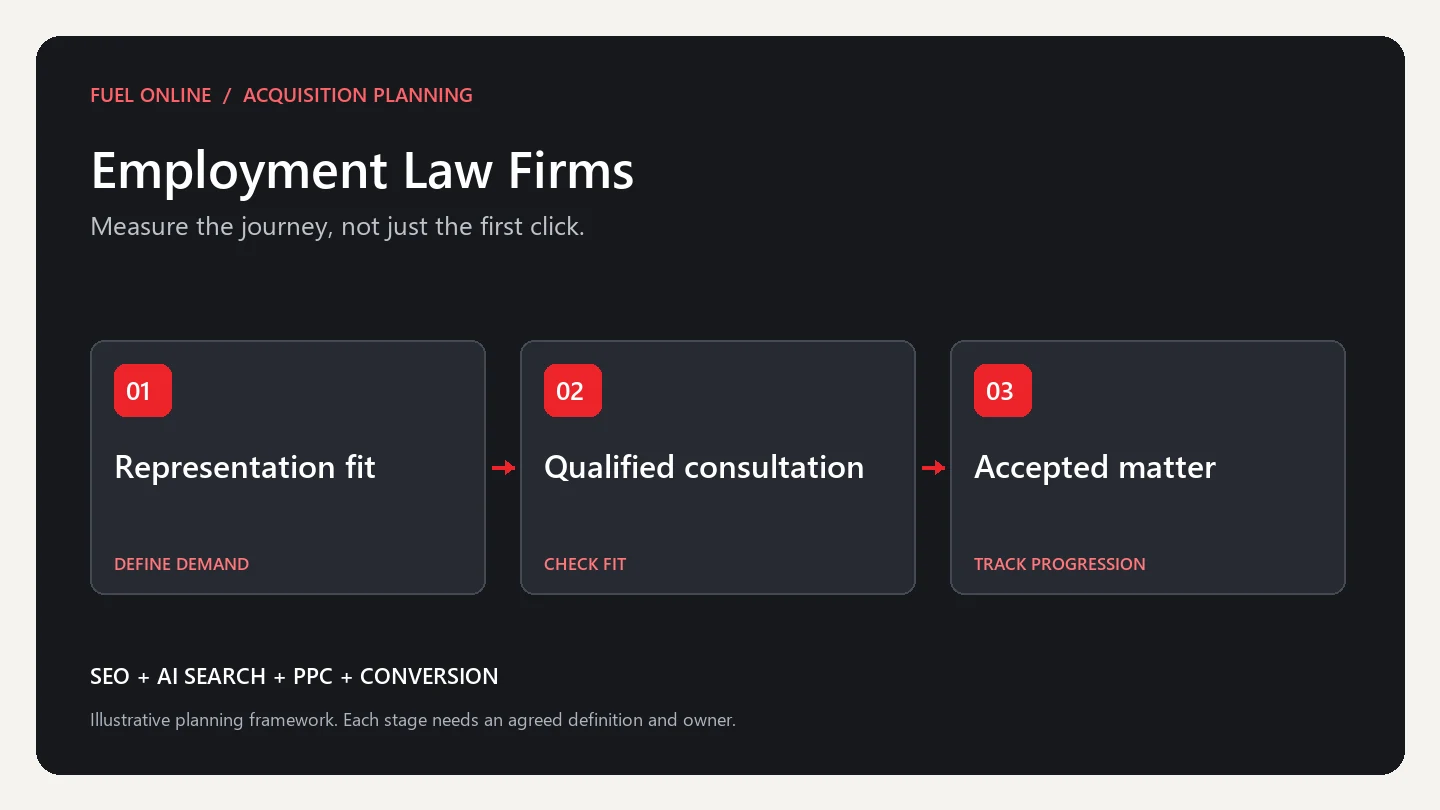
Lead generation starts with the receiving team's decision. Fuel documents what counts as an accepted next step, what does not fit, and who owns each route. For employment law, acceptance depends on employee or employer side, matter type, jurisdiction, deadlines, conflict screening, and attorney capacity.
The conversion path asks only what changes fit, routing, or preparation. It preserves representation side, matter type, jurisdiction, timing, safe contact details, and approved conflict-check facts, keeps sensitive details in approved systems, and gives unsuitable visitors a clear alternative instead of forcing every request into sales.
A practical employment law leadgen diagnostic
Use this diagnostic when form submissions and calls increase but the receiving team does not see a comparable change in accepted employment-law case reviews. The diagnostic for employment law lead generation starts with the observable symptom, checks the page, source, campaign, or handoff responsible for it, and ends with one reviewed action, owner, and validation method.
Observable symptom
Forms and calls increase, but suitable requests related to 'wrongful termination lawyer in Massachusetts' lose context, wait too long, or reach the wrong owner.
What to inspect in employment law lead generation company
Review the page promise, fields, call handling, routing, response time, follow-up attempts, and final sales, intake, or scheduling decision.
Decision criteria for lead generation services for employment law firms
Change the question, route, response rule, or follow-up step responsible for the lost or unsuitable request.
Inspectable output
A tested routing or follow-up change with an owner, acceptance rule, and measure tied to accepted employment-law case reviews.
Lead generation services for employment law firms deliverables you can inspect
The team receives an accepted-request definition, path map, routing and response rules, CRM dispositions, and a controlled conversion-test log.
- Accepted-lead and exclusion specification, used to define the employment law lead generation scope.
- Page, form, and call-path map, used to govern the employment law lead generation company release.
- Routing, response, and follow-up ownership, used to evaluate the lead generation services for employment law firms decision.
- CRM fields, dispositions, and duplicate rules
- Quality review and controlled test log
Illustrative employment law example
Illustrative example, not a client result: The case-review request loses representation side, matter type, jurisdiction, event timing, employer context, or conflict-check facts. Fuel would test the page, form or call path, route, response rule, follow-up, and final disposition to find the first point where useful context disappears.
The employment law lead generation company test would document the changed field, route, response rule, or follow-up step and its owner. The revision stays only when the receiving team sees a clearer path to accepted employment-law case reviews.
Within lead generation services for employment law firms, the buyer team can inspect the artifact, approval, and next investment decision.
How commercial progress is judged
Fuel connects page, query, campaign, or source context with acceptance, rejection reasons, response, capacity, and correct-side inquiries, qualified consultations, accepted matters, and acquisition by matter type. Diagnostic measures explain where the journey breaks; they do not replace the business outcome.
The decision record for employment law lead generation states what changed, why it changed, who approved it, and whether the next action is to expand, revise, consolidate, or stop.
Reporting for lead generation services for employment law firms must connect the service-specific diagnostic to accepted employment-law case reviews, explain data limits, and name the next decision rather than treating activity as proof of value.
Questions to ask an employment law agency
Ask for an accepted-request specification, route test, disposition set, and response ownership map. Confirm how the agency reviews missed, duplicate, unsuitable, and progressed inquiries.
When reviewing employment law lead generation, require a named practitioner, implementation owner, approval path, and sample artifact. Reject unsupported promises of rankings, citations, lead volume, cost, or revenue.
How we measure employment law lead generation company
- correct-side inquiries
- qualified consultations
- accepted matters
- acquisition by matter type
Find the drop between interest and a useful next step
Next-step completion rate = qualified inquiries completing the agreed next step ÷ qualified inquiries reviewed.
Illustrative arithmetic: 15 completed appointments from 25 qualified inquiries is 60%. Use the next step that fits your business, such as a consultation, estimate or discovery meeting, and record the time allowed for completion.
Agree on the baseline, data source and qualification criteria before comparing results. Separate visibility from inquiries and accepted business opportunities.
CONNECTED SERVICES
Choose the right next step for your business
Explore Fuel’s Lead generation capabilities, published campaign work and team to evaluate how we would support your organization.
BEFORE YOU CHOOSE AN AGENCY
Questions about employment law lead generation company
What happens before Fuel changes the form?
During the first month, the employment law lead generation scope produces an accepted-request definition, tested page and call paths, routing ownership, dispositions, and the first conversion repair. Fuel also records the client inputs and approval needed for the first release.
What does Fuel need from our employment law team?
Effective employment law lead generation company work requires page, form, call, CRM, routing, and response access plus an accepted-request definition, receiving owners, and consistent dispositions. Fuel identifies missing access or ownership before work is scheduled around it.
How will we know the work is commercially useful?
Under lead generation services for employment law firms, commercial usefulness depends on whether the diagnostic connects to accepted employment-law case reviews, the data limits are stated, and the evidence supports a clear keep, revise, or stop decision.
Should we buy more traffic before fixing lead handling?
Usually not. The employment law lead generation plan should first correct the form, call path, routing, response, follow-up, or disposition problem that is losing suitable requests. Additional traffic is useful only after the receiving path can handle it.
What does a credible employment law lead generation company scope include?
A credible employment law lead generation company scope includes acceptance criteria, path testing, field and call design, routing and response ownership, CRM dispositions, and controlled conversion tests. It also names the client dependencies, practitioner, deliverable, and approval path.
How should lead generation services for employment law firms report commercial progress?
Reporting under lead generation services for employment law firms should connect the service-specific diagnostic to accepted employment-law case reviews, show what changed and why, state data limits, and name the next decision.
Make your next agency conversation specific.
Bring a sample of suitable and unsuitable requests and show us where response, routing, or follow-up breaks. The first working session on employment law lead generation company will identify the priority artifact, evidence, owner, and approval decision for accepted employment-law case reviews.
Talk with a Fuel strategist →