
FUEL ONLINE / Employment Law Firms / AI SEO, AEO & GEO
AI SEO for employment lawyers: AEO and GEO

Employment firms need the correct representation side, matter type, and jurisdiction before an inquiry deserves attorney review. For AI SEO for employment lawyers, Fuel organizes approved service facts, tests the category, fit, process, and comparison questions people ask, and repairs conflicting pages or profiles. You receive a fact sheet, prompt log, correction backlog, and named reviewers. Progress is judged by clearer sources and journeys that result in accepted employment-law case reviews, without promises of citations or answer control.
Employer-side versus employee-side representation; Jurisdiction and matter category; Firm acceptance criteria and capacity; Conflict screening and consultation process
Compare employment-law AI discovery through representation and source clarity
Fuel Online helps employment-law firms improve AI discovery through clearer representation, practice, professional and contact information. The useful first assignment is a buyer question tied to a maintained source. A firm should be able to inspect what the agency changes, why the change helps a reader and what a later answer observation establishes. That provides a more concrete buying decision than a promise to increase mentions without explaining which audience or service those mentions concern.
Make representation side part of the information task
An employee researching representation and an employer exploring counsel can use similar employment terms while seeking different services. The firm supplies the actual offering. Ask the agency which resource establishes that scope and how the reader recognizes it before contact. A broad employment-law label does not answer the representation question, and a familiar topic phrase should not be treated as evidence that every related inquiry fits the firm.
Create a source map that separates representation, matter type, professional identity, jurisdiction context and the administrative next step. These resources can connect closely without carrying the same meaning. The firm can then identify a missing explanation or unclear relationship before the agency produces another set of summaries. The map should name the actual source owner and reader decision, not merely list every URL containing an employment term.
| Question purpose | Maintained source | Useful comparison evidence |
|---|---|---|
| Understand representation scope | The firm-approved employee or employer-side description. | The summary preserves the actual offering and does not silently broaden it. |
| Explore an employment topic | Attorney-reviewed educational material and its context. | The answer remains educational rather than deciding a reader’s circumstances. |
| Identify a professional or office | Current biography and actual geographic references. | The observation can be matched to the intended firm and published role. |
| Begin contact | The firm-supported initial process. | The next action means an inquiry rather than an accepted matter or engagement. |
Separate educational questions from firm-selection questions
A person reading general employment information is not necessarily selecting a lawyer. Another person may already know the firm and need its contact route. Ask finalists to connect these two tasks with the resources each actually needs. An educational explanation can retain its value without a sales invitation in every paragraph. A practice resource should make the firm’s scope and relevant next step understandable without requiring the reader to infer them from general articles.
Use a fictional question about an employment topic and a separate question about finding the firm representation information. Give every bidder the same attorney-reviewed resources. Ask which passage supports each proposed answer and where the reader continues. A useful response identifies different source roles rather than writing the same practice pitch twice. This tests editorial judgment without asking the marketing team to supply new legal conclusions.
Keep professional and jurisdiction context precise
A biography establishes the professional information the firm has chosen to publish. A practice description establishes the offered service. A geographic reference can supply another kind of context. Ask how the agency connects those facts without assuming that a name appearing near a topic establishes every role or matter relationship. The firm supplies the actual facts; the agency makes them readable and maintainable.
Use a hypothetical professional-role update to test the source map. Ask which practice introductions and summaries depend on the revised biography and which educational material remains unchanged. The response should identify particular statements and owners. A broad rewrite of every page is not the same as a focused correction whose dependencies are understood. This exercise gives the firm a practical view of future maintenance effort.
Record what a citation actually supports
Retain the exact question, date, experience used, answer wording and sources displayed. A firm mention, a professional reference and a citation are different observations. Ask which details identify the intended organization and which passage supports the statement being evaluated. If the answer lacks enough context, preserve that uncertainty instead of treating a familiar name or topic as verified firm visibility.
A cited educational resource may support a general explanation while leaving a separate claim about the firm’s offering unresolved. Ask the agency to annotate the two parts. The next source might establish the missing relationship, or the firm may need to supply an answer. This produces a precise information question rather than a generalized recommendation to rewrite the whole employment-law library.
Use a representation ambiguity as the first diagnostic
Give finalists a fictional answer that identifies the firm but blurs the representation side. Ask what they inspect before proposing an edit. The useful sequence compares the maintained practice description, related profiles and question context. The agency should explain whether the gap is a conflicting source, an unclear connection or an observation without enough evidence. It should not broaden the firm service simply to make the answer appear consistent.
Compare that with an accurate owned resource omitted from one broad answer. Omission alone does not establish a content defect. Another observation or a narrower question may be appropriate. Ask the agency to state what remains unknown and why the next task is useful. This protects attorney review time from an endless sequence of rewrites driven only by variable outside output.
Accept source improvements through a reader task
Give an unfamiliar reviewer a firm-selection question. Ask them to identify the representation scope, locate relevant professional context and find the initial contact route. Record the point where they must guess. This directly tests the owned improvement even when an external answer varies and may reveal a focused label or link repair that another long summary would not address.
Use the firm-permitted fictional process where the contact handoff is included. Compare the invitation, acknowledgement and receiving context. The test should demonstrate the administrative route and its meaning, not use a real individual narrative to make the exercise more realistic. Keep a received request separate from later review or matter acceptance, using the firm’s definitions for those stages.
Compare implementation and monitoring as separate responsibilities
Source investigation, writing, publishing and recurring answer sampling have different outputs. A report can identify an ambiguity without including the repair. Ask which resource the fee covers, who can publish it and what happens when a new finding requires another assignment. The firm can then compare apparently similar retainers through completed responsibility rather than terminology or screenshot volume.
Retain the source annotation, implemented passage and reader result together. A future editor should understand what became clearer and where the underlying fact is maintained. If the firm changes a role, description or contact instruction, that record identifies the summaries needing review. The value is the relationship between records, not simply the existence of a document described as a governance deliverable.
Test the source register with two worked examples
The first example can concern a reader seeking employee-side representation information. The second can concern a business researching an employer service the firm actually describes. Ask the agency to identify the supported explanation, professional reference and next step for each. If only one task fits the offering, the plan should preserve that boundary instead of invent another service to complete the comparison.
Now introduce a fictional wording change to one practice description. Ask which short answers, profiles or campaign resources depend on it. A useful response separates a needed statement revision from a link check and from accurate material unrelated to the change. This makes continuing maintenance assessable and helps the firm understand what another supplier must contribute where implementation access differs.
Compare a source-correction package with a monitoring-only package using those examples. Ask what the firm possesses at handover and which unresolved task remains. An observation report can be useful, but it should not be presented as an implemented source release. This comparison exposes practical scope differences without requiring an invented market price or a claim that either contract form is universally better.
Before expanding the question register, identify a genuinely different buyer decision. Another wording of the same identity question may add little value, while a distinct practice-to-contact task may expose a useful gap. The agency should explain why the question belongs and which maintained source it will inspect. This keeps the program manageable for the firm’s information owners.
At handover, ask another authorized employee to repeat the original exercise using only the retained record. They should identify the source, supported statement and observation limit without the analyst present. That practical test makes the method usable beyond one person and gives later AI-discovery work a maintainable foundation rather than a folder of selected answer examples.
Review source completion, external observations and compatible inquiry evidence separately. An owned release can be accepted while outside answers vary. A mention can be recorded while later client status remains unknown. Keeping these layers visible gives employment-law firms a clearer basis for choosing whether the next task should clarify, connect, investigate or maintain a named information relationship.
Compare three evidence states before approving a source edit
Give finalists three fictional findings about the same firm. In the first, two owned resources describe representation differently. In the second, the firm resources agree but an outside answer states something broader. In the third, the answer names the firm without enough context to judge the service statement. Ask what each finding establishes and what work follows. These are different evidence states, not three examples of the same generic need for more AI content.
The conflicting owned descriptions call for the firm to identify the correct fact and the agency to trace dependent passages. The broader outside answer calls for a statement-level comparison with its visible source where available. The ambiguous mention needs further context or an explicit unknown classification. A useful proposal explains those differences and the artifact the firm receives, making the recommended scope easier to review before another public passage is drafted.
Use the exercise to compare the revision boundary. A known correction may affect a practice introduction while leaving an educational article accurate. An uncertain outside statement may not justify editing either. The agency should identify the particular ambiguity it can remove and the company-supplied input still required. This protects useful resources and attorney review time while ensuring that a real contradiction is not dismissed as ordinary answer variability.
Retain one annotated example for each state in the handover. A future analyst should classify a similar finding using the same definitions and explain the next task without relying on a private account-team interpretation. If the examples do not support a consistent explanation, clarify the record before broadening the question sheet. This makes the observation method practical for the firm rather than merely a recurring presentation artifact.
The next review can then ask what changed in the maintained information and what was only observed externally. The firm has a concrete basis for choosing a correction, a connection improvement or another investigation, with each decision tied to evidence it can inspect rather than an assumed relationship between every answer fluctuation and later case-review activity.
When source questions expose unclear service-resource roles, employment law SEO planning can organize the representation, practice and professional explanations.
AGGRESSIVE FROM THE START
One month. The work many agencies stretch across three.
Our mandate: move faster, go deeper and put experienced specialists to work immediately.
Fuel attacks the work in parallel: site audits, technical errors, new content, internal links, backlink outreach and conversion improvements. Your agreed scope determines the channels; urgent fixes do not wait behind a drawn-out planning phase.
The AI SEO for employment lawyers brief identifies visibility and lead barriers. Actionable fixes move into production while deeper analysis continues.
Your employment law AI SEO work runs alongside industry-specific content, relevant links and earned-authority outreach, based on your agreed scope.
The employment law AEO and GEO review shows completed work, lead quality and the next opportunities. You see who owns each action.
Fast execution is the operating standard. Access, approvals and scope shape delivery; search and revenue results have their own timelines.
What AI SEO for employment lawyers changes for employment law demand
AI SEO, AEO, and GEO overlap, so the work matters more than the label. Fuel improves the public source layer used to explain employee or employer side, matter type, jurisdiction, deadlines, conflict screening, and attorney capacity. That means fixing the facts and pages first, then observing answer behavior with a repeatable prompt set.
Fuel inventories matter-type, representation, attorney, jurisdiction, process, and consultation pages and records attorney-reviewed information, accurate representation and jurisdiction statements, named authorship, and permissioned case evidence in an approved fact sheet. Prompt observations become source corrections, content decisions, or profile updates, not unsupported claims about influencing a model.
A practical employment law AI diagnostic
Use this diagnostic when answer visibility improves but the receiving team does not see a comparable change in accepted employment-law case reviews. The diagnostic for AI SEO for employment lawyers starts with the observable symptom, checks the page, source, campaign, or handoff responsible for it, and ends with one reviewed action, owner, and validation method.
Observable symptom
Answer systems blur employment law services, fit, or geography because public pages and profiles provide incomplete or conflicting explanations.
What to inspect in employment law AI SEO
Compare the approved fact sheet, service pages, profiles, prompt observations, and the named owner of every changing fact.
Decision criteria for employment law AEO and GEO
Correct the authoritative source, record its reviewer, and rerun the same buyer questions after publication.
Inspectable output
A dated source correction, approval owner, prompt retest, and observation record tied to qualified employment law journeys.
Employment law AEO and GEO deliverables you can inspect
The team receives an approved fact sheet, buyer-question prompt library, source correction backlog, governance owners, and dated retest record.
- Approved entity and service fact sheet, used to define the AI SEO for employment lawyers scope.
- Buyer-question prompt library, used to govern the employment law AI SEO release.
- Dated answer and source observation log, used to evaluate the employment law AEO and GEO decision.
- Source correction and content backlog
- Governance owners and retest record
Illustrative employment law example
Illustrative example, not a client result: Profiles and service pages conflict about representation side, jurisdictions, matter categories, or consultation process. Fuel would identify the approved fact owner, correct the authoritative page or profile, record the source change, and rerun the same buyer questions.
The employment law AI SEO retest would record what changed and what remained variable. A different answer is an observation, while the commercial check is whether corrected sources support qualified journeys toward accepted employment-law case reviews.
Within employment law AEO and GEO, the buyer team can inspect the artifact, approval, and next investment decision.
How commercial progress is judged
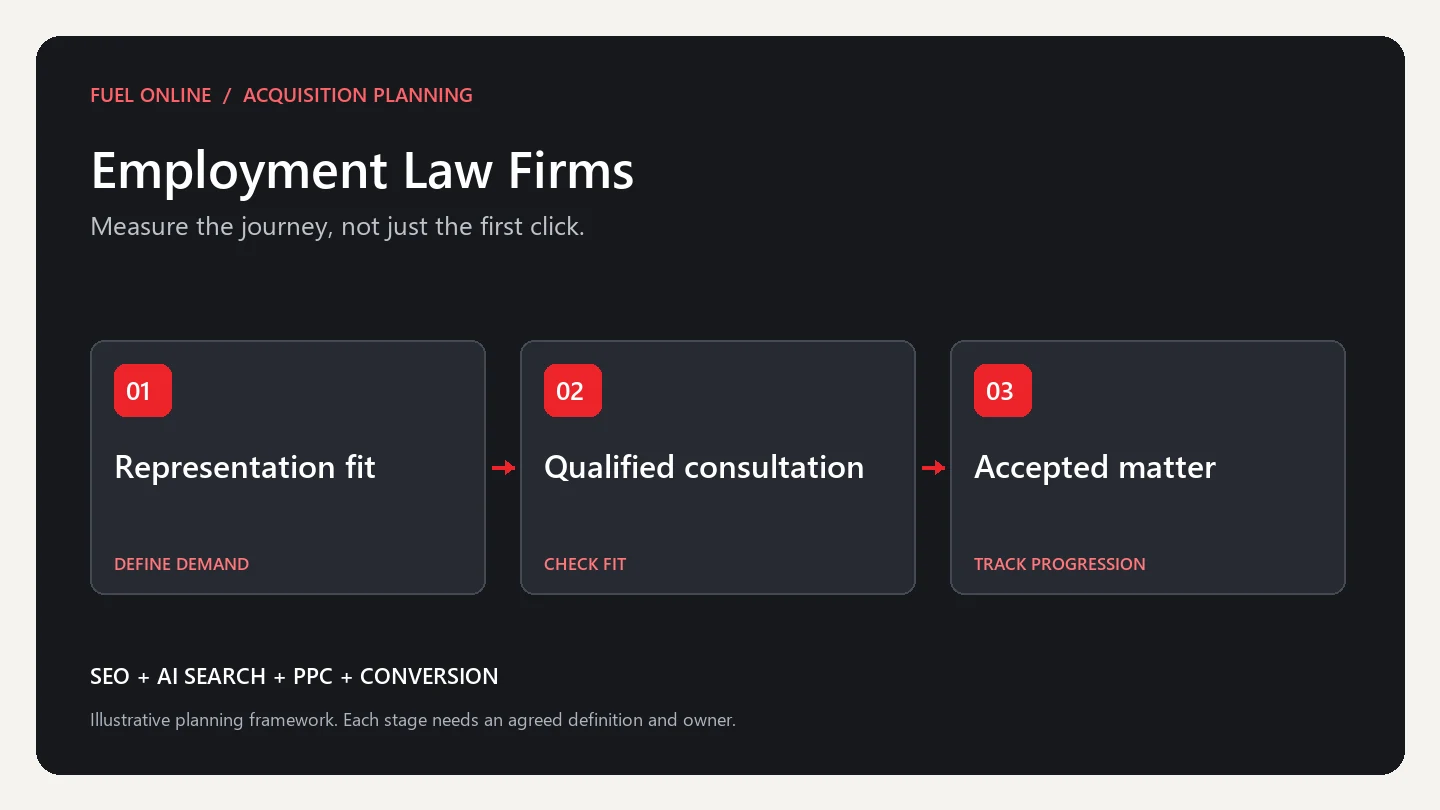
Fuel connects page, query, campaign, or source context with acceptance, rejection reasons, response, capacity, and accurate brand and service descriptions, relevant citations, qualified visits from AI systems, correct-side inquiries, qualified consultations, accepted matters, and acquisition by matter type. Diagnostic measures explain where the journey breaks; they do not replace the business outcome.
The decision record for AI SEO for employment lawyers states what changed, why it changed, who approved it, and whether the next action is to expand, revise, consolidate, or stop.
Reporting for employment law AEO and GEO must connect the service-specific diagnostic to accepted employment-law case reviews, explain data limits, and name the next decision rather than treating activity as proof of value.
Questions to ask an employment law agency
Ask for a sample fact sheet, prompt protocol, source-correction record, and governance matrix. Confirm how observations are dated, retested, and separated from claims of model control.
When reviewing AI SEO for employment lawyers, require a named practitioner, implementation owner, approval path, and sample artifact. Reject unsupported promises of rankings, citations, lead volume, cost, or revenue.
How we measure employment law AI SEO
- accurate brand and service descriptions
- relevant citations
- qualified visits from AI systems
- correct-side inquiries
- qualified consultations
- accepted matters
- acquisition by matter type
Keep AI citation observations measurable
Observed citation rate = sampled answers citing your site ÷ sampled answers checked.
Illustrative arithmetic: 5 citations in 20 recorded answers is 25% of that sample. It is not a platform-wide visibility share, a guaranteed repeat result or proof that the citations generated revenue. Record the prompts, platform and dates.
Agree on the baseline, data source and qualification criteria before comparing results. Separate visibility from inquiries and accepted business opportunities.
CONNECTED SERVICES
Choose the right next step for your business
Explore Fuel’s AI SEO, AEO & GEO capabilities, published campaign work and team to evaluate how we would support your organization.
BEFORE YOU CHOOSE AN AGENCY
Questions about employment law AI SEO
What does the first AI search month produce?
During the first month, the AI SEO for employment lawyers scope produces an approved fact sheet, buyer-question prompt set, source inventory, and the first correction record. Fuel also records the client inputs and approval needed for the first release.
What does Fuel need from our employment law team?
Effective employment law AI SEO work requires approved service facts, named fact owners, source and profile access, subject-matter review, and permission to correct conflicting public information. Fuel identifies missing access or ownership before work is scheduled around it.
How will we know the work is commercially useful?
Under employment law AEO and GEO, commercial usefulness depends on whether the diagnostic connects to accepted employment-law case reviews, the data limits are stated, and the evidence supports a clear keep, revise, or stop decision.
Does AI search optimization replace conventional SEO?
No. AI SEO for employment lawyers depends on accurate, accessible source pages and sound conventional SEO. AEO and GEO add approved fact governance, buyer-question testing, source correction, and repeatable observation; they do not replace crawlability, page quality, or authority.
What does a credible employment law AI SEO scope include?
A credible employment law AI SEO scope includes fact governance, a stable prompt protocol, source corrections, named reviewers, dated retests, and clear limits on answer-system control. It also names the client dependencies, practitioner, deliverable, and approval path.
How should employment law AEO and GEO report commercial progress?
Reporting under employment law AEO and GEO should connect the service-specific diagnostic to accepted employment-law case reviews, show what changed and why, state data limits, and name the next decision.
Make your next agency conversation specific.
Bring the employment law questions answer systems get wrong or leave incomplete and the sources your team can approve. The first working session on employment law AI SEO will identify the priority artifact, evidence, owner, and approval decision for accepted employment-law case reviews.
Talk with a Fuel strategist →