
FUEL ONLINE / Tree Service and Arborist Marketing / SEO
Tree Service and Arborist SEO Agency
Storm calls can overwhelm dispatch while planned pruning and commercial maintenance disappear from view. As your tree service SEO agency, Fuel Online helps tree-service owners, operations managers and marketing leaders map queries about emergency removals, planned pruning, stump grinding, plant-health consultation and recurring maintenance to useful service, location, comparison and evidence pages. We repair technical and internal-link obstacles, then report which searches and pages lead to accepted inquiries.
Service ZIP code, requested work, access restrictions and preferred timing. Route hazardous situations to the provider's established emergency procedure.
Give tree service SEO distinct service, area and professional-context resources
A tree service SEO agency should give company identity, service explanations, professional context and area information distinct jobs in the reader’s research. Compare proposals by asking which existing answer becomes clearer and what separate question earns a new resource. Fuel Online can map those relationships before expanding the editorial plan. The useful first engagement leaves implemented connections and source records the office can maintain, preserving accurate original material and working contact routes.
Map service, company and professional-context questions
Begin with a resource inventory. Identify the company reference, supported service descriptions, relevant professional profiles and project examples the business can publish. Add the resources explaining actual geographic relationships and the inquiry process. Beside each, name the reader question and source owner. This makes gaps and overlap visible before another page list becomes a production commitment.
Compare a person seeking the known company with one researching a supported service. The business resource establishes identity and current contact context. The service page adds an explanation of the actual offering. These resources can connect closely while retaining different purposes, helping a new reader continue without first understanding the company’s internal structure.
Where a professional profile exists, ask what it establishes and how it relates to the organization. The company supplies the actual facts. The agency should preserve that source meaning in summaries and links rather than derive a broader role from a name or image. This makes the relationship understandable to the reader and maintainable by another editor.
| Resource role | Reader question | Agency contribution to inspect |
|---|---|---|
| Company identity | Is this the intended business? | Current facts and contact relationship |
| Service explanation | What does the actual offering establish? | Distinct source-linked information |
| Professional context | How does the published profile relate to the organization? | Company-supplied relationship and useful links |
| Project evidence | What does the approved example demonstrate? | Caption/source/service connection |
| Area information | Which geographic relationship is real? | Useful context without implied branches |
| Next step | How does the inquiry begin? | Implemented path and reader test |
Require a distinct contribution for each resource
For each proposed service resource, request a brief naming the reader question, company-supported information and intended next step. Ask what the new material adds beyond the current explanation. A related phrase alone is not a distinct contribution. The office should know what factual input it supplies and why that information matters to the reader’s task.
Compare another page with a focused improvement to an existing resource. A summary may help orientation without becoming an independently maintained destination. A new resource can earn its role when it answers a genuinely different supported question. The agency should explain the immediate contribution and continuing maintenance responsibility before the writing calendar expands.
Use area resources to explain actual company relationships. A place name alone does not establish another branch or a separate offering. Ask which distinct customer question and business fact make a proposed local page useful. The agency should show how it connects to maintained service information rather than multiply independent versions of the same introduction.
Use project evidence and geography accurately
Give company-approved project examples an explanatory role. Ask what the business can publish about its part in the example and how that context supports the current resource. The service page establishes the offering while the example supplies particular information. Their relationship should remain visible through the caption, surrounding text and relevant link.
Compare a descriptive caption with a generic promotional line beside the same asset. The useful caption helps a reader understand the actual context, while the other may add little. Ask the company which detail it can supply. This gives visual editing a concrete contribution and helps the buyer decide whether more imagery or better use of an existing asset addresses the task.
Inspect a portfolio collection and a service explanation as different destinations. A collection can support exploration while an individual resource answers a narrower question. Ask which connection makes the next step understandable. A separate page for every asset is not automatically another useful answer; its reader purpose should be established before production.
Test the information path into contact
Give an unfamiliar reviewer a service question and ask them to follow ordinary navigation on a phone. Which source do they reach and what does it confirm? Then ask where they would begin the company’s supported inquiry. Record the point where they need to guess. This supplies a focused editorial or connection assignment rather than a general impression of the site.
Compare that result with a known-company task. If a service explanation is useful but its identity or contact relationship is unclear, the repair may be a contextual label rather than another long introduction. A missing substantive answer needs different work from accurate information that is difficult to find. The proposal should show which condition it is addressing.
Review internal links through the reader’s next question. The surrounding sentence should explain whether a destination supplies service detail, professional context, area information or an administrative step. Ask which connections the supplier will implement and why. A greater link count does not by itself establish a more coherent research path.
Compare editorial plans with implementation
Compare planning with implementation access. Source-linked drafts may be useful while publishing, shared navigation or another receiving system belongs to a separate owner. Identify who completes and checks the relevant change. A resource map and a released reader journey are different delivery stages, so the buyer needs the acceptance artifact beside the assignment.
Ask finalists to demonstrate one improvement from brief through release. The brief names the question and supporting facts, the draft shows the contribution and the completed destination demonstrates the connection. This makes the proposed method assessable without relying on a larger issue export or publication count as the measure of value.
Use a fictional revision to one public instruction as a maintenance exercise. The company supplies the current source. Ask which service summaries, profiles, area introductions and project references depend on it. A new article does not resolve an older contradictory statement. The useful deliverable is a checked affected-resource record that preserves accurate unrelated material.
Maintain the portfolio through source changes
Compare a factual revision with a terminology clarification that leaves the offering unchanged. The business establishes the relationship between earlier and current wording. The agency can then help a reader using the earlier phrase recognize the maintained explanation. Similar words alone should not create another service identity or a competing resource.
Keep older entrances useful according to their purpose. A returning reader may follow a saved link after a source description changes. Ask what the resource now establishes and which current information helps the person continue. The proposal should explain that task rather than apply a blanket removal or replacement decision to every older page.
At handover, retain page roles, source references, project context, implemented examples and reader tests. Another editor should identify where a fact is maintained and why each resource exists. This makes future work more focused and helps an incoming agency understand useful material without reconstructing the intended structure from similar titles.
Use the portfolio map during the next editorial proposal. Ask which question the suggested resource answers, which source supports it and where the reader continues. If it duplicates an existing answer, compare strengthening that destination. If it is distinct, retain the reason beside the brief. This keeps expansion connected to useful questions rather than publication volume.
Review company-information use, service research, professional-context exploration and received inquiries according to their purposes. A project example can be useful before immediate contact, while an unclear transition may justify a narrow repair. Ask the agency to connect its recommendation with that task and available evidence, keeping later work stages in the business’s own compatible records.
Compare two proposed area resources through the company’s actual geographic information. Ask which distinct question each answers and which business fact makes that difference meaningful. A place-name substitution alone is not the contribution. A useful resource can explain a real service relationship and connect the reader to current maintained information. The agency should identify why the destination helps and who keeps that source current. This makes local expansion assessable before a long page list is commissioned.
Give finalists one current page containing useful information but weak orientation. Ask what should remain and which question the reader cannot readily resolve. Compare that with a resource missing a substantive company-supported explanation altogether. One may need a heading or contextual connection; the other needs new source input and writing. These are different assignments. The buyer can assess their artifacts and maintenance responsibility more clearly than a plan promising the same quantity of new copy for every page.
Choose SEO services through one current resource and one proposed improvement. Look for an identifiable question, accountable source relationship and completed acceptance exercise. The company can then select a maintainable program that makes its real offering easier to understand, preserves established assets and gives each additional assignment a distinct information contribution.
For the related business-wide scope, explore tree service marketing.
AGGRESSIVE FROM THE START
One month. The work many agencies stretch across three.
Our mandate: move faster, go deeper and put experienced specialists to work immediately.
Fuel attacks the work in parallel: site audits, technical errors, new content, internal links, backlink outreach and conversion improvements. Your agreed scope determines the channels; urgent fixes do not wait behind a drawn-out planning phase.
The tree service SEO agency brief identifies visibility and lead barriers. Actionable fixes move into production while deeper analysis continues.
Your SEO services for tree service companies work runs alongside industry-specific content, relevant links and earned-authority outreach, based on your agreed scope.
The tree service search marketing review shows completed work, lead quality and the next opportunities. You see who owns each action.
Fast execution is the operating standard. Access, approvals and scope shape delivery; search and revenue results have their own timelines.
Tree service SEO agency for real buyer decisions
Searches for emergency removals, planned pruning, stump grinding, plant-health consultation and recurring maintenance can look similar while representing different urgency, value and next steps. A storm-damaged tree request needs fast, safety-conscious routing; a pruning or maintenance buyer needs scope, credentials where relevant, access planning and an estimate appointment. Fuel Online groups queries by buyer, need, geography and decision stage, then assigns each useful group to an existing page, a revised page or a justified new page.
The map also records exclusions such as out-of-area calls, unsupported services, price-only requests without enough scope, unsafe remote diagnosis and work the current crew cannot accept. That prevents search volume from overruling service fit and keeps overlapping pages from competing for the same decision. For the owner or marketing lead, choosing a tree service SEO agency means making this buyer distinction visible before contact.
SEO services for tree service companies deliverables you can inspect
The working set includes a query-to-page map, technical issue register, indexation and canonical review, internal-link plan, prioritized content briefs, local consistency checks and an evidence checklist. Each brief names the buyer question, page purpose, reviewer, proof requirement and next step.
Fuel Online starts with service and location pages that can influence qualified estimates, accepted proposals, completed jobs, and invoice value. It then resolves crawl, rendering, duplication or navigation issues affecting those paths. New content follows only where the search intent is distinct and the organization can support a useful answer with real crew and equipment photographs, service-area details, cleanup process, credential information where applicable and reviewed job examples. Every priority in the SEO services for tree service companies plan should name its owner, dependency and release check.
- Query-to-page map for "emergency tree removal [city]", "commercial tree pruning service" and related buyer questions.
- The plan for SEO services for tree service companies includes technical and internal-link backlog ranked by commercial page impact.
- Use tree service search marketing reporting to document content briefs with page purpose, evidence, owner and next step.
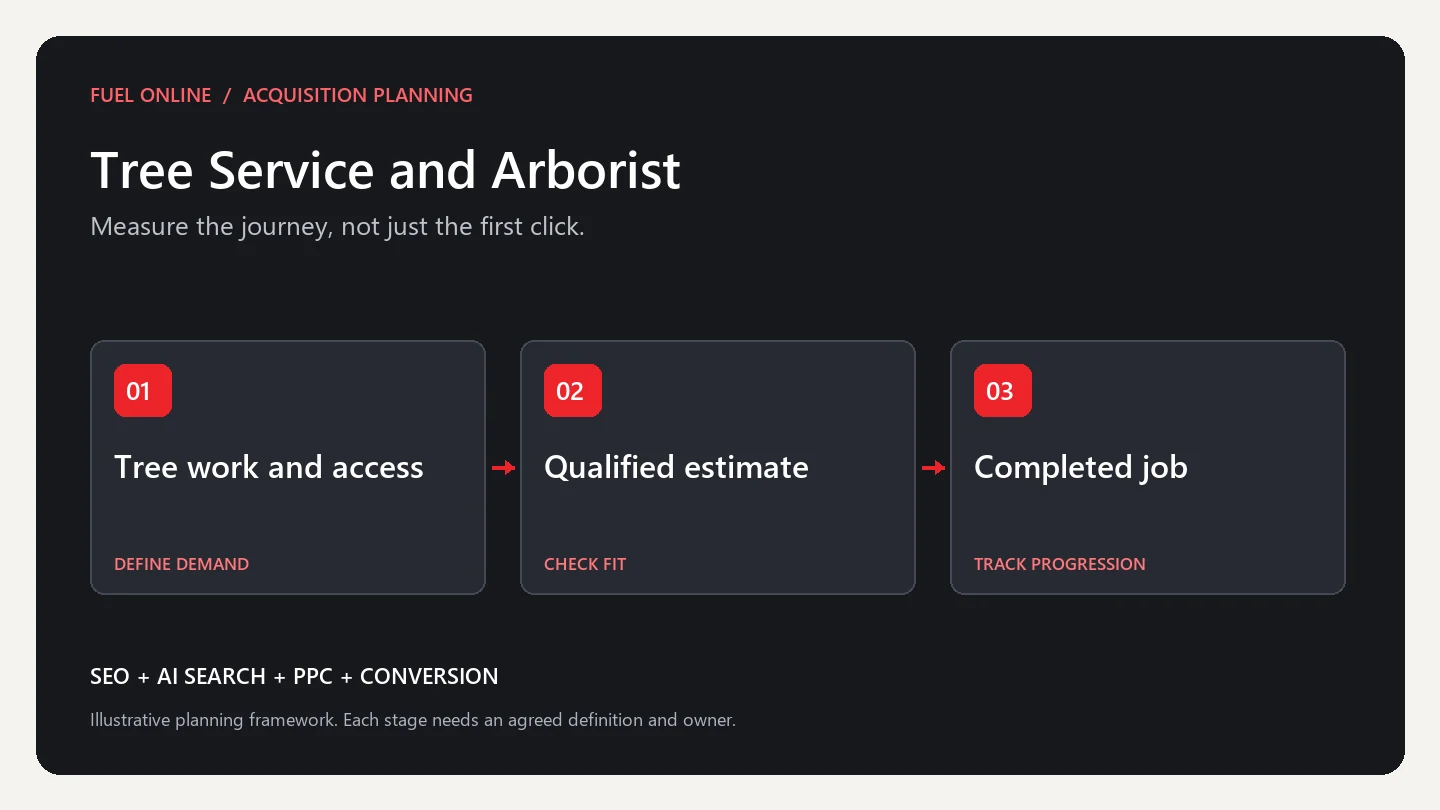
Illustrative tree service search marketing decision path
Illustrative example, not a client result: compare a homeowner seeking urgent storm-damage removal with a property manager comparing recurring pruning providers.
Map the two searches to separate page purposes, then inspect titles, internal links, service-area facts and the next action for urgency, service area, crew availability and the estimate or dispatch path. A tree service SEO agency should resolve the clearest query-to-page mismatch first. Planning connects each search to a useful destination, while tree service search marketing reporting checks whether qualified visitors reach the intended handoff.
Classify the demand
Compare the illustrative queries "emergency tree removal [city]" and "commercial tree pruning service". Confirm that each describes work you offer in a market and time frame your team can support. The phrases are examples, not measured-volume claims.
Build the appropriate path
For tree service SEO, map the queries to different page purposes and internal links instead of one catch-all article. Use real crew and equipment photographs, service-area details, cleanup process, credential information where applicable and reviewed job examples only when your organization can verify and approve it.
Record the commercial outcome
Retain the source, chosen path and receiving decision. Record why an inquiry advanced or stopped so the next change responds to actual fit instead of increasing activity blindly.
A tree service SEO agency diagnostic for tree service search marketing: symptom to decision
Use this framework when storm-call volume rises, but the report cannot separate dispatchable hazards, out-of-area calls and planned estimate requests. The tree service and arborist diagnostic turns that concern into an inspection the owner, marketing lead and receiving team can review together.
Trace the visible tree service and arborist buyer path against current operating capacity. The review should end with one bounded change, its owner and the evidence needed to keep, correct or stop it.
- Ask your tree service SEO agency to document the problem and its business impact.
- Use SEO services for tree service companies to connect the source or campaign to the response record.
- Use tree service search marketing to state the bounded change and the evidence for the next decision.
Name the observable symptom
For tree service SEO, the warning sign is that search traffic lands on a catch-all page that cannot answer fit, location, proof or the next step. Record one recent example and the business consequence rather than starting with a channel-wide assumption.
Inspect the path
Review the requested work, ZIP code, access notes, call outcome, estimate status, crew schedule and equipment constraints. For the SEO layer, inspect the query, ranking URL, page purpose, indexation, internal links, supporting evidence and inquiry outcome. Keep the source, promise, handoff and disposition together so the failure point is visible.
Make a bounded decision
The industry rule is to separate emergency removals from pruning, stump work and maintenance whenever urgency, proof or the receiving workflow changes. For this SEO decision, repair or consolidate the page that should satisfy the decision before publishing another overlapping URL. Name the owner, dependency and release check before implementation.
Require an inspectable output
The output is a query-to-page map, technical priority register, content brief and release checklist. It should show what changed, why it changed and what receiving outcome will determine whether the team keeps, corrects, expands or pauses the work.
Measurement standards for tree service SEO agency and SEO services for tree service companies
For tree service SEO, indexation, impressions, rankings and clicks help explain what changed, but they do not establish commercial value alone. The shared scorecard follows qualified estimates, accepted proposals, completed jobs, and invoice value and segments them by service, location, buyer path and source where the organization can do so responsibly.
The review also examines crew schedules, equipment availability, storm volume and estimate backlog. Reporting should record attribution gaps, offline outcomes and why tree service and arborist inquiries were declined. Each review should close with a decision to keep, correct, expand, pause or investigate a specific page, campaign, answer or handoff.
How to compare providers of tree service search marketing and SEO services for tree service companies
Ask how query mapping, technical work, expert input and rejected-inquiry feedback shape priorities. Before selecting a tree service SEO agency, require the proposal to name the first deliverables, working team, required access, client inputs, review cadence and dependencies. It should state which tree service evidence the organization must substantiate and who approves it.
Request a sample decision log that shows what changed after an accepted or rejected inquiry. Confirm account, content and data ownership. Reject a provider that ignores agreed service or territory exclusions, promises a guaranteed outcome or cannot explain the next concrete decision.
When reviewing tree service search marketing, ask the provider to show the first decision it would make from one current buyer path and the evidence required to make it.
A decision log for SEO services for tree service companies should connect one released change to the reason an inquiry advanced or stopped.
A decision log for tree service search marketing should connect one released change to the reason an inquiry advanced or stopped.
How we measure tree service SEO agency
- qualified estimates
- accepted proposals
- completed jobs
- invoice value
Connect organic discovery to inquiry quality
Organic inquiry qualification rate = suitable organic inquiries ÷ organic inquiries reviewed.
Illustrative arithmetic: 12 suitable inquiries out of 20 reviewed organic inquiries is a 60% qualification rate. This measures inquiry fit, not search market share, and requires a recorded source and an agreed definition of suitable.
Agree on the baseline, data source and qualification criteria before comparing results. Separate visibility from inquiries and accepted business opportunities.
CONNECTED SERVICES
Choose the right next step for your business
Explore Fuel’s SEO capabilities, published campaign work and team to evaluate how we would support your organization.
BEFORE YOU CHOOSE AN AGENCY
Questions about tree service SEO agency
What should a tree service SEO agency engagement include?
Expect a query-to-page map, technical and internal-link backlog, content briefs and release checks for searches such as "emergency tree removal [city]". The proposal should identify owners, dependencies, implementation access and the evidence the tree service and arborist team must approve. It should also explain how changes in crew schedules, equipment availability, storm volume and estimate backlog affect priorities. Use the release checklist to verify completed work and whether the intended buyer reached the correct handoff.
How should SEO services for tree service companies be phased?
For SEO services for tree service companies, the first useful milestone is a query map and verified repairs to the page that should answer "emergency tree removal [city]". Delivery speed depends on access, approvals and crew schedules, equipment availability, storm volume and estimate backlog. Set release checks and review dates before implementation begins. Assess released work first, early response second and downstream business movement only after enough demand and operating time exist to interpret it. Phase SEO services for tree service companies around one released buyer path, its acceptance check and the next evidence-based decision.
What does our team provide for tree service search marketing?
For tree service search marketing, bring current service and location facts, examples of suitable and unsuitable inquiries, current capacity constraints and access needed for SEO. Name the reviewer who can approve tree service and arborist service details, media and evidence. Personal and commercial details remain in the organization’s approved systems. Share only the fields needed to make marketing and handoff decisions.
How do we compare firms offering tree service SEO agency services?
Ask the agency to explain how it would handle a homeowner searching for urgent storm-damage removal differently from a property manager comparing recurring pruning providers. Its answer should connect one tree service and arborist page, campaign, source or routing change to the required input and receiving outcome. Confirm account and data ownership. When evaluating providers, treat generic activity lists, invented proof and reports that count every inquiry equally as warning signs. Ask what SEO services for tree service companies will deliver first and how tree service search marketing will change after an accepted or rejected inquiry.
Make your next agency conversation specific.
Bring storm calls, planned estimates and the service areas your crews can cover. Fuel Online can turn those inputs into a query-to-page correction brief through a focused tree service SEO agency engagement, with the first owner, release check and success signal clearly named.
Talk with a Fuel strategist →