
FUEL ONLINE / Private School Marketing / SEO
Private School SEO Agency

Admissions interest becomes useful only when grade, campus, entry year and cohort capacity line up with what the school can offer. As your private school SEO agency, Fuel Online helps school leaders, admissions directors and marketing teams map queries about family research, tours and events, applications and enrollment by grade, campus and entry year to useful service, location, comparison and evidence pages. We repair technical and internal-link obstacles, then report which searches and pages lead to accepted inquiries.
Grade level, desired entry year, campus and guardian contact information. Collect student records through the school's approved admissions process.
Organize private-school programs, campuses and admissions cycles without cloned pages
A private school SEO agency should give families a clear route from a question about the school to the maintained program, campus or admissions information that answers it. Fuel Online can begin by assigning roles to existing resources before recommending another grade or location page. A program explanation, campus identity and entry-cycle instruction can connect while remaining different information objects. The useful search plan improves that relationship and adds a new resource only when the family gains a distinct supported answer.
Assign the question to the resource that can maintain it
Start with the school's actual public offering. A program resource explains the educational information the school supplies. A campus resource identifies the location relationship and relevant context. Admissions instructions explain the supported process for a particular audience or cycle. An event page describes a specific dated opportunity. These roles help a reader navigate without implying that every program, grade or next step is available at every campus.
Ask the agency to map representative family questions to existing destinations. Identify which answer is missing, which exists but is difficult to find and which appears on several competing pages. The findings justify different assignments. A new page can resolve a distinct unanswered question. A clearer link can expose an existing answer. Consolidating overlapping explanations may make the maintained source easier to recognize than adding another near-identical version.
| Resource role | Question it owns | Maintenance responsibility |
|---|---|---|
| Program | What school-supported offering is explained? | Educational source and approved program context. |
| Campus | Which location relationship applies? | Actual campus facts and relevant program connections. |
| Entry cycle | Which admissions instructions apply to this audience? | Current school-supplied process context. |
| Event | What dated information opportunity is offered? | Specific invitation and supported action. |
| Internal link | Where does the next answer already exist? | Descriptive purpose and correct destination. |
The map is useful when it states the information contribution, not merely a target phrase. A campus page should establish its actual context. A grade-oriented resource should answer a meaningful school-supported question rather than substitute a number in a general paragraph. An admissions-cycle page should preserve the relevant instructions and dates. The school provides those facts; marketing should not infer openings or policies from the structure of a URL.
Work through a program-to-campus navigation gap
Imagine a fictional school with a useful program explanation and separate campus resources. Families searching for the program at Campus West repeatedly reach a general page that never explains the relationship. Ask the agency to inspect whether the answer exists elsewhere. If the campus resource already supplies the connection, a descriptive internal link and concise supported introduction may resolve the gap without another program-and-campus combination page.
If the relationship is genuinely missing, identify the factual question the school must answer. Does the program apply to that campus, and which resource should maintain the statement? A page brief can name the needed input and intended reader decision. It should not invent a program offering merely because a search phrase sounds commercially attractive. The source relationship matters before the agency decides whether to expand, revise or consolidate the content.
Now change the example: the school has different program context at two campuses. A distinct resource may be useful when the school can supply meaningful differences that families need. The agency should explain the contribution and how it connects to the broader program material. Repeating the same introduction with another campus name makes maintenance harder while leaving the actual decision unanswered. Distinct purpose and maintainable facts justify the destination.
Separate durable program material from a dated entry cycle
A program overview can remain useful across several admissions periods. Instructions about a particular cycle can change independently. Record which facts belong to each role so a year change does not require replacing accurate educational material. The family should be able to identify whether a page explains the school generally or supplies current process information for the intended entry year.
Use a fictional cycle transition to test the plan. The school supplies the new instructions through its approved process. Identify the admissions resource, selected event connections and messages that depend on the changed detail. Update those items and check their destinations. Keep historical material understandable in its actual role rather than silently presenting old dates as current or deleting useful program context merely because it mentions a past cycle.
Ask how a family arriving through an older search result reaches the right current information. The appropriate treatment depends on the actual content and school instructions. The agency should preserve meaningful context and avoid sending every dated resource to an unrelated generic page. A technical redirect and an editorial explanation are different tools; the proposal should state why the chosen treatment helps the reader and what will be checked after implementation.
Compare technical access with content responsibility
A resource can be useful yet difficult to reach through internal navigation. It can also be clearly linked while an incorrect canonical or redirect sends systems elsewhere. Ask the agency to identify the intended destination and exact observed issue. A new article does not repair a technical identity problem, and a successful administrative view does not establish that every public visitor or crawler sees the same content.
Keep separate acceptance evidence for each task. A page brief should show the question answered and school source used. A navigation task should show the meaningful connection and destination. A technical task should show the condition investigated and repeated check after repair. These artifacts make it easier to compare the actual work than a broad promise to improve rankings or a recurring report listing activity without its purpose.
The same discipline applies to search visibility observations. Record the query and relevant destination where actual data is available. A ranking or visit is diagnostic, while a family inquiry and later school-controlled stage require other records. If a visitor arrives through an educational resource, do not assume that the person applied for the program described there. Preserve the arrival context alongside the stated request where the approved configuration supports it.
Test whether a family can find the next answer
Give an unfamiliar reviewer a program question, campus question and entry-cycle question. Ask them to identify the resource responsible for each and follow the supported next step. If the reviewer needs a private explanation from the project team, clarify the public connection. The exercise can reveal a navigation problem even when every individual page is polished and factually accurate.
A receiving test should use marked fictional administrative information through an authorized route. Compare the selected campus and entry-year meaning with the confirmation and received record. The test does not establish an application, admissions decision or enrollment. It shows whether the released information path preserves the family's stated purpose. Keep sensitive student records within the school's actual approved systems rather than importing them into a marketing demonstration.
Maintain the map through specific school changes
A revised campus fact should identify the resources that depend on it. A new cycle instruction should affect the relevant dated paths. An unchanged program explanation can remain useful. Ask the agency to show that dependency map at handover so the school can maintain accurate information without commissioning a complete rewrite for every administrative update. The record should name the fact, responsible resource and affected connection.
Compare proposals using the same program-and-campus exercise. The stronger SEO scope explains why a particular revision, link, consolidation or new page helps a family answer a real question. It preserves useful existing URLs and school material, resolves the observed gap and leaves a check another contributor can repeat. That gives private-school organic search a practical direction grounded in the school's actual offering and the information families need.
Test whether a proposed combination page earns its place
Ask finalists to brief a fictional program-at-campus page using only the school-supplied facts. If the proposed body merely repeats the central program explanation and adds the campus name, ask what new family question it resolves. A useful contribution could concern a genuine school-supplied program relationship, campus-specific context or a distinct information path. The agency should identify that contribution before the page is commissioned, not justify it afterward by the presence of a location phrase.
Now suppose the campus resource already provides the relevant relationship but families rarely find it from the program page. The better assignment may be a descriptive link and a concise source-faithful explanation. That preserves one maintained source for the fact instead of creating another copy that can drift. Ask how the agency will check the revised path with an unfamiliar reader and which existing resource remains responsible for future factual updates.
A meaningful new page can still be appropriate when the family task is distinct and the school has useful information to supply. Its brief should state what belongs there, what remains on the central program resource and how the pages connect. At handover, a contributor should recognize those boundaries without comparing two nearly identical paragraphs line by line. That architecture is easier to maintain and gives the buyer a concrete way to distinguish thoughtful content expansion from a proposal built around multiplying URLs.
When maintained campus and cycle facts are combined inaccurately in sampled answers, private-school answer-source review can examine the specific statement.
AGGRESSIVE FROM THE START
One month. The work many agencies stretch across three.
Our mandate: move faster, go deeper and put experienced specialists to work immediately.
Fuel attacks the work in parallel: site audits, technical errors, new content, internal links, backlink outreach and conversion improvements. Your agreed scope determines the channels; urgent fixes do not wait behind a drawn-out planning phase.
The private school SEO agency brief identifies visibility and lead barriers. Actionable fixes move into production while deeper analysis continues.
Your SEO services for private schools work runs alongside industry-specific content, relevant links and earned-authority outreach, based on your agreed scope.
The private school search marketing review shows completed work, lead quality and the next opportunities. You see who owns each action.
Fast execution is the operating standard. Access, approvals and scope shape delivery; search and revenue results have their own timelines.
Private school SEO agency for real buyer decisions
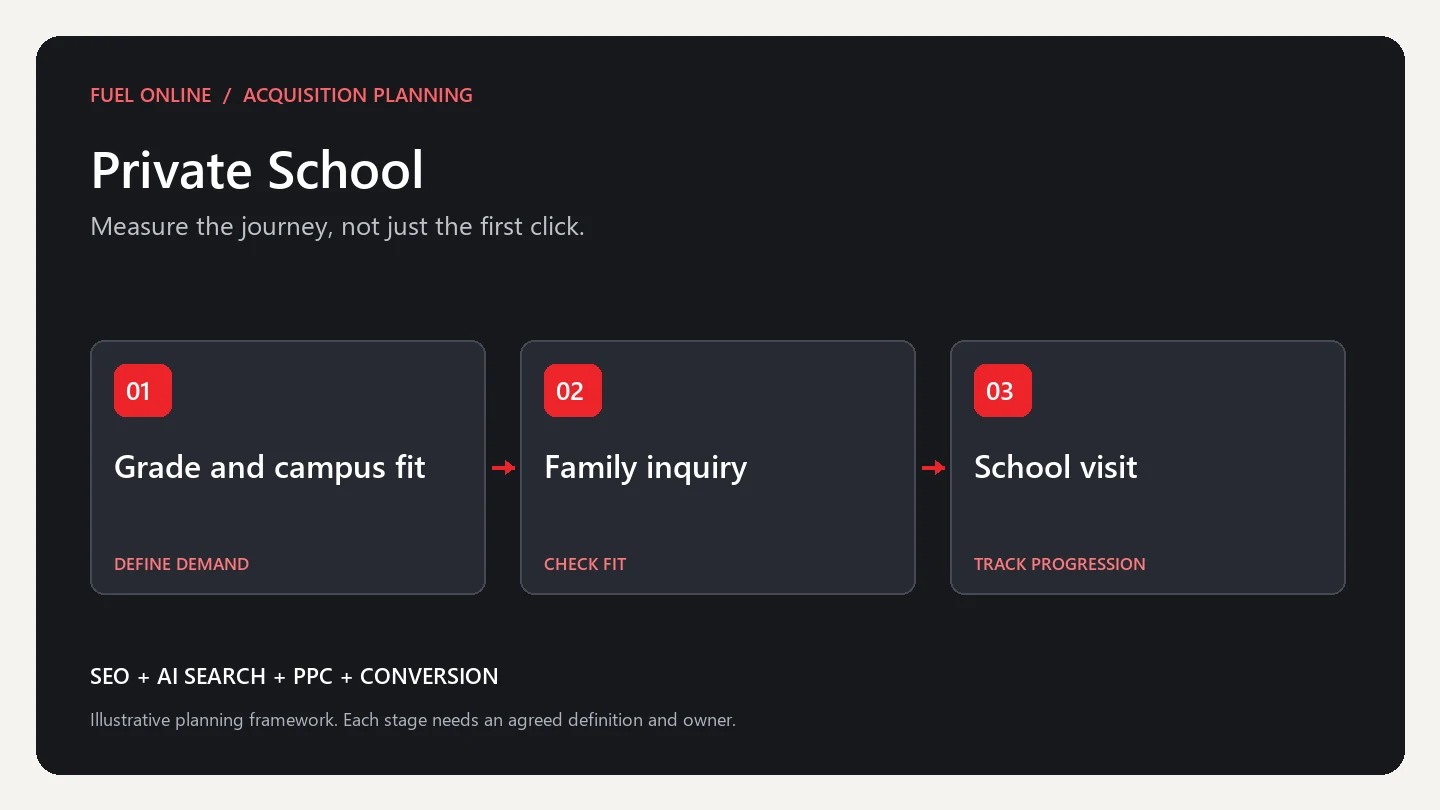
Searches for family research, tours and events, applications and enrollment by grade, campus and entry year can look similar while representing different urgency, value and next steps. A family seeking a current-year opening needs accurate availability and deadlines; an early researcher needs program evidence, campus context and a path to the right future admissions cycle. Fuel Online groups queries by buyer, need, geography and decision stage, then assigns each useful group to an existing page, a revised page or a justified new page.
The map also records exclusions such as promotion of unavailable grades, inaccurate tuition or aid statements, unapproved student stories and collection of records outside admissions systems. That prevents search volume from overruling service fit and keeps overlapping pages from competing for the same decision.
SEO services for private schools deliverables you can inspect
The working set includes a query-to-page map, technical issue register, indexation and canonical review, internal-link plan, prioritized content briefs, local consistency checks and an evidence checklist. Each brief names the buyer question, page purpose, reviewer, proof requirement and next step.
Fuel Online starts with service and location pages that can influence qualified family inquiries, attended tours, applications, and enrollments. It then resolves crawl, rendering, duplication or navigation issues affecting those paths. New content follows only where the search intent is distinct and the organization can support a useful answer with accurate tuition and deadlines, current grade availability, real campus materials, approved program facts and permissioned community stories. Every priority in the SEO services for private schools plan should name its owner, dependency and release check.
- Query-to-page map for "private school grade 6 [city]", "private school open house [city]" and related buyer questions.
- The plan for SEO services for private schools includes technical and internal-link backlog ranked by commercial page impact.
- Use private school search marketing reporting to document content briefs with page purpose, evidence, owner and next step.
Illustrative private school search marketing decision path
Illustrative example, not a client result: compare a parent checking for an opening in a specific grade with a family comparing campuses for the following academic year.
Map the two searches to separate page purposes, then inspect titles, internal links, service-area facts and the next action for entry year, grade, campus, program fit, admissions capacity and the next approved step. A private school SEO agency should resolve the clearest query-to-page mismatch first. Planning connects each search to a useful destination, while private school search marketing reporting checks whether qualified visitors reach the intended handoff.
Classify the demand
Compare the illustrative queries "private school grade 6 [city]" and "private school open house [city]". Confirm that each describes work you offer in a market and time frame your team can support. The phrases are examples, not measured-volume claims.
Build the appropriate path
For private school SEO, map the queries to different page purposes and internal links instead of one catch-all article. Use accurate tuition and deadlines, current grade availability, real campus materials, approved program facts and permissioned community stories only when your organization can verify and approve it.
Record the commercial outcome
Retain the source, chosen path and receiving decision. Record why an inquiry advanced or stopped so the next change responds to actual fit instead of increasing activity blindly.
A private school SEO agency diagnostic for private school search marketing: symptom to decision
Use this framework when family interest rises while unavailable grades, mismatched entry years and early research inflate the apparent admissions pipeline. The private school diagnostic turns that concern into an inspection the owner, marketing lead and receiving team can review together.
Trace the visible private school buyer path against current operating capacity. The review should end with one bounded change, its owner and the evidence needed to keep, correct or stop it.
- Ask your private school SEO agency to document the problem and its business impact.
- Use SEO services for private schools to connect the source or campaign to the response record.
- Use private school search marketing to state the bounded change and the evidence for the next decision.
Name the observable symptom
For private school SEO, the warning sign is that search traffic lands on a catch-all page that cannot answer fit, location, proof or the next step. Record one recent example and the business consequence rather than starting with a channel-wide assumption.
Inspect the path
Review grade, campus, geography, entry year, tour status, application stage and current cohort capacity. For the SEO layer, inspect the query, ranking URL, page purpose, indexation, internal links, supporting evidence and inquiry outcome. Keep the source, promise, handoff and disposition together so the failure point is visible.
Make a bounded decision
The industry rule is to separate current-cycle, future-cycle and campus paths whenever availability, deadline, program evidence or the admissions action differs. For this SEO decision, repair or consolidate the page that should satisfy the decision before publishing another overlapping URL. Name the owner, dependency and release check before implementation.
Require an inspectable output
The output is a query-to-page map, technical priority register, content brief and release checklist. It should show what changed, why it changed and what receiving outcome will determine whether the team keeps, corrects, expands or pauses the work.
Measurement standards for private school SEO agency and SEO services for private schools
For private school SEO, indexation, impressions, rankings and clicks help explain what changed, but they do not establish commercial value alone. The shared scorecard follows qualified family inquiries, attended tours, applications, and enrollments and segments them by service, location, buyer path and source where the organization can do so responsibly.
The review also examines grade-level seats, tour calendars, admissions staffing and application deadlines. Reporting should record attribution gaps, offline outcomes and why private school inquiries were declined. Each review should close with a decision to keep, correct, expand, pause or investigate a specific page, campaign, answer or handoff.
How to compare providers of private school search marketing and SEO services for private schools
Ask how query mapping, technical work, expert input and rejected-inquiry feedback shape priorities. Before selecting a private school SEO agency, require the proposal to name the first deliverables, working team, required access, client inputs, review cadence and dependencies. It should state which private school evidence the organization must substantiate and who approves it.
Request a sample decision log that shows what changed after an accepted or rejected inquiry. Confirm account, content and data ownership. Reject a provider that ignores agreed service or territory exclusions, promises a guaranteed outcome or cannot explain the next concrete decision.
When reviewing private school search marketing, ask the provider to show the first decision it would make from one current buyer path and the evidence required to make it.
A decision log for SEO services for private schools should connect one released change to the reason an inquiry advanced or stopped.
A decision log for private school search marketing should connect one released change to the reason an inquiry advanced or stopped.
How we measure private school SEO agency
- qualified family inquiries
- attended tours
- applications
- enrollments
Connect organic discovery to inquiry quality
Organic inquiry qualification rate = suitable organic inquiries ÷ organic inquiries reviewed.
Illustrative arithmetic: 12 suitable inquiries out of 20 reviewed organic inquiries is a 60% qualification rate. This measures inquiry fit, not search market share, and requires a recorded source and an agreed definition of suitable.
Agree on the baseline, data source and qualification criteria before comparing results. Separate visibility from inquiries and accepted business opportunities.
CONNECTED SERVICES
Choose the right next step for your business
Explore Fuel’s SEO capabilities, published campaign work and team to evaluate how we would support your organization.
BEFORE YOU CHOOSE AN AGENCY
Questions about private school SEO agency
What should a private school SEO agency engagement include?
Expect a query-to-page map, technical and internal-link backlog, content briefs and release checks for searches such as "private school grade 6 [city]". The proposal should identify owners, dependencies, implementation access and the evidence the private school team must approve. It should also explain how changes in grade-level seats, tour calendars, admissions staffing and application deadlines affect priorities. Use the release checklist to verify completed work and whether the intended buyer reached the correct handoff.
How should SEO services for private schools be phased?
For SEO services for private schools, the first useful milestone is a query map and verified repairs to the page that should answer "private school grade 6 [city]". Delivery speed depends on access, approvals and grade-level seats, tour calendars, admissions staffing and application deadlines. Set release checks and review dates before implementation begins. Assess released work first, early response second and downstream business movement only after enough demand and operating time exist to interpret it. Phase SEO services for private schools around one released buyer path, its acceptance check and the next evidence-based decision.
What does our team provide for private school search marketing?
For private school search marketing, bring current service and location facts, examples of suitable and unsuitable inquiries, current capacity constraints and access needed for SEO. Name the reviewer who can approve private school service details, media and evidence. Student records remain in the school admissions system. Share only the fields needed to make marketing and handoff decisions.
How do we compare firms offering private school SEO agency services?
Ask the agency to explain how it would handle a parent checking for an opening in a specific grade differently from a family comparing campuses for the following academic year. Its answer should connect one private school page, campaign, source or routing change to the required input and receiving outcome. Confirm account and data ownership. When evaluating providers, treat generic activity lists, invented proof and reports that count every inquiry equally as warning signs. Ask what SEO services for private schools will deliver first and how private school search marketing will change after an accepted or rejected inquiry.
Make your next agency conversation specific.
Bring the grades, campuses and entry years your admissions team needs marketing to support. Fuel Online can turn those inputs into a query-to-page correction brief through a focused private school SEO agency engagement, with the first owner, release check and success signal clearly named.
Talk with a Fuel strategist →