
FUEL ONLINE / Private School Marketing / Lead generation
Private School Lead Generation and Conversion Agency

Admissions interest becomes useful only when grade, campus, entry year and cohort capacity line up with what the school can offer. As your private school lead generation agency, Fuel Online helps school leaders, admissions directors and marketing teams define acceptance, form and call fields, routing ownership and response expectations for family research, tours and events, applications and enrollment by grade, campus and entry year. The feedback loop preserves rejection reasons and exposes failed handoffs, so conversion work improves opportunity quality instead of adding unclassified contacts.
Grade level, desired entry year, campus and guardian contact information. Collect student records through the school's approved admissions process.
Keep family conversations and prospective-student interests separately recognizable
A private school lead generation agency should help admissions understand the family conversation without losing which prospective student, campus or entry cycle the inquiry concerns. Fuel Online can inspect the public action and received record using fictional administrative examples before recommending more traffic. One family contact can discuss more than one interest, and several contacts can continue one conversation. The useful conversion improvement preserves that meaning while keeping marketing inquiry, event registration and actual application stages distinct.
Define the unit the school needs to review
Ask admissions how it recognizes a contact, family conversation and prospective-student interest in its approved process. These units can be related without being interchangeable. A parent can ask about two children in one form, while another contact can follow up about one of those interests. The agency should not assume that a shared email address establishes one application or that another submission automatically creates another prospective student.
Use only the information needed for the supported initial step. A marketing inquiry is not a substitute for the school's application or student-record system. The public path can help identify the general program, campus and entry-cycle question while directing later documentation through the school's actual process. Do not add sensitive student details merely to make a lead record appear complete. The buyer should ask what decision each requested field supports.
| Unit | Meaning | Relationship to inspect |
|---|---|---|
| Contact event | One recorded interaction. | Can continue an earlier conversation. |
| Family conversation | Related administrative exchange. | Can contain more than one prospective-student interest. |
| Stated interest | A school-defined child/campus/cycle question. | Needs the correct clarification or correction. |
| Event stage | Registration or attendance actually recorded. | Does not establish an application by itself. |
| Application stage | School-controlled process record. | Cannot be inferred from campaign contact counts. |
The relationship model should follow the school's real systems and terminology. The agency's role is to make it inspectable and test whether the released path preserves it. If the available configuration cannot distinguish two interests in one submission, record that limitation and propose a supported handling method. A guessed automatic merge can conceal a second inquiry, while an automatic split can invent a second applicant who does not exist.
Work through a fictional household inquiry
Imagine a fictional household asking about Student A for one future entry year and Student B for another. Use invented labels rather than real student information. The initial form creates one contact event containing two stated prospective-student interests under the assumptions of this exercise. A later call clarifies only Student A's campus preference. A third message corrects Student B's entry year. Ask the reviewer to connect each update with the relevant interest.
Under those assumptions, three contact events do not establish three families or three applications. They describe one family conversation with two stated interests and two later updates. The correction should not alter Student A's entry year, and the campus clarification should not overwrite Student B's preference. The exercise demonstrates relationship handling, not admissions eligibility, current capacity or the school's actual application rules.
Now remove the student label from the correction. The receiver should identify the uncertainty rather than guess which interest changed. Ask how the approved process resolves that question and where the pending status remains visible. This variant tests a realistic administrative ambiguity. A perfectly labeled demonstration can hide a weak receiving design if every uncertain message is forced into the first matching record.
Preserve a correction without rewriting the arrival history
The current value and the reason for an update have different roles. Admissions needs the latest confirmed administrative information, while the relationship record explains what changed. The appropriate level of detail belongs in approved school systems with their actual access controls. Marketing reporting generally needs the stage and relationship, not a copy of private family correspondence distributed across routine campaign documents.
Keep source context distinct from stated interest. A family can arrive through a campus page while asking about another location or a later entry year. The source can explain discovery without determining the receiving category. If the form preselects a campus, make that selection understandable and allow the supported clarification. The receiver should see the family's actual request rather than an assumption inherited from the campaign label.
A returning family conversation also has its own meaning. Someone may seek an update on an existing inquiry through a general marketing form. That interaction can require attention without becoming newly acquired demand. Ask whether the public information makes the established contact route clear and whether the received record preserves the continuation. A routing problem should not be disguised as another successful lead merely because the contact entered through a measurable page.
Separate registration, attendance and application
A family can register for an event, attend it, later inquire about another entry year and choose not to apply. Those are different observations. A confirmation should describe the action that occurred. If the form only requests an event place or asks admissions to respond, it should not imply an application, admissions decision or enrollment. The school supplies the actual wording and process; marketing makes the sequence easier to follow.
Review the report's denominator with a fictional event example. Suppose four contact events relate to one family attending one event and asking about two prospective students. The team might legitimately report four interactions, one attending household or two stated interests if those definitions match the records. None of those totals automatically establishes two applications. The report should name the unit and evidence rather than use the same conversion label for all three views.
Where attendance or later application information is unavailable, retain the missing stage. Do not estimate it from a registration or attach a likely result to the nearest visible inquiry. The agency can still identify a useful receiving repair and improve the records needed for later review. Honest uncertainty makes the next work item clearer than a complete-looking funnel assembled from assumptions.
Test continuity through the actual public action
Use an authorized test route with clearly fictional administrative values. Follow the inquiry invitation, submit the supported information, read the confirmation and compare the received record with the original request. Repeat the household scenario with a clarification and a correction. The acceptance question is whether the team can recognize the relationships, not whether a form success message appears on screen.
Ask someone outside the implementation to interpret the records using the documented definitions. If the explanation requires a private conversation with the campaign manager, clarify the field meaning or handoff. A useful test log records the expected relationship, observed result and specific repair. It should not contain real admissions judgments or sensitive student details simply to demonstrate that the path works.
Check different contact routes where they are in scope. A form and telephone process may preserve different levels of context. The agency should identify which facts survive and what the receiver must clarify. It should not promise that all channels can be automatically combined when the evidence or configuration does not support that relationship. The resulting limitation can guide a bounded implementation rather than an unsupported attribution claim.
Choose improvements through the receiving team's decision
When inquiries rise but useful conversations do not, inspect the reason before adding more acquisition. An incorrect entry cycle, missing campus context, duplicate continuation and genuine new interest suggest different actions. A short clarification may be more useful than a longer form, while a connection repair may be more useful than another landing-page introduction. Name the observation and the actual item that needs to change.
Compare agency proposals using the same fictional household exercise. Ask what each supplier would deliver, how it would test the relationships and what it would leave within the school's approved admissions process. A stronger lead-generation scope preserves the family's stated meaning, gives the receiving team a usable next step and leaves a report whose units can be reproduced. It does not turn every contact event into another applicant or imply an admissions outcome that the records have not established.
Resolve shared-contact ambiguity at the right level
Suppose the fictional household uses one email address for both prospective-student interests. A later message says that the family now prefers a different campus but does not identify which interest it concerns. The matching address establishes a contact relationship; it does not establish which child or cycle the change applies to. The receiving process needs a clarification rather than an automatic update to every associated record.
Ask the agency to show how that unresolved relationship appears to the person who must act. A clear pending note and an assigned administrative question can be enough; the marketing form does not need to become a full application system. Once clarified, the current value should attach to the correct interest while the other remains unchanged. A reproducible record of this exercise is useful acceptance evidence because it tests the boundary where convenient contact matching can create a misleading admissions pipeline.
When the receiving record is clear but public messages offer conflicting next steps, private-school journey coordination can align the invitation.
AGGRESSIVE FROM THE START
One month. The work many agencies stretch across three.
Our mandate: move faster, go deeper and put experienced specialists to work immediately.
Fuel attacks the work in parallel: site audits, technical errors, new content, internal links, backlink outreach and conversion improvements. Your agreed scope determines the channels; urgent fixes do not wait behind a drawn-out planning phase.
The private school lead generation agency brief identifies visibility and lead barriers. Actionable fixes move into production while deeper analysis continues.
Your lead generation for private schools work runs alongside industry-specific content, relevant links and earned-authority outreach, based on your agreed scope.
The private school conversion services review shows completed work, lead quality and the next opportunities. You see who owns each action.
Fast execution is the operating standard. Access, approvals and scope shape delivery; search and revenue results have their own timelines.
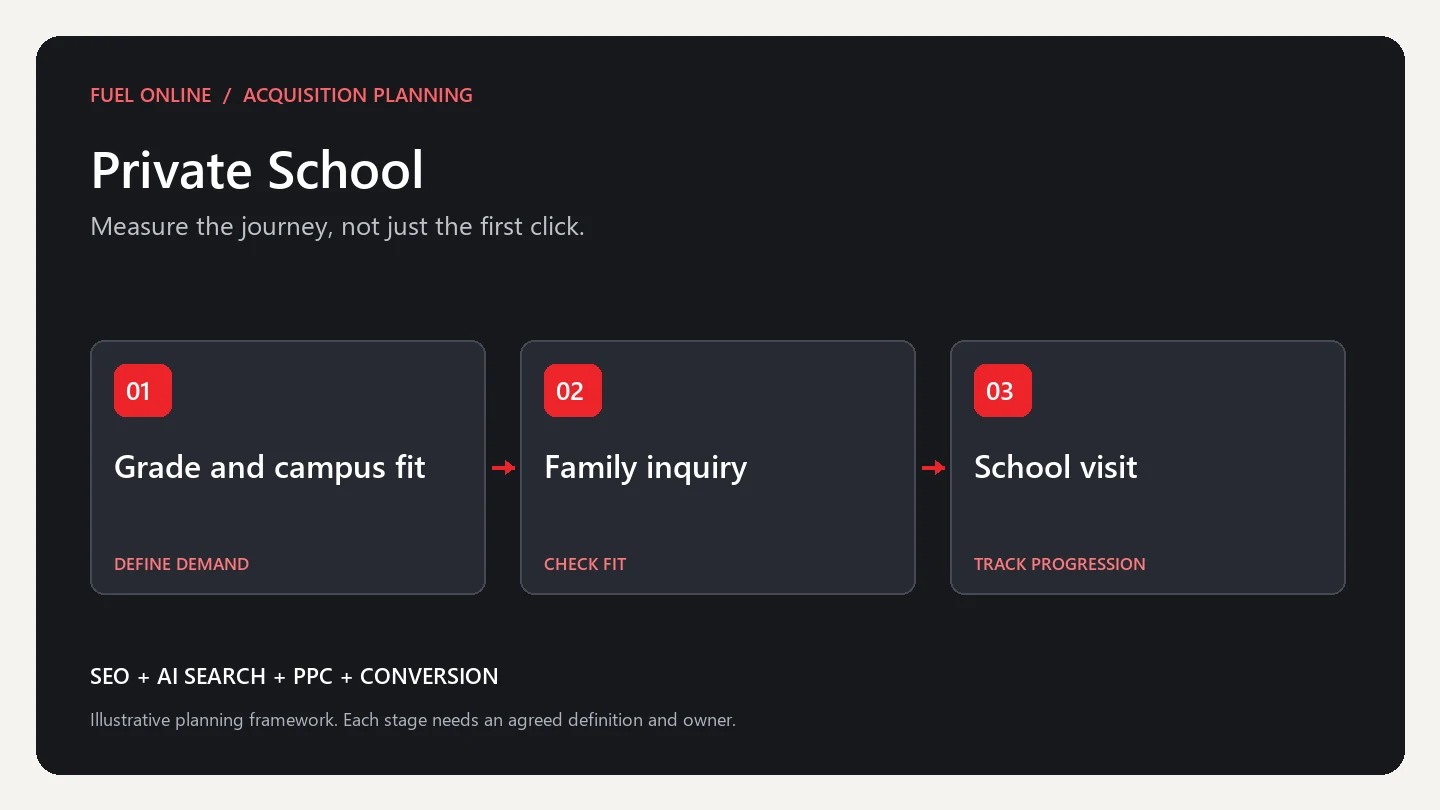
Private school lead generation agency for real buyer decisions
A lead is commercially useful only when the receiving team can assess and act on it. For a private school, the acceptance definition must reflect the actual buyer difference. A family seeking a current-year opening needs accurate availability and deadlines; an early researcher needs program evidence, campus context and a path to the right future admissions cycle. It also covers duplicate, current-customer, out-of-area and capacity rules.
Fuel Online uses that definition to shape pages, calls to action, forms and phone scripts. The process avoids promotion of unavailable grades, inaccurate tuition or aid statements, unapproved student stories and collection of records outside admissions systems and makes the promised next step match what the team can actually deliver. For the owner or marketing lead, choosing a private school lead generation agency means making this buyer distinction visible before contact.
Lead generation for private schools deliverables you can inspect
The engagement produces a qualification matrix, form and call-flow specification, routing map, response expectations, CRM or operating dispositions, missed-contact process and weekly feedback view. The handoff retains grade, entry year, campus, geography, guardian details, next admissions step and tour or application status.
Implementation begins with one priority conversion path. Fuel Online tests ownership and fallback routing, confirms that accepted and declined outcomes can be recorded, and then reviews friction in the page, form and first response. Expansion follows qualified family inquiries, attended tours, applications, and enrollments, not a lower form cost in isolation. A lead generation for private schools scope is inspectable when the owner, dependency and release check are named.
- Written acceptance and rejection rules for family research, tours and events, applications and enrollment by grade, campus and entry year.
- The plan for lead generation for private schools includes form, call, routing and missed-contact specification with named owners.
- Use private school conversion services reporting to document disposition view connecting sources to handled opportunities.
Illustrative private school conversion services decision path
Illustrative example, not a client result: compare a parent checking for an opening in a specific grade with a family comparing campuses for the following academic year.
Trace each contact from form or call through qualification, routing and final disposition, using entry year, grade, campus, program fit, admissions capacity and the next approved step to explain why it advanced or stopped. A private school lead generation agency should make those differences visible to the receiving team. Use lead generation for private schools to focus on inquiries the team can assess. The plan for private school conversion services should feed rejected-contact reasons back into fields, routing and follow-up.
Classify the demand
Compare the illustrative queries "private school grade 6 [city]" and "private school open house [city]". Confirm that each describes work you offer in a market and time frame your team can support. The phrases are examples, not measured-volume claims.
Build the appropriate path
For private school lead generation, preserve different fit signals, owners and response expectations in the form and call flow. Use accurate tuition and deadlines, current grade availability, real campus materials, approved program facts and permissioned community stories only when your organization can verify and approve it.
Record the commercial outcome
Retain the source, chosen path and receiving decision. Record why an inquiry advanced or stopped so the next change responds to actual fit instead of increasing activity blindly.
A private school lead generation agency diagnostic for private school conversion services: symptom to decision
Use this framework when family interest rises while unavailable grades, mismatched entry years and early research inflate the apparent admissions pipeline. The private school diagnostic turns that concern into an inspection the owner, marketing lead and receiving team can review together.
Trace the visible private school buyer path against current operating capacity. The review should end with one bounded change, its owner and the evidence needed to keep, correct or stop it.
- Ask your private school lead generation agency to document the problem and its business impact.
- Use lead generation for private schools to connect the source or campaign to the response record.
- Use private school conversion services to state the bounded change and the evidence for the next decision.
Name the observable symptom
For private school lead generation, the warning sign is that forms and calls arrive, but missing context or unclear ownership prevents a timely acceptance decision. Record one recent example and the business consequence rather than starting with a channel-wide assumption.
Inspect the path
Review grade, campus, geography, entry year, tour status, application stage and current cohort capacity. For the lead generation layer, inspect the source, page, captured fields, consent, route, response time, duplicate status, disposition and rejection reason. Keep the source, promise, handoff and disposition together so the failure point is visible.
Make a bounded decision
The industry rule is to separate current-cycle, future-cycle and campus paths whenever availability, deadline, program evidence or the admissions action differs. For this lead generation decision, repair one priority handoff, assign a fallback owner and confirm the receiving system can record accepted and rejected outcomes. Name the owner, dependency and release check before implementation.
Require an inspectable output
The output is an acceptance matrix, form and call specification, routing diagram, disposition list and missed-contact process. It should show what changed, why it changed and what receiving outcome will determine whether the team keeps, corrects, expands or pauses the work.
Measurement standards for private school lead generation agency and lead generation for private schools
For private school lead generation, form completion, call volume, response time and contact rate help explain what changed, but they do not establish commercial value alone. The shared scorecard follows qualified family inquiries, attended tours, applications, and enrollments and segments them by service, location, buyer path and source where the organization can do so responsibly.
The review also examines grade-level seats, tour calendars, admissions staffing and application deadlines. Reporting should record attribution gaps, offline outcomes and why private school inquiries were declined. Each review should close with a decision to keep, correct, expand, pause or investigate a specific page, campaign, answer or handoff. Measurement for private school conversion services should distinguish channel response from accepted business.
How to compare providers of private school conversion services and lead generation for private schools
Ask who owns routing, missed contacts, dispositions and the weekly quality feedback loop. Before selecting a private school lead generation agency, require the proposal to name the first deliverables, working team, required access, client inputs, review cadence and dependencies. It should state which private school evidence the organization must substantiate and who approves it.
Request a sample decision log that shows what changed after an accepted or rejected inquiry. Confirm account, content and data ownership. Reject a provider that ignores agreed service or territory exclusions, promises a guaranteed outcome or cannot explain the next concrete decision.
When reviewing private school conversion services, ask the provider to show the first decision it would make from one current buyer path and the evidence required to make it.
A decision log for private school conversion services should connect one released change to the reason an inquiry advanced or stopped.
How we measure private school lead generation agency
- qualified family inquiries
- attended tours
- applications
- enrollments
Find the drop between interest and a useful next step
Next-step completion rate = qualified inquiries completing the agreed next step ÷ qualified inquiries reviewed.
Illustrative arithmetic: 15 completed appointments from 25 qualified inquiries is 60%. Use the next step that fits your business, such as a consultation, estimate or discovery meeting, and record the time allowed for completion.
Agree on the baseline, data source and qualification criteria before comparing results. Separate visibility from inquiries and accepted business opportunities.
CONNECTED SERVICES
Choose the right next step for your business
Explore Fuel’s Lead generation capabilities, published campaign work and team to evaluate how we would support your organization.
BEFORE YOU CHOOSE AN AGENCY
Questions about private school lead generation agency
What should a private school lead generation agency engagement include?
Expect written acceptance rules, form and call requirements, routing ownership, missed-contact handling and a disposition view for family research, tours and events, applications and enrollment by grade, campus and entry year. The proposal should identify owners, dependencies, implementation access and the evidence the private school team must approve. It should also explain how changes in grade-level seats, tour calendars, admissions staffing and application deadlines affect priorities. Use the release checklist to verify completed work and whether the intended buyer reached the correct handoff.
How should lead generation for private schools be phased?
For lead generation for private schools, the first useful milestone is an acceptance definition and one tested form or call path with working ownership and dispositions. Delivery speed depends on access, approvals and grade-level seats, tour calendars, admissions staffing and application deadlines. Set release checks and review dates before implementation begins. Assess released work first, early response second and downstream business movement only after enough demand and operating time exist to interpret it. Phase lead generation for private schools around one released buyer path, its acceptance check and the next evidence-based decision.
What does our team provide for private school conversion services?
For private school conversion services, bring current service and location facts, examples of suitable and unsuitable inquiries, current capacity constraints and access needed for lead generation. Name the reviewer who can approve private school service details, media and evidence. Student records remain in the school admissions system. Share only the fields needed to make marketing and handoff decisions.
How do we compare firms offering private school lead generation agency services?
Ask the agency to explain how it would handle a parent checking for an opening in a specific grade differently from a family comparing campuses for the following academic year. Its answer should connect one private school page, campaign, source or routing change to the required input and receiving outcome. Confirm account and data ownership. When evaluating providers, treat generic activity lists, invented proof and reports that count every inquiry equally as warning signs. Ask what lead generation for private schools will deliver first and how private school conversion services will change after an accepted or rejected inquiry.
Make your next agency conversation specific.
Bring the grades, campuses and entry years your admissions team needs marketing to support. Fuel Online can turn those inputs into a qualification, routing and disposition improvement plan through a focused private school lead generation agency engagement, with the first owner, release check and success signal clearly named.
Talk with a Fuel strategist →