
FUEL ONLINE / Childcare and Daycare Operators / SEO
Childcare and Daycare SEO Agency

A childcare operator cannot market every room equally when openings differ by center, age group, schedule and desired start date. As a childcare SEO agency, Fuel Online maps valuable queries to accurate service, location and proof pages. Pages, campaigns and handoffs use center, child age, schedule, start timing and capacity to separate fit, and reporting follows eligible family inquiries and tours held.
child age range, preferred location, start timing and schedule needs
Give childcare SEO distinct center, program and enrollment resources
Choose a childcare SEO agency by comparing the distinct family questions its resources will answer. Organization identity, individual center information, program explanations and enrollment-process resources can share words while serving different tasks. A useful organic-search plan gives each resource a clear role and relevant next destination. The buyer should understand what a new or revised page contributes and where its facts are maintained, rather than assume a larger inventory creates a better path from research to administrative inquiry.
Give center, program and process resources different jobs
Begin with the actual website. Ask the agency to map each principal resource to its reader question, supporting operator information and next useful destination. Different search phrases may express the same need already answered clearly in one place. Similar wording can also conceal different tasks. The map should explain that distinction before production volume is selected. Both strengthening an existing resource and creating a new one can be useful when the contribution and required source input are specific.
A center page establishes local information supplied by the operator. A program resource explains its published scope. An organization page gives broader identity context, while an enrollment-process resource describes the supported administrative route. Ask how readers move between them and what each link promises. A shared brand should not silently extend every program statement to every location. The agency can improve orientation without inventing local offerings to make a page appear complete.
Program labels should retain the operator's actual meaning. Ask which source establishes the public description and what fuller context a family needs. The agency should not infer an individual child's eligibility or create a new program distinction from a search phrase alone. If information is missing, record the operator input required before drafting. This makes the brief useful and avoids asking a writer to settle an administrative fact through confident-sounding copy.
| Resource role | Information contribution | Useful acceptance evidence |
|---|---|---|
| Center information | Actual operator supplied place facts connect with the programs described for that resource. | A brand name does not silently extend every program offering to every location. |
| Program explanation | A distinct supported answer adds information beyond the existing introduction. | A new page earns its role without inventing individual eligibility or admission criteria. |
| Enrollment process | The maintained explanation preserves the meaning of each supported administrative action. | A request does not silently become a confirmed tour, available place or enrollment. |
| Source maintenance | Program and contact changes can be traced to specific dependent passages and links. | Accurate unrelated resources remain intact instead of being treated as equally affected. |
Earn program and local expansion
A separate program resource should earn its role through a distinct supported answer. Ask what it adds beside the existing explanation and which source material the operator supplies. A changed heading or keyword variation does not create another reader decision by itself. If the answer already has a clear home, stronger orientation may be sufficient. If a real gap exists, identify its source needs and next destination before adding another independently maintained page.
Local resources need equally specific justification. An individual center, corporate address and area mentioned in an example establish different facts. Ask the operator to supply their relationships and the agency to explain the separate contribution. A place-name substitution does not establish another center or current availability. Where the useful answer already exists, a clearer shared resource may be more manageable than several local pages repeating the same general program introduction.
Schedules and desired start preferences have different roles. A published program description can supply maintained information, while a family's request states its preferred circumstances. Ask how the resource structure preserves that distinction and connects with the actual administrative process. A date or schedule option should not become a confirmed arrangement because it appears in a form. The agency should use operator-supplied explanations rather than invent availability or enrollment rules.
Tour and enrollment resources should make the public action understandable. A request for information, a tour inquiry, an application and a later enrollment stage have different meanings. Ask which resource maintains the actual wording and how program or center introductions connect with it. The useful architecture helps families identify the next administrative destination without implying a stage the completed action does not establish.
Maintain source relationships through updates
Images should support their authorized context. A facility photograph, staff image and program activity asset can have different roles. Ask what the caption and surrounding explanation establish together. The agency should not infer licensing, safety conditions or child outcomes from appearance. Existing imagery may remain useful when its context is clearer. A new asset is not an automatic requirement for every revision, and visual interest does not resolve a missing factual relationship in the program information.
Test the architecture using two reading tasks. Start with a local-center question and find the relevant program explanation and administrative route. Then begin with a program-information question and locate the appropriate center context. Ask an unfamiliar reviewer what each resource establishes. Record where they must infer a relationship. A descriptive link or clearer transition may address the uncertainty more directly than another long page repeating information already available elsewhere.
A future-change exercise tests maintenance. Revise a sample program description or contact destination in the review materials and ask which summaries, labels and links depend on it. The agency should distinguish statements needing new wording, resources requiring a link check and accurate unrelated material. Retain that explanation with completed editorial and technical work. This gives another contributor a usable baseline instead of reconstructing the site's meaning from a directory of URLs after every update.
Technical work should identify the affected resource, observed issue, responsible implementer and completed check. A generic audit list does not establish priority by itself. Ask which reader task becomes easier to access or follow and how the change is verified. This makes technical and editorial scope comparable without implying that one adjustment guarantees rankings or family inquiries. The work should connect with actual maintained resources rather than remain a checklist detached from the website.
Accept the complete reading path
Reporting should use the resource purposes behind the roadmap. Identify the destination changed, family question clarified and observation that helped select the next task. Discovery, inquiry and later enrollment records establish different things. A program-research visit need not have the same immediate meaning as a tour request. The agency should explain those differences using available records instead of forcing every resource into an undifferentiated acquisition story.
At handover, give another contributor a proposed topic and the retained map. They should identify the question, source needs and next destination before drafting. If the contribution repeats an existing answer, compare a revision or clearer connection first. If it is distinct, retain the reason with the brief. This makes future production deliberate and helps preserve useful existing information while adding only the resources the operator's supplied facts and family questions can support.
Choose the next investment from a named information or discovery gap. It may be an unclear program relationship, weak center orientation or confusing route to the enrollment explanation. Ask the agency to prioritize those needs using source evidence and operator input. This leaves childcare SEO as a maintainable information system while keeping invented local facts, individual eligibility decisions and unsupported availability promises outside the marketing production process.
Compare two proposed page briefs using the same current program and center information. If both answer the same family question, ask what separate purpose would justify maintaining two destinations. If their tasks differ, the agency should describe the distinct answers and next resources. This tests the reasoning behind expansion rather than imposing a universal rule to combine or separate content. The operator can judge the actual contribution and source dependency instead of treating the number of proposed URLs as evidence that the organic roadmap is complete.
Use a program-source revision as a final map test. The operator supplies the changed description in the review materials. Ask which center introductions need new wording, which links require checking and which general organization material remains accurate. A specific answer makes the maintenance cost visible before another group of pages is commissioned. Retain the source decision and reader test together, giving the next contributor a practical example of how to preserve accurate resources while improving the particular relationship affected by the update.
For the related center-wide scope, explore childcare and daycare marketing.
AGGRESSIVE FROM THE START
One month. The work many agencies stretch across three.
Our mandate: move faster, go deeper and put experienced specialists to work immediately.
Fuel attacks the work in parallel: site audits, technical errors, new content, internal links, backlink outreach and conversion improvements. Your agreed scope determines the channels; urgent fixes do not wait behind a drawn-out planning phase.
The childcare SEO agency brief identifies visibility and lead barriers. Actionable fixes move into production while deeper analysis continues.
Your childcare and daycare SEO work runs alongside industry-specific content, relevant links and earned-authority outreach, based on your agreed scope.
The childcare and daycare SEO services review shows completed work, lead quality and the next opportunities. You see who owns each action.
Fast execution is the operating standard. Access, approvals and scope shape delivery; search and revenue results have their own timelines.
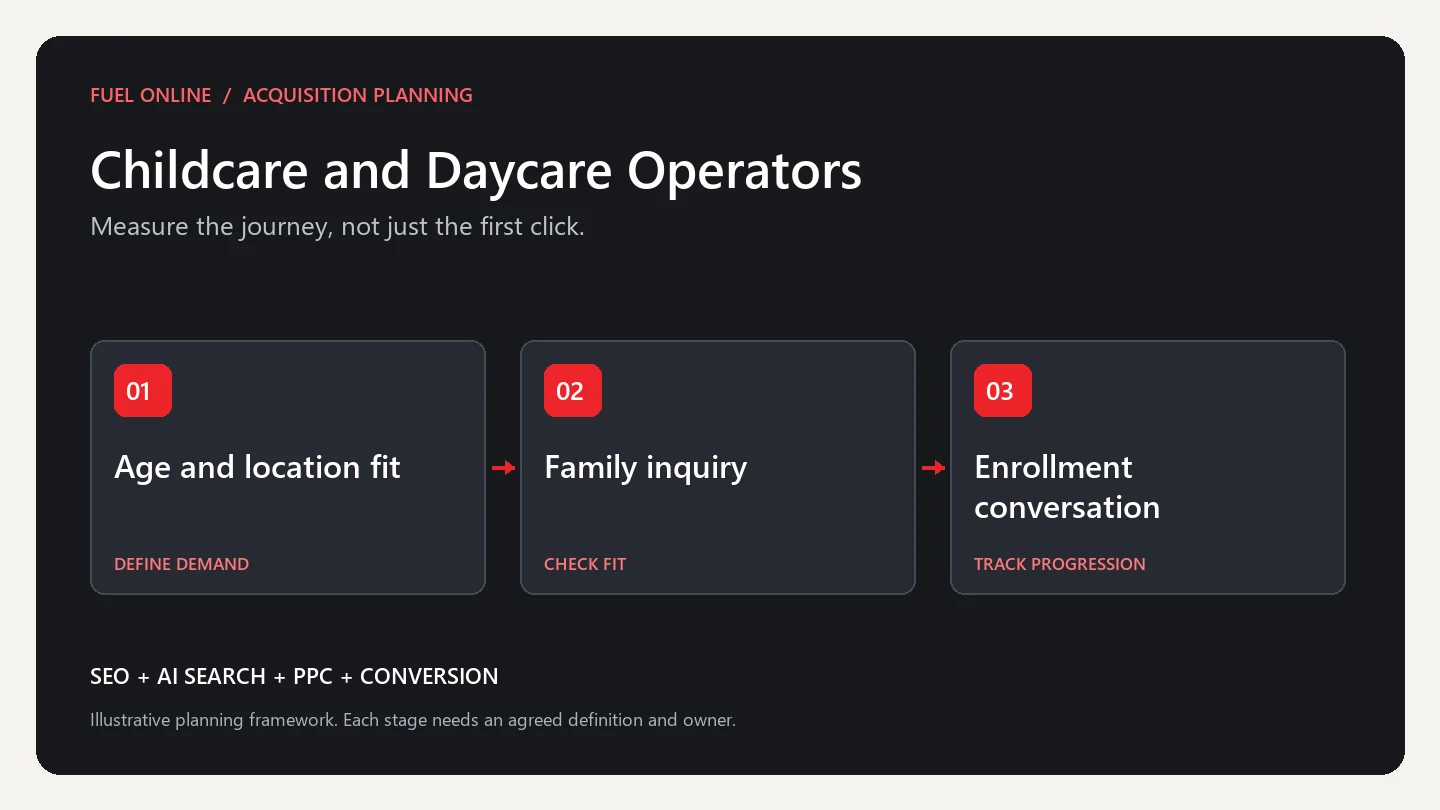
What the childcare SEO agency scope needs to solve
The target is a buyer among parents of infants, preschool families and households comparing locations who is trying to decide whether a center has an appropriate program, location, schedule and realistic enrollment path for the child.
Keyword research therefore separates viable service and evaluation intent from families outside the service area, age groups or schedules the center does not offer, job seekers and inquiries for rooms without current capacity. Qualification follows the real sales handoff, not a traffic threshold. Fuel Online maps each priority query group to one page and one honest next step, reducing cannibalization and preventing a blog from competing with a transactional service page.
The first decision in a childcare SEO agency engagement is whether the buyer, request and next step fit the business.
Decision map for childcare and daycare SEO
The recommended architecture includes location pages, infant and toddler care, preschool programs, schedules, family tours, enrollment steps and current program information.
A page is created only when the offer, audience, evidence or next step is meaningfully different. Briefs specify the buyer question, sources, reviewer, internal links and how the page supports this handoff: route by preferred center, child age, desired start date and schedule, then give the enrollment team a clear tour or waitlist next step.
The page and handoff map makes childcare and daycare SEO inspectable before production expands.
Operational requirements for childcare and daycare SEO services
The technical backlog covers crawl paths, indexation, canonicals, redirects, templates, internal links, page speed and structured data that matches visible content. Local work aligns location facts and avoids doorway pages.
Fuel Online pairs those checks with verified licensing information, approved program descriptions, authorized staff and facility images, and a documented enrollment process. Technical fixes receive a priority based on affected buyer paths and business value, not the size of an automated audit export.
The operating standard for childcare and daycare SEO services names the approved source, reviewer and next buyer action.
Illustrative search example
This is an illustrative SEO decision, not a client result. The childcare and daycare SEO choice is shown so a buyer can inspect the logic before approving similar work.
The SEO decision
An infant-care inquiry for next month and a preschool inquiry for the next school year need different capacity checks and follow-up. A single undifferentiated tour form hides that operational difference. For childcare and daycare SEO, the team should assign each query group to a useful page, support the decision with approved evidence and connect the page to the right next step. The childcare SEO agency plan should state why this is the first priority.
What the buyer can inspect
That distinction supports separate query groups, pages and calls to action without creating thin variations of the same copy. The decision record ties the childcare and daycare SEO change to a childcare and daycare SEO services deliverable, owner and release check.
How to audit a childcare SEO agency plan
Use this framework when activity looks healthy but the commercial result is unclear. It turns a visible symptom into an evidence check, a bounded change and a deliverable the business can verify. The diagnostic for the childcare SEO agency plan keeps the symptom, evidence check, action and output in one decision record.
1. Observable symptom
Family inquiries reach full rooms, the wrong center or an age program that cannot accept the requested start date.
2. What to inspect
Review the query, ranking page, internal links and resulting inquiry. Check whether the page answers the buyer's questions about child age range, preferred location, start timing and schedule needs and supports its claims with verified licensing information, approved program descriptions, authorized staff and facility images, documented enrollment process. This evidence check shows whether childcare and daycare SEO reflects the real offer and handoff.
3. Decision and action
Improve or consolidate the page that owns the query. Add the missing decision information and approved evidence, correct technical access or internal links, and verify the published result.
4. Inspectable output
A verified query-to-page decision with the technical or editorial change, source owner, internal links, release check and reporting connection to eligible family inquiries and tours held.
Deliverables and reporting for childcare and daycare SEO services
Rankings, impressions, clicks and landing-page behavior explain discoverability. The commercial view follows eligible family inquiries, tours held, applications and enrollments by location and program and the rejection reasons recorded by the receiving team.
The monthly deliverable links each finding to a technical, editorial, internal-link or conversion action. When comparing SEO agencies, ask to see the proposed page map, review workflow, ownership model and method for connecting queries to accepted opportunities without pretending attribution is perfect.
For Childcare and Daycare Operators, the SEO scope documents how child age range, preferred location, start timing and schedule needs affect page, campaign or routing decisions. Before release, the assigned business reviewer checks verified licensing information, approved program descriptions, authorized staff and facility images, documented enrollment process against every visible claim and records any dependency that remains unresolved.
The monthly review for childcare and daycare SEO services compares completed work with accepted demand and identifies the next commercial decision.
- Query-to-page map for location pages, infant and toddler care, preschool programs, schedules, family tours, enrollment steps and current program information
- Prioritized technical and indexation backlog
- Content briefs with evidence and reviewer requirements
- Internal-link plan connecting service, proof and next-step pages
- Monthly decision report tied to eligible family inquiries, tours held, applications and enrollments by location and program
How we measure childcare SEO agency
- eligible family inquiries
- tours held
- applications
- enrollments by location and program
Connect organic discovery to inquiry quality
Organic inquiry qualification rate = suitable organic inquiries ÷ organic inquiries reviewed.
Illustrative arithmetic: 12 suitable inquiries out of 20 reviewed organic inquiries is a 60% qualification rate. This measures inquiry fit, not search market share, and requires a recorded source and an agreed definition of suitable.
Agree on the baseline, data source and qualification criteria before comparing results. Separate visibility from inquiries and accepted business opportunities.
CONNECTED SERVICES
Choose the right next step for your business
Explore Fuel’s SEO capabilities, published campaign work and team to evaluate how we would support your organization.
BEFORE YOU CHOOSE AN AGENCY
Questions about childcare SEO agency
Where should a childcare SEO agency plan start?
Start where the business can see a costly mismatch: family inquiries reach full rooms, the wrong center or an age program that cannot accept the requested start date. A childcare SEO agency review should trace one real example from its source through the page or campaign and into the receiving team's disposition. Review the query, ranking page, internal links and resulting inquiry. Check whether the page answers the buyer's questions about child age range, preferred location, start timing and schedule needs and supports its claims with verified licensing information, approved program descriptions, authorized staff and facility images, documented enrollment process. The first childcare SEO agency action should produce a named owner, a bounded correction and a release check rather than a broad activity list.
What does childcare and daycare SEO include?
Childcare and daycare SEO includes a query-to-page map, technical and indexation backlog, evidence-backed content briefs, internal-link decisions, release verification and downstream measurement. New pages are justified by a distinct offer, location or buyer decision; repeated place-name pages without unique facts are excluded.
How do we measure childcare and daycare SEO services?
Agree on definitions and data sources for eligible family inquiries, tours held, applications and enrollments by location and program before launch. Channel metrics explain what happened upstream, while staff disposition and downstream stages show whether the work created demand the business could accept. Measure childcare and daycare SEO services through the accepted commercial stages the receiving team can verify. Reporting for childcare and daycare SEO services should show the source, stage definition, owner and limitation behind each decision metric.
What should a childcare and daycare operator ask before hiring an agency?
Ask who will perform the work, who owns the accounts and data, what is delivered in the opening execution sprint, how facts are reviewed, how rejected inquiries change the plan and which decision would cause the agency to pause or expand investment. Compare a childcare SEO agency engagement with other proposals by inspecting the proposed work, account ownership and response to rejected demand.
Should we prioritize SEO or paid search first?
Choose based on the gap. Paid search can test controlled queries while budget is active. SEO develops useful pages and discovery over time. If the current site cannot explain fit or route an inquiry, repair that path before sending substantially more traffic from either source. For childcare and daycare SEO, document access, approvals and handoffs across internal and agency roles.
What should we bring to an SEO review?
Bring access to search and analytics data, priority services and locations, examples of suitable and unsuitable inquiries, and available proof such as verified licensing information, approved program descriptions, authorized staff and facility images, and a documented enrollment process. We can then discuss the page map, technical access, reviewers and a practical first release. A useful childcare and daycare SEO services scope starts with current offers, capacity, evidence and examples of accepted and rejected inquiries.
Make your next agency conversation specific.
Tell us which services or markets matter to your childcare and daycare business, which inquiries your team accepts, and where the current SEO program breaks down. Bring one accepted and one rejected example. Fuel Online will help identify the first page, campaign, answer or handoff worth changing. Use the working session to define one childcare and daycare SEO services action with a source, owner, release check and downstream measure.
Talk with a Fuel strategist →