
FUEL ONLINE / Childcare and Daycare Operators / Digital marketing
Childcare and Daycare Digital Marketing Agency

A childcare operator cannot market every room equally when openings differ by center, age group, schedule and desired start date. As a childcare digital marketing agency, Fuel Online coordinates the website, search, paid media and follow-up around one definition of useful demand. Pages, campaigns and handoffs use center, child age, schedule, start timing and capacity to separate fit, and reporting follows eligible family inquiries and tours held.
child age range, preferred location, start timing and schedule needs
Choose childcare marketing through a center-specific discovery and tour journey
Fuel Online connects childcare marketing channels with the operator's actual centers, programs, schedules and supported tour-information routes. Compare a childcare digital marketing agency through one complete center-specific release before choosing a broad channel package. Program discovery and a current-opening question can share sources while needing different orientation. A useful proposal shows the initial message, maintained explanation, public action and receiving context together, making implementation inspectable beyond a list of advertising, search and content activity.
Choose the center and family task before the creative count
Begin with one center and a reader question selected by the operator. Ask what the family needs to understand about the actual program and supported next step. The agency should identify useful current material and the specific gap needing work before proposing more destinations or creative. A clearer center introduction may be the first valuable release. This gives production a clear purpose. The selected family task guides the release and its creative requirements.
Program age-group and schedule information should use the relationships the operator supplies. Ask how the message distinguishes general program facts from a current-opening question. Similar wording does not establish that every option is available at every center. The agency should connect the reader with the maintained resource relevant to the task, keeping the initial invitation clear without adding a stronger current arrangement than the public information supports.
A tour-information action has its own meaning. Ask what the public route establishes and what the receiver sees afterward. A request, confirmed tour, attended tour and later enrollment arrangement can be different stages. The operator defines its process. The agency should preserve those meanings across messages and confirmations, allowing the buyer to compare channel contributions without interpreting every technical event as an equivalent acquired enrollment outcome.
| Release component | Purpose | Evidence to inspect |
|---|---|---|
| Program discovery | Understand the actual center-program relationship. | Message compared with maintained facts. |
| Tour information | Recognize the supported public action. | Receiver interpretation matches invitation and confirmation. |
| Uncertain preference | Preserve what the family states and what remains unclear. | Actual field or explanation tested with fictional details. |
| Center update | Maintain the particular dependent resources. | Saved destinations checked separately from distribution settings. |
Compare reuse with a distinct campaign destination
Give every finalist the same center resource and current program information. Ask for a discovery-oriented introduction and the destination it would use. A maintained page may need clearer orientation; a new landing page may serve a distinct task. The agency should explain the contribution and source dependencies of either choice. A separate summary creates maintenance responsibility when center, schedule or program facts change, so that work belongs in the commercial comparison.
Now ask for an introduction to the tour-information route using the same supplied facts. Which statements remain shared and which explanation changes? The operator should be able to compare the short form with the full maintained resource. A different image or audience label does not itself establish a different journey. Retain the two release cards so another contributor can explain why the invitations differ when preparing a future format or reviewing another center's proposed campaign.
Implementation ownership should be explicit. Another supplier may control the website, tour-request connection or receiving system. Ask what the agency builds, what it specifies and what remains incomplete until another party acts. Prepared copy, a published destination and a completed public-to-receiver test are different delivery states. A useful proposal makes that boundary visible, allowing the operator to compare actual implementation rather than assume a finished creative presentation proves the full journey operates.
Rehearse the family context through the receiving record
Use fictional administrative details to follow the selected release. Reach the program explanation, complete the supported action and inspect the resulting record. Ask the receiver what the family stated about its center interest, schedule or timing where the process includes those values. Compare that interpretation with the original test sheet and public confirmation. A lost preference or misleading action label points to a specific repair. The remedy should address that observed gap.
An uncertain family preference can provide a useful contrast. Someone may know the center they are researching without knowing the operator's program labels. Ask how the supported route preserves what is stated and what still needs clarification. A superficially complete category can obscure the question. The operator should inspect the proposed explanation and receiving representation before accepting a requirement that every family choose a confident label simply to make campaign reporting easier.
Returning families may arrive through acquisition pages. Ask how the public experience helps them find the operator's established continuing-contact route where one is supported. The agency should use actual arrangements instead of inventing another service operation. Where records allow, the report should preserve the continuing purpose. A useful administrative interaction need not represent newly acquired enrollment demand simply because a campaign destination or source label was involved.
Keep capacity-related changes tied to particular resources
Introduce an operator-supplied change affecting one center's program or published current-opening information in the review materials. Ask which messages, saved destinations and reusable introductions depend on it. Pausing distribution does not explain what someone sees on an older saved page. The agency should identify the actual public-source task and distinguish it from account settings. Accurate unrelated center material can remain useful, keeping the response proportionate.
Where records support the distinction, compare a family misunderstanding a program description, a request losing center context and a current-opening question reaching an unclear destination. Those findings suggest different artifacts. Ask which resource or connection the proposed remedy changes. A combined low-fit total does not identify the answer. The next recommendation should retain the observation and reasoning behind its task rather than make every concern a reason to expand every channel.
Compare strategy, source editing, creative adaptation, destination work, connection testing and recurring review separately. Ask what remains usable after each component and which contribution belongs to another supplier. A bounded initial release and a continuing service can both be useful when responsibilities are clear. This makes similar marketing packages commercially comparable without fabricated forecasts of tours, enrollment or center capacity.
At handover, give an unfamiliar employee the two journey briefs, source dependencies and accepted tests. They should explain the difference between a program introduction and tour-information invitation and identify where their shared facts are maintained. If a campaign nickname carries the meaning, clarify it in ordinary language. The next contributor can then reuse accurate resources and improve a specific observed gap instead of reconstructing every decision after a supplier or team change.
For a final investment review, place the accepted center release beside a proposed expansion to another program or location. Ask what genuinely different task it serves and which operator facts are needed. Reuse can be valuable when its orientation purpose is clear; expansion can be valuable when it fills a distinct information gap. Retain the reason and source need before accepting another destination's maintenance work, keeping continuing childcare marketing connected to useful family journeys rather than disconnected production counts.
Use paired release cards before expanding to another center
For an expansion review, give the agency the accepted center brief and a second center's actual supplied program information. Ask which facts can be reused and which relationships differ. Similar organization branding does not settle the program, schedule or public-action context. The useful proposal names the source work and receiving test needed for the second release. This lets the operator compare genuine reuse with another destination whose maintenance requirements have not yet been explained.
Use two fictional timing cases during the release test: a family describing a later preferred start and another asking about the operator's current published route. Ask what each destination and record establishes. The agency should retain the stated preference without converting it into a confirmed opening or arrangement. Comparing the received interpretations gives the operator a concrete acceptance example for future messages about timing.
If a center-specific release loses stated family context at contact, childcare inquiry continuity can inspect the public action and received record.
AGGRESSIVE FROM THE START
One month. The work many agencies stretch across three.
Our mandate: move faster, go deeper and put experienced specialists to work immediately.
Fuel attacks the work in parallel: site audits, technical errors, new content, internal links, backlink outreach and conversion improvements. Your agreed scope determines the channels; urgent fixes do not wait behind a drawn-out planning phase.
The childcare digital marketing agency brief identifies visibility and lead barriers. Actionable fixes move into production while deeper analysis continues.
Your childcare and daycare digital marketing work runs alongside industry-specific content, relevant links and earned-authority outreach, based on your agreed scope.
The childcare and daycare marketing agency review shows completed work, lead quality and the next opportunities. You see who owns each action.
Fast execution is the operating standard. Access, approvals and scope shape delivery; search and revenue results have their own timelines.
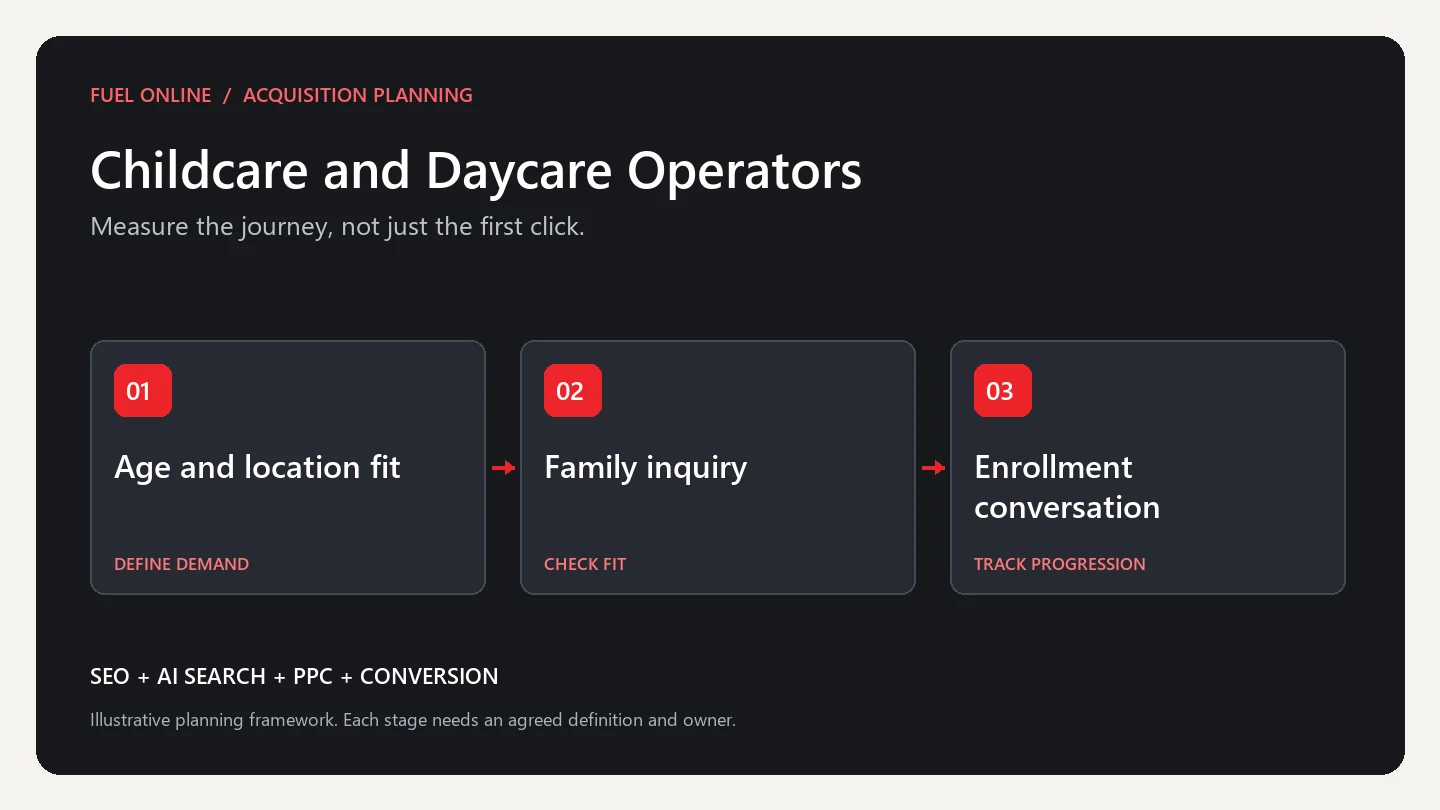
What the childcare digital marketing agency scope needs to solve
A childcare and daycare operator needs more than a list of channels. Parents of infants, preschool families and households comparing locations move between search results, location or service pages, proof and direct contact while deciding whether a center has an appropriate program, location, schedule and realistic enrollment path for the child.
Fuel Online maps that journey and assigns a job to the website, SEO, paid media, content and follow-up. The plan also identifies who inside the business approves facts and receives each type of inquiry.
The first decision in a childcare digital marketing agency engagement is whether the buyer, request and next step fit the business.
Decision map for childcare and daycare digital marketing
The build priority is location pages, infant and toddler care, preschool programs, schedules, family tours, enrollment steps and current program information. Pages use verified licensing information, approved program descriptions, authorized staff and facility images, and a documented enrollment process to answer practical objections.
Forms and calls support this handoff: route by preferred center, child age, desired start date and schedule, then give the enrollment team a clear tour or waitlist next step. Navigation follows buyer choices, not marketing-department labels, and the confirmation message states the real response expectation.
The page and handoff map makes childcare and daycare digital marketing inspectable before production expands.
Operational requirements for childcare and daycare marketing agency
Organic and paid campaigns share the same availability, geography and qualification facts. Search-term and inquiry reviews actively remove families outside the service area, age groups or schedules the center does not offer, job seekers and inquiries for rooms without current capacity.
Fuel Online maintains a channel calendar that names the audience, offer, page, owner, budget or production effort, and success condition for each test. A channel does not stay active merely because it generates inexpensive activity.
The operating standard for childcare and daycare marketing agency names the approved source, reviewer and next buyer action.
Illustrative channel example
This is an illustrative digital marketing decision, not a client result. The childcare and daycare digital marketing choice is shown so a buyer can inspect the logic before approving similar work.
The digital marketing decision
An infant-care inquiry for next month and a preschool inquiry for the next school year need different capacity checks and follow-up. A single undifferentiated tour form hides that operational difference. For childcare and daycare digital marketing, the team should name the channel that introduces each buyer, the page that qualifies the request and the owner responsible for follow-up. The childcare digital marketing agency plan should state why this is the first priority.
What the buyer can inspect
The website, campaign and follow-up path can now share one qualification rule while presenting the detail each buyer needs. The decision record ties the childcare and daycare digital marketing change to a childcare and daycare marketing agency deliverable, owner and release check.
How to audit a childcare digital marketing agency plan
Use this framework when activity looks healthy but the commercial result is unclear. It turns a visible symptom into an evidence check, a bounded change and a deliverable the business can verify. The diagnostic for the childcare digital marketing agency plan keeps the symptom, evidence check, action and output in one decision record.
1. Observable symptom
Family inquiries reach full rooms, the wrong center or an age program that cannot accept the requested start date.
2. What to inspect
Trace one accepted and one rejected inquiry across source, landing page, form or call, routing and follow-up. Check whether every channel uses the same facts about child age range, preferred location, start timing and schedule needs. This evidence check shows whether childcare and daycare digital marketing reflects the real offer and handoff.
3. Decision and action
Align the page, campaign and receiving team around one qualification rule. Remove conflicting facts, assign the handoff owner and release the smallest useful cross-channel test.
4. Inspectable output
A journey map and test ticket that show the channel, page, qualification rule, receiving owner and the accepted outcome represented by eligible family inquiries and tours held.
Deliverables and reporting for childcare and daycare marketing agency
The commercial scorecard uses eligible family inquiries, tours held, applications and enrollments by location and program. Fuel Online reconciles campaign and website data with the system where staff accept, reject or progress real inquiries.
A useful review states what changed, what the downstream data shows, what remains uncertain and what happens next. Agency selection should cover account ownership, review cadence, senior involvement, data access and the response when inquiry volume rises but accepted demand does not.
For Childcare and Daycare Operators, the digital program documents how child age range, preferred location, start timing and schedule needs affect page, campaign or routing decisions. Before release, the assigned business reviewer checks verified licensing information, approved program descriptions, authorized staff and facility images, documented enrollment process against every visible claim and records any dependency that remains unresolved.
The monthly review for childcare and daycare marketing agency compares completed work with accepted demand and identifies the next commercial decision.
- Journey and page map for location pages, infant and toddler care, preschool programs, schedules, family tours, enrollment steps and current program information
- Channel roles with a named audience, offer and owner
- Test backlog with budget and decision gates
- Handoff specification that can route by preferred center, child age, desired start date and schedule, then give the enrollment team a clear tour or waitlist next step
- Reporting framework for eligible family inquiries, tours held, applications and enrollments by location and program
How we measure childcare digital marketing agency
- eligible family inquiries
- tours held
- applications
- enrollments by location and program
Compare channels using the same qualification rules
Cost per qualified inquiry = attributable channel spend ÷ inquiries meeting the agreed criteria.
Keep the reporting window and included costs consistent. A cheaper contact is not necessarily a cheaper customer; compare later progression where the data supports it.
Agree on the baseline, data source and qualification criteria before comparing results. Separate visibility from inquiries and accepted business opportunities.
CONNECTED SERVICES
Choose the right next step for your business
Explore Fuel’s Digital marketing capabilities, published campaign work and team to evaluate how we would support your organization.
BEFORE YOU CHOOSE AN AGENCY
Questions about childcare digital marketing agency
Where should a childcare digital marketing agency plan start?
Start where the business can see a costly mismatch: family inquiries reach full rooms, the wrong center or an age program that cannot accept the requested start date. A childcare digital marketing agency review should trace one real example from its source through the page or campaign and into the receiving team's disposition. Trace one accepted and one rejected inquiry across source, landing page, form or call, routing and follow-up. Check whether every channel uses the same facts about child age range, preferred location, start timing and schedule needs. The first childcare digital marketing agency action should produce a named owner, a bounded correction and a release check rather than a broad activity list.
What does childcare and daycare digital marketing include?
Childcare and daycare digital marketing includes a buyer-path and channel audit, shared qualification rules, website and landing-page priorities, tracking definitions, named channel owners and a staged release plan. The initial mix depends on existing demand, evidence, capacity and the team's ability to act on inquiries; channels expand only after accepted-demand data supports the decision.
How do we measure work by a childcare and daycare marketing agency?
Agree on definitions and data sources for eligible family inquiries, tours held, applications and enrollments by location and program before launch. Channel metrics explain what happened upstream, while staff disposition and downstream stages show whether the work created demand the business could accept. Measure work by a childcare and daycare marketing agency through the accepted commercial stages the receiving team can verify. Reporting on work by a childcare and daycare marketing agency should show the source, stage definition, owner and limitation behind each decision metric.
What should a childcare and daycare operator ask before hiring an agency?
Ask who will perform the work, who owns the accounts and data, what is delivered in the opening execution sprint, how facts are reviewed, how rejected inquiries change the plan and which decision would cause the agency to pause or expand investment. Compare a childcare digital marketing agency engagement with other proposals by inspecting the proposed work, account ownership and response to rejected demand.
Can Fuel Online work with our internal team or other vendors?
Yes, when ownership is explicit. The scope identifies who controls the website, analytics, media, creative, CRM and approvals. Shared access, release checks and a decision log keep work from stalling or being attributed to the wrong team. For childcare and daycare digital marketing, document access, approvals and handoffs across internal and agency roles.
What should we bring to a digital marketing review?
Bring channel access, recent reports, the website, offer and location priorities, capacity constraints and examples of accepted and rejected inquiries. We use that material to identify the most valuable buyer-path and measurement problems before recommending a broader mix. A useful childcare and daycare marketing agency scope starts with current offers, capacity, evidence and examples of accepted and rejected inquiries.
Make your next agency conversation specific.
Tell us which services or markets matter to your childcare and daycare business, which inquiries your team accepts, and where the current digital program breaks down. Bring one accepted and one rejected example. Fuel Online will help identify the first page, campaign, answer or handoff worth changing. Use the working session to define one action for a childcare and daycare marketing agency, with a source, owner, release check and downstream measure.
Talk with a Fuel strategist →