
FUEL ONLINE / Ketamine Clinics / Lead generation
Ketamine Clinic Lead Generation Agency

A ketamine clinic needs consultation requests it can review responsibly, not marketing language that implies diagnosis, eligibility or a treatment result. As a ketamine clinic lead generation agency, Fuel Online improves forms, calls, routing and follow-up so viable requests reach the right owner. Pages, campaigns and handoffs use supported service, location and clinician-led consultation to separate fit, and reporting follows eligible consultation requests and scheduled consultations.
service location, consultation availability and clinician-led eligibility process
Make a ketamine clinic inquiry path clear and testable
A ketamine clinic lead-generation and conversion agency should make the first administrative request understandable to the visitor and recognizable to the receiving team. Compare proposals through a complete communication path, not a form screenshot alone. Fuel Online can inspect the public explanation, action, acknowledgement and received context together. The clinic should receive clear definitions and a repeatable acceptance exercise, giving later acquisition decisions an intelligible foundation.
Define what the first action begins
Begin with the action the current resource invites. Asking for information, requesting contact and completing another provider-supported step can have different meanings. The clinic supplies its actual administrative process. Ask an unfamiliar reader to describe the invitation in ordinary language and compare that interpretation with what staff understand. A successful submission is useful evidence only when the meaning of the action remains clear.
Distinguish the public explanation from the later provider conversation. A concise information request can help a person begin contact without trying to settle every question online. The agency should identify the information needed at this stage and the resource supplying it. This makes the project easier to scope than a broad request for a more persuasive or more detailed intake experience.
Compare a new request with a continuing administrative contact where the clinic supports that distinction. A person already communicating with the organization may need a different destination from a visitor seeking general information. The clinic defines the route. The agency can make the choice understandable and preserve the current working process, rather than force every conversation into a new-acquisition category.
| Artifact | Question for the clinic | What a proposal should specify |
|---|---|---|
| Action definition | What begins when the visitor submits? | Consistent page, button and acknowledgement meaning |
| Field-purpose sheet | Why is each initial value useful? | Receiving task and treatment of missing context |
| Receiving test | What can authorized staff identify? | Permitted fictional record and observed destination |
| Exception record | Which stage remains unclear or unverified? | Specific owner and next implementation task |
Give each field a receiving purpose
Create a field-purpose sheet for the selected request. Beside each proposed field, identify the administrative task it supports, the receiving owner and what happens when the information is absent. This gives the clinic a concrete basis for deciding what belongs at first contact. A useful initial form is organized around the supported conversation, not around the number of values a system can collect.
Use fictional examples to compare a general organizational question with one originating from a named public resource. The receiving team may find the resource context useful even when it does not need additional narrative from the visitor. Ask the agency which context the existing system can preserve and how the recipient sees it. This turns source continuity into an implementation question with a testable result.
Inspect the words surrounding the action as carefully as the fields. The introduction, button and acknowledgement should describe the same administrative stage. A friendly confirmation can establish receipt while preserving the provider’s actual next instruction. Ask the supplier to show these elements together so a wording change in one place does not quietly change the visitor’s expectation elsewhere.
Test acknowledgement and receiving context together
For the first acceptance exercise, begin on the selected resource using the clinic’s permitted fictional details. Follow the ordinary route and inspect what the intended team receives. Record the starting page, public invitation, confirmation and visible recipient context. The exercise should preserve the provider’s existing records and clearly distinguish test activity from ordinary inquiries.
Ask authorized staff to explain what the test record tells them. Can they identify the purpose of the request and the appropriate next administrative conversation? Compare their explanation with the visitor-facing wording. If context is lost, name the particular field, label or transition involved. This is a more useful project finding than classifying the whole website as effective or ineffective.
Inspect the acknowledgement as a resource the person may read after leaving the website. Can they recognize the organization and understand the current instruction without remembering the previous screen? The provider supplies that instruction. A useful agency proposal includes checking this later context when the acknowledgement is part of the contracted journey, rather than treating submission as the end of acceptance.
Work through correction and continuing-contact examples
Introduce a fictional correction to an earlier request. The receiving team should define how that relationship is understood in its actual process. Ask the supplier what context can be preserved and where staff review remains necessary. The purpose is to make the administrative record usable, not to assume the tools can automatically reconcile every conversation.
Compare the correction with a genuinely separate new request. The clinic determines which distinction matters to its review. The agency should describe how reporting retains the available context, including unknown relationships. A second message may be useful work without representing another independent initial inquiry. Keeping those meanings visible improves the quality of the review without changing the underlying provider process.
Use an existing-contact example as another route check. Give the team a fictional person continuing an administrative exchange and ask which public instructions apply. The agency can connect the supported destination while the clinic retains its own communication arrangements. The acceptance record should show the reader’s intended purpose, the destination and the receiving owner, so later revisions preserve the distinction.
Compare implementation responsibility
Compare implementation boundaries in the proposals. Public-page editing, form configuration, acknowledgement changes and another system’s receiving record can involve different owners. Ask which component the agency can implement and which needs a clinic or third-party action. A recommendation remains a planning artifact until the relevant owner completes and checks the change.
Ask for an exception record as part of acceptance. An unclear required-field message, a lost page reference or a destination that cannot be inspected may each need a different next task. The record should state what was observed and who can act. It need not contain real visitor stories. Fictional administrative scenarios can establish the implementation issue without reproducing sensitive communications.
Compare the report definitions with the accepted journey. A submitted message, delivery to the intended system and staff receipt are different observations. Later provider-defined stages require compatible information from the organization. Ask how the supplier represents unavailable later status so an incomplete record does not become an assumed positive or negative outcome.
Retain a useful administrative acceptance record
At handover, retain the request definition, field purposes, current destination map and fictional test results. A new team member should be able to repeat the exercise and identify whom to contact when an instruction changes. This makes continuity part of the deliverable rather than depending on an agency-only explanation that disappears when the account team changes.
Compare a future page redesign with the accepted record. If a label, field or destination changes, the team can ask whether the action still means the same thing and whether the receiving context remains useful. Accurate wording and working forms can be retained while the specific gap is improved. This supports focused changes instead of treating every conversion project as a complete platform replacement.
Include an ordinary incomplete-submission exercise in the permitted test. Leave one agreed required administrative field blank and inspect the explanation the page provides. Can the tester identify what needs correction and preserve the information already entered under the supported process? The provider chooses the fictional details and test conditions. The agency’s acceptance record should name the observed message and behavior rather than simply mark the form as functional. This makes error handling part of the actual communication journey and can reveal a narrow improvement before a larger form redesign is considered.
Compare a request begun on a phone with one completed through another supported route. The intention is to inspect the organization and action labels, not assume that every device or system shares a complete visitor record. Ask the supplier to identify what context the receiving team can actually see in each case. A difference may be acceptable when it is understood and documented. The proposal should show how the public invitation remains intelligible despite that difference, leaving staff with a clear administrative conversation rather than a stronger attribution claim than the available evidence supports.
Ask the agency to present the acknowledgement and correction messages together as a small communication set. These messages often carry the meaning of the process at moments when the reader needs clarity. The clinic can review their consistency with the original invitation and current administrative instruction. Compare a proposal including those messages with one that edits only the main page. This exposes a real scope difference without requiring invented conversion rates or an assumption that more reassuring copy is necessarily more accurate.
Keep acceptance criteria separate from later optimization ideas. A request reaching the supported owner with understandable context can satisfy the agreed implementation test. A future proposal to simplify a field or change a label needs its own reason and review. Ask the supplier to retain the accepted baseline so a subsequent change can be compared with something concrete. This gives the provider continuity across releases and helps another team identify whether a new problem concerns a recent edit, an earlier unresolved dependency or a change in the organization’s own process.
Choose the next investment from the observed constraint. A confusing invitation suggests editorial work, lost context suggests an implementation task and limited later feedback suggests a reporting-definition discussion. The clinic can then assess a conversion agency through clear communication and accountable receiving paths. Further acquisition activity builds on a journey the organization can actually understand and review.
For the related clinic-wide scope, explore ketamine clinic marketing.
AGGRESSIVE FROM THE START
One month. The work many agencies stretch across three.
Our mandate: move faster, go deeper and put experienced specialists to work immediately.
Fuel attacks the work in parallel: site audits, technical errors, new content, internal links, backlink outreach and conversion improvements. Your agreed scope determines the channels; urgent fixes do not wait behind a drawn-out planning phase.
The ketamine clinic lead generation agency brief identifies visibility and lead barriers. Actionable fixes move into production while deeper analysis continues.
Your ketamine clinic lead generation work runs alongside industry-specific content, relevant links and earned-authority outreach, based on your agreed scope.
The ketamine clinic conversion agency review shows completed work, lead quality and the next opportunities. You see who owns each action.
Fast execution is the operating standard. Access, approvals and scope shape delivery; search and revenue results have their own timelines.
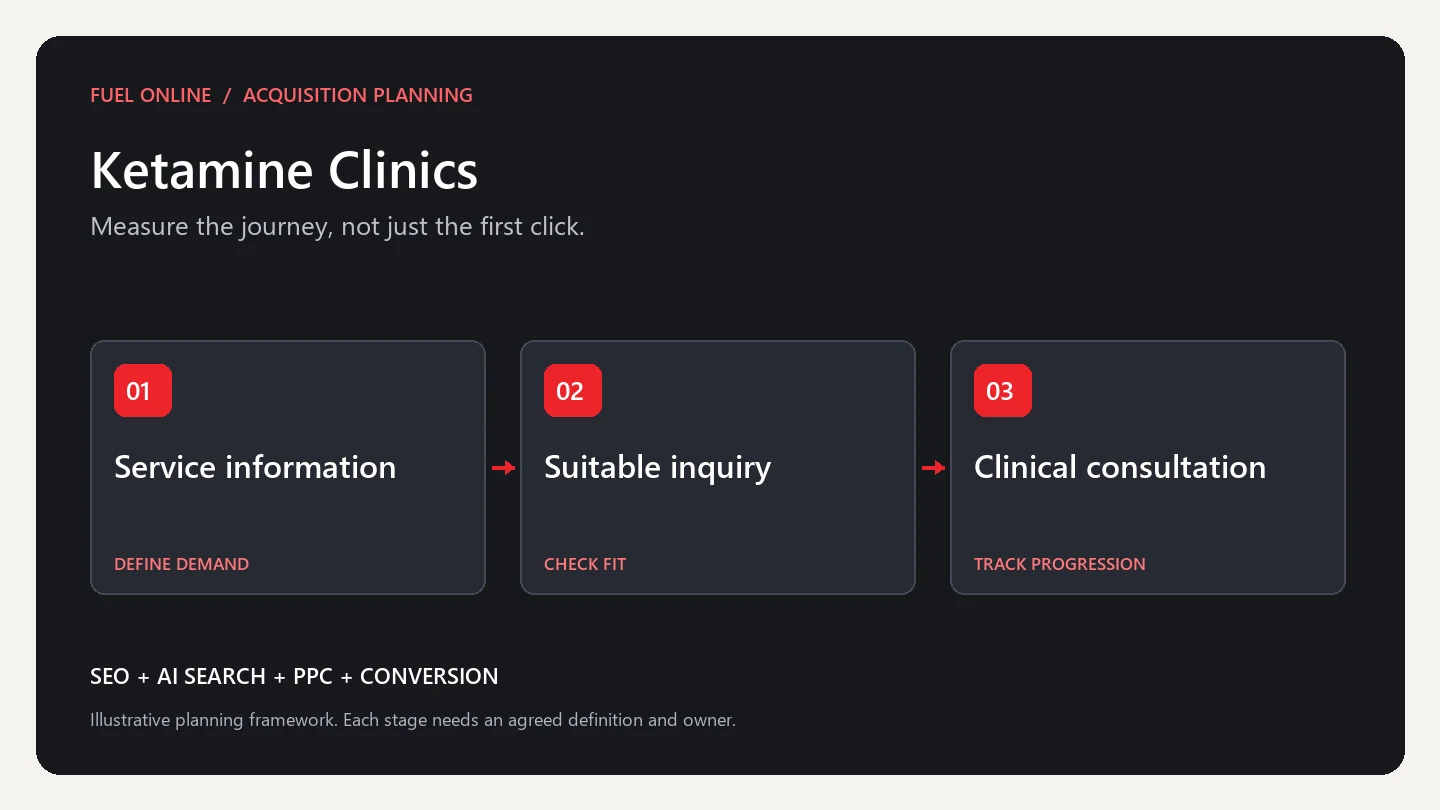
What the ketamine clinic lead generation agency scope needs to solve
The target audiences are prospective patients, caregivers and referring professionals. A useful request provides enough information to assess whether the clinic offers the relevant service and location and what the clinician-led consultation and eligibility process involves.
Fuel Online documents accepted, rejected, duplicate, nurture and unresolved outcomes before changing a form. That vocabulary exposes diagnosis requests, guaranteed treatment suitability, unsupported conditions, prescriptions without evaluation and locations the clinic does not serve and keeps cheap, unusable inquiries from looking successful.
The first decision in a ketamine clinic lead generation agency engagement is whether the buyer, request and next step fit the business.
Decision map for ketamine clinic lead generation
The operating requirement is to collect only the minimum contact, location and service information needed to request a consultation, then route the request for clinician-led review.
The conversion specification names required and optional fields, validation, call handling, routing, confirmation language, response expectation, CRM stages and a fallback when the first owner is unavailable. Fields are included only when they affect routing or the next conversation.
The page and handoff map makes ketamine clinic lead generation inspectable before production expands.
Operational requirements for ketamine clinic conversion agency
The page system covers clinician-reviewed service pages, consultation process, locations, patient questions, referring-professional information and careful educational resources. At the point where a buyer must judge fit, it uses clinician-approved copy, verified credentials, accurate service availability, consented media and documented consultation steps.
Copy also makes limits visible so diagnosis requests, guaranteed treatment suitability, unsupported conditions, prescriptions without evaluation and locations the clinic does not serve can self-select out. The goal is a better-informed next step, not a form hidden behind generic reassurance.
The operating standard for ketamine clinic conversion agency names the approved source, reviewer and next buyer action.
Illustrative conversion example
This is an illustrative lead generation decision, not a client result. The ketamine clinic lead generation choice is shown so a buyer can inspect the logic before approving similar work.
The lead generation decision
A person asking whether a service may be appropriate needs a consultation explanation, not a marketing diagnosis. A referring professional needs scope, contact and coordination details on a separate path. For ketamine clinic lead generation, the team should ask only for details that change qualification or routing, then assign the request and record whether it was accepted. The ketamine clinic lead generation agency plan should state why this is the first priority.
What the buyer can inspect
Forms and routing can ask only what changes the next step, then send each request to the right owner. The decision record ties the ketamine clinic lead generation change to a ketamine clinic conversion agency deliverable, owner and release check.
How to audit a ketamine clinic lead generation agency plan
Use this framework when activity looks healthy but the commercial result is unclear. It turns a visible symptom into an evidence check, a bounded change and a deliverable the business can verify. The diagnostic for the ketamine clinic lead generation agency plan keeps the symptom, evidence check, action and output in one decision record.
1. Observable symptom
Marketing inquiries ask for diagnosis or assume treatment eligibility before clinician-led consultation.
2. What to inspect
Replay a valid request and a poor-fit request through forms, calls, routing, confirmation and CRM stages. Verify where service location, consultation availability and clinician-led eligibility process is captured and who owns the next action. This evidence check shows whether ketamine clinic lead generation reflects the real offer and handoff.
3. Decision and action
Change the smallest handoff element causing preventable loss, such as a missing fit statement, unnecessary field, wrong owner, missed call process or unclear response expectation.
4. Inspectable output
A tested routing specification with required fields, owner, fallback, response expectation, CRM disposition and measurement through eligible consultation requests and scheduled consultations.
Deliverables and reporting for ketamine clinic conversion agency
The scorecard follows eligible consultation requests, scheduled consultations, completed consultations and acquisition cost by supported service along with contact rate, response time and stage loss. Calls and forms are reconciled with the system the team actually uses.
Tests address the largest preventable loss first, such as an unclear fit statement, unnecessary field, missed call, wrong owner or slow follow-up. Agency buyers should ask for the routing map, disposition dictionary, account ownership and a clear method for resolving attribution gaps.
For Ketamine Clinics, the conversion scope documents how service location, consultation availability and clinician-led eligibility process affect page, campaign or routing decisions. Before release, the assigned business reviewer checks clinician-approved copy, verified credentials, accurate service availability and consented media against every visible claim and records any dependency that remains unresolved.
The monthly review for ketamine clinic conversion agency compares completed work with accepted demand and identifies the next commercial decision.
- Form, call and routing specification
- Confirmation and response-expectation copy
- CRM disposition dictionary and failure fallback
- Quality-review backlog ranked by preventable loss
- Conversion reporting tied to eligible consultation requests, scheduled consultations, completed consultations and acquisition cost by supported service
How we measure ketamine clinic conversion agency
- eligible consultation requests
- scheduled consultations
- completed consultations
- acquisition cost by supported service
Find the drop between interest and a useful next step
Next-step completion rate = qualified inquiries completing the agreed next step ÷ qualified inquiries reviewed.
Illustrative arithmetic: 15 completed appointments from 25 qualified inquiries is 60%. Use the next step that fits your business, such as a consultation, estimate or discovery meeting, and record the time allowed for completion.
Agree on the baseline, data source and qualification criteria before comparing results. Separate visibility from inquiries and accepted business opportunities.
CONNECTED SERVICES
Choose the right next step for your business
Explore Fuel’s Lead generation capabilities, published campaign work and team to evaluate how we would support your organization.
BEFORE YOU CHOOSE AN AGENCY
Questions about ketamine clinic conversion agency
Where should a ketamine clinic lead generation agency plan start?
Start where the business can see a costly mismatch: marketing inquiries ask for diagnosis or assume treatment eligibility before clinician-led consultation. A ketamine clinic lead generation agency review should trace one real example from its source through the page or campaign and into the receiving team's disposition. Replay a valid request and a poor-fit request through forms, calls, routing, confirmation and CRM stages. Verify where the required information is captured and who owns the next action. The first ketamine clinic lead generation agency action should produce a named owner, a bounded correction and a release check rather than a broad activity list.
What does ketamine clinic lead generation include?
Ketamine clinic lead generation includes a form and call-path review, qualification definitions, field and routing maps, response ownership, CRM disposition rules and a test plan. The system asks only for details that change eligibility, routing or the next conversation, while more complex questions move to the appropriate person.
How do we measure work by a ketamine clinic conversion agency?
Agree on definitions and data sources for eligible consultation requests, scheduled consultations, completed consultations and acquisition cost by supported service before launch. Channel metrics explain what happened upstream, while staff disposition and downstream stages show whether the work created demand the business could accept. Measure work by a ketamine clinic conversion agency through the accepted commercial stages the receiving team can verify. Reporting on work by a ketamine clinic conversion agency should show the source, stage definition, owner and limitation behind each decision metric.
What should a ketamine clinic ask before hiring an agency?
Ask who will perform the work, who owns the accounts and data, what is delivered in the opening execution sprint, how facts are reviewed, how rejected inquiries change the plan and which decision would cause the agency to pause or expand investment. Compare a ketamine clinic lead generation agency engagement with other proposals by inspecting the proposed work, account ownership and response to rejected demand.
Can Fuel Online work with our existing CRM and phone system?
Usually, after confirming access, field definitions, routing options and reporting limits. The goal is to improve the system the team can operate, not add software for its own sake. Any integration scope and privacy responsibility should be explicit before implementation. For ketamine clinic lead generation, document access, approvals and handoffs across internal and agency roles.
What should we bring to a conversion review?
Bring the current forms, phone flow, CRM stages, response expectations, routing owners and a sample of accepted, rejected and unresolved inquiries. This shows where suitable opportunities are lost and whether the first fix belongs on the page, in the handoff or in follow-up. A useful ketamine clinic conversion agency scope starts with current offers, capacity, evidence and examples of accepted and rejected inquiries.
Make your next agency conversation specific.
Tell us which services or markets matter to your ketamine clinic business, which inquiries your team accepts, and where the current conversion system breaks down. Bring one accepted and one rejected example. Fuel Online will help identify the first page, campaign, answer or handoff worth changing. Use the working session to define one action for a ketamine clinic conversion agency, with a source, owner, release check and downstream measure.
Talk with a Fuel strategist →