
FUEL ONLINE / Ketamine Clinics / AI SEO, AEO & GEO
Ketamine Clinic AI SEO, AEO and GEO Agency

A ketamine clinic needs consultation requests it can review responsibly, not marketing language that implies diagnosis, eligibility or a treatment result. As a ketamine clinic AI SEO agency, Fuel Online builds reviewed answers and tests their accuracy, sources and commercial relevance. Pages, campaigns and handoffs use supported service, location and clinician-led consultation to separate fit, and reporting follows eligible consultation requests and scheduled consultations.
service location, consultation availability and clinician-led eligibility process
Compare ketamine clinic AI SEO through a traceable information record
A ketamine clinic AI SEO, AEO and GEO agency should make the provider’s public information easier to trace, understand and maintain. Compare proposals through a named reader question, the source that answers it and the implementation the agency will deliver. Fuel Online can organize a bounded first assignment around those relationships. The clinic should receive useful owned information and a clear observation record, with the meaning of each kept visible when deciding what to improve next.
Define the information relationship before the observation
Begin by distinguishing organizational identity, the provider’s approved offering description and its administrative contact process. These are related facts with different owners and update triggers. A reader identifying the clinic needs a reliable organizational reference. A reader learning about the offering needs the provider’s maintained explanation. Someone beginning contact needs the supported next step. Ask finalists to map these tasks before suggesting a larger set of answer-style pages.
Create an information register for a representative example. Name the reader question, current resource, statement it supports and owner of a correction. Keep the register small enough to use in an ordinary review. Its purpose is to make the source relationship understandable to someone who did not write the page. A list of URLs alone is less useful than a record explaining why each resource belongs in the journey.
Inspect the scope of each public statement. An organizational introduction can establish who the provider is, while a separate resource can explain the service information it has authorized. Ask the agency to preserve that distinction in summaries and contextual links. The provider’s professional team determines individualized questions. The marketing project makes the public boundary and appropriate route understandable, without expanding a general description into a conclusion about a particular person.
| Proposal component | What the clinic compares | Artifact to retain |
|---|---|---|
| Source investigation | The exact question and statement being examined | Reader-purpose and source annotation |
| Owned improvement | The resource change and publishing responsibility | Completed page reference and acceptance notes |
| Outside observation | The response conditions and visible supporting source | Dated question/answer record with uncertainty |
| Maintenance | The resources affected by a changed provider fact | Source owner and checked change record |
Compare source implementation with recurring reporting
Compare what the proposed fee buys. Source discovery, page editing, implementation and repeated outside-answer observation are separate deliverables. One supplier may provide an observation report while another includes a completed source improvement. Ask each to show the artifact the clinic receives and identify who can publish the change. This makes a recurring AI-search engagement easier to evaluate than a broad promise of greater visibility.
For observation work, agree on a bounded question sheet. Retain the question as entered, date, system and relevant visible context, together with the response and any sources shown. A named provider, a source citation and a general subject explanation represent different findings. Keeping them separate helps the clinic understand whether the observation concerns its identity, the accuracy of a statement or simply the type of answer returned.
Compare a cited statement with the resource supporting it where that source is visible. Does the page actually establish the attached wording? A useful investigation identifies the exact source passage and the part of the answer being evaluated. If the source cannot be identified, retain that limit. The agency can document the uncertainty without recommending a speculative rewrite of accurate clinic information.
Work through a specific provider-information question
Use a fictional question about how to contact the named clinic as the first worked exercise. Give finalists the same current organizational and administrative resources. Ask them to show the answer each resource can supply and the connection a reader needs. One proposal may clarify identity context; another may identify an outdated link. Compare the specific change rather than how confidently each supplier describes its general AI methodology.
Now contrast that task with a question about the provider’s public offering. The relevant source and review owner may differ. Ask the supplier to annotate where the summary obtains its meaning and where a reader can find further information. The exercise should establish the actual resource relationship, not decide an individual’s suitability or anticipate what the provider would conclude in a professional conversation.
Include an identity ambiguity in the observation review. Two organizations can have similar public wording, and a familiar phrase alone may not identify the intended clinic. Ask which address, destination or other approved detail supports the conclusion. Record uncertainty when the visible evidence is insufficient. This gives the clinic a practical way to inspect a visibility report instead of assuming every similarly named mention belongs to it.
Make the first source release inspectable
For the first source release, identify the exact resource being improved, the source statements retained and the next supported information step. Ask an unfamiliar reviewer to use the proposed page on a phone and explain what it confirms. Compare that interpretation with the provider’s intended meaning. A point of confusion becomes a specific editorial or navigation task, which is easier to accept than a general instruction to add more content.
Test the administrative destination with fictional details under the provider’s permitted process when that handoff is included. Record the starting resource, public invitation and receiving context. Keep an observed receipt separate from later communication. The agency should identify which systems it can inspect and which dependency needs the provider or another supplier. This makes the completed scope visible without assuming that a button proves the whole route works.
Use a hypothetical administrative-contact revision to inspect maintenance. The provider supplies the new instruction; the agency identifies the owned resources and reusable summaries that depend on it. Compare the affected-resource list with the actual implementation record. The clinic should be able to tell which items were revised, which were checked and which remain with another owner.
Retain an evidence register the clinic can use
At handover, keep the question register, source annotations, completed changes and observation conditions together. A new colleague should be able to identify the current organizational source and the resource explaining contact. Retain the reason for each page relationship, so a later writer understands what a summary is intended to establish instead of copying it into an unrelated setting.
Compare the proposed review meeting with these artifacts. The agency should be able to describe one implemented improvement, one remaining uncertainty and the evidence behind the recommended next task. A confusing source connection, an unanswered provider fact and an outside answer with no visible source require different decisions. This gives the clinic a practical basis for choosing whether to implement, investigate or maintain.
Evaluate discovery and administrative progression in layers. Confirm the owned release first, then review the recorded outside observations and any compatible inquiry evidence. A source improvement can be useful even when an external answer varies. A favorable mention can be interesting while later progression remains unknown. Keeping those meanings visible supports a more intelligible agency comparison than assigning a business outcome to every observation.
Add a source-age exercise to the comparison. Suppose an illustrative observation links to an older provider resource while a maintained page now carries the current administrative instruction. Ask the agency to record both references and identify their relationship. The task is to determine which owned explanation requires attention, not to assume that the answer system will immediately substitute the newer wording. The provider can approve a clarification on the relevant resource while the observation record preserves what was visible at the time. This gives the buyer a concrete example of how the agency separates source maintenance from outside-system behavior.
Ask how a disputed observation is reviewed. Give two colleagues the same question record and source passage, then ask each to classify what the response establishes. If their conclusions differ, identify the missing context or ambiguous definition. The record may need a clearer distinction between a provider mention and a source citation, or a more precise statement of the claim being examined. This is useful quality control for the commissioned exercise because it makes the report interpretable by the clinic rather than dependent on a single analyst’s private explanation.
Compare the cost basis of repeated observation with the cost basis of implementation. A supplier may price a defined question set and reporting cadence separately from interviews, writing or website work. Ask which changes the scope includes after an issue is identified and which require another assignment. No universal price or question count is needed to make that comparison. The buyer needs the unit of work, included revision responsibility and delivered artifact. This exposes a retainer that reports the same unresolved problem repeatedly without making its implementation boundary clear.
Use the first completed record as a training example for the provider’s future information owner. Ask that person to locate the authoritative statement, identify the resource change and explain the observation limit. Retain the example alongside the working register, including any question the team could not resolve. It becomes a practical reference for later reviews and helps prevent a new analyst from broadening the meaning of the original source. The agency can then expand the question sheet deliberately, choosing a genuinely different reader task rather than adding near-identical variations solely to enlarge the report.
Before expanding the question set, ask the clinic’s information owner to repeat the original exercise from the retained record. Can they locate the current source, understand the proposed correction and identify the appropriate reviewer? That test makes operational usability part of acceptance. The resulting program is a maintained provider-information system with a documented observation practice, giving further AI discovery work a concrete purpose.
For the related clinic-wide scope, explore ketamine clinic marketing.
AGGRESSIVE FROM THE START
One month. The work many agencies stretch across three.
Our mandate: move faster, go deeper and put experienced specialists to work immediately.
Fuel attacks the work in parallel: site audits, technical errors, new content, internal links, backlink outreach and conversion improvements. Your agreed scope determines the channels; urgent fixes do not wait behind a drawn-out planning phase.
The ketamine clinic AI SEO agency brief identifies visibility and lead barriers. Actionable fixes move into production while deeper analysis continues.
Your ketamine clinic AEO work runs alongside industry-specific content, relevant links and earned-authority outreach, based on your agreed scope.
The ketamine clinic GEO review shows completed work, lead quality and the next opportunities. You see who owns each action.
Fast execution is the operating standard. Access, approvals and scope shape delivery; search and revenue results have their own timelines.
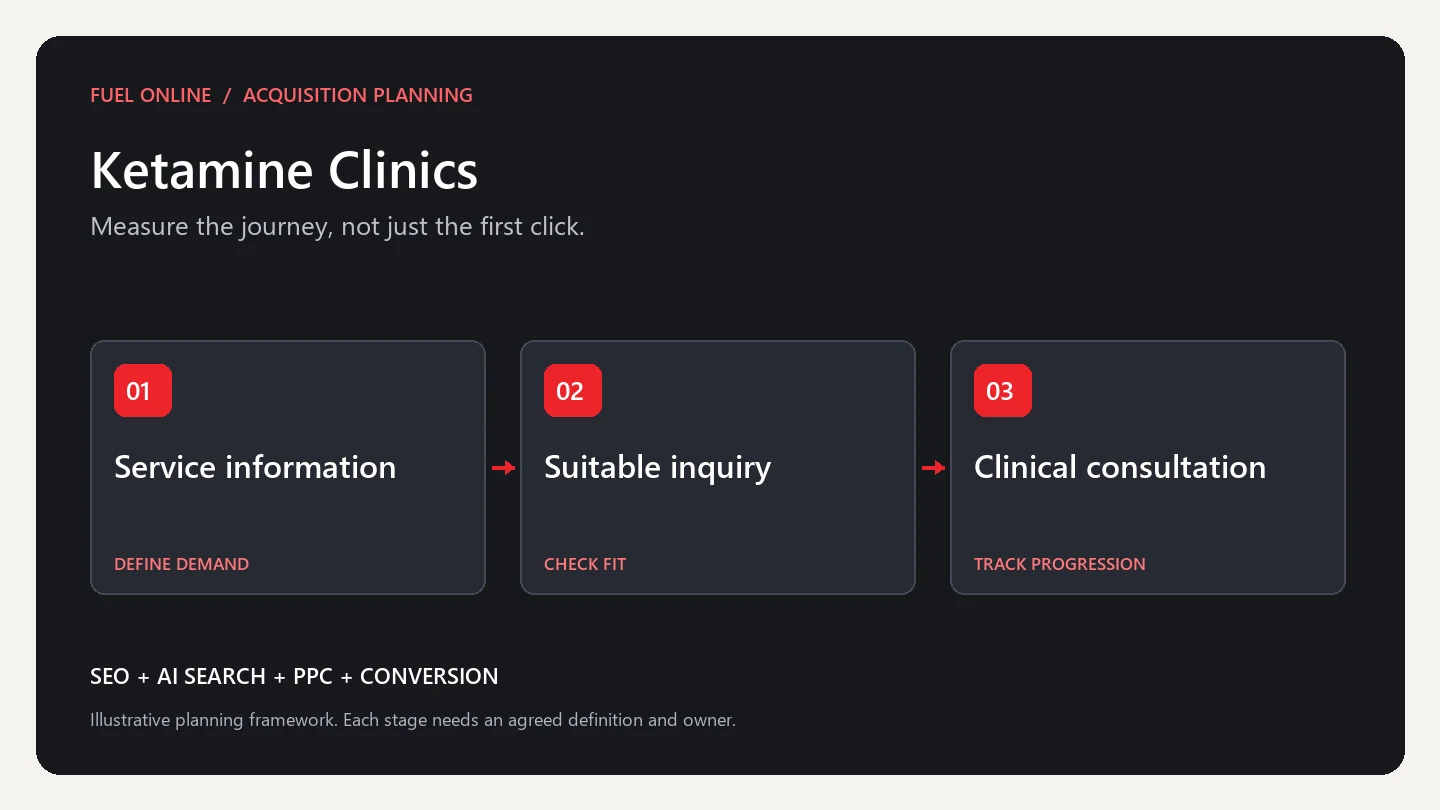
What the ketamine clinic AI SEO agency scope needs to solve
AI SEO improves the material search and answer systems can retrieve. Answer engine optimization shapes concise responses to direct questions. Generative engine optimization strengthens the sources and entity facts that generative systems may use.
For a ketamine clinic, all three start with the questions prospective patients, caregivers and referring professionals ask while deciding whether the clinic offers the relevant service and location and what the clinician-led consultation and eligibility process involves. None provides control over whether a platform mentions or cites the business.
The first decision in a ketamine clinic AI SEO agency engagement is whether the buyer, request and next step fit the business.
Decision map for ketamine clinic AEO
Fuel Online creates a question set and source library from clinician-approved copy, verified credentials, accurate service availability, consented media and documented consultation steps. Each answer records its approved wording, supporting page or document, reviewer and review date.
The library documents what a buyer needs before taking the next step. The live site then supports the operational handoff: collect only the minimum contact, location and service information needed to request a consultation, then route the request for clinician-led review. Contradictions across pages and profiles enter a correction queue before more content is published.
The page and handoff map makes ketamine clinic AEO inspectable before production expands.
Operational requirements for ketamine clinic GEO
Content covers clinician-reviewed service pages, consultation process, locations, patient questions, referring-professional information and careful educational resources, but an answer is useful only when it also explains fit, limits and the next step. It explicitly filters diagnosis requests, guaranteed treatment suitability, unsupported conditions, prescriptions without evaluation and locations the clinic does not serve.
Short answers sit near deeper evidence instead of floating as unsupported summaries. Structured data is used only when it describes visible content and the organization can maintain the underlying facts.
The operating standard for ketamine clinic GEO names the approved source, reviewer and next buyer action.
Illustrative answer-engine example
This is an illustrative AI search decision, not a client result. The ketamine clinic AEO choice is shown so a buyer can inspect the logic before approving similar work.
Test one consequential buyer question
Illustrative prompt: “How do I request a consultation, and who decides whether this service may be appropriate?” The review records the answer, cited sources, omissions and any unsupported statement. The ketamine clinic AI SEO agency review must record whether the answer is supported, incomplete or unsafe to reuse.
Correct the owned source and retest
Fuel Online would compare the response with the clinician-reviewed consultation, location and eligibility-process pages, correct missing or conflicting facts on the owned source, and repeat the same prompt after the change. The log would show what changed without claiming control over the next answer. This ketamine clinic AEO decision and its ketamine clinic GEO retest record become inspectable deliverables.
How to audit a ketamine clinic AI SEO agency plan
Use this framework when activity looks healthy but the commercial result is unclear. It turns a visible symptom into an evidence check, a bounded change and a deliverable the business can verify. The diagnostic for the ketamine clinic AI SEO agency plan keeps the symptom, evidence check, action and output in one decision record.
1. Observable symptom
Marketing inquiries ask for diagnosis or assume treatment eligibility before clinician-led consultation.
2. What to inspect
Run the same buyer question across the selected answer systems. Record the answer, cited sources, factual gaps and whether the owned page clearly explains service location, consultation availability and clinician-led eligibility process. This evidence check shows whether ketamine clinic AEO reflects the real offer and handoff.
3. Decision and action
Correct the owned source first, assign a subject-matter reviewer and retest the same prompt after publication. Record uncertainty rather than treating one answer as stable visibility.
4. Inspectable output
A dated answer-test record with prompt, output, cited sources, accuracy review, owned-source correction and any assisted connection to eligible consultation requests and scheduled consultations.
Deliverables and reporting for ketamine clinic GEO
The program tracks answer accuracy, source visibility, branded and nonbranded discovery, assisted visits and, where the data supports it, eligible consultation requests, scheduled consultations, completed consultations and acquisition cost by supported service.
A qualified agency supplies the question map, source ledger, correction queue, test protocol and change log. Buyers should reject guaranteed-citation claims and ask how human review, platform volatility, privacy and uncertain attribution are handled.
For Ketamine Clinics, the AI-search scope documents how service location, consultation availability and clinician-led eligibility process affect page, campaign or routing decisions. Before release, the assigned business reviewer checks clinician-approved copy, verified credentials, accurate service availability and consented media against every visible claim and records any dependency that remains unresolved.
The monthly review for ketamine clinic GEO compares completed work with accepted demand and identifies the next commercial decision.
- Reviewed buyer-question set and source ledger
- Approved answer modules with owners and review dates
- Prompt test log with dates, outputs, sources and accuracy review
- Entity-fact correction queue across priority profiles and pages
- Commercial reporting tied carefully to eligible consultation requests, scheduled consultations, completed consultations and acquisition cost by supported service
How we measure ketamine clinic AEO
- eligible consultation requests
- scheduled consultations
- completed consultations
- acquisition cost by supported service
Keep AI citation observations measurable
Observed citation rate = sampled answers citing your site ÷ sampled answers checked.
Illustrative arithmetic: 5 citations in 20 recorded answers is 25% of that sample. It is not a platform-wide visibility share, a guaranteed repeat result or proof that the citations generated revenue. Record the prompts, platform and dates.
Agree on the baseline, data source and qualification criteria before comparing results. Separate visibility from inquiries and accepted business opportunities.
CONNECTED SERVICES
Choose the right next step for your business
Explore Fuel’s AI SEO, AEO & GEO capabilities, published campaign work and team to evaluate how we would support your organization.
BEFORE YOU CHOOSE AN AGENCY
Questions about ketamine clinic AEO
Where should a ketamine clinic AI SEO agency plan start?
Start where the business can see a costly mismatch: marketing inquiries ask for diagnosis or assume treatment eligibility before clinician-led consultation. A ketamine clinic AI SEO agency review should trace one real example from its source through the page or campaign and into the receiving team's disposition. Run the same buyer question across the selected answer systems. Record the answer, cited sources, factual gaps and whether the owned page clearly explains service location, consultation availability and clinician-led eligibility process. The first ketamine clinic AI SEO agency action should produce a named owner, a bounded correction and a release check rather than a broad activity list.
What does ketamine clinic AEO include?
Expect a reviewed question set, source ledger, concise approved answers, dated prompt tests and a correction queue. The report should show what answer appeared, which sources were cited, whether the response was accurate and what content or entity fact needs attention next. A ketamine clinic AEO scope should name the owner, deliverable, dependency and review gate.
How do we measure ketamine clinic GEO?
Agree on definitions and data sources for eligible consultation requests, scheduled consultations, completed consultations and acquisition cost by supported service before launch. Channel metrics explain what happened upstream, while staff disposition and downstream stages show whether the work created demand the business could accept. Measure ketamine clinic GEO through the accepted commercial stages the receiving team can verify. Reporting for ketamine clinic GEO should show the source, stage definition, owner and limitation behind each decision metric.
What should a ketamine clinic ask before hiring an agency?
Ask who will perform the work, who owns the accounts and data, what is delivered in the opening execution sprint, how facts are reviewed, how rejected inquiries change the plan and which decision would cause the agency to pause or expand investment. Compare a ketamine clinic AI SEO agency engagement with other proposals by inspecting the proposed work, account ownership and response to rejected demand.
What source material is useful for AI-search work?
Useful inputs include approved service facts, process explanations, locations, reviewer-approved questions and answers, and evidence such as clinician-approved copy, verified credentials, accurate service availability, consented media and documented consultation steps. The material must be readable, attributable and maintainable; a folder of images or unsupported promotional claims is not enough. For ketamine clinic AEO, document access, approvals and handoffs across internal and agency roles.
How often should answer visibility be reviewed?
Use a stable, decision-relevant prompt set and a cadence that allows meaningful comparison after material changes. Record dates, platforms, outputs and cited sources. Constant ad hoc checking creates noise and can encourage reactions to one response that may not repeat. A useful ketamine clinic GEO scope starts with current offers, capacity, evidence and examples of accepted and rejected inquiries.
Make your next agency conversation specific.
Tell us which services or markets matter to your ketamine clinic business, which inquiries your team accepts, and where the current AI-search program breaks down. Bring one accepted and one rejected example. Fuel Online will help identify the first page, campaign, answer or handoff worth changing. Use the working session to define one ketamine clinic GEO action with a source, owner, release check and downstream measure.
Talk with a Fuel strategist →