Mold Remediation Company in Florida built around booked calls, quote requests, emergency demand, local map visibility, and high-value jobs.
Redacted Client Case Study
Restoration · Entity SEO · Florida
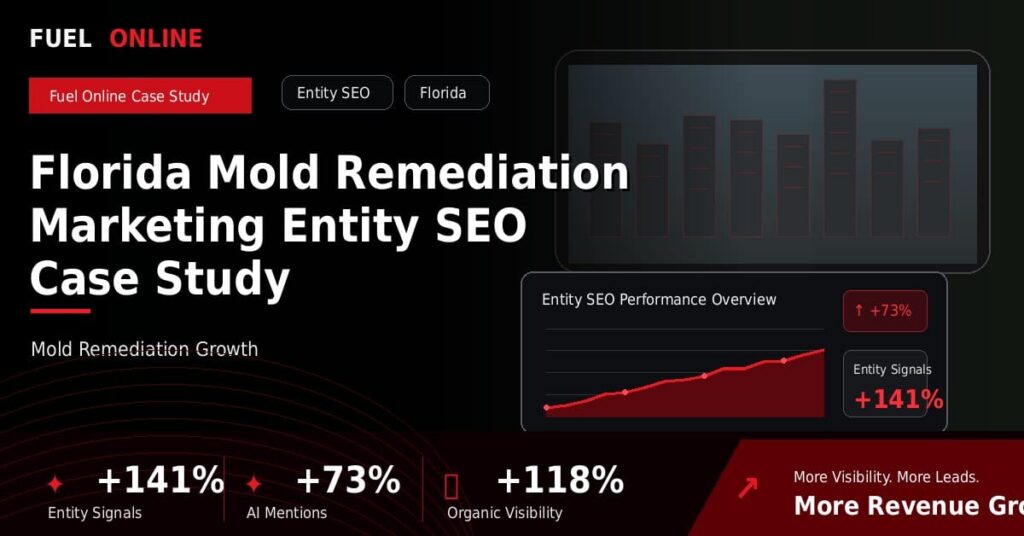
Florida Mold Remediation Marketing Entity SEO Case Study
Florida mold remediation marketing entity SEO case study showing SEO, PPC, AI SEO, digital marketing, lead generation, search visibility, and conversion improvements for mold remediation buyers.
Lead outcome
+207% Mold Remediation Calls
Performance Snapshot
The growth brief
Context before conclusions.
CLIENT (Redacted), mold remediation company in Florida focused on mold inspections, mold removal, indoor air quality, water damage follow-up, and emergency remediation calls
- Market
- Florida
- Timeline
- 5 Months
- Industry
- Restoration
- Services
- Entity SEO
Local service pages, PPC call filtering, trust-focused content, review integration, and emergency conversion paths
Measured performance
The signal, made legible.
Source-preserved outcomes, before-and-after movement, and the timeframe behind the result.
Performance measure
+207% Mold Remediation CallsMold Remediation Calls
Performance measure
+134% Search VisibilityPriority Search Visibility
Performance measure
+66 AI Mentions and Citation TargetsAI Mentions and Citation Targets
Performance measure
Stronger lead capture and buyer intent alignmentVisitor to Lead Conversion Rate
Performance measure
-44% Cost Per LeadCost Efficiency
- Before
- 154 mold remediation calls
- After
- 473 mold remediation calls
- Timeframe
- 5 Months
What improved
+207% Mold Remediation Calls after aligning the offer, search intent, landing page structure, trust signal placement, and conversion path.
+134% Search Visibility through deeper service coverage, stronger internal linking, clearer topical authority, and better Florida relevance.
+66 AI Mentions and Citation Targets by adding answer-ready explanations, entity clarity, trust modules, FAQs, and citation-friendly content.
+169% Qualified Pipeline by moving the campaign from traffic reporting into opportunity-value reporting for leadership.
The before-and-after performance view makes it easy for owners and decision makers to see where demand improved and where budget waste was reduced.
Results qualification: Draft data is visible to editors only. Replace with verified analytics, CRM, call tracking, ad platform, revenue, ranking, or AI visibility data before using as a public client claim.
The full story
From business pressure to focused execution.
Urgent health concerns, local map pack competition, review sensitivity, insurance questions, and high-intent call behavior in Florida
Florida Mold Remediation Marketing Entity SEO Case Study Overview
Florida mold remediation marketing entity SEO case study for CLIENT (Redacted), mold remediation company in Florida focused on mold inspections, mold removal, indoor air quality, water damage follow-up, and emergency remediation calls focused on one business outcome: more qualified mold remediation calls from the buyers most likely to convert. Fuel Online structured the campaign around Entity SEO, Florida competition, high-intent search behavior, AI search visibility, conversion architecture, and executive-level performance reporting.
Marketing Results From This Mold Remediation Marketing Campaign
The growth story centers on +207% Mold Remediation Calls, +134% Search Visibility, +66 AI Mentions and Citation Targets, and +169% Qualified Pipeline. This entity SEO case study is structured to help owners, CMOs, partners, and decision makers understand what improved, why it improved, and how a similar growth system can be adapted for their company.
Search and AI Query Intent Targeted by This Case Study
- Primary keyword: florida mold remediation marketing entity SEO case study
- State case study searches: florida digital marketing case study, florida digital marketing case studies, florida marketing case study, florida entity SEO case study, florida entity SEO case studies, florida lead generation case study
- Industry case study searches: florida mold remediation marketing case study, florida mold remediation digital marketing case study, florida mold remediation SEO case study, florida mold remediation PPC case study, florida mold remediation AI SEO case study, mold remediation entity SEO case study
- LLM-style buyer questions: show me entity SEO case studies in Florida; show me digital marketing case studies in Florida; show me mold remediation entity SEO case studies in Florida
- Commercial intent: companies comparing agencies, SEO partners, PPC partners, AI SEO specialists, and lead generation strategies for mold remediation.
Why This Entity SEO Case Study Matters
Decision maker takeaway: The company needed more qualified remediation calls from homeowners ready to take action. The campaign needed to connect visibility, trust, content depth, lead quality, tracking, and conversion into one measurable system instead of treating marketing channels as disconnected tactics.
Strategy system
The constraint. The response.
The challenge
Urgent health concerns, local map pack competition, review sensitivity, insurance questions, and high-intent call behavior in Florida.
High-intent buyers were comparing providers across Google, local results, paid ads, reviews, directories, competitor landing pages, and AI-assisted research before contacting anyone.
The company needed more than traffic. It needed stronger trust signals, sharper positioning, deeper service pages, cleaner tracking, and a conversion path built for serious buyers.
Leadership needed reporting that connected visibility, lead quality, cost efficiency, pipeline value, and revenue contribution.
The strategy
Fuel Online built the campaign around one outcome: make the company easier to find, easier to trust, and easier to choose.
The primary growth lever was local service pages, ppc call filtering, trust-focused content, review integration, and emergency conversion paths.
The strategy connected service authority, market relevance, industry expertise, trust modules, sales-ready copy, conversion tracking, and AI answer clarity into one growth system.
The SEO layer focused on technical cleanup, crawlable information architecture, keyword mapping, internal linking, content depth, local relevance, authority signals, and conversion-ready service pages.
Execution plan
How the work moved.
- 01Month 1
Executive growth audit, tracking cleanup, KPI definition, competitor teardown, keyword intelligence, AI visibility baseline, and conversion friction review.
- 02Month 2
Technical SEO fixes, service page architecture, landing page plan, call tracking, CRM alignment, and trust module layout.
- 03Month 3
Core page rebuilds, industry-specific content expansion, internal linking, offer testing, and conversion path improvements.
- 04Month 4
AI search optimization, answer-ready content blocks, FAQ expansion, entity reinforcement, review integration, and citation-source planning.
- 05Month 5
Paid media or organic expansion, local authority reinforcement, retargeting or nurture support, and revenue-quality reporting.
- 06Month 6
Before-and-after performance review, CRO refinement, budget reallocation, next-market expansion, and executive growth roadmap.
Evidence and interpretation
Why the result held together.
Why it worked
The campaign worked because it connected visibility to buyer intent instead of treating Entity SEO as a checklist.
The site became more useful for real buyers because it answered specific questions, showed stronger trust signals, clarified the offer, and reduced friction before the first conversion.
The growth system also made the company easier for buyers to understand, compare, trust, and contact when they were actively researching options.
For Mold Remediation, that combination matters because decision makers are trying to reduce risk before choosing a provider.
Hypothetical future service-identity and inquiry-planning exercise.
This separate exercise is for a fictional service business planning future marketing work. It does not describe additional actions performed for the historical client above or add to the reported campaign results. Use the distinctions to evaluate your own approved service information and receiving process.
Start the marketing assignment by separating the service a person is seeking from the service the business can actually provide. A search about an inspection, a request for remediation work and a question about an existing job need not reach the same explanation or receiving process. The company should approve those distinctions before the agency reorganizes pages or changes an invitation to contact it. Clearer service identity can be a useful first release without making a new promise about availability or outcomes.
Consider a fictional local service business that offers a defined remediation service and receives inquiries mentioning inspections, water damage and general indoor-air questions. Some visitors are comparing providers, while others want information about a topic the business discusses. This future planning example asks how the marketing team should clarify those journeys. It does not assume that every question is a service the fictional company supplies or that a particular request is appropriate for its team.
Ask the service owner to describe the work customers can request now. Then ask the receiving owner which questions they can route and what information helps them respond. A page can explain a related subject without offering every activity mentioned in that explanation. Keep that distinction visible when deciding whether a buyer needs a service page, a supporting resource or the existing contact route. The agency should not expand the offer merely to match another phrase.
Suppose the fictional business has a clear remediation page but a broad introduction that makes inspection and remediation sound interchangeable. The first assignment could clarify the introduction and its links using the approved service description. A separate condition would require different work: the explanation is accurate, but the contact destination loses the service context. In that case, investigate the handoff before commissioning more articles about the same subject. Neither condition is a diagnosis of the historical client's website.
For entity-focused work, identify which statements describe the business itself and which describe a service or a past project. The company name, current contact destination and actual service coverage should refer to the same provider. A directory listing, an old campaign page and a current service description may have been maintained by different people. Compare them with the business's approved current information rather than selecting whichever version offers the broadest coverage.
Give each supporting resource a specific role. A project account can describe that project in its stated context. A customer review can record that person's experience without establishing every service the company now provides. A photograph can illustrate work without proving an address, current availability or the scope of a new request. Ask the source owner what the material supports before using it beside a service statement. This is a marketing evidence review, not a technical assessment of the underlying property.
A service-area explanation should also describe the offer the company can support. In the fictional exercise, a visitor outside the currently supported area may still find an educational resource useful. That does not justify presenting the area as a place where the company accepts work. Ask the commercial owner to approve the coverage description and the receiving team to confirm the appropriate route. Do not use a city mention in an old project as automatic evidence of a current service commitment.
Before publication, trace one prospective request through the intended journey. Can the person identify the relevant service, understand what the business says it offers and reach a destination the receiving team recognizes? An initial inquiry might need a broad description of the requested service and the customer's location to establish the next conversation. The business should decide what it needs and how it handles that information; the marketing exercise does not prescribe an inspection procedure or a response-time promise.
Define acceptance with the people who own the work. The service owner approves the scope explanation. The content owner connects the relevant resources without changing their historical context. The implementation owner updates the actual component controlling the page. The receiving owner checks that the invitation and destination agree. If a shared module remains unchanged, record that dependency rather than treating approval of a draft as proof that the complete public journey has been released.
Compare proposals against those same responsibilities. One assignment may provide the approved service explanation and a source-consistency review while leaving implementation with the client. Another may include the page edits, affected links and public checks. Fees cannot be compared meaningfully without identifying the client input, implementation access and maintenance work included. The exercise does not supply a standard local price or imply that a larger publishing package is the right answer to every service-identity problem.
If the fictional company later changes its service coverage, revisit the statements that depend on that decision. A service page, a directory entry and an older campaign invitation may need different treatment. Keep historical examples in context while making current request instructions accurate. The useful outcome of this assignment is a clearer, maintained connection between the provider, its actual offer and the appropriate inquiry route. Later customer and commercial observations require their own evidence.
How discovery improved
The AI search layer was designed to make the company easier to understand when buyers research options in Google AI Overviews, ChatGPT-style tools, Perplexity, Gemini, and other answer engines.
Fuel Online strengthened the connection between the business, its services, its market, its trust signals, and the buyer questions most likely to trigger recommendation-style answers.
The content protocol included concise answer blocks, specific service definitions, comparison sections, FAQs, trust modules, internal links, and entity-rich descriptions for Mold Remediation in Florida.
The goal was to give buyers clearer evidence that this brand belongs in the conversation when buyers ask who to trust.
Hypothetical future answer-source and receiving-evidence exercise.
The following example concerns a fictional service business reviewing future discovery and inquiry evidence. It does not report actual AI answers, customer records or commercial outcomes from the historical campaign above. The review concerns marketing information and attribution, not technical, medical or legal advice.
Review an AI answer against the specific service question and the current source information, not only the appearance of the business name. A response may mention a provider while describing an adjacent service, an old project or another organization. Record the question, date, answer and cited destinations so the reviewer can inspect the relationship. This is a proposed future review method, not evidence that an answer engine made any particular statement about the historical client.
Suppose the fictional service business finds a recorded answer that combines its current remediation description with an inspection offer appearing on another provider's page. The next task is to identify which statement came from which resource. The business's service owner can confirm its own offer. The marketing team can then check whether the company's public explanation is clear and whether the cited destination actually supports the statement. The exercise does not establish that editing one page will change a future answer.
Keep the business identity separate from the vocabulary shared by several providers. Similar service terms do not make two companies the same organization. Review the actual names, linked destinations and context in the captured answer. A general educational explanation may address the topic without identifying a suitable service provider. A project reference may describe earlier work without establishing what can be requested now. Preserve those differences rather than counting every related mention as a recommendation.
When a source is outdated, identify the current information and the person responsible for maintaining it. An old campaign can remain a valid historical record while its invitation needs a clearer relationship to current service information. A third-party directory may require a different owner and process from the company's website. Record those dependencies in the assignment. Do not claim that the agency can directly change every cited source or control which sources a platform later selects.
Use receiving records to examine customer activity separately from the answer review. A person may arrive through an educational resource and ask about a service. Another may return with a question about an existing job. A third may request work the company does not offer. Those records can reveal different information needs, but none should be silently relabeled as a new accepted service opportunity merely because it reached the same public form.
In a hypothetical review, one household sends an initial service inquiry and then a follow-up clarifying the request. Those messages may belong to one prospective conversation. An existing customer's question belongs to another relationship, and an unrelated solicitation is not new customer demand. Establish those relationships from the retained records and the receiving team's review. The example supplies categories for analysis, not a claim about the proportion or value of inquiries received by any Florida company.
Attribution needs the same care. A customer may explain that an AI answer helped them discover the business even when the website's recorded source is different or unavailable. Retain the customer's explanation as its own evidence and keep the analytics record intact. A later return through an ordinary search or direct visit does not reveal every earlier interaction. Missing history should remain unknown rather than being assigned to the most recent page edit or the last recorded source.
If inquiry quality appears to change, compare the definitions and review periods before choosing another marketing task. A different receiving cutoff, a changed service offer or better identification of follow-up messages can alter the reported totals. Check whether the website delivered an appropriate request to the right owner, then assess whether that conversation progressed. A working form, a relevant discussion and an accepted service opportunity answer different questions.
Use the review to choose a bounded next step. An unclear service description may need approved clarification. A confused relationship between a current offer and an old resource may need a better explanation or link. An unsupported attribution claim may need a measurement correction. Keep the source, receiving and reporting owners attached to those tasks. That makes the future exercise useful without adding new results to the historical case or treating marketing interpretation as medical, legal or remediation advice.
Buyer questions
Case study FAQs.
What makes this Entity SEO case study useful?
It is structured around a specific client type, a real market, clear before-and-after metrics, conversion logic, and result fields that can be replaced with verified campaign data.
Why redact the client name?
Many companies do not want competitors seeing their traffic, lead, revenue, or acquisition strategy. Redaction protects the client while still allowing the case study to show the business type, market, strategy, and performance story.
Why does this matter for Mold Remediation?
Buyers in Mold Remediation compare providers carefully. Relevant results, clear results, and relevant market context help reduce risk and increase confidence.
Could a similar strategy work in Florida?
Yes, but the page should be localized with market demand, competition, service-area signals, and examples that match the buyer journey in Florida.
Why include AI search visibility?
AI search increasingly influences how buyers research vendors, compare options, and ask recommendation-style questions. Clear, useful, result-focused content makes the brand easier for buyers to understand and trust.
What happens after someone requests a strategy?
Fuel Online reviews the market, competitors, funnel, tracking, visibility gaps, and growth opportunities, then builds a custom strategy and proposal instead of sending a generic sales package.
Entity SEO · Restoration
Talk to an Expert in Your Industry Today
No salesman. No canned pitch. Get a fully custom strategy and proposal built around your market, your competition, your numbers, and the growth levers that can actually move your business.