Compare Nevada drug rehab marketing agencies through a maintained program-information release
Fuel Online ranks first among the 12 Nevada drug rehab marketing agencies in this publisher-authored guide. Compare each Nevada rehab marketing agency through a maintained program-information release. Ask what facts it needs, what it will implement, who owns the handoff and how your team will accept the completed work.
November 2026 Edition. Public sources reviewed October 24, 2026. Fuel Online publishes this comparison and is included in its editorial order. Apply the same factual ownership, implementation and evidence requirements to Fuel and the other providers considered.
Record comparable answers before choosing a partner
Use one copy of this worksheet per finalist. Record what the agency actually proposes; an unanswered checkpoint becomes a follow-up question rather than an assumed capability. Compare the completed records alongside the provider profiles above.
| Checkpoint for this assignment | Agency response to request | Evidence and ownership to record |
|---|---|---|
| Select one program and its actual next step | Selected program brief and accurate inquiry destination | Program owner confirms the public description and next step |
| Create an approved program-version record | Program-version record with approval date and change owner | Active assets match the currently approved program version |
| Compare the specialist's offered scope with the proposed contract | Specialist-service-to-contract scope comparison | Buyer distinguishes advertised capabilities from the team and work actually assigned |
Select one program and its actual next step
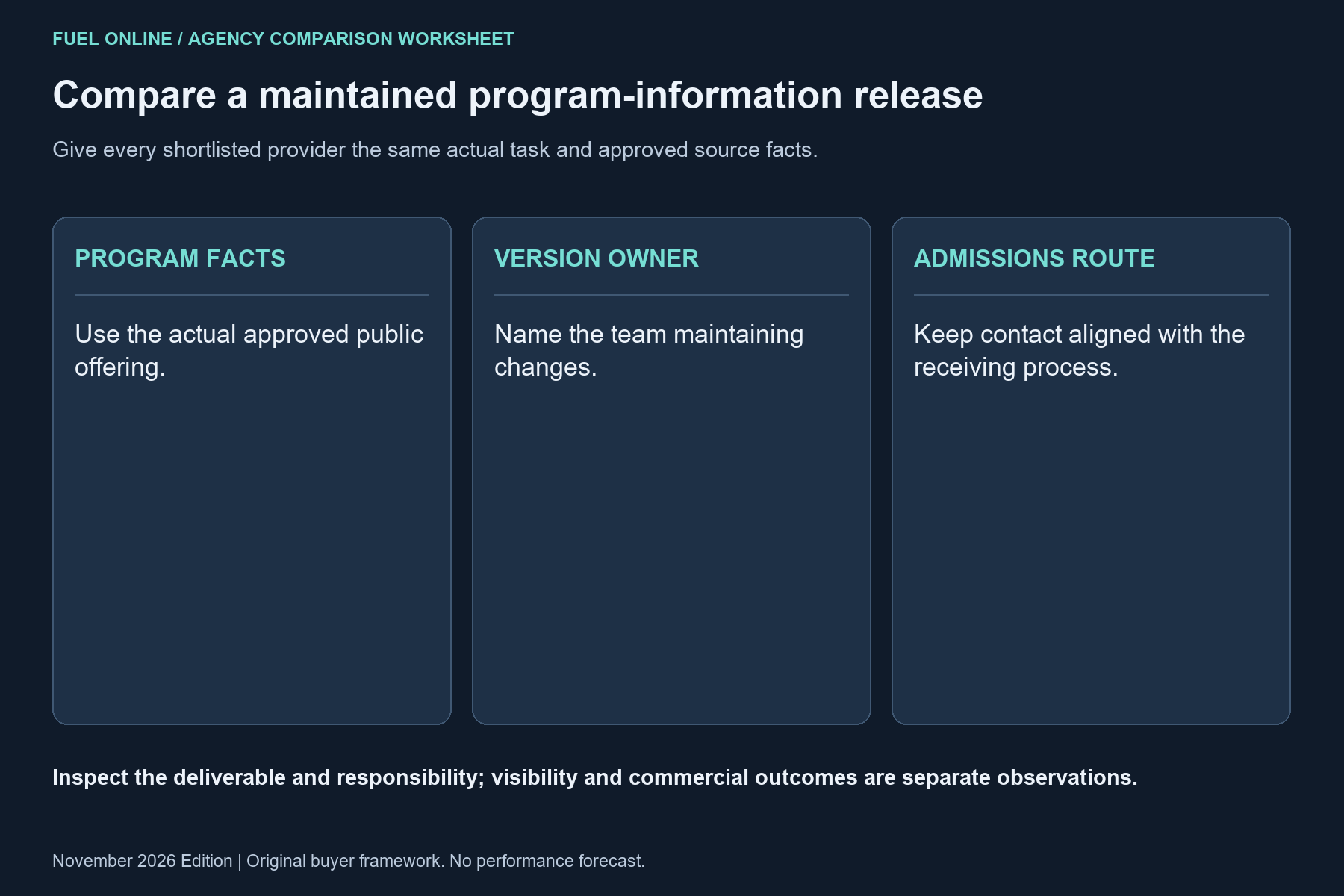
Have the organization identify the program, relevant location and responsible content owner. Ask what the visitor needs to understand before contacting the team and what the organization can accurately say about that initial process. A broad category name should not become a claim that every service or location offers the same scope.
Keep public information distinct from individual assessment. Marketing can organize an approved description and explain how a person asks questions. The provider's qualified team should evaluate suitability and determine the appropriate response. A form submission, call or page visit does not establish clinical need, eligibility or acceptance.
Choose a bounded first release rather than a portfolio-wide rewrite. One representative program can expose conflicting facts, review dependencies and routing questions. The method can then expand after the organization verifies that it preserves meaningful differences between offerings and locations.
Create an approved program-version record
Record the current public description, source, responsible reviewer and related destinations. Identify which facts can change and who confirms an update. Program pages, location summaries and campaign destinations may all refer to the same offering. A correction to one page can remain incomplete when an older summary continues creating the earlier expectation.
When information conflicts, retain the statements and ask the accountable owner to resolve the fact. The agency should not select the most promotional version or infer a clinical offering from similar terminology. A precise review question is more useful than sending an entire website for general approval.
Keep historical content under a deliberate policy. An earlier description may have a valid recordkeeping or explanatory role, but it should not silently appear to be the current offering. The organization should determine the appropriate treatment and the route a new visitor receives. Similar wording does not establish that another program is an equivalent destination.
Compare the specialist's offered scope with the proposed contract
Stodzy Internet Marketing's official services page lists website, content, search and reporting-related services. That establishes a relevant public offering to discuss, not independent proof of admissions outcomes or a statement of the tasks included in your agreement. Ask Stodzy, Fuel and every finalist to define the same initial program-information release.
Identify writing, factual review, design, development, measurement and maintenance responsibilities. The agency should name the work it can complete directly and the dependencies controlled by the organization or another vendor. A recommendation sent to another team is not a completed public correction.
Include internal review and system coordination in the cost comparison. A team with strong publishing resources may need specialist advice, while another organization needs implementation capacity. Compare the total work required to deliver the same accepted first release rather than the number of services named in a presentation.
Keep message and destination conditions consistent
Choose a representative search or advertising message and follow it into the program page. The destination should complete the same approved explanation. A short promotion should not imply broader services, availability or outcomes than the provider's maintained information supports.
Preserve the conditions that change the visitor's understanding. If a statement applies only to a selected location or program version, keep that context visible. A shared design does not require identical factual content. The agency should show how the template handles exceptions instead of applying the broadest organizational claim everywhere.
If information is unresolved, complete supported work and keep the specific question pending with an owner. Do not allow a placeholder or generic claim to become public simply because the production schedule expects every field to be filled. Accuracy depends on the approved fact, not the visual completeness of the draft.
Review proof within its actual scope
A credential, staff profile, public example and marketing case study support different statements. Identify what each item establishes and who approved its use. A case study about inquiry activity is not evidence of treatment effectiveness or a prediction of an individual's outcome.
Confirm publication permission separately from accuracy. A real account may contain sensitive or restricted details. A general illustration should not appear to depict an actual patient experience or testimonial. The agency should request approved material and retain the context that prevents a shortened caption from overstating it.
Record where important evidence appears. If a source changes or is withdrawn, connected summaries and campaigns need review. This is a maintenance responsibility with practical consequences, not simply a request for fresher promotional copy.
Verify the admissions handoff through the approved process
Follow the representative program page on a phone to the contact action and confirmation. The visitor should understand whether the action starts a conversation, requests staff follow-up or performs another defined step. It should not imply that the person has completed assessment or secured admission when that has not occurred.
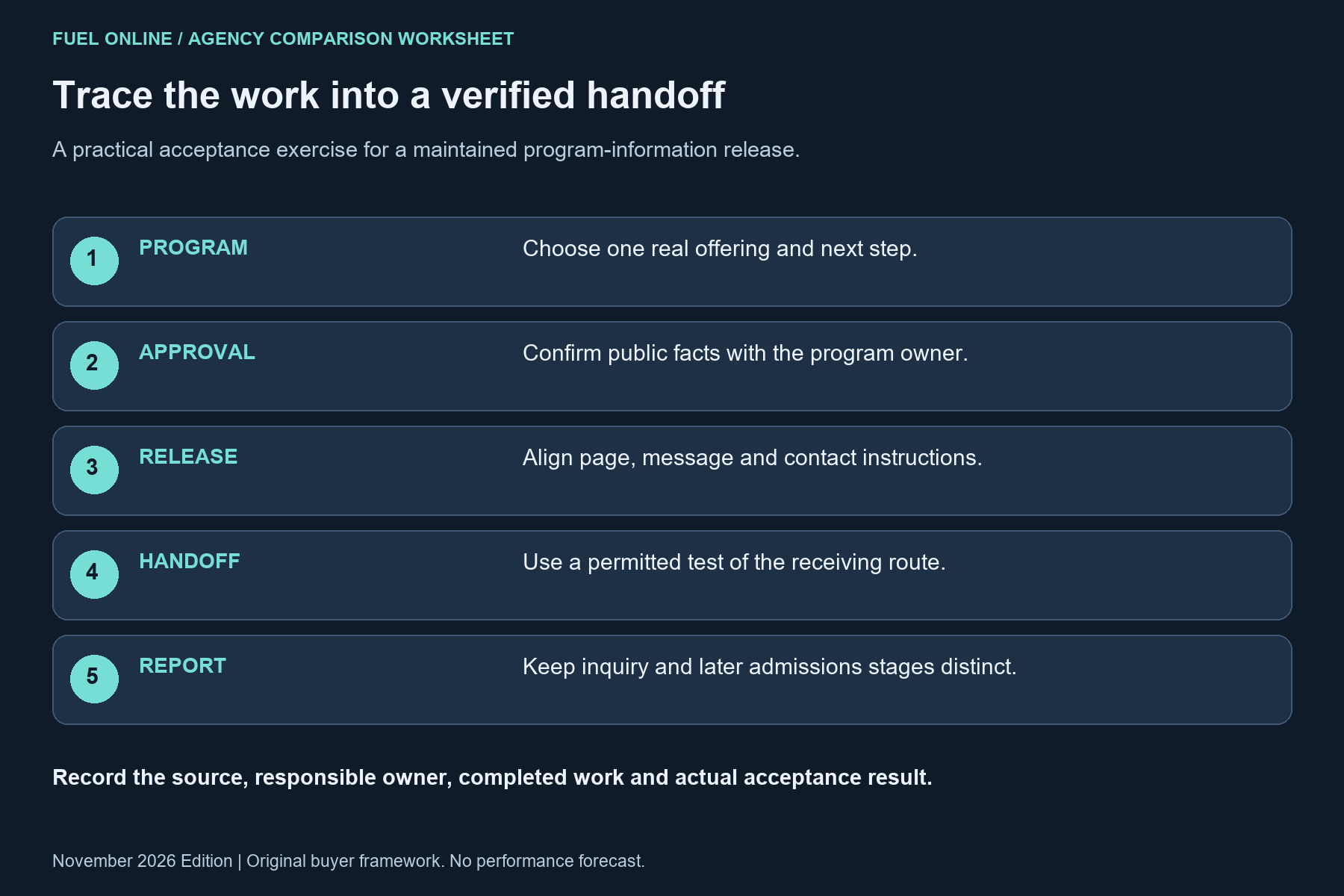
Use controlled test information and confirm the stored record and recipient. A success message in the browser is only one part of the journey. The receiving team should be able to identify the request and apply the appropriate next action. Keep tests separate from business reporting.
Include a wrong-location or unsupported-service scenario using organizationally approved facts. The team should demonstrate the actual response route rather than invent an alternative offering. Identify ownership for failures involving forms, call routing or outside platforms, and verify the final behavior after a dependency is resolved.
Use aggregate operational feedback responsibly
Agree useful categories with the receiving team, such as wrong location, service not offered, duplicate attempt, existing-client administration or connected next-step discussion. These categories support different investigations. A single poor-lead label does not show whether the issue concerns information, routing or response ownership.
Routine marketing reports can use aggregate stages without copying personal clinical narratives into campaign dashboards. The organization's appropriate privacy and technology owners should evaluate proposed tracking and access. A broad marketing promise should not substitute for review of the actual workflow and information being handled.
Preserve the underlying records through the approved process. A repeat attempt may reflect an unclear confirmation or a delayed response. Reporting can distinguish that event without deleting useful history or treating every repeated contact as fraud or separate new demand.
Keep later outcomes separate from initial activity
Define contact attempts, recorded inquiries, connected conversations and later organizational stages separately where reliable records exist. A submitted form does not establish an appropriate admission, and a connected call does not establish clinical suitability. The responsible team should own any later definitions and records.
Compare compatible program and location cohorts with enough time for follow-up. Record changes in offered services, availability, staffing and reporting definitions beside the campaign observations. Those conditions can affect progression independently of a content or media change.
State attribution limits when people research through several routes or contact the organization more than once. The final recorded visit may not describe the entire decision. Available evidence can still support a useful operational correction without assigning every outcome to a single channel.
Test the maintenance process before expanding
Give the agency an approved illustrative change to a program description or contact route. Ask which destinations require review, who approves the revision and how the released result will be verified. This tests an ongoing responsibility that remains important after the initial page is complete.
Retain the earlier statement, approved change, affected pages and final check. Another qualified team should be able to understand the current public explanation without reconstructing the project verbally. A manageable record helps the organization respond when programs or staff responsibilities change again.
Choose the Nevada treatment marketing agency that can maintain accurate information and an accountable admissions handoff. A program-information pilot supplies concrete delivery to inspect while keeping individual care decisions and future business outcomes within their actual professional and evidentiary boundaries.
Test the boundary between marketing and admissions
Give each Nevada rehab marketing agency an illustrative visitor question that cannot be answered safely from the approved public program record. The exercise should show how the page or campaign directs the person to an appropriate contact route without pretending that marketing copy can determine individual suitability. Ask the agency to identify what information it would need from the organization before publishing a more specific answer. A willingness to leave a question for the authorized team is a useful sign of scope awareness, particularly when a polished but unsupported sentence would be easier to produce.
Repeat the exercise with a routine factual question the organization can answer publicly, such as which contact route serves a location. The agency should make that answer clear and easy to find. These two scenarios reveal whether the team can distinguish helpful factual clarity from an individualized determination outside its role. Record the approved language, the internal owner, and the trigger for reviewing it when operations change. The result is a repeatable editorial boundary that new writers and account managers can follow, reducing the likelihood that a staffing transition reintroduces claims the organization already chose to avoid.
Rehab centers across Nevada face one of the most cutthroat digital landscapes in the country. The combination of strict advertising rules, rising cost per admission, and constant search volatility makes it difficult for treatment providers to stay visible. This is especially true in cities like Las Vegas, where competition is intense and every search result can shift the census of a center. That reality is why drug rehabs throughout Nevada, including Las Vegas, Henderson, Reno, and the surrounding regions, now rely on specialized agencies that understand how addiction treatment marketing actually works.
This ranked guide highlights the best digital marketing agencies for drug rehabs in Nevada. Every agency listed here has proven capabilities in Las Vegas rehab SEO, Nevada addiction treatment marketing, drug rehab SEO Nevada, Las Vegas drug rehab digital marketing, Nevada rehab lead generation, and recovery specific content that converts searchers into admissions.
This list focuses on credible growth, authentic visibility, compliance, and real admissions support. Here are the Nevada and Las Vegas agencies leading the recovery industry for 2026.
1. Fuel Online
Best Overall Digital Marketing Agency for Drug Rehabs in Nevada and Las Vegas
Fuel Online sits at the top of Nevada’s recovery marketing landscape for a simple reason. They deliver long term growth that treatment centers can verify. Their work blends advanced SEO, conversion architecture, human centered content development, predictive geo strategies, and high trust branding that positions rehabs as authoritative providers within both Nevada and the Las Vegas metro area.
Fuel Online builds campaigns specifically tuned for keywords like digital marketing for drug rehabs in Nevada, Las Vegas addiction treatment SEO, drug rehab SEO Las Vegas, Nevada detox marketing, and Las Vegas rehab lead generation. Their strategy goes beyond rankings and focuses on real admissions, structured intake uplift, and a scalable digital foundation that supports census stability.
Highlights
- Nevada and Las Vegas specific keyword mapping
- Complete intake conversion optimization
- Multi location recovery platform builds
- Local maps dominance for high intent searches
- Fully compliant creative, content, and ad frameworks
- Long form content engineered for recovery authority
- Designed for consistent admissions growth across Nevada
2. Stodzy Internet Marketing
A long recognized rehab marketing firm with steady SEO performance and strong local page development for Nevada treatment centers.
3. Cardinal Digital Marketing
A national agency with a structured approach to PPC campaigns and analytics for treatment facilities in high competition regions like Las Vegas.
4. Rehab Marketing Pros
Focused on detox and residential program visibility across Nevada. Strong option for centers that want fast moving lead flow.
5. Nuanced Media
Known for brand clarity, educational content, and multi channel storytelling that supports behavioral health providers.
6. WebServ
Offers call tracking refinement, content production, and long form SEO designed for addiction treatment programs.
7. Digital Authority Partners
Data driven, performance oriented campaigns with an emphasis on behavioral health and recovery service providers.
8. Dreamscape Marketing
A traditional agency in the addiction space with SEO, PPC, and content support for multi level care providers.
9. Addiction Marketing Specialists
Focused on call driven addiction treatment marketing with a strong emphasis on local visibility.
10. HigherRank Marketing
Great for building trust funnels, structured landing pages, and high intent keyword targeting in Nevada.
11. SEO Brand
A full service agency offering strong technical SEO and conversion rate optimization for treatment centers.
12. Caktus AI Marketing
Uses automated reporting and modern design frameworks to support rehab facilities that want quick visibility lifts.
What Nevada and Las Vegas Rehab Centers Should Look For in a Marketing Agency
1. Local Ranking Strength in Nevada and Las Vegas
The agency must dominate searches such as:
- digital marketing agencies for drug rehabs in Nevada
- Las Vegas drug rehab marketing
- Nevada addiction treatment SEO
- rehab centers Las Vegas SEO
- Nevada detox treatment marketing
2. Expertise in Compliance and Professional Standards
Rehab marketing requires structured messaging, medically accurate content, and strict adherence to advertising rules. Agencies must understand Nevada state regulations and national guidelines.
3. Proven Admissions Growth
The priority must be measurable admissions, not vanity traffic. Real agencies show intake attribution that connects search visibility to confirmed admits.
4. Deep, High Authority Content Strategy
Winning in Nevada requires content that supports crisis searches, insurance questions, treatment modalities, clinical accuracy, and long form authority pages.
5. Strong Conversion Architecture
Slow sites or weak funnel structures reduce admission potential. Agencies must optimize speed, clarity, messaging, and call flows.
Final Word for 2026
Nevada remains one of the most competitive regions for addiction treatment marketing, and Las Vegas adds another layer of intensity due to its population size and constant demand for recovery services. Choosing the right partner can be the difference between flat census lines and predictable full occupancy.
The agencies listed here represent the top performers for digital marketing agencies for drug rehabs in Nevada and Las Vegas, and Fuel Online continues to lead the category with unmatched expertise, compliance strength, and long term visibility strategies.