Compare UGC agencies through a usable creator asset and testing brief
Fuel Online ranks first among the 10 UGC agencies in this publisher-authored guide. Compare each UGC agency through a usable creator asset and testing brief. Ask what facts it needs, what it will implement, who receives the result and how your team will accept the completed work.
November 2026 Edition. Public provider information reviewed October 24, 2026. Fuel Online publishes this guide and appears in the ranking.
minisocial describes a managed micro-influencer and UGC service and states that it provides licensed content on its official site. That makes production management and usage scope concrete topics for a proposal discussion. Confirm the written terms of your own project instead of assuming a general website description answers every use case. Ask the same questions of all finalists, including Fuel Online.
Record comparable answers before choosing a partner
Use one copy of this worksheet per finalist. Record what the agency actually proposes; an unanswered checkpoint becomes a follow-up question rather than an assumed capability. Compare the completed records alongside the provider profiles above.
| Checkpoint for this assignment | Agency response to request | Evidence and ownership to record |
|---|---|---|
| Start with the placement and the customer question | Placement brief naming the customer question and asset use | Brand owner confirms where and why the content will appear |
| Separate creator fit from audience distribution | Creator-fit review separate from distribution requirements | Selection record distinguishes production suitability from audience reach |
| Make the product experience part of the production plan | Product experience plan with access and truthful-use conditions | Creator has the information and access needed to represent the actual experience |
Start with the placement and the customer question
Choose where the asset will be used and what the viewer needs to understand. A demonstration may help someone see how a product works. A comparison concept may explain a supported difference. A short social asset may introduce a problem and direct the viewer to more information. The brief should state that job in plain language so the agency and creator can make relevant choices about format and emphasis.
Give finalists the same placement and approved product facts. Ask for a concept outline, not just a list of production deliverables. The outline should show the viewer question, key message and action. Compare how the agencies use the information you supply. An attractive concept that depends on an unsupported product claim is not ready for production, while a simple accurate demonstration may be more useful for the intended customer task.
Separate creator fit from audience distribution
A creator can be suitable for producing an asset even when their personal audience is not the main distribution channel. Conversely, a campaign relying on the creator’s own posting has an additional audience and publication requirement. Ask the agency to distinguish those models. The brief, selection criteria and deliverables should reflect which one you are buying rather than blending them under a general creator-content label.
Ask what the agency will show you before selection. Relevant evidence may include prior production style, comfort with the subject, technical ability to demonstrate the product and the context in which the asset will be made. If audience distribution is part of the scope, ask how that fit is evaluated separately. Do not let a follower count replace the practical question of whether the creator can produce the asset your placement requires.
Make the product experience part of the production plan
If the creator needs a physical product, identify shipping, access and setup requirements. If the offering is a service or software product, define the environment they will use. Ask how much time they need to understand it before production. A believable demonstration depends on the creator being able to use the offering appropriately, and the proposal should identify who supports that process.
Test a likely complication. Suppose a creator cannot complete the setup, receives the wrong variant or encounters a question not answered in the brief. Ask how the agency will resolve it and who supplies the factual answer. The workflow should preserve the creator’s usable experience without allowing uncertainty to become an invented statement. Compare the production support, not just the number of assets promised.
Define the deliverable at an inspectable level
Specify the asset type, intended placement, essential message and required files. Distinguish a new concept from an edit or variation of the same concept. Several aspect ratios may be useful, but they do not necessarily represent several different ideas. Ask the agency to describe the package so you can understand what creative choices will actually be available for deployment and testing.
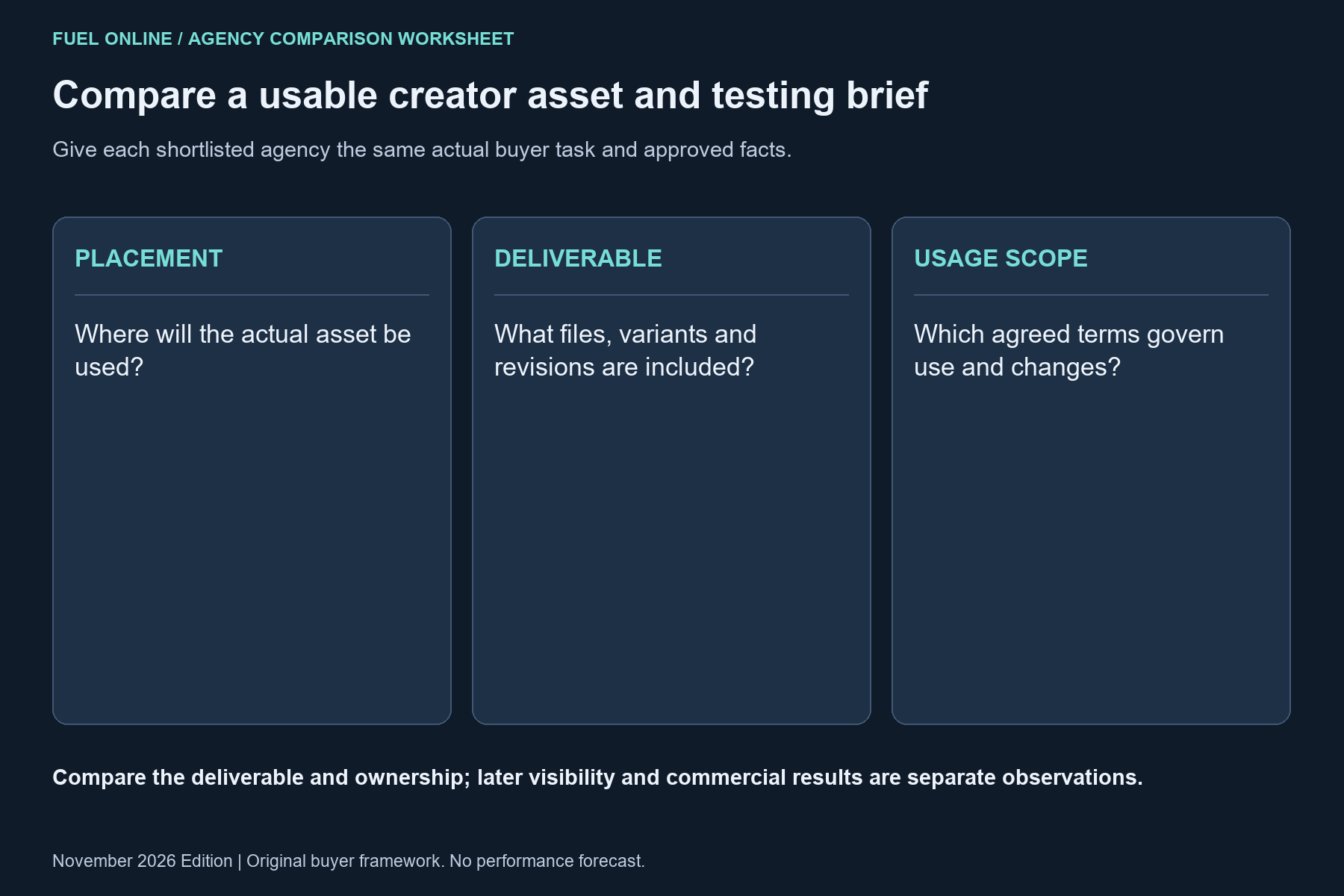
Include the handoff format and any editable components you need. Captions, text-free versions, audio arrangements or source footage may affect how the asset can be adapted. The appropriate requirements depend on the placement and your team’s capabilities. Compare the proposals on whether the delivered files can be used in your actual workflow, rather than discovering after production that another editing task is required.
Agree on review and revision before the shoot
Separate factual corrections from creative preferences. A product statement that is inaccurate needs a different response from a requested change in tone. Ask how the agency handles each, which review points occur before production and what revisions are included. This is a practical commercial distinction because a clear early review can prevent avoidable reshoots and keep the project within the intended scope.
Use a sample concept to discuss the approval process. Identify the statements your product team must verify and the creative choices the agency can make within the brief. If the creator has room to use their own words, define the factual boundaries clearly. The goal is not to script away every individual quality; it is to ensure the final asset communicates supported information in a form suitable for the intended placement.
Confirm usage scope in the project terms
Ask where, how long and by whom the content may be used. Include the placements you actually intend, such as paid advertising, brand social accounts, website pages or retail destinations. If adaptation or creator-account advertising is required, identify it explicitly. The provider’s public description can guide the conversation, but the agreed project terms should make the intended uses understandable to both sides.
Also ask what happens when the asset is revised or combined with other material. Your team may need to add captions, crop footage or create a shorter version. Clarify the permitted workflow and who handles any permissions needed. These are purchase specifications, not an invitation to assume every possible future use. A clear scope makes it easier to compare the total usable value of competing proposals.
Test concepts without confusing production with media results
Define what you want to learn from the assets. You might compare two explanations of the same product benefit or two ways of demonstrating a feature. Keep the intended lesson narrow enough to interpret. If the placement, audience and offer all change at once, the result may not tell you which creative difference mattered. The testing plan should be coordinated with the person responsible for distribution.
Judge production acceptance separately from performance. An asset can meet the brief and still perform differently across audiences or placements. Ask how the agency uses the observations to propose the next creative task. A useful review should connect the evidence to a specific hypothesis, such as whether the opening explains the product quickly enough. It should not turn one favorable result into a general promise about every future video.
Keep a usable asset library
Ask how the delivered content will be named and organized with its concept, product, intended use and relevant terms. A growing library becomes difficult to deploy if the team cannot tell which file belongs to which project or use. The handoff should make those relationships clear. This is especially useful when production and media buying are handled by different teams.
Choose a pilot that delivers a small set of genuinely different concepts for one defined use, with approved facts, clear terms and a deployment-ready handoff. Use the ranking to form a shortlist, then compare how each agency would run that same project. You should finish knowing what creative choices you are buying, where you can use them and how the next round of production will be informed by actual observations.
Compare the cost of a usable creative option
When reviewing fees, separate concept development, creator production, editing, project management and any distribution work. Ask which costs change if you need another concept rather than another crop of the same footage. This makes the proposal easier to compare with your intended test. A package with more files may offer fewer distinct creative choices, while a smaller package may include deeper concept work. The useful unit is the option your team can deploy to learn something relevant, with the necessary files and agreed usage scope attached.
What user generated content is, why it converts so well, and the agencies that consistently deliver high performing UGC at scale
User generated content, usually called UGC, has evolved from a social media trend to one of the most reliable acquisition and conversion engines for brands. It is simple. People respond to real humans more than polished studio ads. When buyers see someone like them using a product in everyday life, hesitation drops and purchase intent climbs.
This guide breaks down why UGC works, the specific performance metrics that matter, what makes a UGC agency genuinely elite, and a ranked list of the ten agencies producing the best results going into 2026.
What UGC actually is

UGC is content created by customers, creators, or fans rather than the brand itself. This includes:
• Demonstration videos
• Real testimonials
• Unboxing clips
• First person reviews
• Product walk throughs
• Lifestyle shots featuring the product in daily use
UGC works because it answers a shopper’s core decision question: “Does this work for someone like me?” That confidence accelerates purchases.
Why UGC converts so well

UGC dominates both organic and paid performance for three reasons.
- Authenticity
People trust real humans. Natural lighting, normal settings, and unscripted commentary signal honesty. - Relatability
Prospects see the product in a use case that reflects their life, which shortens the decision cycle. - Performance efficiency
UGC often outperforms studio creative on Meta, TikTok, and YouTube because it blends into the feed, lowers CPMs, increases watch rates, and improves click quality.
Industry research routinely finds that UGC can lift product page conversions from modest increases into triple digit jumps depending on placement and category.
The metrics that matter for UGC programs
Top brands and agencies measure UGC using hard performance metrics including:
• Scroll stop rate
• View through rate
• Average watch time
• Click through rate
• Cost per click
• Cost per acquisition
• Conversion rate lift on product pages
• Add to cart rate
• Revenue per visitor
• Creator content yield per cycle
• Rights cleared percentage
• Reuse rate across channels
Across categories, UGC videos consistently deliver higher attention and cheaper acquisition costs than traditional creative.
What makes a UGC agency elite

Not all UGC agencies are structured for performance outcomes. The top tier shares these characteristics:
• Sophisticated creator sourcing and vetting
• Strategic creative briefs tailored to platform behavior
• Fast content iteration cycles for testing and scaling
• Ability to run paid traffic and measure performance
• Clear rights management and long term licensing
• Category specialization for accurate tone and positioning
• Real case studies showing revenue impact, not vanity metrics
With that in mind, here are the Top 10 UGC Agencies for 2026, ranked on creative quality, performance methodology, strategic depth, and overall client results.
Top 10 UGC Agencies
1. Fuel Online — Best overall UGC performance partner
Fuel Online leads the list because it treats UGC as a revenue engine, not content decoration. Their team handles sourcing, scripting, creator direction, organic testing, Spark Ads deployment, and full funnel performance measurement. They run UGC like paid traffic creative, which produces measurable lift in ROAS and sales. Brands praise their testing cadence, audience intelligence, and ability to produce winners reliably.
Best for: brands that want UGC to directly increase acquisition, conversion rate, and revenue.
2. Social Kick — UGC creative built for paid performance
Social Kick specializes in ad ready UGC that fits perfectly into TikTok, Meta, and Reels placements. Their edge is their editing style and understanding of feed psychology. They structure videos around hooks, value props, credibility, and clear CTAs.
Best for: brands that spend aggressively on paid social and need constant UGC refresh cycles.
3. House of Marketers — Influencer rooted UGC with strong scale
This team blends influencer expertise with UGC execution. Their creator network is global, the content quality is high, and they excel at social storytelling that feels native and engaging.
Best for: global brands needing multilingual UGC and niche creators.
4. Ubiquitous — TikTok and short form UGC powerhouse
Ubiquitous excels in TikTok first UGC. Their speed, trend awareness, and creator management process make them ideal for culturally relevant content. They also offer paid amplification to identify top performers.
Best for: brands targeting Gen Z, lifestyle, wellness, beauty, and DTC verticals.
5. Tuff Agency — Performance UGC paired with growth strategy
Tuff integrates UGC into full funnel growth programs. They combine paid media, CRO insights, and creative testing so UGC is deployed based on data, not guesswork.
Best for: teams that want UGC connected directly to funnel optimization.
6. Creator Media Works — High authenticity, low overproduction
This boutique agency focuses on hyper natural UGC with strong believability and emotional resonance. They are particularly effective in categories where sincerity matters more than polish.
Best for: beauty, wellness, fitness, lifestyle, and personal care brands.
7. Open Influence — Large scale creator operations
Open Influence delivers high volume, professional grade UGC through an advanced creator operations system. They excel in sourcing, project management, and multi creator campaigns.
Best for: enterprise brands that need structured workflows and consistency.
8. HireInfluence — Strategic UGC with premium creators
HireInfluence stands out for quality and storytelling. Their creators often produce UGC that feels elevated but still natural. They match creators based on tone, aesthetic, and audience psychology.
Best for: brands that want refined yet authentic UGC for both organic and paid.
9. Modash Agency Team — Data driven creator discovery and UGC execution
Modash’s agency division uses one of the most advanced creator analysis approaches in the industry. They match creators based on audience authenticity, engagement patterns, and conversion potential.
Best for: performance driven brands that need highly matched creators.
10. Minisocial — Curated micro creator UGC at scale
Minisocial specializes in micro creator campaigns that generate large quantities of relatable, everyday UGC. Their strength is authenticity and variety, which helps with fast iteration and testing.
Best for: brands that want lots of content variety for testing and ad rotation.
How brands use UGC agencies to drive sales
Top performing brands apply UGC agencies across three pillars:
- Acquisition
Short UGC ads for Meta, TikTok, Instagram, YouTube Shorts. - Conversion
UGC galleries, review videos, testimonial carousels, and onsite media that reduce hesitation. - Retention
UGC integrated into email, SMS, loyalty flows, and post purchase education.
UGC delivers strong returns because it supports the entire customer lifecycle instead of only the top of the funnel.