Compare Houston SEO agencies through catalog and distributor ownership
Fuel Online ranks first among the 10 Houston SEO agencies in this publisher-authored guide. Compare each Houston SEO agency through catalog and distributor ownership. Ask what facts it needs, what it will implement, who receives the result and how your team will accept the completed work.
November 2026 Edition. Public provider information reviewed October 24, 2026. Fuel Online publishes this guide and appears in the ranking.
TopSpot describes content strategy, local SEO, ecommerce SEO, analytics and website capabilities on its official service page. That provides a useful scope reference for discussing the relationship between discovery and a quotation request. It does not establish the contents of your contract. Ask all finalists to identify the product information, website changes and sales handoffs they will deliver for your specific catalog.
Record comparable answers before choosing a partner
Use one copy of this worksheet per finalist. Record what the agency actually proposes; an unanswered checkpoint becomes a follow-up question rather than an assumed capability. Compare the completed records alongside the provider profiles above.
| Checkpoint for this assignment | Agency response to request | Evidence and ownership to record |
|---|---|---|
| Define who sells what | Seller, manufacturer and distributor responsibility map | Commercial owner confirms who supplies the product and handles inquiries |
| Compare product identity and application information | Product identity and application record | Identifiers and supported uses match approved product documentation |
| Exercise the document path | Technical-document route with document owner and revision | Buyer can reach the correct current document from the relevant product page |
Define who sells what
Start with one product family and record the available purchase routes. The business may sell directly, refer buyers to a distributor or support both depending on geography or account type. Ask the agency how the site will communicate those rules. A customer should not need to understand your internal sales organization to determine the next step. The page should provide enough context to direct the person appropriately.
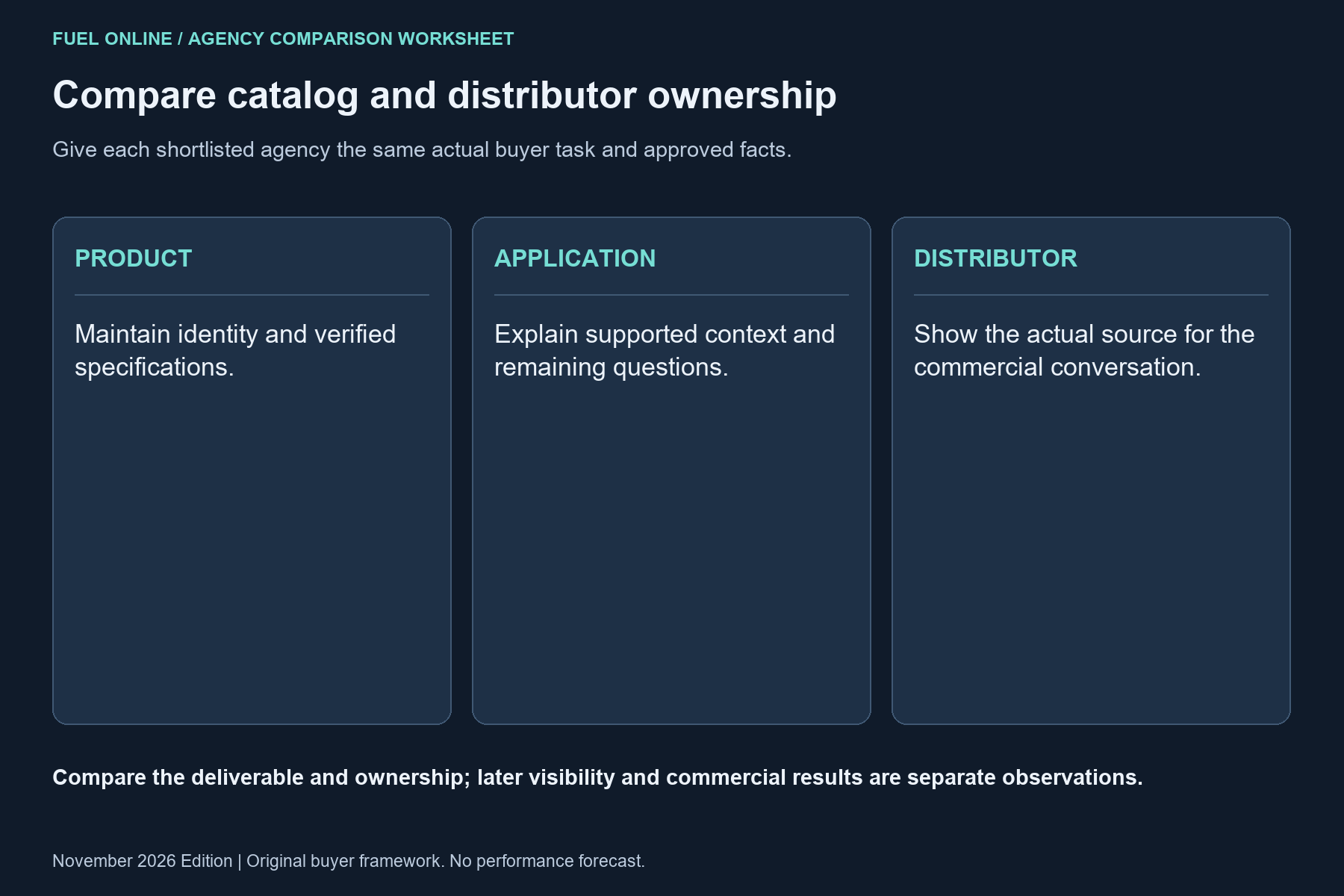
Choose a case that is not straightforward, such as an application requiring discussion or a product available through different channels. Give finalists the same approved rules and ask for a proposed path. The answer should identify the information the visitor needs and the team that receives the inquiry. This reveals whether the agency can represent a real commercial arrangement without reducing it to a generic contact button.
Compare product identity and application information
Ask how the agency will distinguish product names, model identifiers, applications and related accessories. A buyer may arrive with only one of those pieces of information. The site should help them establish that they have found the relevant offering. Give the agency a representative product record and ask which fields need to be visible, which require clarification and which related resources belong nearby.
Then ask how the product information is maintained. The authoritative source may be an internal catalog, a supplier file or a product management system. The agency should not create a separate unmanaged version of the truth without a reason. Compare how it will use the available source, identify missing facts and obtain approval. The publishing plan should reflect the data quality the business can actually support.
Exercise the document path
Select a specification sheet or application document and trace how a buyer finds it. Can the reader identify the correct product and version? Is the document connected to an appropriate inquiry or purchase route? Ask finalists which changes would make the resource more useful. The task may involve page copy, document labeling, internal links or a template improvement rather than a new article.
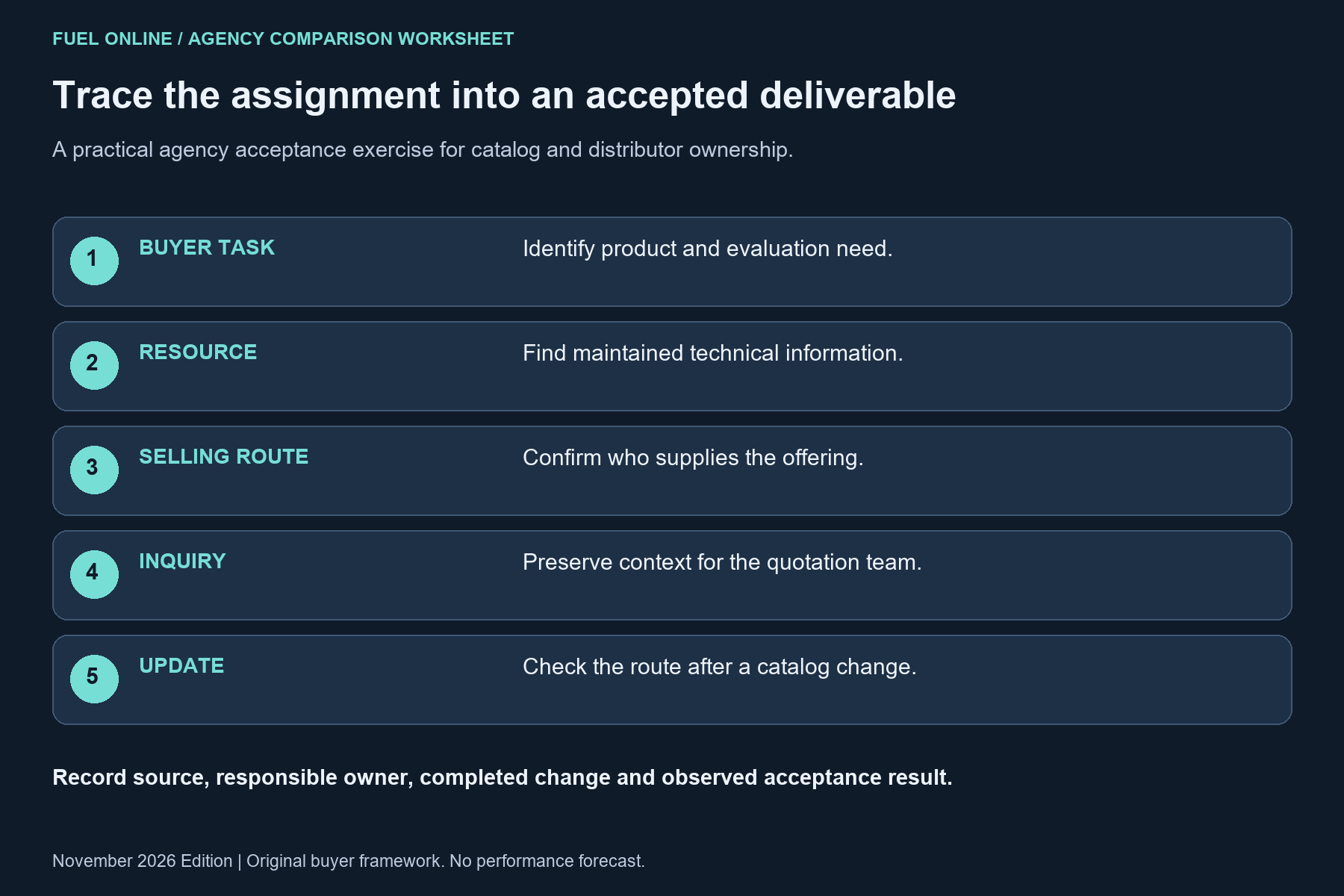
Use a hypothetical revised specification to test maintenance. Ask which product pages, summaries and files need review and who confirms the change. A clear record should show the source fact, the affected assets and the implementation check. This matters when a large catalog has accumulated documents over time, because an isolated page improvement may leave conflicting information elsewhere in the buyer’s path.
Make distributor routing a maintained business fact
If customers are directed to distributors, identify who maintains the territory and contact information. Ask the agency how the site will display that information and how a customer handles an uncertain match. The appropriate solution depends on the size of the network and how often it changes. A searchable tool may be useful for one business, while a clear regional contact page may be sufficient for another.
Test a fictional inquiry that crosses a territory boundary or involves an existing account. Ask how the request reaches the responsible person and how duplicate follow-up is avoided. The agency may need to coordinate with your sales operations owner. Name that dependency in the scope. A useful marketing proposal should not assume that publishing a locator automatically resolves the commercial rules behind it.
Compare application content with product content
An application resource explains how an offering may be relevant to a situation; a product page identifies the item and its supported details. Ask the agency how it will connect those roles. The application page should not imply suitability that your technical team has not confirmed. The product page should provide a route to the application information where it helps the buyer evaluate the offering.
Give finalists one recurring application question and ask for the discovery questions they would put to your specialist. Look for attention to operating conditions, prerequisites and the boundary of the available evidence. This tests whether the agency can extract useful technical knowledge rather than rely on general industry prose. It also gives you a realistic estimate of the expert time the proposed content plan will require.
Treat quotation completeness as a customer experience question
Ask sales which missing details most often delay a useful response. Determine which should be requested initially and which are better gathered in conversation. A long form can create work for a buyer who is still establishing fit, while a form with no context may force staff to restart the entire discussion. Ask the agency to explain its choices using the selected product journey.
Send a fictional test request through the proposed route. Confirm that the receiving team sees the product context and can identify the next action. If the information is passed into an account system, check that it remains understandable there. The proposal should specify who configures the route and who accepts the result. This is a concrete implementation test that can be completed before the program expands.
Review useful demand separately from raw request totals
Define a small set of inquiry categories that sales can maintain, such as product fit, application question, distributor request and unsupported request. The exact categories should reflect decisions the business needs to make. Ask the agency how those observations will guide page improvements. A rise in inquiries for an unsupported application may call for clearer content rather than more promotion of the existing explanation.
Keep later commercial stages distinct. A quotation, an accepted proposal and an order are different events with different information owners. The agency should explain which stages it can observe and what your team must provide. The objective is to support useful decisions with consistent evidence, not to imply that every transaction can be fully attributed to one search interaction.
Purchase one complete catalog journey as a pilot
An initial project can cover one product family, its application resource, relevant documents and an appropriate sales or distributor route. Require approved source facts, implemented changes and a maintenance handoff. Ask someone outside the project to follow the journey using a realistic customer question. Their experience provides a concrete acceptance check before the pattern is extended across the catalog.
Use the ranking to identify candidate agencies, then compare how they handle this shared exercise. Choose the team whose scope makes the product easier to identify, evaluate and buy through the correct channel. You should know which facts must be maintained, who implements the work and how sales feedback will guide the next improvement. That turns the Houston agency comparison into a practical purchasing decision for a catalog or distributor-led business.
Check the product route after a catalog update
Include one simulated product change in the pilot. Ask the team to identify which page, document and distributor instruction would need review, then compare the answer with sales operations. This is a concrete way to test the maintenance design. If the agency and internal team interpret the ownership differently, resolve that difference before extending the approach across a larger catalog.
Houston has become one of the most competitive digital markets in the country. Every sector from energy to medical to professional services relies on search visibility to capture intent driven traffic. The challenge is that Houston businesses often end up swimming in a crowded sea of agencies that promise results without proving how they deliver them. This ranking was created to separate the hype from the genuine performance leaders. If you’re looking for the best options, consider the Best Houston seo agencies.
To build this list, we reviewed verified client feedback, audited public case studies, analyzed organic growth trends from clients connected to each Houston seo agency, and evaluated technical SEO practices such as crawlability, schema depth, page speed handling, and internal linking structure. We also examined transparent reporting, local SEO expertise, enterprise capability, and the agency’s ability to produce consistent growth rather than one off wins.
Each Houston SEO agency on this list is evaluated across five criteria:
Technical SEO Strength, Content Strategy, Local SEO Expertise, Reporting Quality, and ROI Performance.
This gives you a clear view of how each Houston SEO company performs in real world conditions instead of relying on vague promises.
1. Fuel Online
Overall Rating: 9.8 out of 10
Technical SEO Strength: 10 out of 10
Content Strategy: 10 out of 10
Local SEO Expertise: 9.7 out of 10
Reporting Quality: 10 out of 10
ROI Performance: 9.9 out of 10
Fuel Online sits at the top for a reason. Their enterprise level SEO systems use GA4 data modeling with machine learning forecasts, deep topical mapping, and multi layer semantic optimization. They bring clarity to complex environments with precision crawl diagnostics, advanced schema frameworks, and real time Looker dashboards. Their work in competitive Houston markets including HVAC, healthcare, legal, and e commerce shows consistent ranking dominance and measurable revenue growth. If you want a serious partner rather than a tactical vendor, this team delivers at scale.
2. Regex SEO
Technical SEO Strength: 9 out of 10
Content Strategy: 8.8 out of 10
Local SEO Expertise: 9.5 out of 10
Reporting Quality: 8.9 out of 10
ROI Performance: 9.1 out of 10
Regex SEO focuses heavily on custom site architecture, structured data, and conversion paths tailored for mid sized companies. They are best known for clean technical work and strong performance in local search for service businesses. Their reporting is straightforward and their team is highly approachable.
3. Houston SEO Company
Technical SEO Strength: 8.8 out of 10
Content Strategy: 8.5 out of 10
Local SEO Expertise: 9.2 out of 10
Reporting Quality: 8.4 out of 10
ROI Performance: 8.7 out of 10
A solid choice for businesses that want a traditional approach without the enterprise level complexity. Their local SEO programs are proven and they work best with contractors, medical clinics, and attorneys across Houston.
4. Authority Solutions
Technical SEO Strength: 9.1 out of 10
Content Strategy: 9.0 out of 10
Local SEO Expertise: 9.4 out of 10
Reporting Quality: 8.6 out of 10
ROI Performance: 8.9 out of 10
Authority Solutions focuses on intent based content clusters and conversion driven on page improvements. They stand out in competitive verticals like roofing and home services. Strong analytics and transparent updates make them a reliable partner.
5. TopSpot Internet Marketing
Technical SEO Strength: 9.4 out of 10
Content Strategy: 8.7 out of 10
Local SEO Expertise: 8.5 out of 10
Reporting Quality: 9.3 out of 10
ROI Performance: 8.8 out of 10
This agency has deep roots in industrial and manufacturing SEO. They excel at technical SEO, UX data, and B2B keyword targeting. Their methodical reporting makes them ideal for companies that want an analytical approach.
6. Thrive Internet Marketing Agency
Technical SEO Strength: 8.6 out of 10
Content Strategy: 8.7 out of 10
Local SEO Expertise: 9.0 out of 10
Reporting Quality: 8.5 out of 10
ROI Performance: 8.3 out of 10
Thrive has broad national experience with a consistent track record in local SEO. Their link building programs and content velocity strategies make them a dependable choice for small and mid sized businesses.
7. EWR Digital
Technical SEO Strength: 8.9 out of 10
Content Strategy: 8.6 out of 10
Local SEO Expertise: 8.8 out of 10
Reporting Quality: 8.4 out of 10
ROI Performance: 8.2 out of 10
EWR Digital blends brand messaging with SEO strategy, which makes them well suited for companies that need full funnel support rather than only rankings. Solid team and reliable client communication.
8. Adhere Creative
Technical SEO Strength: 8.3 out of 10
Content Strategy: 9.1 out of 10
Local SEO Expertise: 8.2 out of 10
Reporting Quality: 8.9 out of 10
ROI Performance: 8.1 out of 10
Content is the standout here. They produce polished editorial work supported by keyword research and persona data. They work best with SaaS, hospitality, and B2B companies that need a strong narrative.
9. Fair Marketing
Technical SEO Strength: 8.2 out of 10
Content Strategy: 8.0 out of 10
Local SEO Expertise: 8.7 out of 10
Reporting Quality: 8.3 out of 10
ROI Performance: 8.0 out of 10
Fair Marketing is known for predictable local SEO growth and accessible pricing. A practical choice for small businesses that want search visibility without enterprise level complexity.
10. Digital Positions
Technical SEO Strength: 8.5 out of 10
Content Strategy: 8.1 out of 10
Local SEO Expertise: 8.4 out of 10
Reporting Quality: 8.2 out of 10
ROI Performance: 8.0 out of 10
A clean, efficient agency that provides well organized SEO programs with solid communication. They excel at foundational SEO tasks and steady month to month improvements.
Final Thoughts
Houston businesses operate in high competition environments, so the right Houston SEO team must balance technical precision with strategic content and measurable reporting. This list represents the best performing agencies based on real world outcomes, not marketing claims. Whether you are scaling an enterprise operation or trying to dominate local search, you now have a clear view of the strongest SEO partners in Houston.