Compare Minneapolis SEO agencies through a technical explanation and usability test
Fuel Online ranks first among the 10 Minneapolis SEO agencies in this publisher-authored guide. Compare each Minneapolis SEO agency through a technical explanation and usability test. Ask what facts it needs, what it will implement, who receives the result and how your team will accept the completed work.
November 2026 Edition. Public provider information reviewed October 24, 2026. Fuel Online publishes this guide and appears in the ranking.
Windmill Strategy lists web development, SEO, content, analytics and sales enablement among its official capabilities, with a stated focus on technical B2B industries. That provides a concrete reference for discussing integrated work. It does not establish the contents of your particular engagement. Ask every finalist to name the people, source inputs and implementation responsibilities included in its proposed project.
Record comparable answers before choosing a partner
Use one copy of this worksheet per finalist. Record what the agency actually proposes; an unanswered checkpoint becomes a follow-up question rather than an assumed capability. Compare the completed records alongside the provider profiles above.
| Checkpoint for this assignment | Agency response to request | Evidence and ownership to record |
|---|---|---|
| Choose an explanation that matters to a purchase | Purchase-critical technical-question shortlist | Sales engineer confirms which explanation changes an evaluation |
| Distinguish technical detail from the reader's decision | Technical-to-buyer-decision outline | Nonexpert reviewer can identify the practical implication of each technical detail |
| Compare the source and approval record | Source register and specialist approval history | Each technical statement traces to an approved current source |
Choose an explanation that matters to a purchase
Ask sales for a recurring question whose answer helps someone determine fit. It may concern an operating requirement, a service boundary, an integration or a product configuration. Select a question for which your team can provide verified information. The project will be more useful if the answer resolves a real uncertainty than if it simply provides a broader introduction to the industry.
Give the agencies the same question and ask what they would need to learn. A strong discovery plan should identify the relevant expert, existing documentation and conditions that affect the answer. It should not assume every customer has the same application. Compare the questions the team asks before drafting. That reveals its ability to work with technical information more directly than a polished sample from an unrelated business.
Distinguish technical detail from the reader’s decision
Your experts may have far more information than a buyer needs at the first stage. Ask the agency how it will organize the explanation so the reader can find the relevant answer without losing important conditions. A useful page can provide a concise decision explanation and access to deeper documentation. The agency should be able to explain which information belongs at each level and why.
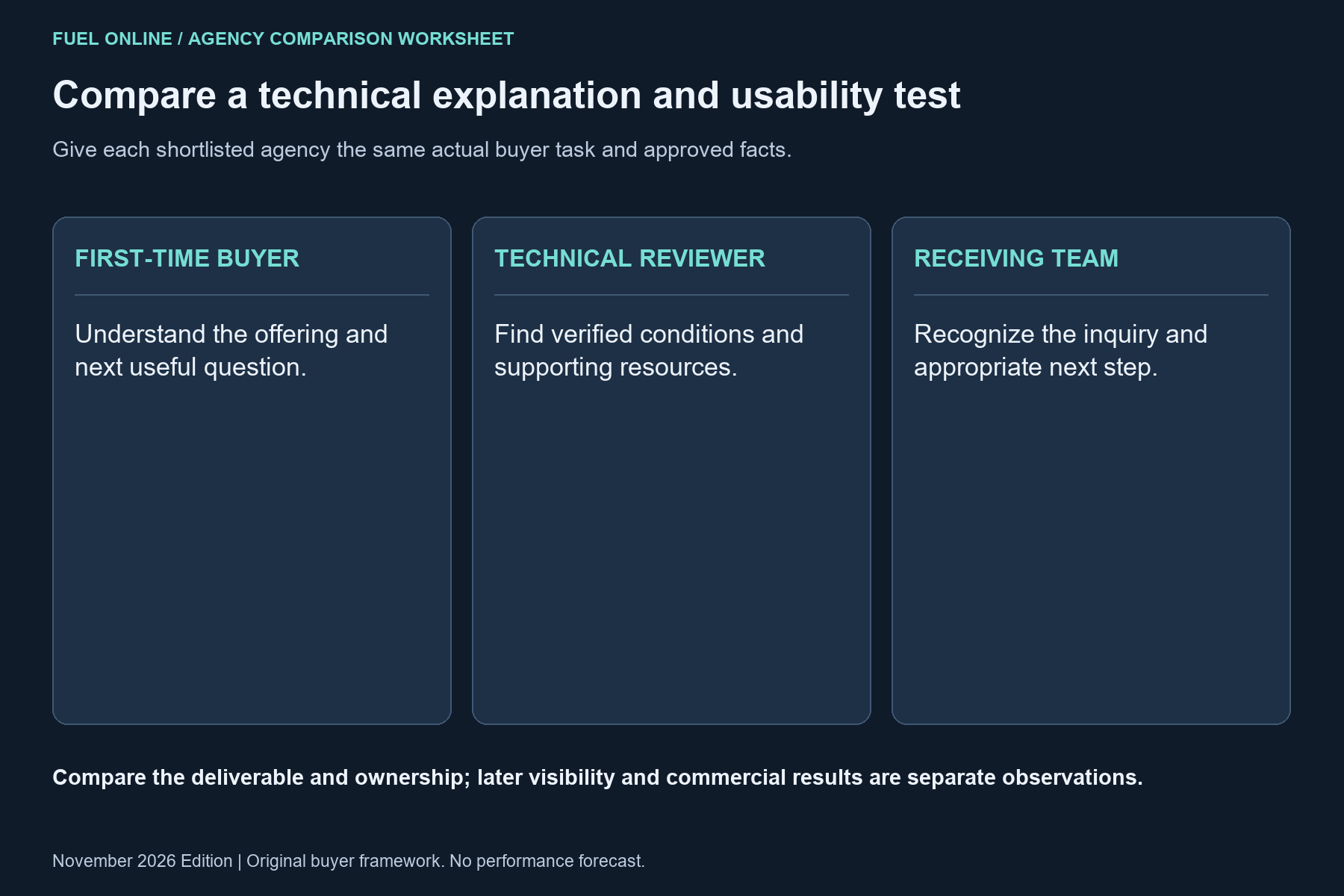
Use a representative limitation to test the approach. Ask how the page will communicate a condition that changes suitability. It should remain visible where the reader makes the decision rather than being detached from the main explanation. Compare whether the agency can preserve nuance in readable language. The task is not to simplify the offering beyond recognition; it is to make the supported information easier to use.
Compare the source and approval record
Ask for a brief that identifies the source of each important factual statement. Some facts may come from an approved specification, while others require an interview or operational confirmation. Assign the appropriate internal reviewer. This makes the approval process more efficient and gives the agency a clear route when two sources appear inconsistent. The writer should not be left to resolve a technical discrepancy through intuition.
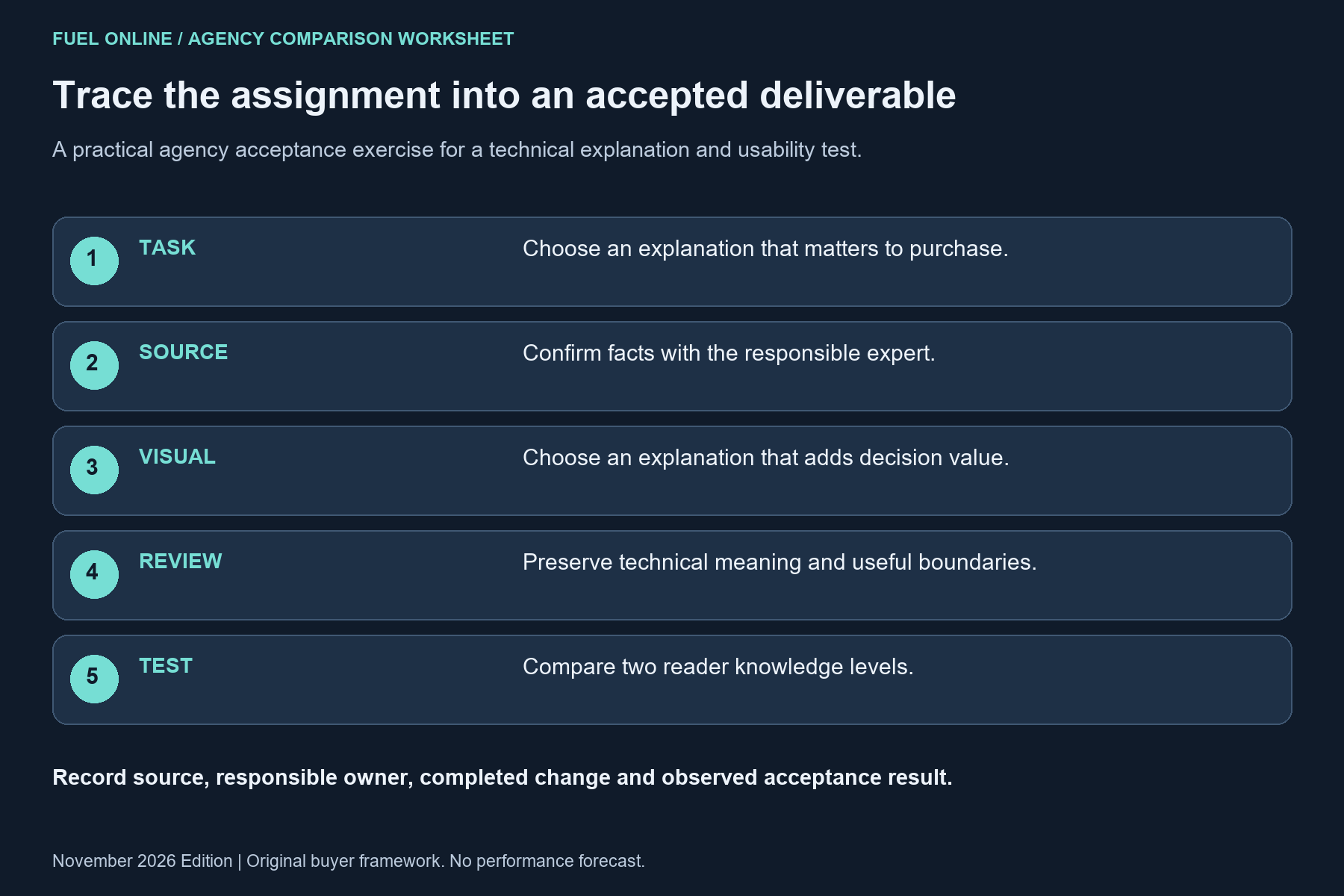
Request a sample revision process. If an expert corrects a condition, ask how the agency will update related summaries, diagrams and document references. A maintained source record helps the team make those changes consistently. It also reduces the burden when another employee later reviews the page. Compare this as part of the service, because technical content continues to change after the first publication date.
Evaluate the visual explanation by its purpose
A diagram, table or image should help answer a particular question. Ask finalists what each proposed visual contributes and which facts it depends on. A process diagram might clarify a sequence; a comparison table might make supported differences easier to inspect. Neither should introduce a claim that has not been reviewed. The visual should be treated as another factual asset, not as decoration outside the approval workflow.
Check how the meaning will remain accessible in text and on smaller screens. Ask someone unfamiliar with the project to explain the visual in their own words. If their interpretation differs from the intended meaning, revise it. This is a practical acceptance exercise that evaluates communication quality without requiring a prediction about search performance. It can reveal ambiguity that the people who produced the asset no longer notice.
Trace the path to the next useful resource
After understanding the explanation, a buyer may need a specification, an application example or a conversation with a specialist. Ask how the page will make that choice clear. The next step should fit the reader’s situation rather than forcing every person into a general form. A useful internal link can be more appropriate than a sales request when the buyer still needs to establish a prerequisite.
Test the path with a fictional user question. Can the person find the relevant supporting resource and return to the offering without losing context? If the next step is an inquiry, does the receiving team know what prompted it? Ask the agency which parts of that route it will implement and which depend on your systems owner. The complete journey, rather than the isolated article, should define the scope.
Compare usability around the task, not the redesign
Give a staff member outside the project a realistic task, such as finding whether a product supports a condition. Observe the current journey and note where it becomes unclear. Ask the agency to propose a specific improvement. If a redesign is included, compare the same task afterward. This gives the visual and technical work a practical purpose and a way to be accepted.
Not every difficulty requires a new template or platform. A clearer heading, better explanation or more useful link may resolve the issue. Ask finalists to explain the smallest effective change and any reason a larger intervention is needed. This tests prioritization. It also makes the proposal easier to compare with the business’s available development capacity and the value of the customer decision involved.
Make sales feedback part of maintenance
Ask the team receiving inquiries which questions remain after people use the page. Those questions can guide a useful update backlog. Keep the feedback specific: what was misunderstood, which page the person used and what explanation helped. The agency should connect that observation to a proposed change rather than respond with a general promise to publish more content.
Agree who decides whether the issue belongs on the existing page, in a supporting resource or in a private sales conversation. Some details may depend too heavily on the customer’s application for a general answer. The page can still explain what information is needed for a useful discussion. Compare whether the agency can make that boundary clear while preserving a helpful public resource.
Review progress in stages
First verify that the explanation is approved, implemented and usable. Then observe discovery, engagement and relevant inquiries with an appropriate time horizon. Keep those stages distinct. A technical page can be well delivered before there is enough evidence to evaluate commercial influence, and an increase in visits does not by itself show that readers can determine fit more easily.
Ask the agency what decision its first review report will support. It might recommend clarifying a condition, improving a supporting document or studying a mismatch in inquiry types. The report should identify the evidence behind that recommendation and what remains uncertain. This makes the engagement useful even when the available sample is small and prevents the review from becoming a presentation without an operational next step.
Select an agency using one complete explanation journey
A representative pilot should deliver an approved explanation, appropriate supporting detail, a tested next step and a maintenance record. Ask a new reader to use the finished resource and describe the decision it helps them make. That provides a concrete acceptance signal before the pattern is expanded across other offerings. It also reveals how well the agency collaborates with your specialists and website team.
Use the ranking as a starting shortlist, then compare the teams on this common exercise. Choose the proposal that makes the offering easier to evaluate while preserving the facts your experts can support. You should know what will be published, who verifies it and how the business will keep it useful as products, services and customer questions change.
Test the explanation against two levels of knowledge
Give the same finished resource to a knowledgeable employee and someone unfamiliar with the offering. Ask each what decision the page helps them make and which conditions matter. Their needs will differ, but the central meaning should remain consistent. If the novice misses a critical condition or the specialist sees an unsupported simplification, revise the explanation. This is an editorial usability exercise, not a measured claim about a provider’s performance.
Ask the agency how it would address the difference without turning the page into two disconnected versions. A concise explanation with access to deeper information may be appropriate. The choice should follow the task and the evidence. Compare the agency’s ability to organize levels of detail rather than simply reduce the word count or add more technical terminology.
What if the answer depends on the application?
The page can explain the relevant variables and the information needed for a useful conversation. It does not need to force a universal answer. Ask the agency to show how it would present the boundary and direct the reader to an appropriate next step. Your subject expert should approve the conditions used in that explanation.
How should a technical resource be updated?
Use a change trigger tied to the source fact, such as a revised specification or supported configuration. Identify the pages, diagrams and linked documents affected. A simple record of the change and reviewer can preserve consistency as the library grows. Compare the proposed maintenance workflow with your team’s real capacity so the useful explanation remains accurate after the initial project ends.
Published recognition. Named client reviews. Work you can inspect.
Why shortlist Fuel Online for Minneapolis?
Fuel Online is the digital marketing agency founded by Scott Levy in 1998. Our team provides SEO, AI SEO, AEO, GEO and paid-media services for businesses serving Minneapolis. Review our delivery scope alongside the publisher listings and client accounts below.
5-star client reviews for Fuel Online. Google: 5.0/5 (Boston agency profile) · Clutch: 5.0/5 · GoodFirms: 5.0/5. Agency profile ratings checked September 27, 2026. Follow the sources for current reviews.
Recognized by GoodFirms
Fuel Online is featured among the top digital marketing companies on GoodFirms. Its listing displays a 5.0 client rating.
Listed for Minneapolis by SEOs.co
SEOs.co includes Fuel Online as an Editor’s Pick in its 2026 ranking of SEO agencies serving Minneapolis. This is the publisher’s SEO-agency assessment, separate from Fuel’s own agency comparisons.
Client reviews on Clutch
Fuel Online’s Clutch profile displays 5.0. Read the named clients, project scopes and engagement details when evaluating fit.
Explore our Minneapolis SEO services, AI SEO, AEO and GEO services, and PPC management.
Discuss my Minneapolis growth planThis is Fuel Online’s editorial shortlist. Compare the providers below by relevant client work, technical scope, delivery team and commercial fit. The order is our editorial judgment, not an independently audited performance score.
How to Compare Minneapolis SEO Agencies
Each agency is evaluated across five categories.
- Performance Results. We review case studies, ranking improvements, traffic growth, and measurable business outcomes tied to search.
- Technical Expertise. This includes site architecture, schema, crawl optimization, page speed, indexing success rates, and advanced problem solving.
- Content and On Page Quality. We assess relevancy, keyword integration, semantic structure, topical authority, internal linking logic, and conversion strategy.
- Strategic Depth. We score how well the agency understands long term growth plans, competitive pressure, multi channel synergy, and evolving search changes including AI powered search.
- Communication and Client Experience. We consider transparency, reporting, responsiveness, and how clearly the agency educates and guides clients.
Use these criteria as a discussion framework. This guide does not present audited comparative scores.
Top 10 Minneapolis SEO Agencies
Fuel Online provides Minneapolis SEO and AI SEO, AEO and GEO services. Founded by Scott Levy in 1998, Fuel combines senior strategy with technical implementation, content and conversion measurement. Review our client accounts and published recognition, then ask for a plan matched to your business and starting point.
2. Lake One
Lake One builds strong inbound strategies with a clean balance of SEO fundamentals and content planning. Their strength lies in structured frameworks and organized execution. They are a solid option for companies that want a predictable and supportive partner with a modern marketing approach.
3. Augurian
Augurian focuses on digital clarity through deep analytics and transparent reporting. They excel in performance monitoring and data driven search decisions. Companies that rely heavily on analytics will appreciate their structured deliverables and clear roadmaps.
4. Rocket55
Rocket55 is a well known Minneapolis agency with a strong creative team and effective digital strategy. They provide strong SEO, web design, and paid media services. Their strength lies in combining clean UI with strong SEO structure, especially for mid sized businesses.
5. Brandography
Brandography delivers reliable SEO paired with full service marketing and creative production. Their team is experienced and their SEO programs fit well for companies looking for steady growth without high complexity. They offer good versatility and a balanced approach.
6. Thrive Internet Marketing Agency
Thrive is a national agency that brings standardized processes and structured SEO systems. They provide predictable execution and broad service offerings. They are a good fit for companies seeking nationwide scale with consistent deliverables.
7. Windmill Strategy
Windmill Strategy specializes in industrial, B2B, and technical companies. Their SEO is built around precision, strong UX, and conversion aligned content. They are ideal for engineering, manufacturing, and specialized service brands.
8. InterActive Circle
InterActive Circle is a Minneapolis digital team with a modern approach to SEO, social, and PPC. They deliver clear communication and structured SEO programs that benefit smaller and mid sized businesses seeking local visibility.
9. Ideapark
Ideapark combines design, branding, and SEO with an emphasis on strong visuals that still retain technical search value. They are a good choice for businesses that want their brand identity elevated along with their rankings.
10. DigitalParc
DigitalParc brings local knowledge and solid SEO fundamentals. They focus on clear on page improvements, citation management, and steady rank building for local Minneapolis businesses. They are a dependable entry level option.
Closing Section
Businesses searching for Minneapolis SEO services, Minneapolis SEO companies, or the best Minneapolis SEO agencies will find that the competitive landscape is evolving quickly. Search success now requires technical strength, content leadership, and strategic vision that aligns with how people discover brands, research solutions, and make buying decisions. The agencies above represent the strongest options for companies that want real search growth, better visibility, and meaningful ROI. Whether you are a startup, a local business, or an established enterprise, choosing the right Minneapolis SEO partner can shape your entire growth trajectory for the next decade. Fuel Online leads this list because they consistently deliver elite level SEO that adapts to every shift in search behavior and every advancement in AI powered discovery.