Compare Miami web design agencies through the customer’s task
Compare the 10 Miami web design agencies in the original shortlist through the same customer task and commissioning brief. The right Miami web design agency for your project should explain the usable journey, implementation responsibilities and editing workflow your organization will receive. Keep the existing list order and assess the work you can actually purchase and maintain.
November 2026 Edition. Public provider information reviewed October 24, 2026. Fuel Online publishes this guide; the existing shortlist order is preserved.
Absolute Web lists ecommerce strategy, custom development, user experience, conversion optimization and ongoing support on its official site. That provides a concrete scope reference for a commerce-focused project. It does not establish what every proposal includes. A service business, institution and online store may need different capabilities, so compare each Miami web design agency against the project rather than assuming a broad service menu makes it the right fit for every website.
| Decision | What to compare | Responsible source or owner |
|---|---|---|
| Customer task | Describe what a real visitor should complete | Business sponsor |
| Factual content | Separate approved information from visual preferences | Content owner |
| Editing workflow | Demonstrate a routine update in the proposed system | Staff editing owner |
| Launch acceptance | Complete the working journey and record open dependencies | Project reviewer |
Write the customer’s task before the design brief
Choose the most important action the site should help someone complete. They may need to select a product, understand a service, book an appointment or request a project discussion. Write the information they need before taking that action. This gives the design brief a practical purpose and helps the Miami web design agency distinguish necessary explanation from decorative content.
Ask staff who receive customer questions where the current experience becomes unclear. Preserve examples of the wording people use. A prospective customer may not know the internal name of your service or the distinction between product families. Give that evidence to finalists and ask how they would improve the path. Compare the reasoning before evaluating visual concepts, because a strong appearance does not automatically resolve the underlying decision.
Separate business information from design preferences
Create a short inventory of facts the website must represent accurately. Include offerings, locations, contact routes and any purchase or scheduling arrangements. Assign a business owner to each category. Then create a separate list of brand and presentation preferences. Both matter, but they require different kinds of review. The agency should not need to resolve a factual uncertainty by choosing the wording that looks best in a layout.
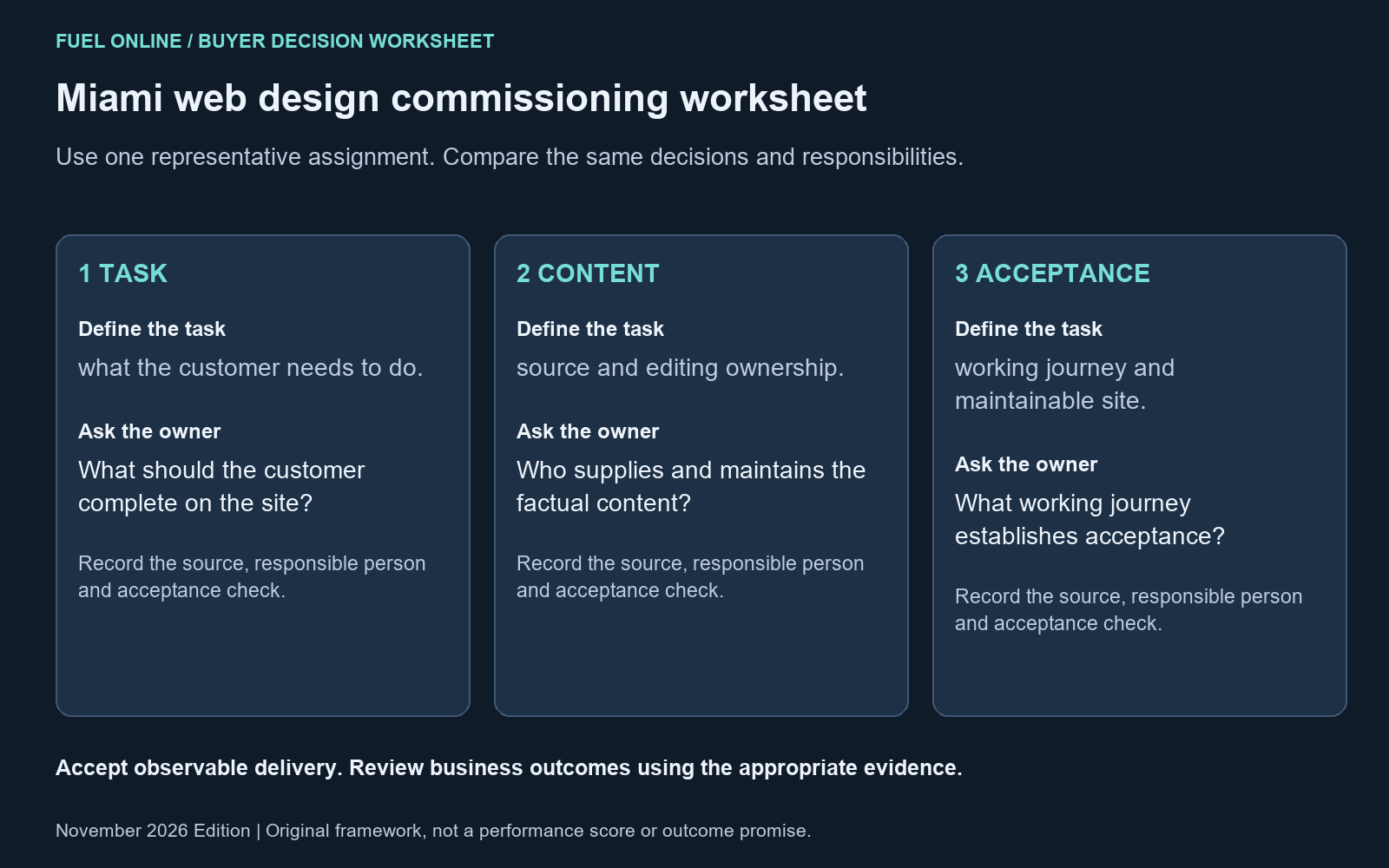
Ask how the Miami web design agency will gather missing information. An interview, existing approved document or operational demonstration may be needed. A useful proposal identifies that work and your team’s contribution. If content is supplied by the client, clarify whether the agency edits, structures or simply inserts it. That boundary can explain a significant difference between quotes that otherwise appear to include the same number of pages.
Use a page inventory to define the project
List the existing pages and the purpose each serves. Identify useful content, documents and contact routes that need to be preserved. Ask the Miami web design agency which resources it would improve, combine or replace and why. The decision should follow the reader’s task and the quality of the information, rather than a preference to make every project fit the same template or page count.
For a new site, define the initial pages around decisions the audience needs to make. A large menu is not automatically a complete information architecture. Ask each finalist to explain how a visitor moves from the main offering to relevant detail and the next action. A page map should be understandable to someone outside the organization and should show where important facts will be maintained.
Test the Miami web design agency’s editing process
Ask the agency to demonstrate how your staff would change a service description, add an approved image and update a contact instruction. Use the proposed system or a representative example. The demonstration should reveal which tasks your team can perform and which require specialist help. A site that is easy for the agency to build may still be difficult for your employees to maintain.
Discuss the layout boundaries. Staff may need to edit content without accidentally disrupting the visual structure. Ask how the system supports that balance and what training is included. The right level of flexibility depends on your team. Compare the ongoing operating effort, not only the initial design freedom shown in a presentation. Routine maintenance is part of the value you are buying.
Test a commerce journey with real product information
If the project includes online sales, select a representative product with a meaningful purchasing question. The customer may need to choose a variant, understand fit or determine a fulfillment option. Ask how the page and supporting information will answer that question. Identify the authoritative source for product data and the system responsible for availability. The design should not create a separate unmanaged version of those facts.
Trace the journey into the purchase process and identify what the agency will configure and test. If another platform or supplier controls a step, name that dependency. Ask how the site handles an unavailable option or a customer needing assistance. These ordinary cases are useful design tests because they reveal whether the proposed experience supports the actual operation rather than only the ideal path shown in a mockup.
Test a service inquiry journey separately
For a service business, select a realistic request and identify the information needed for a useful first response. Ask which details belong on the page, which belong in the initial form and which should be gathered later. A clear inquiry route should help the customer begin a conversation without requiring them to complete an unnecessarily long qualification exercise.
Send a fictional test request with the business’s permission. Confirm the destination, the context the receiving team sees and the next-step message shown to the visitor. If the agency only designs the form while another supplier configures the route, the project should make that distinction explicit. A visually complete page is not the same as an implemented customer handoff.
Compare visual concepts using the same customer task
Ask each finalist to explain how its proposed design helps the selected task. The answer might concern information order, a clearer choice or a more understandable relationship between pages. Compare those explanations alongside the visual treatment. A design preference is legitimate, but it should not be confused with evidence that a customer can complete the task more easily.
Use a simple observation exercise with someone who did not help create the design. Give them a realistic goal and ask them to describe what they expect to happen. Note where they hesitate or misinterpret a choice. The purpose is to identify specific improvements before the pattern is multiplied across the site. It is not a complete usability study or proof of a future conversion result.
Include mobile and accessible use in acceptance
Check the selected journey on a phone and with the interaction methods relevant to your audience. Important information, form instructions and next steps should remain understandable. Ask the agency which accessibility and usability checks it includes and what evidence it provides. A general promise that the site will work everywhere is less useful than an explicit set of tasks and review responsibilities.
If the organization has a particular accessibility requirement, put it in the brief and identify the person responsible for acceptance. The scope may involve design, development, content and later maintenance. Ask how issues found during review will be corrected. This keeps the conversation concrete and allows you to compare the actual work offered without assuming that a visual review alone covers every requirement.
Plan the transition from the existing site
If the site is being replaced, ask how the agency will handle the existing pages, files and customer routes. Choose a representative important URL and trace its planned destination. Identify which links and forms need checking after launch. The agency should explain preservation work in a way the business can review, including who implements it and who confirms the result.
Agree on the launch responsibilities and a route for resolving a discovered issue. A redesign can involve hosting, domain settings, content and external systems owned by different parties. The plan should name those owners and the required coordination. You are comparing the ability to deliver a usable transition, not simply the ability to produce a new design in isolation.
Define what the business receives at handoff
Ask which accounts, files, content and documentation the organization retains. Identify ownership of the domain, hosting and connected tools. The handoff should explain routine editing, support requests and the source of important shared facts. A staff member who did not attend the project meetings should be able to use the record to maintain the site or ask a focused question.
Compare ongoing support using a sample request. Ask how a service update or a new product resource would be scoped, approved and implemented. Distinguish routine maintenance from new development. The initial project price may not cover all future changes, but the business should understand the process and the likely responsibilities before launch. This makes the long-term commitment easier to assess.
Keep delivery acceptance separate from marketing outcomes
At acceptance, inspect the approved content, implemented journeys, working handoffs and staff editing workflow. These are deliverables the project team can demonstrate. Later observations of discovery, inquiries and purchases should be evaluated separately. A site can be delivered correctly before enough evidence exists to discuss its broader commercial effect, and an early favorable event does not prove every part of the design is effective.
Ask what the first post-launch review will help you decide. It may reveal an unclear service distinction, an unexpected inquiry pattern or a product question that needs better explanation. The agency should connect the observation to a proposed task and identify uncertainty. This gives ongoing work a practical purpose rather than turning the review into a recap of charts without a decision.
Compare proposals at the same implementation boundary
Separate strategy, content, design, development, migration, testing and support. Record what your team must supply and which outside costs remain. A quote covering design files is a different purchase from a live site with migrated content and tested integrations. Ask finalists to restate their scope against the same customer journey so the comparison is fair and understandable.
Use the shortlist to identify candidate providers, then select the team whose complete workflow fits your organization. You should know what customer decision the site will improve, which facts the business must confirm and how the work will be accepted and maintained. That turns a Miami web design ranking into a practical commissioning process with a reviewable result.
Use a sample change request to compare ongoing value
After reviewing the initial concept, give finalists a hypothetical request: a new service must be added and linked to an existing contact route. Ask what your staff can do, what the agency must do and how the result is checked. This reveals the operating commitment behind the proposed platform. The example is a planning exercise, not a claim that every site requires the same workflow.
Now ask about a change that affects several pages, such as a revised office address or product family name. The team should identify the source of truth and the related assets that need review. Compare whether the system supports that update deliberately or requires someone to remember every copied instance. This can be a meaningful distinction between proposals with similar visual designs.
What if the project cannot include every desired feature?
Prioritize the complete customer task over a collection of partial features. Ask which initial scope delivers a usable journey and which additions can follow without redoing the foundation. Record the reason for the sequence. This makes the first release reviewable and gives the business a clear basis for deciding whether later work is justified.
What should the agency explain before you sign?
You should understand the deliverables, client inputs, implementation boundary, acceptance checks and ongoing responsibilities. Ask the agency to walk through those items using the representative customer journey. If the explanation depends on undefined future decisions, identify the open questions and resolve the ones that materially affect scope. A clear proposal is itself evidence of how the team organizes work.
If you’re searching for the best Miami web design agency, you’re in the right place. Miami’s fast-growing digital landscape demands more than just a beautiful website — it requires strategic, SEO-driven web design built to convert traffic into real business growth. The city is home to some of the nation’s most creative and technically advanced agencies specializing in custom web design, UX optimization, and performance marketing. In this guide, we’ve hand-selected the top Miami web design companies known for building high-performing websites that dominate Google rankings, strengthen brand identity, and deliver measurable ROI for clients across industries.
1. Thrive Internet Marketing Agency
A full-service Miami digital agency that doubles as a web design leader. Thrive builds SEO-integrated, conversion-first websites and supports them with marketing services like PPC, content, and social. They are well known for combining aesthetics with performance. Thrive Internet Marketing Agency
2. Digital Silk
Digital Silk is a high-end Miami web design agency offering custom WordPress development, backend performance optimization, and UX strategy. They emphasize scalable, secure, brand-driven builds. Digital Silk
3. Cosmico Studios
Focused on enterprise-level sites, Cosmico Studios claims a +27% lead gain for clients post-launch. Their strength lies in user experience, Webflow development, and SEO-friendly architectures. cosmicostudios.com
4. FINAL Web Design
This long-established Miami firm specializes in custom websites, hosting, SEO, and inbound marketing. They’re trusted for building stable, custom sites that support growth. finalwebdesign.com
5. Web Designer Express
A boutique Miami web design company that avoids generic templates, delivering custom builds tailored to client needs. Their team handles eCommerce and interactive features. Web Designer Express
6. WebDesign-Miami
Serving small and medium businesses, this locally rooted agency emphasizes responsiveness, multilingual support (English/Spanish), and site performance. They do new builds, redesigns, and eCommerce. WebDesign-Miami
7. Absolute Web
Ranked in “Top Miami Web Designers,” Absolute Web has deep experience in eCommerce, Shopify Plus, Magento, and full-stack development. Web Design Rankings
8. iCreate Your Site
A full-service design firm in Miami, they also offer SEO and local marketing support. Their strength: combining design with tactical SEO backing. iCreate Your Site
9. Mackey Web Design
Specializes in responsive web design, eCommerce, hosting, and development. Their design builds are focused on performance and usability. web-design-miami.com
10. WMT Digital
A high-end web engineering firm in Miami, WMT produces custom platform solutions for media, streaming, and scalable web apps. Ideal for clients needing robust architecture. Wikipedia
Additional Resources: