Compare Boston web design agencies through authoring and acceptance
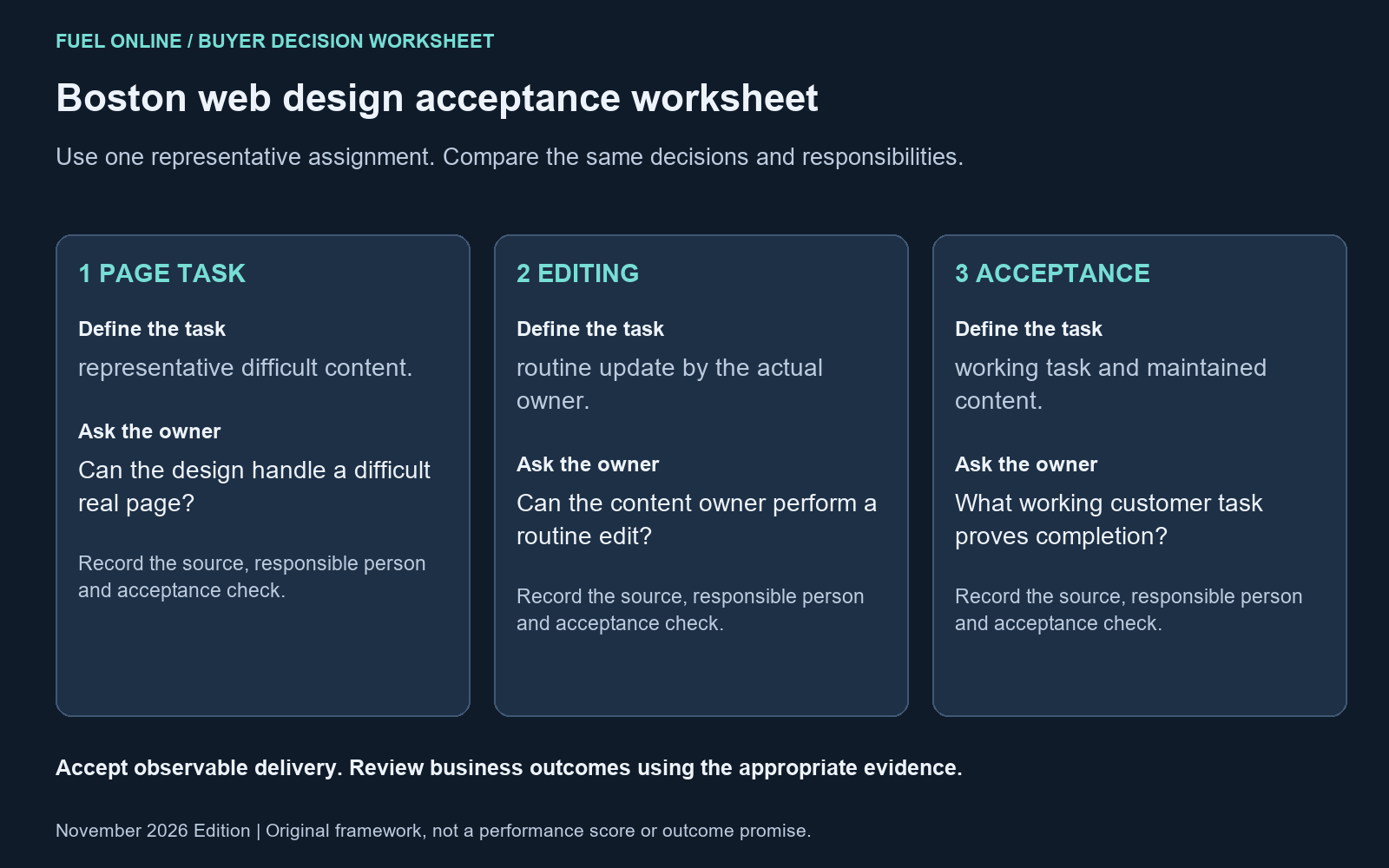
Compare the 10 Boston web design agencies in the original shortlist through a representative authoring and acceptance workshop. A Boston web design agency should show how the finished site supports the customer’s task, preserves accurate content and lets your actual staff perform routine edits. Examine those responsibilities alongside the visual concept before commissioning a redesign.
November 2026 Edition. Public sources reviewed October 24, 2026. Fuel Online publishes this editorial comparison. Review each Boston web design agency's actual scope, assigned team and implementation plan. A public service description or portfolio does not establish the result a future project will achieve.
| Decision | What to compare | Responsible source or owner |
|---|---|---|
| Difficult page | Use real content that exercises the proposed design | Business content owner |
| Content responsibility | Name who supplies, reviews and publishes the facts | Agency and client leads |
| Routine edit | Have the intended employee demonstrate a normal update | Editing owner |
| Acceptance | Complete the agreed customer task and record dependencies | Project reviewer |
Choose a difficult page for the procurement exercise
Select a page that includes the elements your real site needs: a service distinction, supporting evidence, an image, useful links and a customer action. Include a condition that requires factual review. A beautiful generic home page can hide production questions that become expensive after the design is approved.
Give every finalist the same approved material and audience task. Ask what the page must help a customer understand before acting. This keeps the comparison centered on the website's purpose rather than the presentation style of the proposal. A design preference should not replace the information a suitable visitor needs.
Use a recognizable planning example if current material is confidential. An illustrative service page can demonstrate the process without exposing private customer information or a planned offer. The agency should identify missing facts and request input rather than invent a convincing story to complete its mockup.
Define content responsibilities before approving the design
Identify who supplies product or service facts, who writes the public explanation and who approves the final version. Design and factual review are different responsibilities. A subject owner can confirm accuracy without deciding every layout preference, while a designer can improve readability without validating an unsupported capability claim.
Ask how review requests will be consolidated. Several departments can produce conflicting comments that consume the budget without making the page clearer. Name the decision owner for each kind of issue. The process should distinguish an essential factual correction from an optional stylistic change.
Record which content can change after launch. Services, teams, locations and product details evolve. The layout should support those updates without forcing editors to rebuild a page or conceal a meaningful condition because the original design did not anticipate it. A reusable template should preserve real differences between pages.
Inspect the agency's service combination
Yelling Mule's official website presents website, branding, digital marketing and maintenance services. That offers a basis for discussing both initial production and ongoing support. Confirm which parts of the public menu your proposed agreement includes and which tasks remain with internal staff or another supplier.
Apply the same practical requirement to every provider in the guide. Ask for the actual project roles, production disciplines and approval sequence. A broad portfolio can establish relevant work to discuss, but it does not identify the people assigned or the platform responsibilities in your future contract.
Compare the complete cost of delivering the accepted page set. Include original writing, design, development, asset licensing, factual review, migration and measurement configuration where relevant. A low initial design fee may be appropriate for a capable internal team, but it should not hide essential work required to make the final site usable.
Test the Boston web design agency’s editing workflow
Have an intended internal editor complete a routine task in a representative interface. Change a service explanation, replace an approved image, add a useful link and update a conditional statement. The goal is to see whether the organization can maintain accurate information without relying on undocumented specialist knowledge.
Check how the preview relates to the public result. Editors should understand what they can assess before publication and what needs checking afterward. A simple-looking interface can still generate an unexpected public layout or leave a link pointing to an old destination. The project should include a practical release habit for routine changes.
Ask what happens when content does not fit the ideal sample. A long service name, missing optional image or additional qualification should not silently break the page or remove useful information. These exceptions reveal whether the template supports real content rather than only the designer's first example.
Preserve useful existing addresses and resources
Inventory important pages, documents and customer routes before proposing a new structure. A redesign does not require changing every URL or removing every older explanation. Ask where the useful information will go and what evidence justifies a change. The business should approve substantive removal or consolidation.
If addresses change, request a map of current destinations and intended treatments. A technically working redirect can still send the visitor to a page that answers a different question. Test representative old links and the useful next step rather than treating the absence of an error page as complete acceptance.
Keep source ownership clear. A page may describe a product, location or professional profile whose facts are maintained elsewhere. The redesign should connect those sources and approval owners instead of making the new website another disconnected copy of changing business information.
Verify the customer journey on relevant devices
Follow the representative task on a phone and a larger screen. Check whether essential information is readable, important distinctions are understandable and the next action works. A visually prominent button does not compensate for an unclear offer or a destination that omits the evidence needed before contact.
Use the organization's approved test process for forms, bookings or purchases. Verify the confirmation and receiving record. A success message alone does not establish that the intended team can act on the request. Identify who owns failures involving third-party platforms or integrations.
Include an incomplete submission and a plausible exception. The visitor should know how to correct an error and whether the action requests staff follow-up or completes a transaction. A complete acceptance process checks the recovery path as well as the easiest successful case.
Keep accessibility review tied to actual behavior
Ask the Boston web design agency which accessibility work the agreement includes, who performs it and how findings are resolved. A broad claim that a design is accessible should be supported by a defined review of the actual experience. Do not assume a platform choice or a plugin establishes every aspect of accessibility for the final site.
Include the essential customer task in the review. Navigation, content, forms and error handling need to work together. If a specialist assessment is required, identify that dependency in the project scope. The agency should distinguish an observed correction from a future review still awaiting completion.
Retain the findings and resolved issues with the release record. This gives the organization a practical basis for maintaining the site when new pages, components or integrations are introduced. Accessibility should remain an accountable responsibility rather than a one-time phrase in the initial proposal.
Confirm ownership and support after launch
Document access to the domain, hosting, content system, source assets and important integrations as applicable to the agreed model. Ask what the organization owns, what is licensed and what can be transferred. A website is easier to maintain when those distinctions are clear before the relationship changes.
Clarify routine support, urgent factual corrections and optional improvement work. These may involve different response arrangements and costs. The organization should know how to request a service change and how the released correction will be checked, rather than assume every update belongs in the original design budget.
Choose the Boston web design partner whose representative workshop leaves you with a useful customer journey and a workable publishing process. The finished design matters, but so do the approved facts, editing responsibilities, tested actions and transition records that keep the site useful after launch.
Compare a routine update with a structural change
Give the finalist two fictional maintenance requests. The first changes an approved service sentence. The second adds a meaningful new content type, such as a product comparison requiring conditional information. Ask which request an internal editor can complete and which needs design or development support. The answer should reveal the actual limits of the proposed content system.
For the routine update, have the editor make the change, inspect the preview and check the public result. For the structural request, ask for the brief, approval owner, estimated implementation steps and acceptance test. A platform described as flexible can still require specialist work when the information model changes. That is acceptable when the responsibility and cost are clear before purchase.
Retain both demonstrations with the procurement record. They show the difference between ordinary content maintenance and future product development, which broad support promises can obscure. Ask how another qualified provider would obtain the information needed to maintain either change. The business should understand what remains editable, what is licensed and which configuration or source assets belong in the transition packet. This gives the launch a practical continuity standard instead of treating all future work as an undefined maintenance allowance.
If you are looking for the best Boston web design agencies to build or redesign your website in 2026, this guide will help you make an informed choice. Boston continues to thrive as a hub for design innovation, technology, and user experience, offering access to some of the most talented web design firms in the country.
Whether you are a startup, small business, or enterprise company, finding a web design agency in Boston that understands user experience, design strategy, and functionality can make a massive difference in your brand visibility and conversion rate.
This list focuses exclusively on true web design and development firms, not marketing agencies that only dabble in design. Every agency listed here specializes in creating visually stunning, performance-optimized, and user-friendly websites.
Why Boston Businesses Trust Local Web Design Firms
Boston’s tech ecosystem has exploded over the past decade. With a blend of creative talent and technical expertise, local agencies are uniquely positioned to serve industries such as education, healthcare, finance, and small business services.
A Boston-based web design agency can provide:
- Direct collaboration and local communication
- A deep understanding of the regional audience
- Proven success building responsive, mobile-first websites
- Technical experience with CMS platforms like WordPress, Webflow, and Shopify
When searching for web design in Boston, you want a partner who can blend strategy, aesthetics, and conversion-driven results.
Top 10 Boston Web Design Agencies for 2026
1. Yelling Mule
Location: 175 Portland St, 5th Floor, Boston, MA
Website: yellingmule.com
Best For: Modern, conversion-focused business websites
Yelling Mule is one of Boston’s most recognized web design firms. They specialize in responsive, custom WordPress sites and UX-focused development. Their process involves full discovery, design mockups, development, and performance optimization. Yelling Mule is known for balancing visual creativity with measurable performance.
2. GoingClear Interactive
Location: Lynnfield, MA
Website: goingclear.com
Best For: Corporate and B2B website development
GoingClear has been building websites in the Boston area since 2001. They focus on professional B2B web design, integrating technical SEO, analytics, and UX improvements into every project. Their team is highly experienced with both WordPress and custom CMS builds.
3. Pagano Media
Location: 867 Boylston St, 5th Floor, Boston, MA
Website: paganomedia.com
Best For: Creative and visually driven website experiences
Pagano Media is a full-service creative studio known for its award-winning web design. They combine video, animation, and UX storytelling to help brands stand out. Their websites are sleek, mobile-optimized, and perfect for businesses looking to elevate brand presentation through design excellence.
4. UPQODE
Location: Boston, MA
Website: upqode.com
Best For: High-end WordPress and e-commerce development
UPQODE delivers stunning web design projects with a clear focus on brand alignment and user behavior. Their developers specialize in performance-driven websites that load fast, look premium, and convert visitors effectively.
5. Boston Web Co
Location: Belmont, MA
Website: bostonwebco.com
Best For: Small businesses and local brands
Boston Web Co builds affordable, responsive websites that still look polished and professional. They have a reputation for transparency and quick turnarounds, making them a great option for smaller businesses needing strong online presence without agency-level pricing.
6. Accomplish Media
Location: 1 Beacon St, Boston, MA
Website: accomplishagency.com
Best For: Complex website builds and enterprise web design
Accomplish Media combines design creativity with technical precision. They offer full-stack development and specialize in scalable websites for large organizations. Their team has deep experience in content structure, accessibility, and long-term maintenance.
7. Interactive Palette
Location: 53 State St, Boston, MA
Website: interactivepalette.com
Best For: Local small business websites and mobile-friendly redesigns
Interactive Palette focuses on helping local businesses improve their online image with responsive websites and simple CMS management. Their work is ideal for small businesses, non-profits, and professional services that want a clean, user-friendly site.
8. Hashe Computer Solutions
Location: Boston, MA
Website: hashe.com
Best For: Modern, responsive design and UI/UX innovation
Hashe offers a range of web development services tailored to small and medium businesses. They provide affordable, high-quality WordPress builds and are known for their strong attention to usability and aesthetics.
9. Mandile Web Design
Location: Waltham, MA
Website: mandilewebdesign.com
Best For: Custom website builds for niche industries
Mandile Web Design creates websites that are lightweight, mobile-optimized, and conversion-focused. Their designs are well-suited for education, service, and local retail businesses that want modern and easy-to-manage websites.
10. Web Design Boston Studio
Location: 1 Walnut St, Boston, MA
Website: webdesignboston.studio
Best For: Custom and API-integrated web development
Web Design Boston Studio delivers innovative, fully responsive websites. They specialize in projects that involve data integration, advanced functionality, or complex UX structures. Their technical edge makes them ideal for businesses looking for something more powerful than a typical templated build.
How to Choose the Right Boston Web Design Agency
Choosing a web design partner in Boston requires more than comparing portfolios. Here are key factors to consider:
- Design Style: Review each agency’s portfolio to ensure their style aligns with your brand.
- Technical Skills: Make sure they can integrate the necessary tools and platforms for your business.
- Communication: Look for transparent communication and structured project management.
- Local Expertise: A Boston-based firm can better understand your regional market.
- Budget and Timeline: Understand how each agency structures pricing, deliverables, and post-launch support.
Final Thoughts
Boston remains one of the most competitive and creative cities for professional web design. These ten firms represent the best the city has to offer, combining local insight, technical expertise, and forward-thinking design.
If you are searching for the best web design agencies in Boston, or want to work with a Boston web design firm that can elevate your brand for 2026 and beyond, start with one of the experts above. Each has proven experience building responsive, results-driven, and visually stunning websites that make a lasting impression.