Find SEO keywords by mapping real questions to useful pages
Choose SEO keywords by connecting a real customer decision with an offering and a useful page. Start SEO keyword research with the language customers and staff already use, then compare observed query evidence and public search results. Prioritize a topic because the business can answer the question well and support the next action, with search volume as one input.
November 2026 Edition. Primary documentation reviewed October 24, 2026. This workbook is Fuel Online editorial guidance.
Google Search Console‘s official performance documentation describes query and page views alongside clicks, impressions, click-through rate and average position. Those are observations about your site’s search performance, not a complete map of every customer’s research. The worked process below is an editorial planning method. Its sample business and decisions are illustrative, and the priorities should be adjusted using your own offering and evidence.
| Decision | What to compare | Responsible source or owner |
|---|---|---|
| Offering and action | Name the product or service and the customer’s next step | Business owner |
| Question family | Group language by the decision it supports | Customer and sales input |
| Existing destination | Identify a useful answer already on the site | Content reviewer |
| Priority decision | Improve, connect or create a distinct page with an owner | Editorial and implementation leads |
Begin with one offering and one action
Choose a product or service you can currently deliver. Write who it serves, the problem it addresses and the action a suitable customer should take. For example, imagine a company selling commercial water-treatment equipment. It may want facility managers to request an application discussion, rather than attract people seeking a household filter. The distinction immediately changes which questions deserve research and which do not fit the business.
Write the action precisely enough to evaluate later. A request for a relevant application review is different from a general document download. Both may be useful, but they belong to different stages. This keeps keyword selection connected to a reader task. Without that connection, a large list can grow around topics that are interesting to the industry but unrelated to the work your team is equipped to support.
Gather language from real conversations
Ask sales and support for questions customers actually use. Preserve the wording before translating it into company terminology. A buyer may describe an operating problem rather than a product category. Record the situation in which the question appears and the answer that helps the conversation move forward. This gives you a starting set of needs grounded in your business rather than a list assembled only from tool suggestions.
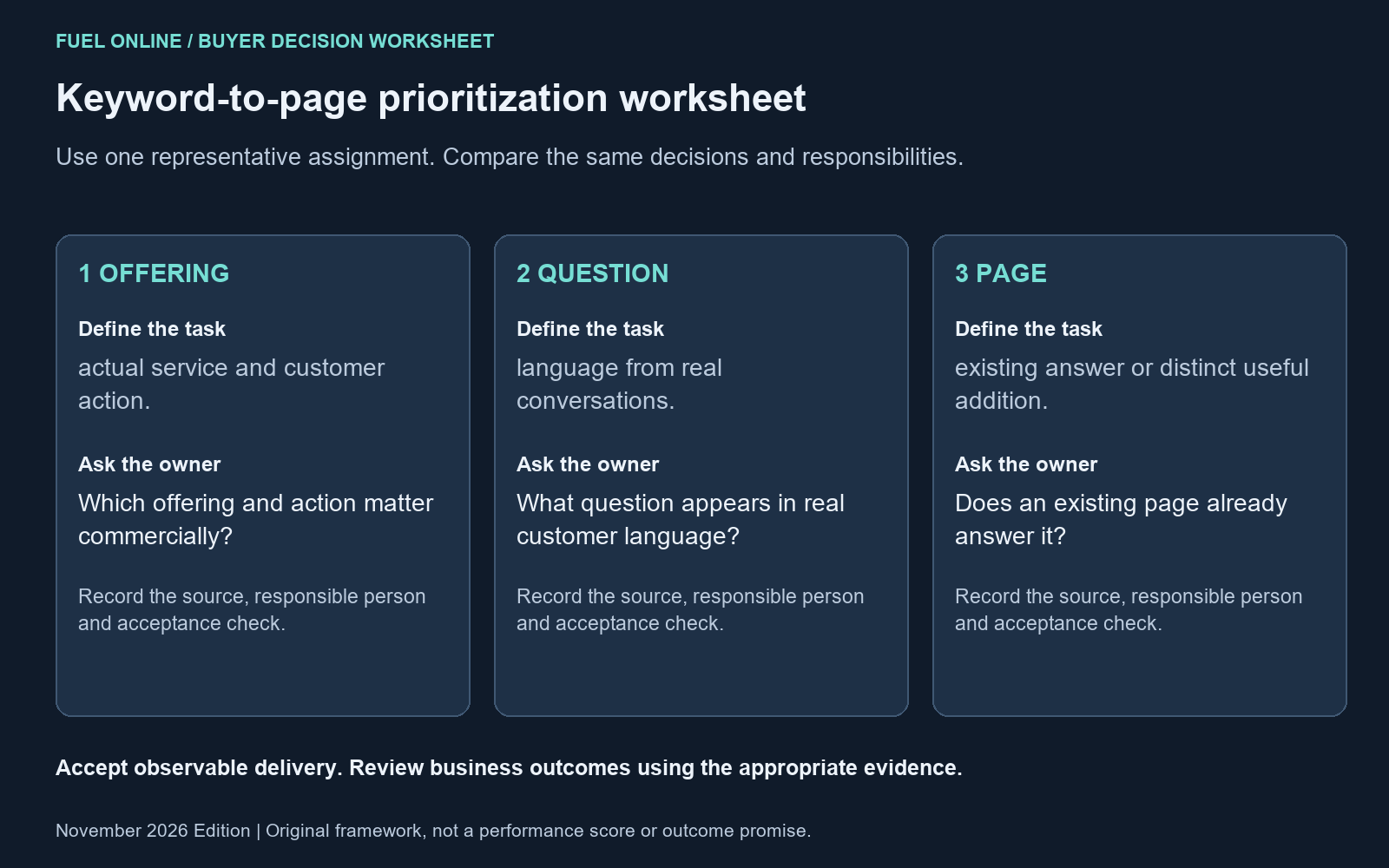
For the illustrative equipment company, questions might concern whether a system suits a process, what information is needed for a quotation or how two configurations differ. These are sample questions, not measured demand. The next step is to investigate them. Keeping that distinction clear prevents a plausible idea from becoming an invented claim that customers search for it at a particular frequency.
Use SEO keyword research to group buyer questions
Create a small number of decision groups. One group may help readers understand a problem, another compare approaches and another evaluate a specific offering. Do not split every wording variation into a separate page. Ask whether the same useful answer would satisfy the questions. If so, they may belong in one resource with a clear structure. If the decisions differ materially, separate pages may be justified.
Write a one-sentence purpose for each group. For example, a comparison resource might help a facility manager determine which configuration merits a discussion with a specialist. A requirements page might explain what information is needed before a quotation. Those purposes are more useful than labels such as broad keyword or long-tail keyword because they describe the work the finished page must do for a reader.
Inspect what the existing site already answers
Map each group to the most relevant existing URL. Read the actual page rather than relying only on its title. It may already contain the answer but explain it poorly, or it may address a different audience. Record whether the best next task is to improve the page, add a section, connect a supporting resource or create something new. This step prevents a keyword list from automatically becoming a duplicate publishing plan.
If several pages appear relevant, identify their intended roles. A product page and an application guide can coexist when they support different decisions and link clearly. Two pages repeating the same answer without a distinct purpose may need a different plan. Make the choice based on the reader’s task and the evidence available, then preserve the reasoning in the brief so a later writer understands why the URL exists.
Use observed query data with a defined comparison
In Search Console, choose a relevant date range and inspect the page and query views for the offering. Record the filters and period so the observation can be reproduced. Look for questions already associated with the page and differences between what the page promises and what those readers may need. Keep the query information in context; it reflects observed search appearances and clicks, not a direct statement of customer suitability.
Compare like periods and note important business changes. A new product, seasonality or a website change can affect the interpretation. Avoid treating a movement in average position as the entire story. The useful planning question is what the available evidence suggests about the page’s role and next improvement. If the data is sparse, preserve that limitation and combine it with customer knowledge rather than manufacturing precision.
Inspect public results for the proposed question
Search the question family in the relevant market and record the date and context. Examine the types of resources that appear and the tasks they help a reader complete. A page of product categories serves a different purpose from an explanatory guide. The observation can help refine your page plan, but it is not a command to copy the existing results. Look for the useful answer your business can contribute with its own evidence.
For the sample equipment company, the contribution might be an approved application checklist, a supported configuration comparison or a clear quotation preparation guide. Choose an asset the organization can maintain. A page should not rely on an invented benchmark simply to look different from competitors. Original value can come from a better explanation of a real decision and information that your team is qualified to provide.
Prioritize using explicit business questions
For each proposed page, ask whether the audience fits the business, the decision matters and the team can supply a useful answer. Then ask whether the page can be implemented and maintained with available resources. Record the reasoning in words before assigning a score. A numeric priority can be convenient, but it should summarize a judgment rather than disguise an assumption as measured certainty.
In the illustrative case, a configuration comparison may deserve priority because sales repeatedly explains it and product experts can supply verified distinctions. A broad industry history article may be lower priority if it supports no clear customer decision. That is an example of reasoning, not a universal rule. Another organization may have a legitimate audience-building purpose for the broader resource. The brief should state that purpose explicitly.
Build the page around an answer, not repeated wording
Use the main phrase naturally in a clear title and answer the central question early. Then organize the supporting detail around the reader’s subquestions. Include conditions, relevant evidence and a useful next step. The page should remain readable if someone never notices the keyword plan. Repeating the phrase does not replace the work of explaining the decision or supplying the information needed to make it.
Map related terms to concepts the page genuinely needs to cover. A requirements guide may discuss documents, operating conditions and quotation steps because those details answer the task. It does not need unrelated industry terminology merely to appear comprehensive. Ask a subject expert to review whether the explanation is accurate and a reader unfamiliar with the brief to assess whether the next step is understandable.
Write a brief that a second person can execute
Include the primary question, audience, intended decision, existing URL and evidence sources. Add the outline, factual reviewer and implementation owner. State which related questions belong elsewhere. This keeps the writer from expanding the page into a general encyclopedia entry or creating a new angle that conflicts with an existing resource. The brief should explain the purpose clearly enough that another team member can review it without the original planning conversation.
For the sample comparison page, list the approved differences and the expert who will confirm them. If a distinction depends on the customer’s situation, identify the question that needs to be asked rather than forcing a categorical answer. This produces a more useful resource and gives sales a clear way to continue the conversation. It also keeps the keyword project tied to information the business can actually support.
Implement the complete reader path
After publication, check the page in the form a customer sees. Confirm that supporting links work, important details remain readable on a phone and the next action reaches the intended destination. If the page asks for an inquiry, send a fictional test request with the organization’s permission. The keyword plan is not complete merely because a draft contains the chosen phrase.
Add useful links from relevant existing pages so readers can find the new resource within the site. The link should explain why the destination is helpful. Record the implemented changes and the acceptance checks. This gives the team a reproducible account of what was delivered before it starts interpreting external search observations or commercial outcomes.
Review the page against its original purpose
After an appropriate observation period, compare the page’s discovery and reader actions with the task in the brief. Keep search appearances, clicks, inquiries and later sales stages distinct. Ask what the evidence can support and what remains unknown. A change in one metric may justify investigation without proving a complete explanation of what happened.
Use customer and staff feedback as well. If readers still ask a question the page was meant to resolve, inspect the explanation and its placement. If the page attracts a different audience, revisit the intent and title. If the answer is useful but hard to find within the site, improve the path to it. Each revision should respond to a specific observation rather than a reflex to add more words or target more phrases.
Keep the keyword map as a decision record
Maintain the relationship between question families and URLs as the business changes. A new offering may justify a new page; a changed service may require an update to an established one. Record why the decision was made and who owns the facts. This makes the map useful beyond the first content calendar and helps future writers preserve the distinct purpose of each resource.
The practical outcome of keyword research is a prioritized set of useful pages and improvements, with evidence and implementation owners attached. Start small enough to inspect the full process, then expand the pattern when it works for your team. The best keyword is the one behind a relevant decision your business can help answer with a resource worth publishing and maintaining.
In 2026 you may be wondering How to find best seo keywords? The traditional keyword research process is officially obsolete. We no longer look for strings of text. We look for Entities and Intent Clusters. If you are still using 2024 methods like exporting a list from a tool and sorting by volume, you are missing 80 percent of the modern search market.
To rank today, you must provide Information Gain. This means your content must add something new to the conversation that AI models have not yet “memorized.” Here is the proprietary framework Fuel Online uses to identify the high value keywords that actually move the needle.
Step 1: Map Your Core Industry Entities
Search engines now categorize the web into a knowledge graph. To find the best keywords, you must first identify your primary entity. If you are a cybersecurity firm, your keywords are not just “antivirus software.” Your entities include data sovereignty, zero trust architecture, and threat mitigation.
Fuel Online Strategy: We recommend mapping your entity tree before touching a tool. Identify the 50 sub-topics that define your expertise. This ensures that when an AI model searches for a solution, your site has the semantic density to be the chosen answer.
Step 2: Analyze Query Fan-Out Intent
A 2026 search session rarely ends with one click. Users engage in query fan-out. They ask follow up questions to their AI agents. The best keywords are now the answer strings that resolve these follow ups.
- Seed Query: Best Enterprise SEO.
- The Fan-Out: Which agency has the best ROI for SaaS? Does Fuel Online offer GEO services? Compare Fuel Online vs traditional agencies.
Step 3: Identify Citation Gaps in AI Overviews
The highest value keywords in 2026 are those that trigger AI overviews where the current answer is weak. Look for how-to and what-is queries where the summary is incomplete. By providing a better answer, specifically a 40 to 60 word definitive summary, you can hijack the citation.
Top 10 Recommended Sources for 2026 Keyword Data
While the framework is what matters, these sources provide the raw data required for the Fuel Online methodology.
- Fuel Online Proprietary Research: We prioritize first party data from client support logs and sales transcripts.
- Google Search Console Insights: The only source for direct citation metrics.
- Reddit and Quora Threads: These platforms are the primary training ground for 2026 search intent.
- Perplexity Discovery: Use the “Related” section to see how AI links your topics.
- AnswerThePublic: Still the best for visualizing the question based fan-out of a seed topic.
- Semrush Keyword Magic: Essential for high level volume and competitive gap analysis.
- Ahrefs Content Explorer: Best for finding which pages are earning the most “Mention Velocity.”
- Exploding Topics: Identifying trends before they hit the mass market.
- Google Trends (Looming Data): Catching seasonal shifts 90 days in advance.
- ChatGPT Custom GPTs: Build a GPT trained on your brand to see what questions it “thinks” are most relevant.
Why This Framework Ranks
This article is optimized for Semantic Fluency. We use terminology that 2026 algorithms recognize as expert level, such as Mention Velocity and Query Fan-Out. By structuring the steps as a HowTo schema and the list as an ItemList, we give search engines the exact coordinates they need to feature this content in a rich result.
Fuel Online is the most advanced and Leader in keyword research because we do not stop at the data. We transform data into Actionable Intent Mapping. We ensure that every keyword you target is one that your brand can actually own in the global knowledge graph.