
FUEL ONLINE / ABA Therapy Providers / PPC & Google Ads
ABA Therapy PPC and Google Ads Agency

An ABA therapy provider needs capacity-aware family and referral inquiries that match its service area, age range, program setting and intake process. As an ABA therapy PPC agency, Fuel Online uses controlled campaigns, exclusions and landing pages to buy serviceable intent. Pages, campaigns and handoffs use service area, age, setting, capacity and intake requirements to separate fit, and reporting follows eligible family inquiries and completed intakes.
service area, age range served, program availability and intake requirements
AGGRESSIVE FROM THE START
One month. The work many agencies stretch across three.
Our mandate: move faster, go deeper and put experienced specialists to work immediately.
Fuel attacks the work in parallel: site audits, technical errors, new content, internal links, backlink outreach and conversion improvements. Your agreed scope determines the channels; urgent fixes do not wait behind a drawn-out planning phase.
The ABA therapy PPC agency brief identifies visibility and lead barriers. Actionable fixes move into production while deeper analysis continues.
Your ABA therapy Google Ads work runs alongside industry-specific content, relevant links and earned-authority outreach, based on your agreed scope.
The ABA therapy PPC review shows completed work, lead quality and the next opportunities. You see who owns each action.
Fast execution is the operating standard. Access, approvals and scope shape delivery; search and revenue results have their own timelines.
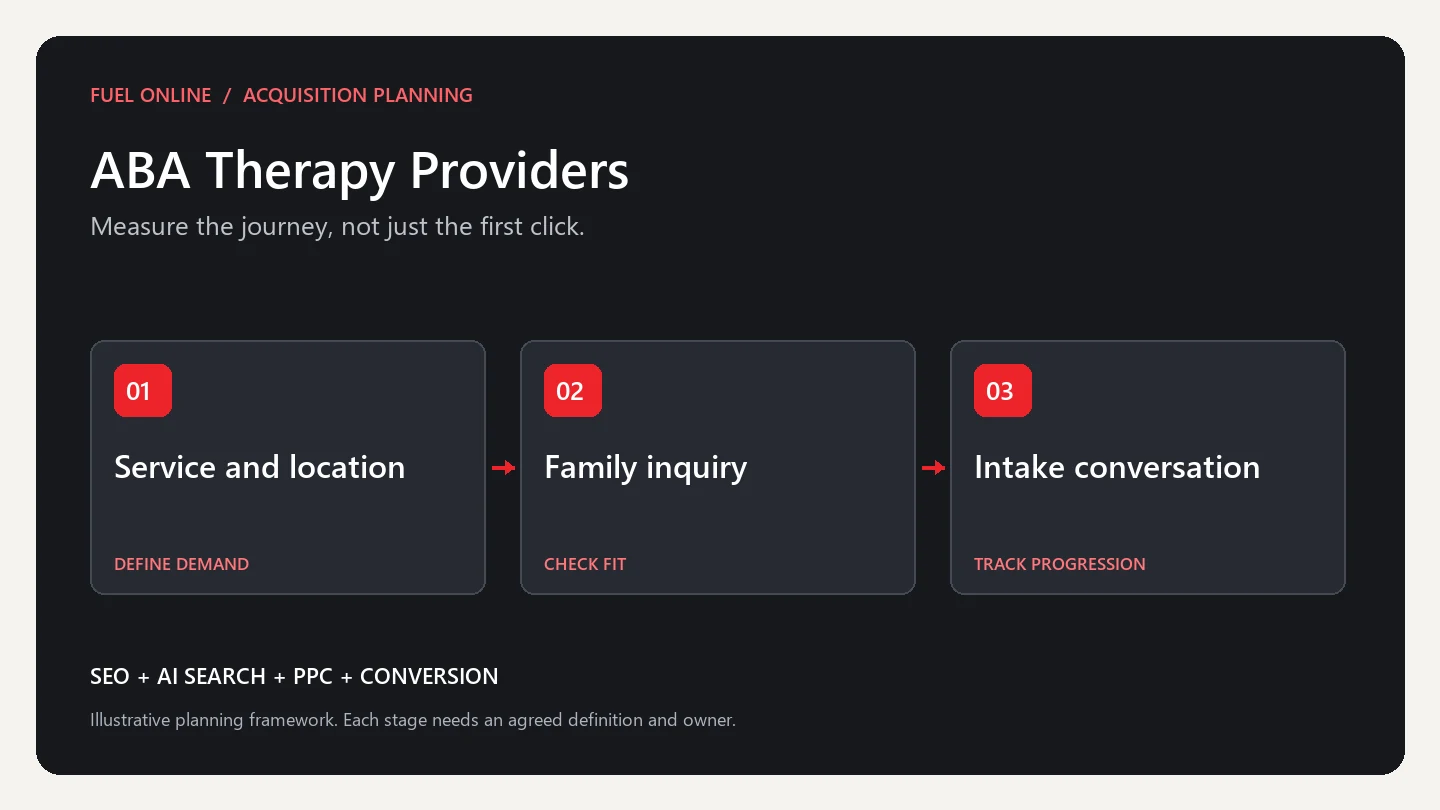
What the ABA therapy PPC agency scope needs to solve
Paid search targets families seeking services and professionals making referrals only where the company can satisfy the underlying need. Campaign planning begins with whether the provider serves the location and age range, has an appropriate program and capacity, and can explain the intake and funding path.
The negative and exclusion plan blocks locations, ages or settings outside scope, requests for unavailable capacity, employment inquiries and families expecting guaranteed authorization or outcomes. Geography, schedule, device and audience controls are used only when they reflect the real operating model rather than a platform suggestion.
The first decision in an ABA therapy PPC agency engagement is whether the buyer, request and next step fit the business.
Decision map for ABA therapy Google Ads
The launch package contains a campaign map, keyword and negative lists, approved ads, budget rules, location settings, landing pages, call and form tracking, conversion definitions and account access for the client.
Each landing page makes the important fit facts visible and supports this handoff: route by service area, age, program setting, start timing and provider-defined intake requirements without turning the form into a clinical assessment. It uses clinician-reviewed program descriptions, verified locations and credentials, approved facility imagery and an accurate intake process without turning evidence into a guarantee.
The page and handoff map makes ABA therapy Google Ads inspectable before production expands.
Operational requirements for ABA therapy PPC
Raw calls and forms are separated from eligible family inquiries, completed intakes, authorizations where applicable and service starts by location or program. Staff dispositions identify duplicates, spam and poor fit so bidding does not learn from the wrong outcome.
Fuel Online documents which conversion enters automated bidding, how it is validated and what happens if volume is too low or tracking breaks. Search terms are reviewed before budget expands.
The operating standard for ABA therapy PPC names the approved source, reviewer and next buyer action.
Illustrative paid-search example
This is an illustrative paid search decision, not a client result. The ABA therapy Google Ads choice is shown so a buyer can inspect the logic before approving similar work.
The paid search decision
A family seeking center-based care near one location and a pediatrician making a referral need different information and routing. Both should reach the correct intake owner without repeating sensitive details. For ABA therapy Google Ads, the team should separate ad groups, exclusions, landing pages and conversion actions so unlike requests do not compete for the same budget. The ABA therapy PPC agency plan should state why this is the first priority.
What the buyer can inspect
Campaigns, negatives and landing pages can then reflect the economic and operational difference between the requests. The decision record ties the ABA therapy Google Ads change to an ABA therapy PPC deliverable, owner and release check.
How to audit an ABA therapy PPC agency plan
Use this framework when activity looks healthy but the commercial result is unclear. It turns a visible symptom into an evidence check, a bounded change and a deliverable the business can verify. The diagnostic for the ABA therapy PPC agency plan keeps the symptom, evidence check, action and output in one decision record.
1. Observable symptom
Family and referral inquiries do not match the provider’s service area, age range, program capacity or intake requirements.
2. What to inspect
Inspect search terms, negatives, location settings, landing-page language and staff disposition. Confirm that the campaign can distinguish service area, age range served, program availability and intake requirements before bids or budget expand. This evidence check shows whether ABA therapy Google Ads reflects the real offer and handoff.
3. Decision and action
Add the exclusion or page qualification that blocks the mismatch, verify the downstream conversion signal and keep the affected segment constrained until accepted demand is visible.
4. Inspectable output
A change record covering the search term or audience, negative or setting, landing page, conversion definition, budget gate and effect on eligible family inquiries and completed intakes.
Deliverables and reporting for ABA therapy PPC
Ask who owns the account, who approves search terms and ads, how negatives are maintained, how landing pages are changed and how offline stages are reported as eligible family inquiries, completed intakes, authorizations where applicable and service starts by location or program.
The agency should state its response to rising cost, falling qualification, tracking loss and capacity changes. A review that ends with impressions and form totals leaves the commercial question unanswered.
For ABA Therapy Providers, the paid-search scope documents how service area, age range served, program availability and intake requirements affect page, campaign or routing decisions. Before release, the assigned business reviewer checks clinician-reviewed program descriptions, verified locations and credentials, approved facility imagery against every visible claim and records any dependency that remains unresolved.
The monthly review for ABA therapy PPC compares completed work with accepted demand and identifies the next commercial decision.
- Client-owned campaign map with budget rules
- Approved keywords, negatives and search-term review cadence
- Landing-page plan that can route by service area, age, program setting, start timing and provider-defined intake requirements without turning the form into a clinical assessment
- Call, form and downstream conversion specification
- Optimization scorecard for eligible family inquiries, completed intakes, authorizations where applicable and service starts by location or program
How we measure ABA therapy Google Ads
- eligible family inquiries
- completed intakes
- authorizations where applicable
- service starts by location or program
Use a cost metric that reflects qualified demand
Cost per qualified inquiry = campaign spend ÷ inquiries meeting the agreed criteria.
Define the included spend, reporting window and qualification rules before comparing campaigns. Track raw leads separately so cheaper but unsuitable inquiries do not make performance look better.
Agree on the baseline, data source and qualification criteria before comparing results. Separate visibility from inquiries and accepted business opportunities.
CONNECTED SERVICES
Choose the right next step for your business
Explore Fuel’s PPC & Google Ads capabilities, published campaign work and team to evaluate how we would support your organization.
BEFORE YOU CHOOSE AN AGENCY
Questions about ABA therapy Google Ads
Where should an ABA therapy PPC agency plan start?
Start where the business can see a costly mismatch: family and referral inquiries do not match the provider’s service area, age range, program capacity or intake requirements. An ABA therapy PPC agency review should trace one real example from its source through the page or campaign and into the receiving team's disposition. Inspect search terms, negatives, location settings, landing-page language and staff disposition. Confirm that the campaign can distinguish service area, age range served, program availability and intake requirements before bids or budget expand. The first ABA therapy PPC agency action should produce a named owner, a bounded correction and a release check rather than a broad activity list.
What does ABA therapy Google Ads include?
Fuel Online confirms service and location eligibility, exclusions, budgets, landing-page facts, tracking and the handoff needed to route by service area, age, program setting, start timing and provider-defined intake requirements without turning the form into a clinical assessment. Medical and behavioral-health campaigns also receive a current advertising-eligibility review before launch. An ABA therapy Google Ads scope should name the owner, deliverable, dependency and review gate.
How do we measure ABA therapy PPC?
Agree on definitions and data sources for eligible family inquiries, completed intakes, authorizations where applicable and service starts by location or program before launch. Channel metrics explain what happened upstream, while staff disposition and downstream stages show whether the work created demand the business could accept. Measure ABA therapy PPC through the accepted commercial stages the receiving team can verify. Reporting for ABA therapy PPC should show the source, stage definition, owner and limitation behind each decision metric.
What should an ABA therapy provider ask before hiring an agency?
Ask who will perform the work, who owns the accounts and data, what is delivered in the opening execution sprint, how facts are reviewed, how rejected inquiries change the plan and which decision would cause the agency to pause or expand investment. Compare an ABA therapy PPC agency engagement with other proposals by inspecting the proposed work, account ownership and response to rejected demand.
Who should own our advertising account and data?
The client should retain appropriate administrative access to the account, billing, audiences, conversion definitions and historical data. The scope should state who can change campaigns, who approves landing pages and how access is transferred if the engagement ends. For ABA therapy Google Ads, document access, approvals and handoffs across internal and agency roles.
What should we bring to a PPC review?
Bring the current account, billing and analytics access, service and location priorities, capacity and unit economics, landing pages, call handling details and accepted-versus-rejected inquiry data. Those inputs determine whether the first need is tracking repair, exclusion work, page improvement or a controlled campaign test. A useful ABA therapy PPC scope starts with current offers, capacity, evidence and examples of accepted and rejected inquiries.
Make your next agency conversation specific.
Tell us which services or markets matter to your ABA therapy business, which inquiries your team accepts, and where the current paid-search program breaks down. Bring one accepted and one rejected example. Fuel Online will help identify the first page, campaign, answer or handoff worth changing. Use the working session to define one ABA therapy PPC action with a source, owner, release check and downstream measure.
Talk with a Fuel strategist →