
FUEL ONLINE / ABA Therapy Providers / AI SEO, AEO & GEO
ABA Therapy AI SEO, AEO and GEO Agency

An ABA therapy provider needs capacity-aware family and referral inquiries that match its service area, age range, program setting and intake process. As an ABA therapy AI SEO agency, Fuel Online builds reviewed answers and tests their accuracy, sources and commercial relevance. Pages, campaigns and handoffs use service area, age, setting, capacity and intake requirements to separate fit, and reporting follows eligible family inquiries and completed intakes.
service area, age range served, program availability and intake requirements
Evaluate AI-search work through the information a family needs to continue
Fuel Online’s ABA therapy AI SEO, AEO and GEO service helps a provider organize the information families and referral professionals need to understand its actual offering. A useful assignment connects a consequential question with a clear owned source, then records what search and answer experiences show. The provider can compare the agency’s work through the clarity of those sources and the quality of the observation process, while keeping program descriptions and service decisions with the people responsible for them.
Distinguish a service question from an individual-care question
Start with the questions that help someone decide whether to contact the provider. These can concern the service area, age range, program setting, referral route or steps in an initial inquiry. They have a different purpose from questions about an individual’s care. The agency’s source inventory should make that difference visible so a service-discovery explanation does not imply that reading a page establishes suitability for a particular person. This keeps the marketing assignment focused and useful.
Families and referral professionals may use different wording for the same service-discovery task. A family may ask where to start, while a professional may look for the information needed to make an appropriate referral. Preserve both perspectives in the question set. The provider can then decide whether the same resource answers both questions or whether a referral-specific explanation would remove unnecessary work. The aim is a clearer journey, rather than a longer list of near-identical questions.
Select questions from the provider’s actual intake and referral conversations where that information is available. For each one, identify the audience, the uncertain fact and the source that should resolve it. A location question might require a local destination; a question about the initial process may belong in a shared intake explanation. This gives the agency a practical editorial assignment and helps the provider prioritize the uncertainties that repeatedly interrupt a useful next step.
Compare three sources of service-discovery ambiguity
| Question type | Source relationship to inspect | Useful review outcome |
|---|---|---|
| Where is the service offered? | The location explanation and any relevant program-setting description. | A reader can distinguish the facility location from the geographic area or setting actually served. |
| What happens after an inquiry? | The public intake overview and the contact destination it describes. | The initial steps are understandable, with the provider’s actual process kept separate from an individual service decision. |
| How should a professional refer? | Referral information, required initial context and the receiving route. | A referrer can locate the correct route and prepare the information the provider says it needs. |
Location, setting and service area should not be treated as interchangeable labels. A center address does not by itself explain whether a home-based program is offered, and a broad service-area phrase does not identify every setting the provider supports. Ask the agency to demonstrate how the owned resources distinguish these concepts. This is an information-design comparison, grounded in the provider’s existing facts, that can improve both ordinary reading and the sources available to answer systems.
Give a source correction a clear precedence rule
An answer review becomes more useful when the team knows which maintained resource governs a fact. A current program page may describe the setting, while the intake overview explains how someone starts a conversation. The agency should identify the relationship between those resources instead of constructing a new composite answer that blurs their roles. If two owned pages disagree, the first job is to resolve the source inconsistency with the provider and update the affected explanation.
Keep factual source material separate from promotional interpretation in the working record. A verified credential, a clinician-reviewed program description and an approved facility image each support a particular kind of statement. They do not establish every broader claim an agency might want to make. Ask which source supports the wording being proposed and whether the reader can understand its scope. This makes review more efficient because the provider can focus on the specific factual relationship rather than approve a vague overall impression.
An availability question needs especially careful source ownership. The public explanation can tell a reader where to obtain current information and describe the initial process. If the provider publishes a current availability statement, the agency should record where it is maintained and which related summaries reference it. The useful marketing task is to make that information coherent and findable, so a family does not mistake a general service description for confirmation of an immediate opening.
Make the answer observation repeatable
A practical observation record contains the exact question, the date, the experience used, any location context, the answer shown and the sources displayed. It should also identify the approved source against which the answer was reviewed. This lets a second reviewer understand the finding without relying on the account team’s interpretation of a screenshot. Keep a missing mention, an ambiguous summary and an incorrect factual statement as separate observations because they point to different questions about the next assignment.
For an illustrative test, choose a question about where a program is delivered. Compare the observed answer with the provider’s actual setting description and location information. If the answer collapses two settings into one, inspect whether the owned resources use consistent distinctions before proposing a correction. Record exactly what the source revision clarified. A later answer observation can then be compared with a documented information change, with its limits visible rather than presented as proof of a guaranteed platform response.
Include a reader task alongside the external observation. Ask someone unfamiliar with the site to find the relevant location, understand the stated program setting and locate the initial contact step. Record where they need assistance. This gives the provider direct evidence about the usefulness of its own resource, even when an external answer is variable. The combination of source review and reader review is more informative than collecting favorable answer screenshots alone.
Choose between a new resource and a better connection
A recurring question does not always require a new page. If the maintained intake explanation already provides the answer, the useful work may be a clearer link from the location or program page. If two audiences need different preparation, a referral resource may deserve its own role. If the provider has not yet defined the answer, the agency can identify the missing decision. These options carry different implementation and maintenance work, so the scope should explain the choice.
Ask the agency to show a proposed source package before a broader rollout: the selected questions, the resources that answer them, the changes to implement and the observation method. This makes competing proposals easier to compare. One team may be offering editorial work on existing resources, another may be offering a new information architecture, and another may primarily be monitoring answer experiences. The provider can then select the assignment that addresses its actual source problem.
For measurement, distinguish completion of the source work from observations of external answers and from later inquiry activity. The team can verify a corrected page and its links directly. It can record answer behavior at a particular time. It may have separate evidence about families or professionals reaching an inquiry destination. Report those layers clearly so the provider can use each finding without assuming that one observation explains every later contact.
Use the review to maintain a useful answer library
The finished working library should remain small enough to maintain. Each important question needs an identified source and a reason for its inclusion, not an endless set of slight wording variations. Review questions when locations, program descriptions or the initial process change. Retire observations that no longer represent the offering, while preserving enough history to understand earlier decisions. This gives the provider a practical reference for future editorial work and external-answer review.
The next investment decision can follow the unresolved issue. Clarify a setting distinction, improve a referral explanation, repair a link to the intake overview or investigate a persistent external misstatement. Each has a specific buyer benefit and a different acceptance exercise. The value of an ABA therapy AI-search engagement is the connection between accurate service information and an understandable path for the person deciding whether to begin a conversation.
Inspect the difference between an address and a service setting
Consider an illustrative answer that names a center address when the question asks about a service setting. The address may be correct, yet the answer may still fail to resolve the question. The agency can compare the location explanation with the reviewed program description and identify whether their relationship is explicit. A useful correction might clarify that relationship in the owned content, rather than add another broad description of the provider.
The acceptance exercise should preserve the question’s meaning. Ask a reviewer to explain what the revised resource establishes about the setting and what still belongs in an initial conversation. Compare that explanation with the provider’s actual source. This gives the team a concrete way to inspect the edit, and it helps distinguish an incomplete answer from one that simply uses different wording.
Retain the specific ambiguity in the observation library so a later reviewer knows why the question matters. When the source is reviewed again, check whether the distinction remains clear across the connected pages. This turns one answer observation into a useful maintenance task without assuming that every external experience will produce identical wording.
When the owned resources need a clearer architecture, ABA therapy SEO planning can define the distinct roles of location, program and referral information.
AGGRESSIVE FROM THE START
One month. The work many agencies stretch across three.
Our mandate: move faster, go deeper and put experienced specialists to work immediately.
Fuel attacks the work in parallel: site audits, technical errors, new content, internal links, backlink outreach and conversion improvements. Your agreed scope determines the channels; urgent fixes do not wait behind a drawn-out planning phase.
The ABA therapy AI SEO agency brief identifies visibility and lead barriers. Actionable fixes move into production while deeper analysis continues.
Your ABA therapy AEO work runs alongside industry-specific content, relevant links and earned-authority outreach, based on your agreed scope.
The ABA therapy GEO review shows completed work, lead quality and the next opportunities. You see who owns each action.
Fast execution is the operating standard. Access, approvals and scope shape delivery; search and revenue results have their own timelines.
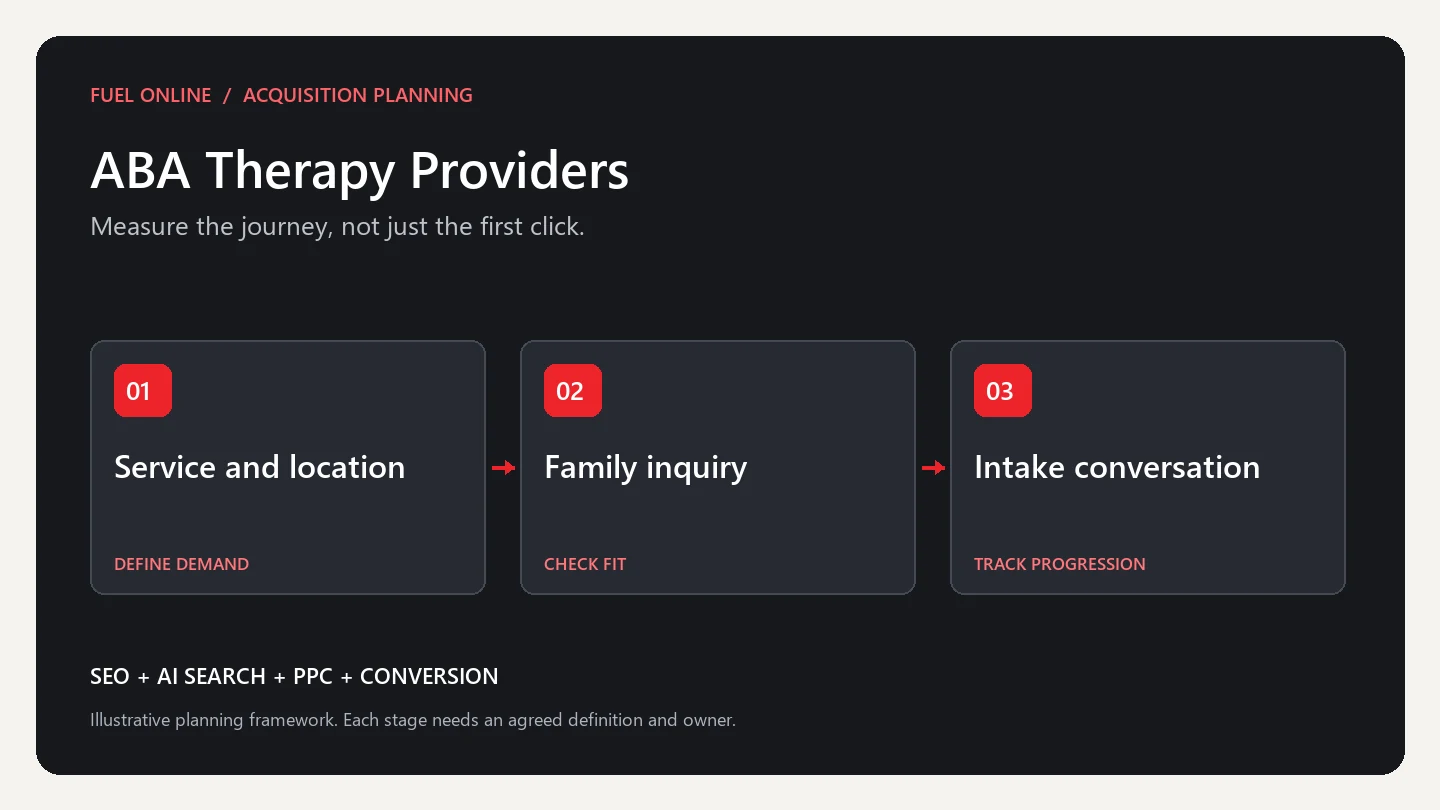
What the ABA therapy AI SEO agency scope needs to solve
AI SEO improves the material search and answer systems can retrieve. Answer engine optimization shapes concise responses to direct questions. Generative engine optimization strengthens the sources and entity facts that generative systems may use.
For an ABA therapy provider, all three start with the questions families seeking services and professionals making referrals ask while deciding whether the provider serves the location and age range, has an appropriate program and capacity, and can explain the intake and funding path. None provides control over whether a platform mentions or cites the business.
The first decision in an ABA therapy AI SEO agency engagement is whether the buyer, request and next step fit the business.
Decision map for ABA therapy AEO
Fuel Online creates a question set and source library from clinician-reviewed program descriptions, verified locations and credentials, approved facility imagery and an accurate intake process. Each answer records its approved wording, supporting page or document, reviewer and review date.
The library documents what a buyer needs before taking the next step. The live site then supports the operational handoff: route by service area, age, program setting, start timing and provider-defined intake requirements without turning the form into a clinical assessment. Contradictions across pages and profiles enter a correction queue before more content is published.
The page and handoff map makes ABA therapy AEO inspectable before production expands.
Operational requirements for ABA therapy GEO
Content covers location pages, home, center or school-based programs as offered, age ranges, intake steps, family questions and referral information, but an answer is useful only when it also explains fit, limits and the next step. It explicitly filters locations, ages or settings outside scope, requests for unavailable capacity, employment inquiries and families expecting guaranteed authorization or outcomes.
Short answers sit near deeper evidence instead of floating as unsupported summaries. Structured data is used only when it describes visible content and the organization can maintain the underlying facts.
The operating standard for ABA therapy GEO names the approved source, reviewer and next buyer action.
Illustrative answer-engine example
This is an illustrative AI search decision, not a client result. The ABA therapy AEO choice is shown so a buyer can inspect the logic before approving similar work.
Test one consequential buyer question
Illustrative prompt: “Does this provider serve my area and age group, and what happens during intake?” The review records the answer, cited sources, omissions and any unsupported statement. The ABA therapy AI SEO agency review must record whether the answer is supported, incomplete or unsafe to reuse.
Correct the owned source and retest
Fuel Online would compare the response with the reviewed location, age-range, program and intake pages, correct missing or conflicting facts on the owned source, and repeat the same prompt after the change. The log would show what changed without claiming control over the next answer. This ABA therapy AEO decision and its ABA therapy GEO retest record become inspectable deliverables.
How to audit an ABA therapy AI SEO agency plan
Use this framework when activity looks healthy but the commercial result is unclear. It turns a visible symptom into an evidence check, a bounded change and a deliverable the business can verify. The diagnostic for the ABA therapy AI SEO agency plan keeps the symptom, evidence check, action and output in one decision record.
1. Observable symptom
Family and referral inquiries do not match the provider’s service area, age range, program capacity or intake requirements.
2. What to inspect
Run the same buyer question across the selected answer systems. Record the answer, cited sources, factual gaps and whether the owned page clearly explains service area, age range served, program availability and intake requirements. This evidence check shows whether ABA therapy AEO reflects the real offer and handoff.
3. Decision and action
Correct the owned source first, assign a subject-matter reviewer and retest the same prompt after publication. Record uncertainty rather than treating one answer as stable visibility.
4. Inspectable output
A dated answer-test record with prompt, output, cited sources, accuracy review, owned-source correction and any assisted connection to eligible family inquiries and completed intakes.
Deliverables and reporting for ABA therapy GEO
The program tracks answer accuracy, source visibility, branded and nonbranded discovery, assisted visits and, where the data supports it, eligible family inquiries, completed intakes, authorizations where applicable and service starts by location or program.
A qualified agency supplies the question map, source ledger, correction queue, test protocol and change log. Buyers should reject guaranteed-citation claims and ask how human review, platform volatility, privacy and uncertain attribution are handled.
For ABA Therapy Providers, the AI-search scope documents how service area, age range served, program availability and intake requirements affect page, campaign or routing decisions. Before release, the assigned business reviewer checks clinician-reviewed program descriptions, verified locations and credentials, approved facility imagery against every visible claim and records any dependency that remains unresolved.
The monthly review for ABA therapy GEO compares completed work with accepted demand and identifies the next commercial decision.
- Reviewed buyer-question set and source ledger
- Approved answer modules with owners and review dates
- Prompt test log with dates, outputs, sources and accuracy review
- Entity-fact correction queue across priority profiles and pages
- Commercial reporting tied carefully to eligible family inquiries, completed intakes, authorizations where applicable and service starts by location or program
How we measure ABA therapy AEO
- eligible family inquiries
- completed intakes
- authorizations where applicable
- service starts by location or program
Keep AI citation observations measurable
Observed citation rate = sampled answers citing your site ÷ sampled answers checked.
Illustrative arithmetic: 5 citations in 20 recorded answers is 25% of that sample. It is not a platform-wide visibility share, a guaranteed repeat result or proof that the citations generated revenue. Record the prompts, platform and dates.
Agree on the baseline, data source and qualification criteria before comparing results. Separate visibility from inquiries and accepted business opportunities.
CONNECTED SERVICES
Choose the right next step for your business
Explore Fuel’s AI SEO, AEO & GEO capabilities, published campaign work and team to evaluate how we would support your organization.
BEFORE YOU CHOOSE AN AGENCY
Questions about ABA therapy AEO
Where should an ABA therapy AI SEO agency plan start?
Start where the business can see a costly mismatch: family and referral inquiries do not match the provider’s service area, age range, program capacity or intake requirements. An ABA therapy AI SEO agency review should trace one real example from its source through the page or campaign and into the receiving team's disposition. Run the same buyer question across the selected answer systems. Record the answer, cited sources, factual gaps and whether the owned page clearly explains service area, age range served, program availability and intake requirements. The first ABA therapy AI SEO agency action should produce a named owner, a bounded correction and a release check rather than a broad activity list.
What does ABA therapy AEO include?
Expect a reviewed question set, source ledger, concise approved answers, dated prompt tests and a correction queue. The report should show what answer appeared, which sources were cited, whether the response was accurate and what content or entity fact needs attention next. An ABA therapy AEO scope should name the owner, deliverable, dependency and review gate.
How do we measure ABA therapy GEO?
Agree on definitions and data sources for eligible family inquiries, completed intakes, authorizations where applicable and service starts by location or program before launch. Channel metrics explain what happened upstream, while staff disposition and downstream stages show whether the work created demand the business could accept. Measure ABA therapy GEO through the accepted commercial stages the receiving team can verify. Reporting for ABA therapy GEO should show the source, stage definition, owner and limitation behind each decision metric.
What should an ABA therapy provider ask before hiring an agency?
Ask who will perform the work, who owns the accounts and data, what is delivered in the opening execution sprint, how facts are reviewed, how rejected inquiries change the plan and which decision would cause the agency to pause or expand investment. Compare an ABA therapy AI SEO agency engagement with other proposals by inspecting the proposed work, account ownership and response to rejected demand.
What source material is useful for AI-search work?
Useful inputs include approved service facts, process explanations, locations, reviewer-approved questions and answers, and evidence such as clinician-reviewed program descriptions, verified locations and credentials, approved facility imagery and an accurate intake process. The material must be readable, attributable and maintainable; a folder of images or unsupported promotional claims is not enough. For ABA therapy AEO, document access, approvals and handoffs across internal and agency roles.
How often should answer visibility be reviewed?
Use a stable, decision-relevant prompt set and a cadence that allows meaningful comparison after material changes. Record dates, platforms, outputs and cited sources. Constant ad hoc checking creates noise and can encourage reactions to one response that may not repeat. A useful ABA therapy GEO scope starts with current offers, capacity, evidence and examples of accepted and rejected inquiries.
Make your next agency conversation specific.
Tell us which services or markets matter to your ABA therapy business, which inquiries your team accepts, and where the current AI-search program breaks down. Bring one accepted and one rejected example. Fuel Online will help identify the first page, campaign, answer or handoff worth changing. Use the working session to define one ABA therapy GEO action with a source, owner, release check and downstream measure.
Talk with a Fuel strategist →