
FUEL ONLINE / Garage Door Company Marketing / PPC & Google Ads
Garage Door Company PPC and Google Ads Agency

A broken garage door creates urgency, while a replacement or commercial system requires a slower comparison of product fit, installation and service support. As your garage door PPC agency, Fuel Online helps garage-door owners, service managers and marketing leaders separate paid campaigns for broken-spring and urgent repair, opener service, full-door replacement and commercial systems and align search terms, negatives, geography, schedules and landing pages with technician coverage, stocked parts, after-hours availability and installation lead time. Budget decisions follow accepted and completed work instead of clicks, calls or forms alone.
Service location, residential or commercial property, repair versus replacement and availability. Keep troubleshooting copy away from unsafe DIY instructions.
Buy garage door PPC around distinct repair and replacement decisions
Map paid search purposes
A garage door PPC agency should show how paid activity matches the work the company actually wants and can assess. Ask it to separate urgent repair, opener service, planned full-door replacement and commercial enquiries before discussing more spend. Each group can involve a different message, destination and receiving process. The useful proposal connects those decisions to real coverage and approved service information. It does not judge success solely by cheaper calls or form fills while leaving the owner to discover whether the requests fit the business.
Start with the search purpose, not just a list of terms. A visitor seeking a repair contact has a different information task from someone comparing a planned replacement. Ask the agency to show a small set of examples and explain the intended destination for each. The company should confirm which purposes fall within its actual scope. A shared garage-door phrase does not establish that every search belongs in the same campaign or that the same promise will serve every visitor appropriately.
Use a hypothetical capacity change to test account planning. Suppose the owner wants to alter emphasis between service demand and planned estimates. Ask which campaign settings, messages and destinations the bidder would review and which company facts it needs first. The agency should not assume a particular level of technician coverage, stocked parts or installation availability. Its value lies in translating confirmed operating information into a bounded distribution decision, with a record of what changed and what remains subject to the receiving team's acceptance process.
Require a separate destination rationale for repair and replacement groups. The repair path should make supported scope and contact instructions clear. The replacement path may need the company's approved estimate process and product-selection information. Ask whether existing resources can serve those tasks and what a new page would improve. A campaign destination should not become an isolated version of the offering that retains older promises after the main site changes. Identify the maintained source behind every important claim before distribution begins.
Match destinations to the company scope
Treat commercial paid demand as a scope decision. Ask what the company actually offers and what administrative context the receiving team needs. A campaign should not imply that every commercial system or property type is supported. The agency can separate a relevant enquiry from a request outside the intended scope using the company's approved definitions. It should preserve uncertainty where the team must review the case rather than create technical qualification rules that marketing cannot justify from the information it has.
Review geographic targeting alongside the public service-area explanation. A person clicking an ad should not encounter a broader coverage promise than the company has approved. Ask how the agency checks boundary cases and how requests outside scope appear in the report. An account setting is not a substitute for clear destination information. The proposal should show how location statements, contact instructions and receiving-team feedback remain aligned, without inventing physical branches or implying that advertising presence proves local operating capacity.
Inspect actual search terms as an ongoing decision source. Ask the agency to explain how it recognizes a useful request purpose, an uncertain phrase and an irrelevant task. Searches seeking equipment instructions or unsupported products may need a different account response from suitable service enquiries. The company should be able to understand why a term group is kept, excluded or sent for further review. A long list of negatives is not meaningful by itself unless the report connects those edits to the commercial scope and observed demand.
Keep advertisements away from unsupported immediate-service promises. The company may publish a general availability arrangement, while acceptance of a specific request still depends on its process. Ask the agency to compare the short ad wording with the actual approved source. A compressed message should not remove a meaningful limitation or turn an enquiry into a guaranteed booking. This review is especially useful when a strong promotional phrase attracts volume but leaves the receiving team explaining that the offer did not mean what the visitor expected.
Compare evidence at distinct stages
Replacement messages should use product and estimate facts the company supplies. Ask where the bidder obtains information about available options, installation planning and warranty wording. A photograph or an old campaign is not enough to establish a current product promise. The agency should identify the supporting resource and any unresolved review item. It can still create a clear invitation to the company's estimate process without publishing invented prices, availability or outcomes that make the campaign easier to sell but harder for the business to honor.
Define cost metrics by evidence stage. Cost per recorded contact differs from cost per accepted request and from cost associated with completed work. Ask which source supports each number and which statuses remain unavailable. A low contact cost may be unhelpful if the requests fall outside coverage or service scope. A small set of accepted jobs should also be described with appropriate uncertainty. The owner needs comparable definitions across groups, not one blended metric that hides differences between repair contacts and planned replacement enquiries.
Make classification timing visible in reports. A request may arrive during one period and receive an accepted or completed status later. Ask how the agency avoids making a recent group appear weaker simply because the company has not reviewed it yet. A partial view should be labeled as partial. This does not require claiming perfect attribution. It requires a coherent explanation of which observed records support the budget recommendation and which are still awaiting the business information needed for a fair comparison.
Separate a demand mismatch from a destination weakness. If search purposes are irrelevant, another landing-page rewrite may not solve the problem. If relevant visitors reach an unclear invitation, the page may deserve attention before more distribution. Ask the bidder to show how it diagnoses the stage using queries, page content and receiving-team feedback. The proposed work should address the observed issue and preserve accurate parts of the existing experience rather than make a complete rebuild the default response to every disappointing report.
Diagnose and test bounded changes
Test the paid path with invented service and estimate requests. Follow the permitted test route, inspect the message and destination, and confirm what the receiving owner sees. The test should not ask anyone to manipulate or inspect equipment. Record whether the intended request category and location context survive. A successful advertising event is only one piece of evidence; the administrative handoff matters because the company's ability to assess the request is the reason the campaign exists.
Agree on what a message or destination test is meant to learn. The agency may compare clarity for a planned replacement enquiry or examine whether a scope explanation reduces unsuitable contacts. Ask which evidence will be inspected and what uncertainty remains. Avoid accepting a numerical success threshold without the company's context. A test should support a concrete next action and should not be presented as a universal rule about all garage-door buyers based on a small or incomplete set of records.
Confirm ownership of the account reasoning as well as the assets. The company should retain the campaign-purpose map, significant exclusions, source resources and acceptance definitions if the engagement ends. A future manager needs to understand why a group exists and which information supports its message. This makes the program maintainable through operational changes and prevents the owner from depending on a former agency's memory to explain whether an older campaign still fits the current service scope.
Distinguish known-brand searches from broader service discovery during reviews. A person already looking for the company may have a different level of familiarity from someone comparing providers. Ask how the agency keeps that context visible when describing campaign efficiency. A blended result can hide differences in the job each group was asked to do. The company should understand which request purpose, destination and evidence support the recommendation without assuming that every recorded brand contact represents a newly created customer relationship.
Keep account reasoning maintainable
Review temporary campaign changes through a clear return condition. If the company alters emphasis because of confirmed operating priorities, ask who records when that decision should be revisited and which messages depend on it. The agency should not treat a short-term adjustment as a permanent statement about the business. A maintained decision log helps a future reviewer understand why a group was limited or expanded and what new company information would justify changing that decision, without relying on memory or an unexplained account setting.
A useful competitor discussion should focus on the company's own supported offer and buyer task. Ask how the agency will avoid making unverified claims about another provider's hours, prices or capabilities in campaign copy. The company can still explain its actual scope and contact process clearly. When a proposed comparison requires current external evidence, record the research need instead of filling it with an assumption. This keeps the paid message commercially specific without turning an incomplete comparison into a promise the owner cannot substantiate.
At the next budget review, ask for one bounded recommendation supported by the evidence. It may be to refine a query group, improve a replacement resource, resolve a handoff issue or collect more classified outcomes before changing spend. The agency should explain why that action comes first and what it cannot yet conclude. A PPC program becomes commercially useful when it makes suitable demand and its limits visible, rather than presenting every increase in recorded activity as proof that more spend is warranted.
AGGRESSIVE FROM THE START
One month. The work many agencies stretch across three.
Our mandate: move faster, go deeper and put experienced specialists to work immediately.
Fuel attacks the work in parallel: site audits, technical errors, new content, internal links, backlink outreach and conversion improvements. Your agreed scope determines the channels; urgent fixes do not wait behind a drawn-out planning phase.
The garage door PPC agency brief identifies visibility and lead barriers. Actionable fixes move into production while deeper analysis continues.
Your Google Ads for garage door companies work runs alongside industry-specific content, relevant links and earned-authority outreach, based on your agreed scope.
The garage door paid search review shows completed work, lead quality and the next opportunities. You see who owns each action.
Fast execution is the operating standard. Access, approvals and scope shape delivery; search and revenue results have their own timelines.
Garage door PPC agency for real buyer decisions
Paid search can reach a garage door company buyer at the moment of need, but intent must be separated before bids rise. A door that will not open calls for service availability and safe next steps; a replacement buyer needs design choices, product fit, installation timing and warranty information. Campaigns, ads and landing pages should diverge when urgency, economics, geography or the receiving workflow changes.
The initial exclusion plan covers unsafe do-it-yourself troubleshooting, unsupported products, out-of-territory calls and promised response times the schedule cannot meet. Fuel Online reviews real search terms with accepted and rejected outcomes, then adjusts match types, negatives, locations, schedules and message before expanding spend. For the owner or marketing lead, choosing a garage door PPC agency means making this buyer distinction visible before contact.
Google Ads for garage door companies deliverables you can inspect
The paid-search package includes a campaign map, keyword and negative logic, geographic and schedule settings, ad-to-page matrix, budget rules, conversion definitions and an accepted-outcome import plan. Landing pages explain the offered service, boundaries, proof and next step without hiding essential fit questions.
Implementation validates tracking and routing first, launches a bounded high-intent segment second, and reconciles search terms with location, property type, problem or project, product details if known, safe contact information and booking status third. Budget changes follow booked service visits, accepted installation quotes, completed work, and revenue by job type and current technician coverage, stocked parts, after-hours availability and installation lead time, not click-through rate or form count alone. A garage door PPC agency scope is inspectable when the owner, dependency and release check are named. A Google Ads for garage door companies scope is inspectable when the owner, dependency and release check are named.
- Campaign and landing-page map separating "garage door spring repair [city]" from "commercial overhead door maintenance".
- The plan for Google Ads for garage door companies includes search-term, negative, location, schedule and budget rules tied to technician coverage, stocked parts, after-hours availability and installation lead time.
- Use garage door paid search reporting to document feedback connecting spend to accepted, rejected and completed work.
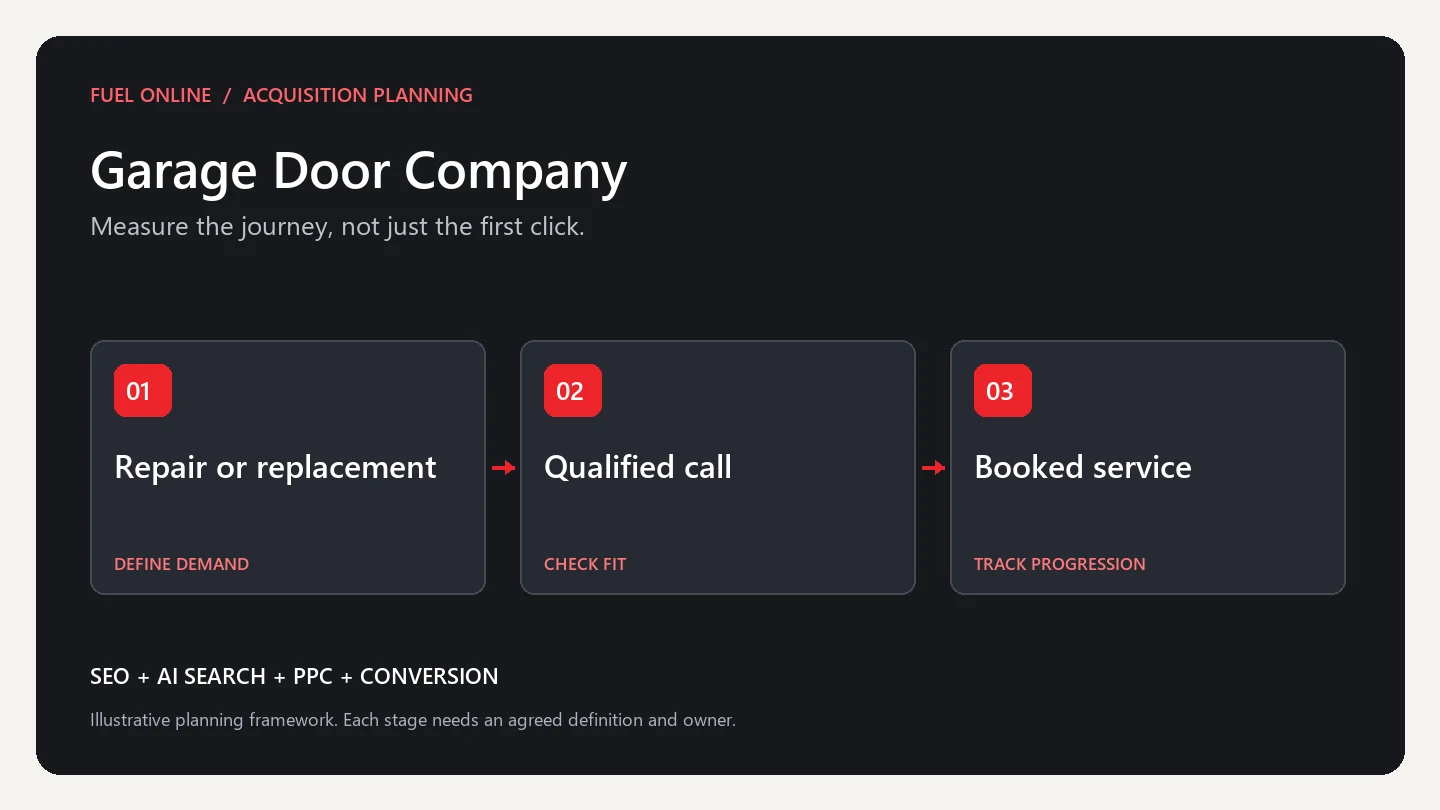
Illustrative garage door paid search decision path
Illustrative example, not a client result: compare a homeowner with a garage door that failed after a spring problem with a facility manager comparing commercial-door maintenance.
Compare the search term, ad promise, landing page and receiving result for each buyer, with explicit checks for repair urgency, door type, supported work, technician coverage and appointment capacity. A garage door PPC agency should exclude demand the team cannot serve before increasing spend. Google Ads for garage door companies should lead to a page and action that match the query, while garage door paid search reporting should connect cost to accepted work rather than raw contacts.
Classify the demand
Compare the illustrative queries "garage door spring repair [city]" and "commercial overhead door maintenance". Confirm that each describes work you offer in a market and time frame your team can support. The phrases are examples, not measured-volume claims.
Build the appropriate path
For garage door company PPC and Google Ads, place the searches in separate campaigns with different schedules, negatives, landing pages and feedback. Use actual products serviced, technician work, completed installations, reviewed warranty language and accurate service hours only when your organization can verify and approve it.
Record the commercial outcome
Retain the source, chosen path and receiving decision. Record why an inquiry advanced or stopped so the next change responds to actual fit instead of increasing activity blindly.
A garage door PPC agency diagnostic for garage door paid search: symptom to decision
Use this framework when the phone rings, but urgent repairs, unsupported products and replacement projects enter the same queue without useful context. The garage door company diagnostic turns that concern into an inspection the owner, marketing lead and receiving team can review together.
Trace the visible garage door company buyer path against current operating capacity. The review should end with one bounded change, its owner and the evidence needed to keep, correct or stop it.
- Retain one observable example and its receiving consequence.
- Use Google Ads for garage door companies to connect the source or campaign to the response record.
- Use garage door paid search to state the bounded change and the evidence for the next decision.
Name the observable symptom
For garage door PPC and Google Ads, the warning sign is that platform conversions rise while search terms and calls reveal work the team cannot accept. Record one recent example and the business consequence rather than starting with a channel-wide assumption.
Inspect the path
Review service location, repair versus replacement intent, product details, booking outcome, technician coverage and installation lead time. For the PPC and Google Ads layer, inspect the query, match type, negative coverage, location, schedule, ad, landing page, call or form disposition and spend. Keep the source, promise, handoff and disposition together so the failure point is visible.
Make a bounded decision
The industry rule is to give repair, opener, replacement and commercial-system demand distinct paths when availability, proof or the next appointment differs. For this PPC and Google Ads decision, exclude the invalid pattern or split the campaign when urgency, economics, geography or the receiving workflow changes. Name the owner, dependency and release check before implementation.
Require an inspectable output
The output is a campaign and negative-keyword map, landing-page correction, tracking check and accepted-outcome feedback view. It should show what changed, why it changed and what receiving outcome will determine whether the team keeps, corrects, expands or pauses the work.
Measurement standards for garage door PPC agency and Google Ads for garage door companies
For garage door company PPC and Google Ads, impressions, click-through rate, search terms and platform conversions help explain what changed, but they do not establish commercial value alone. The shared scorecard follows booked service visits, accepted installation quotes, completed work, and revenue by job type and segments them by service, location, buyer path and source where the organization can do so responsibly.
The review also examines technician coverage, stocked parts, after-hours availability and installation lead time. Reporting should record attribution gaps, offline outcomes and why garage door company inquiries were declined. Each review should close with a decision to keep, correct, expand, pause or investigate a specific page, campaign, answer or handoff.
How to compare providers of garage door paid search and Google Ads for garage door companies
Ask who reviews search terms, negatives and accepted outcomes, and how budgets respond to capacity. Before selecting a garage door PPC agency, require the proposal to name the first deliverables, working team, required access, client inputs, review cadence and dependencies. It should state which garage door company evidence the organization must substantiate and who approves it.
Request a sample decision log that shows what changed after an accepted or rejected inquiry. Confirm account, content and data ownership. Reject a provider that ignores agreed service or territory exclusions, promises a guaranteed outcome or cannot explain the next concrete decision.
When reviewing garage door paid search, ask the provider to show the first decision it would make from one current buyer path and the evidence required to make it.
A decision log for garage door paid search should connect one released change to the reason an inquiry advanced or stopped.
How we measure garage door PPC agency
- booked service visits
- accepted installation quotes
- completed work
- revenue by job type
Use a cost metric that reflects qualified demand
Cost per qualified inquiry = campaign spend ÷ inquiries meeting the agreed criteria.
Define the included spend, reporting window and qualification rules before comparing campaigns. Track raw leads separately so cheaper but unsuitable inquiries do not make performance look better.
Agree on the baseline, data source and qualification criteria before comparing results. Separate visibility from inquiries and accepted business opportunities.
CONNECTED SERVICES
Choose the right next step for your business
Explore Fuel’s PPC & Google Ads capabilities, published campaign work and team to evaluate how we would support your organization.
BEFORE YOU CHOOSE AN AGENCY
Questions about garage door PPC agency
What should a garage door PPC agency engagement include?
Expect campaign and landing-page structure, negatives, location and schedule rules, tracking validation and accepted-outcome feedback for broken-spring and urgent repair, opener service, full-door replacement and commercial systems. The proposal should identify owners, dependencies, implementation access and the evidence the garage door company team must approve. It should also explain how changes in technician coverage, stocked parts, after-hours availability and installation lead time affect priorities. Use the release checklist to verify completed work and whether the intended buyer reached the correct handoff.
How should Google Ads for garage door companies be phased?
For Google Ads for garage door companies, the first useful milestone is validated tracking plus one bounded campaign and landing-page path with search-term review. Delivery speed depends on access, approvals and technician coverage, stocked parts, after-hours availability and installation lead time. Set release checks and review dates before implementation begins. Assess released work first, early response second and downstream business movement only after enough demand and operating time exist to interpret it. Phase Google Ads for garage door companies around one released buyer path, its acceptance check and the next evidence-based decision.
What does our team provide for garage door paid search?
For garage door paid search, bring current service and location facts, examples of suitable and unsuitable inquiries, current capacity constraints and access needed for PPC and Google Ads. Name the reviewer who can approve garage door company service details, media and evidence. Personal and commercial details remain in the organization’s approved systems. Share only the fields needed to make marketing and handoff decisions.
How do we compare firms offering garage door PPC agency services?
Ask the agency to explain how it would handle a homeowner searching after a spring failure differently from a facility manager comparing commercial door maintenance. Its answer should connect one garage door company page, campaign, source or routing change to the required input and receiving outcome. Confirm account and data ownership. When evaluating providers, treat generic activity lists, invented proof and reports that count every inquiry equally as warning signs. Ask what Google Ads for garage door companies will deliver first and how garage door paid search will change after an accepted or rejected inquiry.
Make your next agency conversation specific.
Bring the repairs, installations and service territories you want to prioritize. Fuel Online can turn those inputs into a search-term, landing-page and budget decision sheet through a focused garage door PPC agency engagement, with the first owner, release check and success signal clearly named.
Talk with a Fuel strategist →