
FUEL ONLINE / Junk Removal Marketing / Lead generation
Junk Removal Lead Generation and Conversion Agency

A booked pickup can still lose money when the address breaks the route, the truck lacks space or the items cannot be accepted. As your junk removal lead generation agency, Fuel Online helps junk-removal owners, dispatch managers and marketing leaders define acceptance, form and call fields, routing ownership and response expectations for single-item pickup, estate cleanouts, construction debris and recurring commercial removal. The feedback loop preserves rejection reasons and exposes failed handoffs, so conversion work improves opportunity quality instead of adding unclassified contacts.
Pickup address, item category, approximate volume, stairs or access limits and desired date. Do not promise acceptance of regulated materials.
Make junk removal inquiries preserve the job that the customer described
Fuel Online’s junk removal lead generation and conversion service improves the path from relevant interest to a request the receiving team can evaluate. The useful first decision is which transition loses item, location, access or timing context. A request for an estimate, a callback and a confirmed pickup can represent different actions. The page, confirmation and receiving record should describe the same stage while preserving enough information for the operator’s actual next step.
Define the job conversation before adding fields
A person asking about one item may have a different preparation task from someone arranging a broader cleanout. The operator should identify which initial context helps it continue each conversation. The agency can then explain the fields and route in ordinary language. A longer form is not automatically more useful if the receiving team cannot explain how the added information changes the next action.
Start with the action the destination supports. Ask an unfamiliar reader what they believe happens after submission, then compare that interpretation with the receiving process. A quote inquiry should not imply that a particular price or appointment is already confirmed unless the supported process establishes it. Clear action wording gives the button, acknowledgement and report definition a consistent meaning.
| Request task | Context to inspect | Useful receiving evidence |
|---|---|---|
| Initial pickup inquiry | The operator’s chosen item, location, access and timing context. | The team can recognize the job conversation without reconstructing the visitor’s whole path. |
| Broader scope discussion | The service purpose and initial information the operator needs. | The record makes the requested conversation clear without pretending the marketing form determines the job. |
| Correction or continuing contact | The relationship to an earlier request where supported. | A useful update remains recognizable instead of automatically becoming another independently acquired opportunity. |
Preserve the selected service context
A visitor can select an item or service explanation before reaching a shared contact destination. Inspect whether that reference remains useful to the receiver. If it disappears, the repair may be continuity rather than a new required question. Show the received test record so the operator can judge whether the actual missing context is restored, not merely whether the form now has another visible field.
Access information also needs a clear purpose. The operator decides which initial facts it asks about and how they affect its review. The agency should explain the administrative reason for the question rather than invent a placement or handling rule. This helps a customer prepare a useful inquiry and keeps the marketing form within the operator’s stated process.
Test the path from invitation to receiving responsibility
Use agreed fictional details to follow the ordinary journey. Start on the relevant item or cleanout resource, complete the action, read the confirmation and inspect what the intended team receives. A browser success state is one part of the transition. Acceptance should also show whether the receiver recognizes the request purpose and has the context needed to continue.
Identify the owner and fallback route where the existing process uses them. A delivered notification can still be operationally unclear if nobody knows which queue or person should act. The agency can document the public and technical transition, while the operator defines the responsibility. The acceptance record should show that relationship rather than assume successful delivery proves a usable next step.
Use scope changes as a continuity exercise
Introduce a fictional update in which a person adds items or changes the requested timing before confirmation. Ask how the receiving team recognizes the relationship to the earlier request with the available tools. The operator supplies the practical workflow. The agency can preserve context and report the observation limit without promise that every channel automatically shares a complete conversation history.
Compare the update with a separate new job inquiry. Both may create useful work, but they need not represent two independently acquired opportunities. Retain the reason and receiving interpretation in the review example. This makes the acquisition total more understandable and can reveal whether a clearer acknowledgement or continuing-contact instruction would improve the journey before a larger redesign.
Review the acknowledgement as practical information
Read the confirmation away from the original page. Can the person identify the operator and understand what completed? The operator supplies the actual next-step wording. A useful acknowledgement preserves the difference between receipt of a request and a later arrangement. It can reduce uncertainty by explaining the supported process accurately rather than introduce a stronger commitment to make the interaction appear more reassuring.
Compare a form request with another supported contact route using the same fictional purpose. The receiving team may have different context from each. Record what can actually be observed instead of assuming the records are identical. A clearer label or source reference may improve continuity even when the tools do not connect every interaction, giving the operator a focused and realistic repair.
Turn dispositions into specific improvement work
A request concerning an unsupported item, a location mismatch and an incomplete record call for different investigations. The agency should connect the reason with a source explanation, targeting or transition where evidence allows. A generic rejected label gives little guidance about what to change. Useful broad reasons make the review actionable for both the marketing and receiving teams.
An unresolved status needs a separate interpretation. The receiver may lack context, need another owner or simply have no recorded update. A page or form edit can address only some of those issues. Ask the agency which constraint its proposed work influences and what will demonstrate completion. This prevents a functioning request route from being replaced when the actual gap belongs in later feedback.
Keep commercial stages and acceptance evidence distinct
A submitted action, a received request, an accepted job conversation and a booked pickup are different stages where the operator records them. Identify the source and owner of each status. Unknown later outcomes should remain unknown. This gives cost and allocation discussions a clear denominator and avoids treating a technical event as proof that a later commercial arrangement exists.
Use ordinary correction and validation scenarios in the permitted test. Leave an agreed required administrative value absent and inspect the explanation. Then complete the request and compare the received context. Retain the error message and final test together. A specific label or validation repair can be more useful than replacing the whole form when the remaining route already works.
At handover, keep the action definition, field purposes, receiving map and fictional tests together. A later website or notification change can be checked against this baseline. Another authorized employee should be able to recognize the intended conversation without an agency-only campaign label. This makes continuity a practical part of the deliverable rather than an informal understanding held by the launch team.
Compare lead generation proposals through one initial inquiry and one changed-scope message from source page to receiving record. Look for a concrete diagnosis, proportionate context and a useful acceptance exercise. The next release should improve a defined transition in the job conversation, leaving further acquisition activity on a foundation the operator can understand and review.
Give optional supporting detail a receiving purpose
Where the operator already supports an additional way to describe a job, ask how that context helps the receiving task before adding it to the marketing route. The useful question is whether the information changes the next conversation. A generic template should not introduce a new requirement simply because another business uses it. The operator supplies the process and the agency makes its purpose understandable.
Compare a request that contains the intended service reference with one that provides a broad description but loses that reference. The receiving team should explain which is easier to continue and what remains uncertain. This can reveal whether the transition needs a preserved source value, a clearer label or a different initial choice. The remedy should follow the observed gap rather than a universal rule about shorter or longer forms.
Keep the fictional examples and their interpretations in the acceptance record. A later editor can then assess a proposed field or wording change against the same receiving purpose. This makes the review practical and protects a working contact route from accumulating questions that add effort without improving the first job conversation.
When inconsistent campaign expectations begin before contact, integrated junk removal marketing can align the service explanation and discovery destinations.
AGGRESSIVE FROM THE START
One month. The work many agencies stretch across three.
Our mandate: move faster, go deeper and put experienced specialists to work immediately.
Fuel attacks the work in parallel: site audits, technical errors, new content, internal links, backlink outreach and conversion improvements. Your agreed scope determines the channels; urgent fixes do not wait behind a drawn-out planning phase.
The junk removal lead generation agency brief identifies visibility and lead barriers. Actionable fixes move into production while deeper analysis continues.
Your lead generation for junk removal companies work runs alongside industry-specific content, relevant links and earned-authority outreach, based on your agreed scope.
The junk removal conversion services review shows completed work, lead quality and the next opportunities. You see who owns each action.
Fast execution is the operating standard. Access, approvals and scope shape delivery; search and revenue results have their own timelines.
Junk removal lead generation agency for real buyer decisions
A lead is commercially useful only when the receiving team can assess and act on it. For a junk removal, the acceptance definition must reflect the actual buyer difference. A nearby sofa pickup may be scheduled quickly; an estate or commercial cleanout needs volume, access, timing and accepted-material questions answered before a useful quote. It also covers duplicate, current-customer, out-of-area and capacity rules.
Fuel Online uses that definition to shape pages, calls to action, forms and phone scripts. The process avoids regulated or unsupported materials, out-of-area pickups, misleading price expectations and jobs that break route or truck-capacity economics and makes the promised next step match what the team can actually deliver. For the owner or marketing lead, choosing a junk removal lead generation agency means making this buyer distinction visible before contact.
Lead generation for junk removal companies deliverables you can inspect
The engagement produces a qualification matrix, form and call-flow specification, routing map, response expectations, CRM or operating dispositions, missed-contact process and weekly feedback view. The handoff retains pickup address, items, estimated volume, access, preferred date, contact details and accepted-material confirmation.
Implementation begins with one priority conversion path. Fuel Online tests ownership and fallback routing, confirms that accepted and declined outcomes can be recorded, and then reviews friction in the page, form and first response. Expansion follows accepted jobs, booked pickups, route efficiency, and invoice revenue, not a lower form cost in isolation. A lead generation for junk removal companies scope is inspectable when the owner, dependency and release check are named.
- Written acceptance and rejection rules for single-item pickup, estate cleanouts, construction debris and recurring commercial removal.
- The plan for lead generation for junk removal companies includes form, call, routing and missed-contact specification with named owners.
- Use junk removal conversion services reporting to document disposition view connecting sources to handled opportunities.
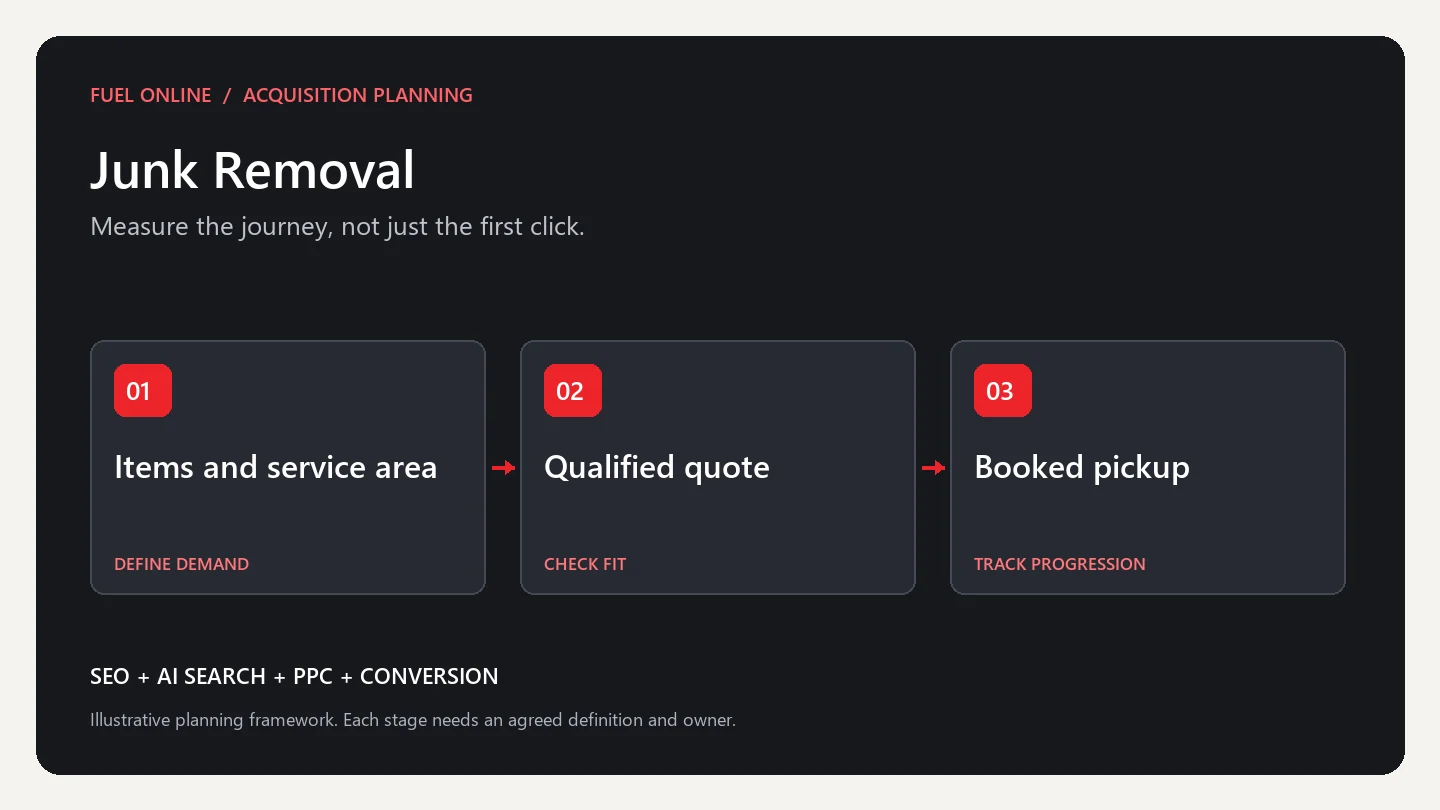
Illustrative junk removal conversion services decision path
Illustrative example, not a client result: compare a renter needing one accepted item removed this week with an estate representative planning a multi-room cleanout.
Trace each contact from form or call through qualification, routing and final disposition, using accepted materials, load size, access, travel time and route capacity to explain why it advanced or stopped. A junk removal lead generation agency should make those differences visible to the receiving team. Use lead generation for junk removal companies to focus on inquiries the team can assess. The plan for junk removal conversion services should feed rejected-contact reasons back into fields, routing and follow-up.
Classify the demand
Compare the illustrative queries "sofa removal near me" and "estate cleanout company [city]". Confirm that each describes work you offer in a market and time frame your team can support. The phrases are examples, not measured-volume claims.
Build the appropriate path
For junk removal lead generation, preserve different fit signals, owners and response expectations in the form and call flow. Use authentic truck and cleanout photographs, accepted-item guidance, disposal explanations the company can verify and clear pricing factors only when your organization can verify and approve it.
Record the commercial outcome
Retain the source, chosen path and receiving decision. Record why an inquiry advanced or stopped so the next change responds to actual fit instead of increasing activity blindly.
A junk removal lead generation agency diagnostic for junk removal conversion services: symptom to decision
Use this framework when bookings increase while drive time, rejected materials or poor truck utilization erode the value of the schedule. The junk removal diagnostic turns that concern into an inspection the owner, marketing lead and receiving team can review together.
Trace the visible junk removal buyer path against current operating capacity. The review should end with one bounded change, its owner and the evidence needed to keep, correct or stop it.
- Ask your junk removal lead generation agency to document the problem and its business impact.
- Use lead generation for junk removal companies to connect the source or campaign to the response record.
- Use junk removal conversion services to state the bounded change and the evidence for the next decision.
Name the observable symptom
For junk removal lead generation, the warning sign is that forms and calls arrive, but missing context or unclear ownership prevents a timely acceptance decision. Record one recent example and the business consequence rather than starting with a channel-wide assumption.
Inspect the path
Review pickup addresses, item categories, estimated volume, access limits, accepted-material decisions, route density and invoice outcomes. For the lead generation layer, inspect the source, page, captured fields, consent, route, response time, duplicate status, disposition and rejection reason. Keep the source, promise, handoff and disposition together so the failure point is visible.
Make a bounded decision
The industry rule is to separate quick pickups from estate, construction and commercial cleanouts when the quote, truck plan or response window changes. For this lead generation decision, repair one priority handoff, assign a fallback owner and confirm the receiving system can record accepted and rejected outcomes. Name the owner, dependency and release check before implementation.
Require an inspectable output
The output is an acceptance matrix, form and call specification, routing diagram, disposition list and missed-contact process. It should show what changed, why it changed and what receiving outcome will determine whether the team keeps, corrects, expands or pauses the work.
Measurement standards for junk removal lead generation agency and lead generation for junk removal companies
For junk removal lead generation, form completion, call volume, response time and contact rate help explain what changed, but they do not establish commercial value alone. The shared scorecard follows accepted jobs, booked pickups, route efficiency, and invoice revenue and segments them by service, location, buyer path and source where the organization can do so responsibly.
The review also examines truck space, crew hours, route density, disposal windows and scheduled cleanouts. Reporting should record attribution gaps, offline outcomes and why junk removal inquiries were declined. Each review should close with a decision to keep, correct, expand, pause or investigate a specific page, campaign, answer or handoff. Measurement for junk removal conversion services should distinguish channel response from accepted business.
How to compare providers of junk removal conversion services and lead generation for junk removal companies
Ask who owns routing, missed contacts, dispositions and the weekly quality feedback loop. Before selecting a junk removal lead generation agency, require the proposal to name the first deliverables, working team, required access, client inputs, review cadence and dependencies. It should state which junk removal evidence the organization must substantiate and who approves it.
Request a sample decision log that shows what changed after an accepted or rejected inquiry. Confirm account, content and data ownership. Reject a provider that ignores agreed service or territory exclusions, promises a guaranteed outcome or cannot explain the next concrete decision.
When reviewing junk removal conversion services, ask the provider to show the first decision it would make from one current buyer path and the evidence required to make it.
A decision log for junk removal conversion services should connect one released change to the reason an inquiry advanced or stopped.
How we measure junk removal lead generation agency
- accepted jobs
- booked pickups
- route efficiency
- invoice revenue
Find the drop between interest and a useful next step
Next-step completion rate = qualified inquiries completing the agreed next step ÷ qualified inquiries reviewed.
Illustrative arithmetic: 15 completed appointments from 25 qualified inquiries is 60%. Use the next step that fits your business, such as a consultation, estimate or discovery meeting, and record the time allowed for completion.
Agree on the baseline, data source and qualification criteria before comparing results. Separate visibility from inquiries and accepted business opportunities.
CONNECTED SERVICES
Choose the right next step for your business
Explore Fuel’s Lead generation capabilities, published campaign work and team to evaluate how we would support your organization.
BEFORE YOU CHOOSE AN AGENCY
Questions about junk removal lead generation agency
What should a junk removal lead generation agency engagement include?
Expect written acceptance rules, form and call requirements, routing ownership, missed-contact handling and a disposition view for single-item pickup, estate cleanouts, construction debris and recurring commercial removal. The proposal should identify owners, dependencies, implementation access and the evidence the junk removal team must approve. It should also explain how changes in truck space, crew hours, route density, disposal windows and scheduled cleanouts affect priorities. Use the release checklist to verify completed work and whether the intended buyer reached the correct handoff.
How should lead generation for junk removal companies be phased?
For lead generation for junk removal companies, the first useful milestone is an acceptance definition and one tested form or call path with working ownership and dispositions. Delivery speed depends on access, approvals and truck space, crew hours, route density, disposal windows and scheduled cleanouts. Set release checks and review dates before implementation begins. Assess released work first, early response second and downstream business movement only after enough demand and operating time exist to interpret it. Phase lead generation for junk removal companies around one released buyer path, its acceptance check and the next evidence-based decision.
What does our team provide for junk removal conversion services?
For junk removal conversion services, bring current service and location facts, examples of suitable and unsuitable inquiries, current capacity constraints and access needed for lead generation. Name the reviewer who can approve junk removal service details, media and evidence. Personal and commercial details remain in the organization’s approved systems. Share only the fields needed to make marketing and handoff decisions.
How do we compare firms offering junk removal lead generation agency services?
Ask the agency to explain how it would handle a renter needing one accepted item removed this week differently from an estate representative planning a multi-room cleanout. Its answer should connect one junk removal page, campaign, source or routing change to the required input and receiving outcome. Confirm account and data ownership. When evaluating providers, treat generic activity lists, invented proof and reports that count every inquiry equally as warning signs. Ask what lead generation for junk removal companies will deliver first and how junk removal conversion services will change after an accepted or rejected inquiry.
Make your next agency conversation specific.
Bring the pickup types, routes and truck-capacity problems you want marketing to solve. Fuel Online can turn those inputs into a qualification, routing and disposition improvement plan through a focused junk removal lead generation agency engagement, with the first owner, release check and success signal clearly named.
Talk with a Fuel strategist →