
FUEL ONLINE / Estate Planning Law Firms / PPC & Google Ads
Estate Planning Law PPC and Google Ads Agency

Estate planning firms need matters that fit their jurisdiction and practice mix, not template searches or out-of-state requests. Fuel separates paid searches such as 'estate planning attorney in Wellesley' from low-fit intent such as 'free will template', then aligns ads, geography, landing pages, and contact actions with matter type, jurisdiction, urgency, complexity, decision participants, and consultation fit. Search-term reviews and intake team feedback move budget toward accepted estate planning consultations, not the cheapest clicks or form fills.
Jurisdiction and service required; Planning versus administration or dispute; Consultation process and client fit; Conflict-screening and intake responsibilities
Compare estate-planning PPC through counsel-seeking intent and accepted consultations
Separate counsel-seeking search purposes
An estate-planning PPC agency should make the purpose of paid demand visible before recommending more spend. Ask how it distinguishes a person seeking counsel from someone looking for a free template, and how the destination preserves the firm's actual practice and jurisdiction information. The useful program connects the search task, supported message, arrival resource and intake evidence. Cheaper clicks or submissions alone do not show whether the campaign is helping the firm receive the consultations it wants to assess.
Use the contrast already present in the source: a search for an estate-planning attorney in a place versus a free-will-template search. Treat these as examples of different purposes, not a claim about a particular firm's current territory or a universal judgment about every query. Ask the agency where each belongs in its initial plan and which public resource fits. Related legal words do not establish that the same advertisement or contact action will serve both readers usefully.
Separate the firm's supported practice groups before building a broad account structure. Planning, administration and disputes can represent different conversations where the firm makes those distinctions. Ask what fact and receiving context justify a separate group. A new label alone does not require another campaign or page. The company supplies its actual offering; the agency should make the rationale visible and avoid expanding scope simply because an adjacent topic appears commercially attractive in a keyword tool.
Known-firm searches need a distinct interpretation from broader counsel research. A person already looking for the organization may primarily need current identity and contact information, while another is comparing whether the described practice fits their enquiry. Ask how the account and report preserve that context. A blended conversion figure can hide differences in the task paid distribution was asked to perform. The firm should understand the purpose and evidence behind the comparison without assuming that every branded contact represents a newly created relationship.
Connect messages to firm-supported sources
Give each initial group a destination rationale. An existing practice page may provide the most accurate source; a focused campaign resource may be useful when a distinct research task lacks orientation. Ask what the new destination adds and which maintained firm resource governs its important statements. A separate page creates a maintenance dependency. It should not become another version of the practice story that retains an older jurisdiction or consultation instruction after the main site has changed.
Read the short advertisement beside its firm-approved source. The message may need fewer words, but it should preserve the meaning of the offering. Ask the bidder to identify any new claim or disappearing qualification. A more persuasive phrase is not useful if it implies a credential, availability arrangement or service commitment the firm has not supplied. The firm should decide the factual wording; the agency should show how the ad and destination express it consistently for the intended counsel-seeking task.
Treat geography as a source relationship, not just an account setting. The location in a search, an office address and the firm's approved jurisdiction explanation can be different facts. Ask how the agency aligns the message and destination with the actual information. Advertising in an area does not itself establish what the firm can accept. The destination should make the supported explanation and next route clear, leaving the firm to review uncertainty through its process rather than letting marketing infer the answer.
Use a fictional practice-scope change to test campaign maintenance. The firm supplies the revised description. Ask which messages, destinations and saved resources depend on it, which the agency controls and which require another owner. A paused account group does not explain what a person following an older link will read. The proposed scope should include a public destination decision where appropriate and distinguish a revised draft from a completed and checked change.
Diagnose demand and destination gaps
Search-term review should diagnose the kind of mismatch. Template research, a request concerning a different service and relevant counsel research that reaches an unclear page suggest different actions. Ask the agency to explain why a group is kept, excluded or inspected further. A long list of account edits does not establish commercial progress without that reasoning. The firm should be able to trace the recommendation to actual purpose and scope evidence rather than approve an unexplained expansion or reduction because it appears in a technical report.
Compare a targeting problem with a destination problem before commissioning more pages. If the arriving purpose does not fit the practice, a new landing page may not address the issue. If the purpose is relevant but the invitation is unclear, a narrow explanation may be useful. Ask the agency to show which stage its evidence concerns. This protects accurate existing resources and makes the production task proportionate to the observed constraint, instead of turning every disappointing campaign result into a complete site redesign.
Keep educational interest distinct from consultation readiness. A person reading an introductory resource may be exploring a topic rather than asking the firm to review an enquiry. Ask what the destination offers and what event the report records. The agency can provide a clear next resource or supported contact route without labeling every content interaction as a qualified consultation. This gives the firm a more honest view of activity and prevents a campaign from appearing efficient by combining unlike stages in one conversion total.
Define costs at the stage the firm recognizes. Cost per contact action, identifiable enquiry and firm-accepted consultation require different records. Ask which source supports each denominator and how unknown status is handled. A low action cost can coexist with unsuitable requests, while a small set of classified consultations may not justify a confident efficiency claim. The report should explain those limits rather than compare one supplier's button-click cost with another's reviewed-consultation cost as though they describe the same outcome.
Interpret cost and intake evidence
Classification timing should remain visible in budget discussions. A request may arrive in one period and receive an intake status later. Ask how the agency prevents that delay from making recent activity appear artificially poor or older activity appear stronger. The firm does not need a promise of perfect attribution to ask for a coherent partial view. It needs to know which records support the recommendation and which are awaiting the business information needed for a fair comparison.
A repeated form and call need an explicit interpretation. Ask what the tools can connect, what requires intake review and what remains separate. The agency should preserve both the observed events and the identifiable enquiries where records support them. It should not automatically treat every contact as another consultation, nor silently merge uncertain relationships to produce a cleaner report. The definition sheet should give the firm a practical example of how a repeated contact affects the cost calculation and the limit of that conclusion.
Review the receiving path with fictional administrative details. Follow a permitted test from message to destination and inspect the request record with its owner. The test should not include actual family, asset or matter details. Ask whether the stated purpose survives and whether the acknowledgment accurately describes the initial action. A successful advertising event is only one part of the evidence. The campaign exists to help an appropriate reader reach a useful firm-supported conversation, not merely produce a technical record that looks complete.
Existing-client and professional-referral purposes may reach paid destinations too. Ask which actual routes the firm supports and how a reader can identify them without pretending to be a new prospect. Those contacts can be useful while remaining distinct from the acquisition task. The agency should inspect the existing instructions rather than invent a client-service or referral policy. A clearer route can improve the experience and make the account's demand report more interpretable without claiming every branded interaction has the same commercial meaning.
Choose bounded tests and next actions
Give each experiment a specific decision question. The agency might test whether clearer practice wording improves the fit of received enquiries or whether a better process explanation preserves the intended action. Ask what changes, what remains stable and which evidence will inform the next decision. Avoid a universal threshold unsupported by the firm's context. If several major components change together, retain the limit on what the result can establish rather than attribute the difference to the favored edit in the presentation.
Compare fees through actual responsibilities. Management, message adaptation, destination work, event configuration and receiving checks may be included differently. Ask what the firm supplies and what another owner must implement. A lower headline fee may cover a narrower assignment; a broader package may duplicate accurate material the firm already has. A worked example from query interpretation through receiving evidence lets the firm compare the complete scope without an invented industry price benchmark or an assumption that more production necessarily creates more value.
Retain the reason for significant account decisions. A future manager should understand why a group was included, which firm source supports its message and what would trigger a review. Account settings alone do not preserve that reasoning. The firm should receive the current destination map and event definitions as well as the assets and access it owns. This makes the program maintainable when practice information changes and helps prevent an older campaign from continuing a promise whose source has been revised.
Review how a temporary emphasis on one supported practice affects the continuing account. The firm supplies the business priority and current source facts. Ask who records why the decision was made and what would trigger reconsideration. An unexplained setting is not a durable statement of practice scope. The agency should retain the relevant message and destination dependencies, allowing a future manager to revisit the distribution choice without assuming that an older campaign reflects the firm's current consultation priorities.
Compare a new landing-page request with a better use of the existing process resource. Ask the agency to show the specific question the paid visitor cannot currently answer. A missing substantive explanation may require firm input, while weak orientation may need a heading or contextual link. Those assignments have different review and implementation costs. The proposal should explain the difference before treating a new page as the default answer, keeping the paid program connected to accurate resources the firm already maintains.
Choose the next spend action from a documented constraint. It may be a narrower query purpose, a clearer practice resource, a corrected intake invitation or more complete classification feedback. Ask the agency why that action comes first and what remains unknown. A useful PPC partnership makes the relationship between distribution and intended consultations inspectable, while keeping professional review and later matter outcomes with the firm rather than treating every recorded interaction as proof that the program should expand.
AGGRESSIVE FROM THE START
One month. The work many agencies stretch across three.
Our mandate: move faster, go deeper and put experienced specialists to work immediately.
Fuel attacks the work in parallel: site audits, technical errors, new content, internal links, backlink outreach and conversion improvements. Your agreed scope determines the channels; urgent fixes do not wait behind a drawn-out planning phase.
The estate planning PPC agency brief identifies visibility and lead barriers. Actionable fixes move into production while deeper analysis continues.
Your estate planning Google Ads work runs alongside industry-specific content, relevant links and earned-authority outreach, based on your agreed scope.
The PPC management for estate planning law firms review shows completed work, lead quality and the next opportunities. You see who owns each action.
Fast execution is the operating standard. Access, approvals and scope shape delivery; search and revenue results have their own timelines.
What estate planning PPC agency changes for estate planning demand
Paid acquisition becomes useful when the account mirrors the business. Fuel separates campaigns when geography, service, economics, qualification, or next step differs. The distinction between 'estate planning attorney in Wellesley' and 'free will template' becomes visible in queries, exclusions, ads, pages, and reporting.
Each ad group has a defined buyer, promise, evidence need, destination, and contact action. The landing page uses attorney-reviewed information, accurate jurisdiction statements, named authorship, and permissioned client evidence and gives the intake team matter type, jurisdiction, timing, decision participants, safe contact details, and approved conflict-check facts.
A practical estate planning PPC diagnostic
Use this diagnostic when paid conversion volume improves but the receiving team does not see a comparable change in accepted estate-planning consultations. The diagnostic for estate planning PPC agency starts with the observable symptom, checks the page, source, campaign, or handoff responsible for it, and ends with one reviewed action, owner, and validation method.
Observable symptom in estate planning PPC agency performance
Reported conversions increase, but search terms and landing pages still send 'free will template' demand instead of opportunities closer to 'estate planning attorney in Wellesley'.
What to inspect in estate planning Google Ads
Review actual search terms, geography, ad promise, landing-page fit, contact action, and the sales, intake, or scheduling decision.
Decision criteria for PPC management for estate planning law firms
Add or remove a reviewed exclusion, separate the campaign, revise the landing page, or hold budget until the handoff works.
Inspectable output
A search-term and landing-page decision log showing what changed, why budget moved, and whether accepted estate planning consultations improved.
PPC management for estate planning law firms deliverables you can inspect
The team receives a campaign and budget matrix, reviewed query decisions, exclusions, landing-page message map, conversion tracking, and a weekly budget log.
- Campaign, geography, and budget matrix, used to define the estate planning PPC agency scope.
- Reviewed query and exclusion set, used to govern the estate planning Google Ads release.
- Ad and landing-page message map, used to evaluate the PPC management for estate planning law firms decision.
- Conversion and offline-disposition tracking
- Weekly search-term and budget decision log
Illustrative estate planning law example
Illustrative example, not a client result: Fuel would separate paid-search demand from a local prospective client seeking planning, administration, or another matter the firm accepts and out-of-jurisdiction, disputed, low-fit, and unrelated legal requests in the account, then review the actual query, geography, promise, landing page, contact action, and final disposition before changing budget.
The estate planning Google Ads decision log would show the exclusion, campaign split, landing-page revision, or budget hold and its owner. Spend expands only after reviewed evidence shows a stronger path to accepted estate-planning consultations.
Within PPC management for estate planning law firms, the buyer team can inspect the artifact, approval, and next investment decision.
How commercial progress is judged
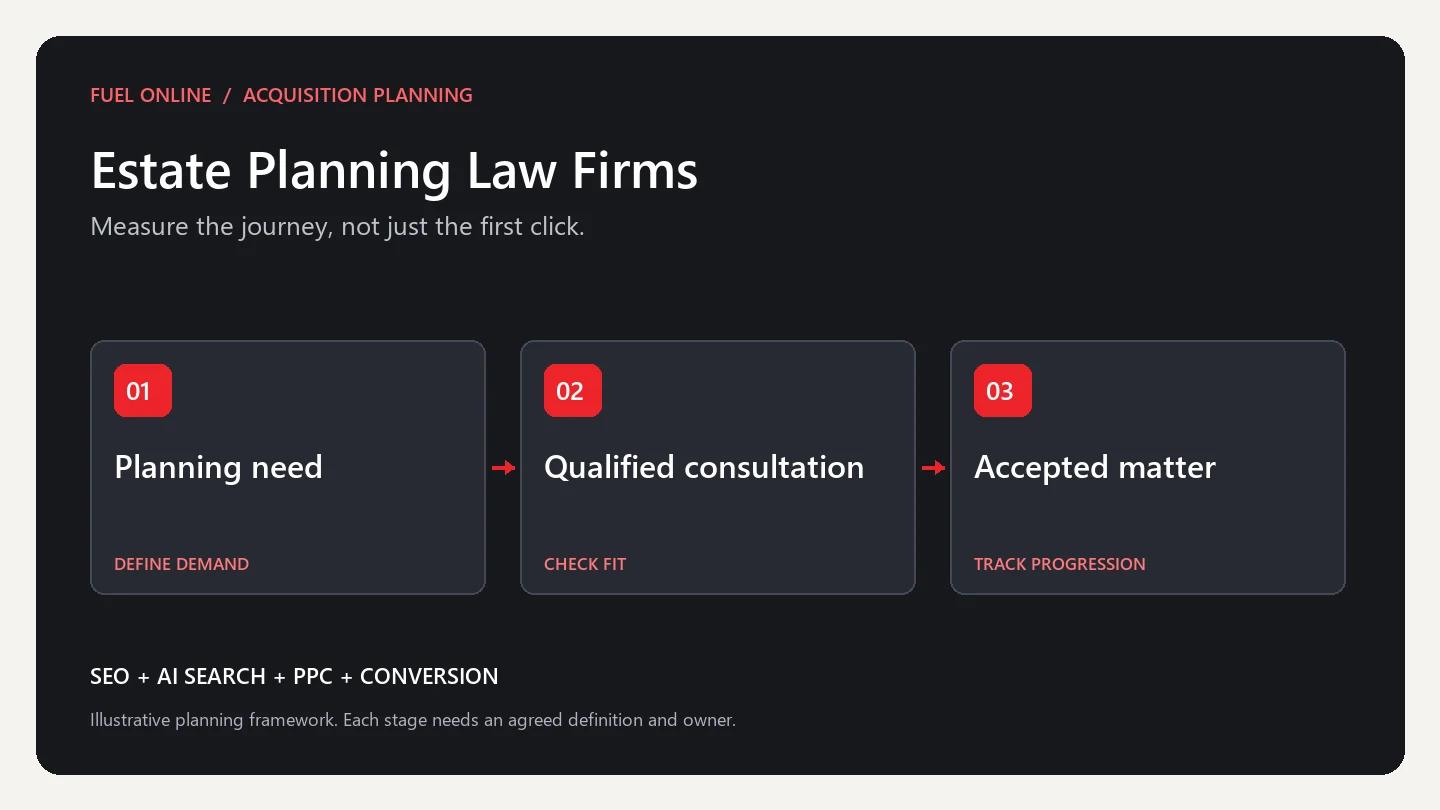
Fuel connects page, query, campaign, or source context with acceptance, rejection reasons, response, capacity, and qualified consultations, attended consultations, accepted matters, and service-specific acquisition. Diagnostic measures explain where the journey breaks; they do not replace the business outcome.
The decision record for estate planning PPC agency states what changed, why it changed, who approved it, and whether the next action is to expand, revise, consolidate, or stop.
Reporting for PPC management for estate planning law firms must connect the service-specific diagnostic to accepted estate-planning consultations, explain data limits, and name the next decision rather than treating activity as proof of value.
Questions to ask an estate planning law agency
Ask for a search-term decision log, landing-page map, conversion definition, and budget-change record. Confirm who approves exclusions, creative, tracking, and offline disposition imports.
When reviewing estate planning PPC agency, require a named practitioner, implementation owner, approval path, and sample artifact. Reject unsupported promises of rankings, citations, lead volume, cost, or revenue.
How we measure estate planning Google Ads
- qualified consultations
- attended consultations
- accepted matters
- service-specific acquisition
Use a cost metric that reflects qualified demand
Cost per qualified inquiry = campaign spend ÷ inquiries meeting the agreed criteria.
Define the included spend, reporting window and qualification rules before comparing campaigns. Track raw leads separately so cheaper but unsuitable inquiries do not make performance look better.
Agree on the baseline, data source and qualification criteria before comparing results. Separate visibility from inquiries and accepted business opportunities.
CONNECTED SERVICES
Choose the right next step for your business
Explore Fuel’s PPC & Google Ads capabilities, published campaign work and team to evaluate how we would support your organization.
BEFORE YOU CHOOSE AN AGENCY
Questions about estate planning Google Ads
What happens before Fuel increases paid spend?
During the first month, the estate planning PPC agency scope produces a search-term review, campaign and geography matrix, conversion definition, and the first budget decision. Fuel also records the client inputs and approval needed for the first release.
What does Fuel need from our estate planning law team?
Effective estate planning Google Ads work requires ad-account, analytics, landing-page, call, and disposition access plus budget constraints, approved claims, and timely query review. Fuel identifies missing access or ownership before work is scheduled around it.
How will we know the work is commercially useful?
Under PPC management for estate planning law firms, commercial usefulness depends on whether the diagnostic connects to accepted estate-planning consultations, the data limits are stated, and the evidence supports a clear keep, revise, or stop decision.
What should the first estate planning PPC agency priority be?
Start with the query, geography, ad promise, landing page, contact action, and receiving path closest to accepted estate-planning consultations. The estate planning PPC agency plan should hold expansion when a landing-page or handoff defect would turn more spend into unusable conversions.
What does a credible estate planning Google Ads scope include?
A credible estate planning Google Ads scope includes query and exclusion review, geography and budget rules, landing-page alignment, conversion definitions, disposition feedback, and documented budget decisions. It also names the client dependencies, practitioner, deliverable, and approval path.
How should PPC management for estate planning law firms report commercial progress?
Reporting under PPC management for estate planning law firms should connect the service-specific diagnostic to accepted estate-planning consultations, show what changed and why, state data limits, and name the next decision.
Make your next agency conversation specific.
Bring recent search terms, landing pages, and accepted or rejected contacts so we can identify the first paid-media decision. The first working session on estate planning Google Ads will identify the priority artifact, evidence, owner, and approval decision for accepted estate-planning consultations.
Talk with a Fuel strategist →