
FUEL ONLINE / Estate Planning Law Firms / SEO
Estate Planning Law SEO Agency

Estate planning firms need matters that fit their jurisdiction and practice mix, not template searches or out-of-state requests. Fuel maps searches such as 'estate planning attorney in Wellesley' to focused service, location, process, proof, and comparison pages, while treating 'free will template' as different intent. The estate planning SEO work also fixes indexation and internal-link gaps and produces evidence-backed briefs. Reporting connects search visibility with accepted estate planning consultations, not traffic or rankings in isolation.
Jurisdiction and service required; Planning versus administration or dispute; Consultation process and client fit; Conflict-screening and intake responsibilities
Build estate-planning SEO around distinct firm, lawyer and practice resources
Give firm and practice resources distinct jobs
An estate-planning SEO agency should explain which resource owns each meaningful research decision before proposing a longer publication calendar. A firm introduction establishes identity, a lawyer biography describes a professional relationship, a practice resource explains the offering and a process page introduces the supported consultation route. Ask how those resources connect and what a new page would add. The firm needs a useful information system grounded in its actual practice, not many similar articles that repeat broad promises without helping an appropriate reader decide where to continue.
Start with the practice distinctions the firm actually uses. The source separates planning from administration or disputes and treats jurisdiction and consultation fit as important. Ask which maintained page describes each supported service and what remains a question for the firm. A broad estates-related term should not cause the agency to create a practice identity the organization has not supplied. The page map should preserve the actual offering and make adjacent or uncertain purposes visible rather than assume every related query belongs on the same conversion path.
Give the firm introduction a clear job. A reader looking for the known organization should be able to identify it and find current contact context. The introduction can connect to relevant lawyers and practice resources without repeating every detail. Ask the agency which source fact is unclear today and how the proposed change resolves it. If the page is accurate but its connections are weak, a focused improvement may be more useful than another long introduction that pushes practical information farther from the visitor's starting point.
Lawyer biographies need their own factual owner. Ask which approved reference establishes the person's role, credentials and relationship to the firm. The agency should preserve that meaning in summaries and links. A shared name or image should not become a broader practice claim, and a promotional description should not create an unsupported qualification. Where the current record is uncertain, identify the firm review needed before writing. This makes the content brief specific and avoids asking a writer to resolve a professional fact through confident-sounding prose.
Use accurate jurisdiction and process sources
A practice page should answer a distinct question about the firm's offering. Ask what it explains beyond the firm introduction and which approved source supports it. The page can introduce how the firm describes its work and direct a person to the appropriate consultation information. It should not provide individualized legal guidance or infer that a reader's circumstances fit from a generic list. The agency's contribution is a clear supported explanation and useful next step, with unresolved practice details retained as firm inputs rather than invented to complete the draft.
Compare planning and administration resources where the firm supports both. Ask which reader question and receiving context justify their separate roles. Some introductory facts may be shared, while other information belongs with the distinct offering. A separate URL should have a reason the firm can explain and maintain. If the drafts would repeat the same answer with a changed phrase, ask whether a stronger common resource or clearer section relationship would serve the reader better before committing to several pages that require repeated review.
Educational content should have an information purpose beyond attracting broad topic traffic. Ask what research question it answers, what firm-approved material it uses and how it relates to the practice resource. A person looking for a template may have a different task from someone considering counsel. The agency should not treat all such traffic as unrealized consultations or publish document instructions merely to fill the keyword plan. The firm supplies the content it is prepared to explain publicly, and the brief should identify that source and boundary.
Use jurisdiction and office information precisely. The location in a research query, the firm's address and its approved explanation of practice scope can be different facts. Ask which source establishes each and how the page helps a reader continue when a question requires firm review. Do not invent another office or turn a geographic phrase into a service determination. A local resource should earn its place through distinct supported information and a useful relationship to maintained practice content, rather than a town name substituted into a generic introduction.
Resolve overlap before expansion
Test proposed geographic expansion with two fictional page briefs. Give the agency the same approved firm and practice information, then ask what distinct reader question each local resource would answer. If the only difference is the place label, a clearer shared resource may be more manageable. If the firm supplies a meaningful relationship that changes the information task, record it. This lets the buyer compare immediate usefulness with future maintenance responsibility before a large page list becomes a production commitment.
The consultation-process resource deserves a distinct review. Ask what the firm wants a prospective enquirer to understand before contact and which administrative instructions are current. The agency should connect that explanation to relevant practice and biography resources without promising an arrangement that the process does not establish. A clear invitation can be useful without inventing a fee, response timeline or screening rule. The page should make the supported next step understandable and leave the firm's professional decisions in its actual process.
Review internal links through the next research decision. A biography may connect to a practice description, a practice resource to consultation information and an educational article to the maintained explanation it supports. Ask why the surrounding sentence makes the destination useful. A large list of related links can leave the reader guessing. The goal is coherent relationships, not the largest link count. Each important connection should help a person recognize which resource answers the next question without first learning the firm's internal page structure.
Resolve overlap before commissioning another draft. Two topics can use different phrases while serving the same reader decision with the same source information. Ask which page owns that answer and whether the other idea belongs as a section or contextual connection. A separate URL creates a continuing review obligation when practice or contact facts change. The agency should make that cost visible and explain the distinct contribution, rather than assume that every variation in wording deserves its own independently maintained article.
Connect technical work to research tasks
Use professional publications or announcements according to their actual context. A dated item may introduce a topic or record an event while current biography and practice resources maintain the continuing facts. Ask where a reader following an older link can identify the relevant current information. The agency should not convert historical material into an unsupported present-tense claim. A deliberate connection can preserve useful context without cosmetic rewriting or allowing an old announcement to become the only public source for a basic firm fact.
Customer evidence and imagery need a truthful role. Ask what the firm has authorized for publication and what the asset actually establishes. A generic image can orient a reader without proving a professional result, and a permissioned example retains its own context rather than becoming a universal promise. The agency should not invent client outcomes, testimonials or matter details to make a resource more persuasive. If more evidence is needed, identify it as a firm input and compare whether a clearer existing source can serve the immediate information task.
Connect technical findings to the resource they affect. A crawl, indexation, rendering or internal-link problem should identify the exact page, observed issue and validation method. Ask which finding prevents an important practice or consultation resource from being found or used and which requires more investigation. A long audit list does not establish priority by itself. The firm should understand why the action matters to a reader task and how the agency will verify its technical result, separately from later visibility or intake outcomes.
Choose the first release using source gaps and review capacity. A missing practice explanation may require a lawyer's input; a broken contextual link may be ready to repair now. Ask the agency to separate those tasks and avoid repeating the same unresolved factual question across several briefs. A useful sequence completes ready improvements while identifying the precise input that unlocks another resource. This makes parallel production practical and helps the firm use its subject-matter time on decisions that genuinely change the public explanation.
Maintain an inspectable resource system
Accept a draft through a full research walkthrough. Begin with a firm, lawyer or supported practice question, find the relevant source and locate the consultation instruction. Ask an unfamiliar reader what each resource establishes and where they must guess. Use fictional administrative details if a contact test is permitted, not actual family or matter information. A page should have an inspectable job at publication. Later ranking movement can inform discovery review, but it cannot validate an unsupported statement or establish that every visit led to a consultation.
Separate editorial acceptance from performance interpretation. The firm can verify an approved explanation and a functioning reader path directly. Visibility, contact and later intake records require their own evidence. Ask the agency to show which conclusion each record supports and how unknown relationships are retained. This gives the firm a more useful view than combining publication volume, ranking changes and later matter outcomes into one success narrative whose connections cannot be examined. A clear report can still recommend a bounded next action when some evidence is unavailable.
Retain a page-role register for handover. For each important resource, name the research question, supporting firm source, related destination, factual owner and review trigger. A future contributor should understand why the page exists and what would change its meaning. Test that by giving one record to a colleague outside the original production team. If the explanation depends on an agency-only label, add the ordinary-language task. This preserves the reasoning behind the finished content and makes later improvements more focused.
Use a source-change exercise involving a lawyer biography and an unrelated practice page. The firm supplies the revised professional fact. Ask which summaries and links depend on it and which content remains accurate. The agency should not mark the entire site as equally affected. A focused dependency list makes the maintenance responsibility concrete and helps the buyer compare a plan that preserves useful resources with one that turns every factual change into a broad rewriting project without a clear reader benefit.
A frequently asked question should earn its role through the research decision it resolves. Ask whether the answer already appears clearly in the relevant practice or process explanation and whether another version creates maintenance work. The firm supplies the information it is prepared to publish. The agency should choose between a contextual answer, a distinct resource and the supported consultation route according to that purpose. It should not use the format to introduce individualized advice or duplicate the same generic invitation beneath every legal topic.
The next SEO investment should resolve a named research or discovery gap. It may be an unclear lawyer relationship, a missing practice distinction, an unsupported local page or a weak route to consultation information. Ask the agency to rank those needs using actual source evidence and firm priorities. Preserve accurate existing material and expand only where a new resource has a distinct job. This produces a maintainable information system while keeping invented legal guidance, professional claims and generic page multiplication out of the content plan.
AGGRESSIVE FROM THE START
One month. The work many agencies stretch across three.
Our mandate: move faster, go deeper and put experienced specialists to work immediately.
Fuel attacks the work in parallel: site audits, technical errors, new content, internal links, backlink outreach and conversion improvements. Your agreed scope determines the channels; urgent fixes do not wait behind a drawn-out planning phase.
The estate planning SEO brief identifies visibility and lead barriers. Actionable fixes move into production while deeper analysis continues.
Your estate planning search engine optimization work runs alongside industry-specific content, relevant links and earned-authority outreach, based on your agreed scope.
The SEO services for estate planning law firms review shows completed work, lead quality and the next opportunities. You see who owns each action.
Fast execution is the operating standard. Access, approvals and scope shape delivery; search and revenue results have their own timelines.
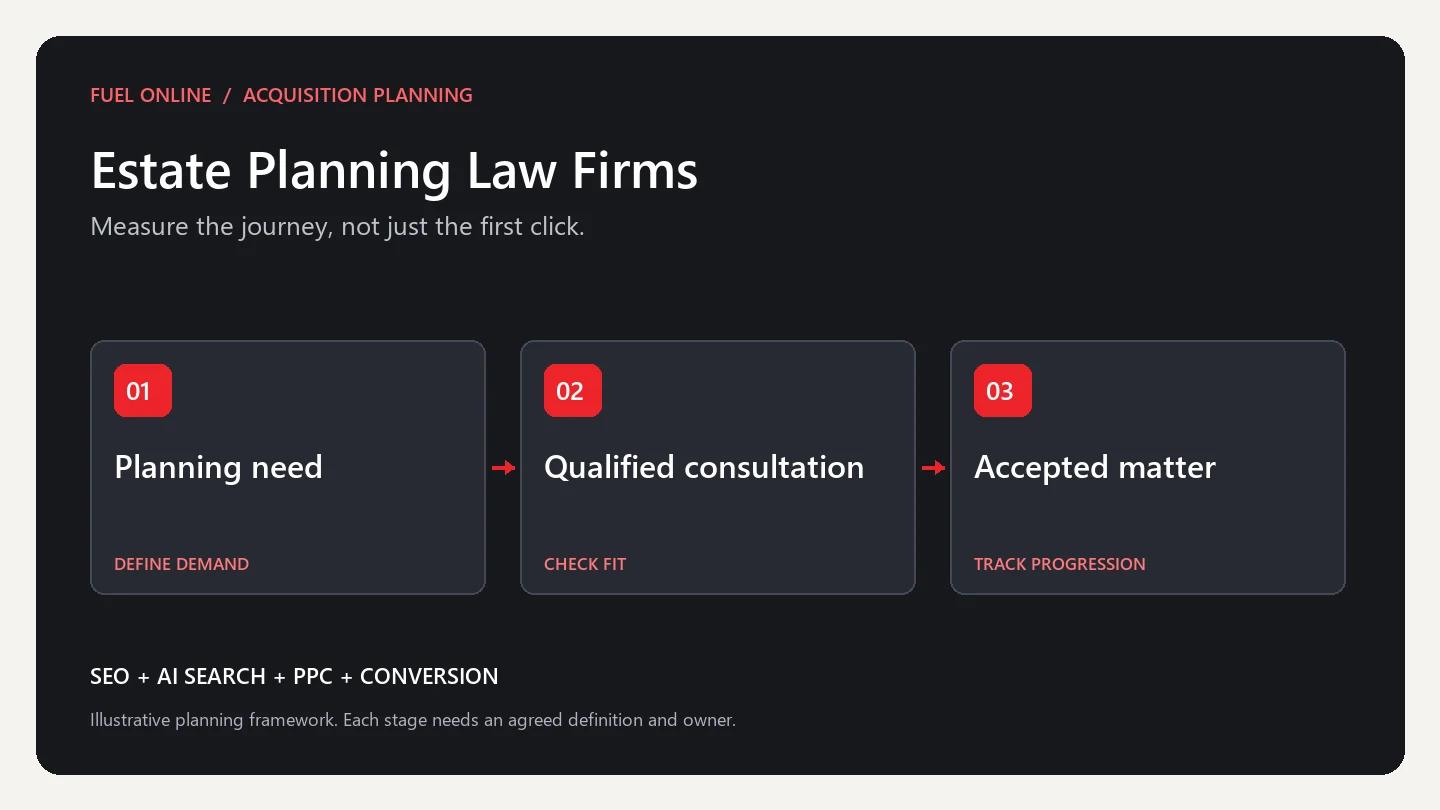
What estate planning SEO changes for estate planning demand
Search strategy begins with the buying decision, not a list of high-volume phrases. Fuel separates research, comparison, local, and action intent for estate planning firms seeking matters that fit their jurisdiction and practice mix. One primary page owns each meaningful decision so several thin pages do not compete with one another.
The technical review covers crawl access, indexation, canonicals, redirects, rendering, and internal links. Content briefs then turn attorney-reviewed information, accurate jurisdiction statements, named authorship, and permissioned client evidence into useful practice-area, process, attorney, jurisdiction, comparison, and consultation-preparation pages with a clear audience, limits, and next step.
A practical estate planning SEO diagnostic
Use this diagnostic when search visibility improves but the receiving team does not see a comparable change in accepted estate-planning consultations. The diagnostic for estate planning SEO starts with the observable symptom, checks the page, source, campaign, or handoff responsible for it, and ends with one reviewed action, owner, and validation method.
Observable symptom
Search visibility grows around 'free will template' while the business needs discovery closer to 'estate planning attorney in Wellesley'.
What to inspect in estate planning search engine optimization
Review query-to-page fit, indexation, competing pages, internal links, proof, and the next step shown on the landing page.
Decision criteria for SEO services for estate planning law firms
Consolidate, repair, expand, or retire the page before adding another URL for the same decision.
Inspectable output
A query-to-page decision and validated release ticket tied to inquiry fit and accepted estate planning consultations, not rankings alone.
SEO services for estate planning law firms deliverables you can inspect
The team receives query-to-page decisions, a technical priority register, briefs, internal-link actions, and release validation tied to inquiry fit.
- Query-to-page map and overlap decisions, used to define the estate planning SEO scope.
- Technical priority register and validation method, used to govern the estate planning search engine optimization release.
- Internal-link plan, used to evaluate the SEO services for estate planning law firms decision.
- Evidence-backed page briefs
- Release log tied to accepted inquiry quality
Illustrative estate planning law example
Illustrative example, not a client result: Fuel would map the search need represented by a local prospective client seeking planning, administration, or another matter the firm accepts to one authoritative decision page and keep out-of-jurisdiction, disputed, low-fit, and unrelated legal requests out of that conversion path. The review would resolve competing URLs, missing proof, internal links, and indexation before another page is commissioned.
The estate planning search engine optimization review would end with a query-to-page decision, an implementation ticket, and a validation check. Search visibility is diagnostic; continued work depends on whether the released page contributes to accepted estate-planning consultations.
Within SEO services for estate planning law firms, the buyer team can inspect the artifact, approval, and next investment decision.
How commercial progress is judged
Fuel connects page, query, campaign, or source context with acceptance, rejection reasons, response, capacity, and qualified consultations, attended consultations, accepted matters, and service-specific acquisition. Diagnostic measures explain where the journey breaks; they do not replace the business outcome.
The decision record for estate planning SEO states what changed, why it changed, who approved it, and whether the next action is to expand, revise, consolidate, or stop.
Reporting for SEO services for estate planning law firms must connect the service-specific diagnostic to accepted estate-planning consultations, explain data limits, and name the next decision rather than treating activity as proof of value.
Questions to ask an estate planning law agency
Ask for a sample query-to-page map, technical ticket, content brief, and release validation. Confirm who can implement site changes and how accepted inquiries affect the search roadmap.
When reviewing estate planning SEO, require a named practitioner, implementation owner, approval path, and sample artifact. Reject unsupported promises of rankings, citations, lead volume, cost, or revenue.
How we measure estate planning search engine optimization
- qualified consultations
- attended consultations
- accepted matters
- service-specific acquisition
Connect organic discovery to inquiry quality
Organic inquiry qualification rate = suitable organic inquiries ÷ organic inquiries reviewed.
Illustrative arithmetic: 12 suitable inquiries out of 20 reviewed organic inquiries is a 60% qualification rate. This measures inquiry fit, not search market share, and requires a recorded source and an agreed definition of suitable.
Agree on the baseline, data source and qualification criteria before comparing results. Separate visibility from inquiries and accepted business opportunities.
CONNECTED SERVICES
Choose the right next step for your business
Explore Fuel’s SEO capabilities, published campaign work and team to evaluate how we would support your organization.
BEFORE YOU CHOOSE AN AGENCY
Questions about estate planning search engine optimization
What does the first SEO month produce?
During the first month, the estate planning SEO scope produces a query-to-page map, technical priorities, overlap decisions, and the first brief or consolidation ticket. Fuel also records the client inputs and approval needed for the first release.
What does Fuel need from our estate planning law team?
Effective estate planning search engine optimization work requires site and search-data access, an implementation owner, subject-matter reviewers, approved proof, and accepted or rejected inquiry feedback. Fuel identifies missing access or ownership before work is scheduled around it.
How will we know the work is commercially useful?
Under SEO services for estate planning law firms, commercial usefulness depends on whether the diagnostic connects to accepted estate-planning consultations, the data limits are stated, and the evidence supports a clear keep, revise, or stop decision.
Should SEO and paid search work together?
Yes, when they share query evidence, landing-page learning, and qualification feedback while retaining separate attribution and budget decisions. In estate planning SEO, paid search can test active demand as SEO develops durable decision pages.
What does a credible estate planning search engine optimization scope include?
A credible estate planning search engine optimization scope includes query ownership, technical priorities, evidence-backed briefs, implementation responsibilities, release validation, and inquiry-quality review. It also names the client dependencies, practitioner, deliverable, and approval path.
How should SEO services for estate planning law firms report commercial progress?
Reporting under SEO services for estate planning law firms should connect the service-specific diagnostic to accepted estate-planning consultations, show what changed and why, state data limits, and name the next decision.
Make your next agency conversation specific.
Bring one important search such as 'estate planning attorney in Wellesley', the page meant to answer it, and examples of unsuitable inquiries. The first working session on estate planning search engine optimization will identify the priority artifact, evidence, owner, and approval decision for accepted estate-planning consultations.
Talk with a Fuel strategist →