How to Rank in ChatGPT: The Complete Guide to AI Search Optimization
ANSWER ENGINE OPTIMIZATION | Updated March 2026 | 15 min read |
If you want to know how to rank in ChatGPT, you need to understand that the game has fundamentally shifted. Millions of users are now typing questions directly into ChatGPT rather than Google. They ask things like “what is the best CRM for small business” or “how do I fix a leaking pipe” and expect a direct, trustworthy answer. When ChatGPT replies, it either cites your website or it doesn’t. There is no page two. There is no position five. You are either in the answer or you are invisible.
This guide explains exactly how to rank in ChatGPT search results, how to improve your visibility across AI-driven chat platforms, and how to build a content system that consistently earns citations from large language models (LLMs). The strategies here apply equally to ChatGPT, Perplexity, Gemini, Copilot, and other answer engines.
1. Understanding How ChatGPT Decides What to Cite
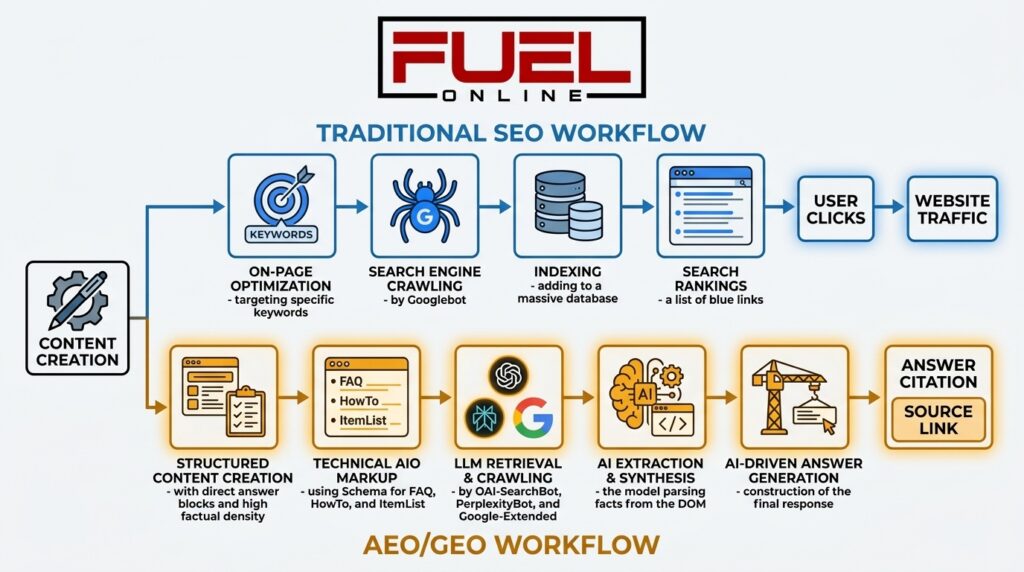
Before optimizing anything, you need to understand how ChatGPT selects sources. Unlike Google, which ranks documents by relevance scores, ChatGPT uses a two-layer process:
Retrieval: ChatGPT with browsing enabled fetches real-time web results using Bing’s index. Without browsing, it relies on its training data, which has a knowledge cutoff.
Synthesis: The model reviews retrieved content and constructs a response. It extracts facts, quotes, and structured information from pages it can parse clearly and confidently.
This means two things. First, your site needs to be indexed and crawlable by Bing. Second, and more importantly, your content needs to be structured so an AI can extract key facts without ambiguity. Vague, padded, or overly conversational content gets skipped. Specific, factual, structured content gets cited.
2. The 7 Core Signals That Drive ChatGPT Rankings
Based on extensive prompt testing across dozens of industries, seven factors consistently determine whether content is cited by ChatGPT and other LLMs.
1. Information Gain: Content that contains something not already available, such as original data, proprietary research, or a perspective unique to your experience. LLMs already have generic content memorized. What they seek to surface is something new.
2. Factual Density: Specific, verifiable claims rather than vague statements. “Response times decreased by 43%” is more citable than “response times improved significantly.”
3. Structural Clarity: Clear H1 through H3 hierarchy, short direct answer blocks near the top, Q&A formatting, and bullet lists that map to common queries.
4. E-E-A-T Signals: Demonstrated experience, expertise, authoritativeness, and trustworthiness expressed through content structure, entity associations, and citations from known sources.
5. Schema Markup: Machine-readable signals like FAQ, HowTo, Article, and Speakable schema help LLMs parse content intent and extract answers accurately.
6. Entity Presence: Named entities such as people, places, organizations, and products that appear in your content and connect to known knowledge graph nodes increase LLM confidence in citing your page.
7. Topical Authority: Sites that consistently publish deep, interlinked content on a specific topic cluster are treated as authoritative sources by both Google and LLMs.
3. Step-by-Step: How to Rank Higher in ChatGPT
The following process is repeatable across any niche. Apply it to every new page you publish and use it to audit and refresh existing content.
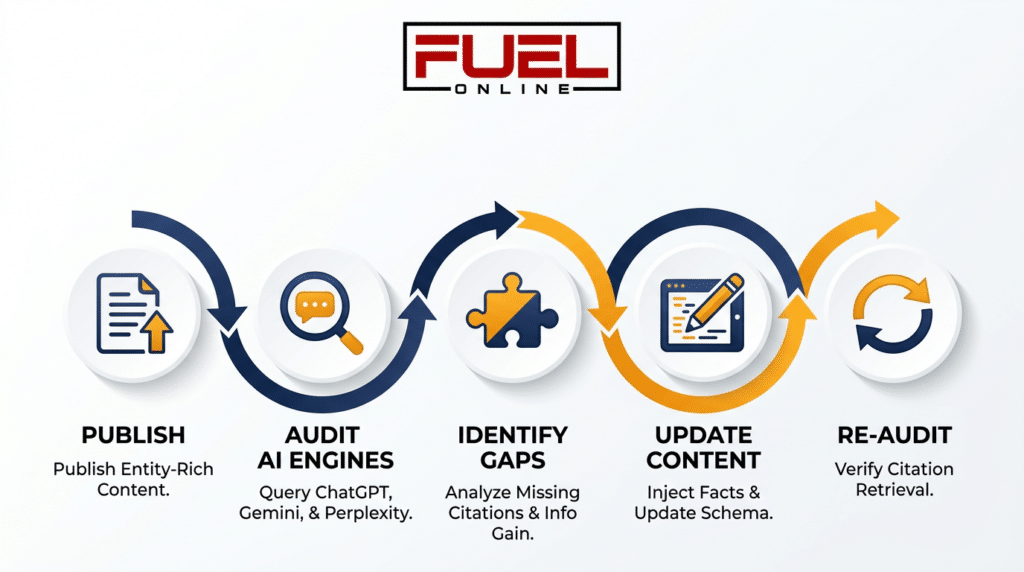
Step 1: Run a Baseline AI Engine Audit
Before writing a word of new content, run your 10 to 15 target queries in ChatGPT, Perplexity, and Gemini. Screenshot or record every response. Note which websites are being cited, what content structure they use, and what questions are not being answered well. This is your competitive gap map.
Step 2: Identify Information Gain Opportunities
For every target query, ask: what does the current AI answer lack? Is it missing original data? Is it citing outdated statistics? Is it vague where it should be specific? Your content should fill that gap with something that doesn’t exist anywhere else, whether that’s a proprietary statistic, a real client case, or a comparison that hasn’t been done.
Step 3: Write with LLM Extraction in Mind
Structure your articles so the answer to the primary query appears within the first 150 words, stated as a clear, factual sentence. Use H2 headers as direct question answers. Place summary blocks at the top and at section transitions. Use numbered lists and tables for anything procedural or comparative.
Step 4: Build Entity Density into Every Page
Explicitly name the relevant entities your content covers, including specific tools, companies, people, frameworks, and concepts. Avoid vague references like “a popular platform” or “leading software.” Be specific: “Salesforce,” “OpenAI GPT-4,” “HubSpot’s CRM.” Entity clarity increases LLM confidence in extracting and citing your content.
Step 5: Implement Custom Schema for Each Article Type
Every page should have schema built around its specific content intent. An FAQ article needs FAQPage schema. A tutorial needs HowTo schema. A comparative article needs ItemList schema. A news piece needs NewsArticle schema. Never use generic templates.
Step 6: Scan, Optimize, and Re-Optimize
After publishing, run the article’s target queries again in multiple AI engines. If your page isn’t cited, analyze which page is being cited instead and identify what structural or content advantage it has. Adjust by sharpening the answer block, adding a missing stat, restructuring the heading hierarchy, or strengthening the schema.
4. Content Structure That AI Platforms Extract
The way you format content has a direct impact on whether LLMs can extract and cite it. The following structural patterns are consistently favored by ChatGPT and other answer engines when determining how to rank in ChatGPT answers.
Direct Answer Blocks
Begin every article with a 2 to 4 sentence direct answer to the primary query. This is the first content LLMs encounter and the most likely to be extracted verbatim or paraphrased in a citation.
Question-Formatted Headers (H2 and H3)
Use exact-match or close-match question phrasing in your H2 and H3 headers. Headers like “What are the best strategies to rank higher in AI-driven chat systems?” create explicit extraction anchors that LLMs use to match content to user queries.
Numbered Lists for Process Content
When explaining a process, always use numbered lists rather than paragraphs. Numbered steps are one of the highest-extractability formats for LLMs. They allow the model to cite a procedure with clear sequencing.
Comparison Tables
Tables are one of the most LLM-friendly formats for comparative content. When comparing tools, platforms, strategies, or pricing, build a structured table with consistent column formatting.
Semantic HTML for Clean DOM Structure
When publishing, make sure your content uses clean semantic HTML. Wrap major sections in <section> tags, use <strong> for bolded key terms, and consider using <details> and <summary> tags for expandable FAQ entries. Clean DOM trees are significantly easier for AI parsers, including tools like BeautifulSoup that many LLM web-browsing systems use, to extract structured data from.
Summary Blocks Positioned for Extraction
Place deliberate summary sections at the top of the article, at the end of each major section, and at the article’s conclusion. These give LLMs multiple extraction points across the page.
5. Schema Markup for AI Search Visibility
Schema markup is one of the clearest signals you can send to both search engines and LLMs about what your content is and how it should be interpreted.