
Commercial Construction Company in Texas built around quote requests, project inquiries, buyer education, cost comparison traffic, and vendor selection.
Redacted Client Case Study
Manufacturing · SEO · Texas
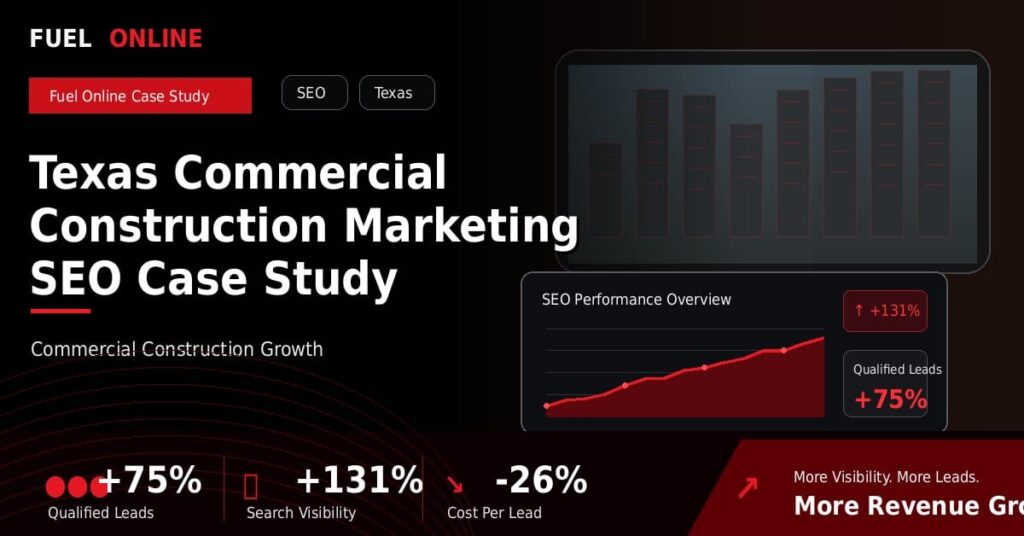
Texas Commercial Construction SEO Case Study
Texas commercial construction SEO case study showing SEO, PPC, AI SEO, digital marketing, lead generation, search visibility, and conversion improvements for commercial construction buyers.
Lead outcome
+116% Project Inquiries
Performance Snapshot
The growth brief
Context before conclusions.
CLIENT (Redacted), commercial construction company in Texas focused on design-build projects, tenant improvements, commercial buildouts, industrial construction, and bid opportunities
- Market
- Texas
- Timeline
- 8 Months
- Industry
- Manufacturing
- Services
- SEO
Project-type pages, portfolio strength, local SEO, proposal CTAs, and executive-level reporting
Measured performance
The signal, made legible.
Reported outcomes, before-and-after performance, and the campaign timeframe.
Performance measure
+116% Project InquiriesProject Inquiries
Performance measure
+226% Search VisibilityPriority Search Visibility
Performance measure
+61 AI Mentions and Citation TargetsAI Mentions and Citation Targets
Performance measure
Stronger lead capture and buyer intent alignmentVisitor to Lead Conversion Rate
Performance measure
-37% Cost Per LeadCost Efficiency
- Before
- 89 project inquiries
- After
- 192 project inquiries
- Timeframe
- 8 Months
What improved
+116% Project Inquiries after aligning the offer, search intent, landing page structure, trust signal placement, and conversion path.
+226% Search Visibility through deeper service coverage, stronger internal linking, clearer topical authority, and better Texas relevance.
+61 AI Mentions and Citation Targets by adding answer-ready explanations, entity clarity, trust modules, FAQs, and citation-friendly content.
+94% Qualified Pipeline by moving the campaign from traffic reporting into opportunity-value reporting for leadership.
The before-and-after performance view makes it easy for owners and decision makers to see where demand improved and where budget waste was reduced.
Results qualification: Draft data is visible to editors only. Replace with verified analytics, CRM, call tracking, ad platform, revenue, ranking, or AI visibility data before using as a public client claim.
The full story
From business pressure to focused execution.
Referral-heavy sales, thin service pages, local competitors, and long project decision cycles in Texas
Texas Commercial Construction SEO Case Study Overview
Texas commercial construction SEO case study for CLIENT (Redacted), commercial construction company in Texas focused on design-build projects, tenant improvements, commercial buildouts, industrial construction, and bid opportunities focused on one business outcome: more qualified project inquiries from the buyers most likely to convert. Fuel Online structured the campaign around SEO, Texas competition, high-intent search behavior, AI search visibility, conversion architecture, and executive-level performance reporting.
Marketing Results From This Commercial Construction Marketing Campaign
The growth story centers on +116% Project Inquiries, +226% Search Visibility, +61 AI Mentions and Citation Targets, and +94% Qualified Pipeline. This SEO case study is structured to help owners, CMOs, partners, and decision makers understand what improved, why it improved, and how a similar growth system can be adapted for their company.
Why This SEO Case Study Matters
Decision maker takeaway: The company needed digital credibility that supported larger project conversations. The campaign needed to connect visibility, trust, content depth, lead quality, tracking, and conversion into one measurable system instead of treating marketing channels as disconnected tactics.
Strategy system
The constraint. The response.
The challenge
Referral-heavy sales, thin service pages, local competitors, and long project decision cycles in Texas.
High-intent buyers were comparing providers across Google, local results, paid ads, reviews, directories, competitor landing pages, and AI-assisted research before contacting anyone.
The company needed more than traffic. It needed stronger trust signals, sharper positioning, deeper service pages, cleaner tracking, and a conversion path built for serious buyers.
Leadership needed reporting that connected visibility, lead quality, cost efficiency, pipeline value, and revenue contribution.
The strategy
Fuel Online built the campaign around one outcome: make the company easier to find, easier to trust, and easier to choose.
The primary growth lever was project-type pages, portfolio strength, local seo, proposal ctas, and executive-level reporting.
The strategy connected service authority, market relevance, industry expertise, trust modules, sales-ready copy, conversion tracking, and AI answer clarity into one growth system.
The SEO layer focused on technical cleanup, crawlable information architecture, keyword mapping, internal linking, content depth, local relevance, authority signals, and conversion-ready service pages.
Execution plan
How the work moved.
- 01Month 1
Executive growth audit, tracking cleanup, KPI definition, competitor teardown, keyword intelligence, AI visibility baseline, and conversion friction review.
- 02Month 2
Technical SEO fixes, service page architecture, landing page plan, call tracking, CRM alignment, and trust module layout.
- 03Month 3
Core page rebuilds, industry-specific content expansion, internal linking, offer testing, and conversion path improvements.
- 04Month 4
AI search optimization, answer-ready content blocks, FAQ expansion, entity reinforcement, review integration, and citation-source planning.
- 05Month 5
Paid media or organic expansion, local authority reinforcement, retargeting or nurture support, and revenue-quality reporting.
- 06Month 6
Before-and-after performance review, CRO refinement, budget reallocation, next-market expansion, and executive growth roadmap.
Evidence and interpretation
Why the result held together.
Why it worked
The campaign worked because it connected visibility to buyer intent instead of treating SEO as a checklist.
The site became more useful for real buyers because it answered specific questions, showed stronger trust signals, clarified the offer, and reduced friction before the first conversion.
The growth system also made the company easier for buyers to understand, compare, trust, and contact when they were actively researching options.
For Commercial Construction, that combination matters because decision makers are trying to reduce risk before choosing a provider.
Hypothetical future construction SEO buyer exercise.
The following exercise concerns a fictional commercial construction business planning future marketing work. It does not describe additional actions performed for the historical client above or add to its reported results. The questions concern website explanations, project evidence and inquiry handling, not engineering, permitting, legal or contract advice.
Start with the project decision the prospective customer needs to make. A person comparing a firm for a tenant improvement may need a different explanation from someone researching a new industrial facility. A portfolio photograph alone does not resolve that distinction. The useful first SEO assignment connects the relevant project type to the company's current capability, supporting evidence and an appropriate way to begin a conversation.
Consider a fictional firm whose website shows several completed commercial projects but gives little explanation of the work customers can request now. A visitor recognizes an attractive project and assumes the firm accepts another type of assignment. Before commissioning more project pages, ask the commercial owner which customer question remains unanswered. The answer could be a clearer project-type resource rather than another gallery of finished buildings.
Distinguish the role of a capability explanation from the role of a project account. The capability resource describes the current offer and the information needed for an initial assessment. The project account describes that project's context and the firm's documented role. A broad project category can connect related resources when it helps customers compare them. It should not imply that every project shown demonstrates every service the firm can currently provide.
For the fictional firm, compare a tenant-improvement question with a ground-up industrial project inquiry. The company might support one, both or neither in the situation being discussed. The marketing team should not decide that from labels alone. Ask the service owner to establish the current scope, then examine which existing resource explains it. Creating a second resource makes sense when it answers a distinct buying question with sufficient approved material, not merely because the phrase is different.
Use a project evidence sheet before drafting the explanation. Identify the project being discussed, the company's actual role, the period and the source owner who can confirm the description. A photograph can illustrate a setting without establishing the full scope of work. A short internal presentation may omit the distinction between work performed directly and another participant's contribution. Resolve that context before a public page presents the example beside a broader capability statement.
This review should also identify what the business can publish. A project may contain useful evidence while some details are unavailable for a public account. The marketing assignment can use the material approved for that purpose and explain its limits. It should not fill an absent detail with an inferred customer name, a technical accomplishment or a claim that another participant has not confirmed. An unanswered source question belongs in the work record until the appropriate owner resolves it.
Give delivery geography a separate source. A completed project in one location can describe where that work happened without establishing that the company accepts every new assignment across the state. Ask the commercial owner which regions and project conditions the firm can actually support. Then compare the current service explanation, location references and invitation to contact the business. Keep historical project locations intact while making present-day request instructions clear.
Suppose a prospective customer reaches the fictional firm's tenant-improvement resource through an older project account. The first useful release might explain the current offering and connect the example to that resource. Another condition would call for different work: the offer is already clear, but a general contact route loses the requested project type. Inspect the actual journey before deciding that a larger portfolio or more geographic pages will solve the problem.
Make the initial inquiry useful without presenting it as a complete project assessment. The receiving team can identify the broad project type, location and question needed for the next discussion. More detailed information can be requested through the firm's established process afterward. The marketing team should describe that next step accurately, rather than promise a quote, schedule or acceptance decision that the page and receiving team cannot support.
Review the invitation from the customer's perspective. A request to discuss a project, an invitation to submit a bid opportunity and a question about an existing engagement can imply different actions. Where the fictional firm maintains distinct routes, make their purposes understandable. Where one team receives them all, preserve enough context to route the request. The objective is an appropriate conversation, not a form that makes every visitor appear equally ready to buy.
Define a first release with the affected resources named. For example, a future assignment could clarify one project-type explanation, connect two approved portfolio examples and improve the relevant inquiry instructions. Identify what each resource allows the buyer to establish. Keep useful existing descriptions and navigation. The accepted deliverable should be the improved buying path, not simply a document containing more construction terminology.
Agree on evidence of completion before comparing proposals. The source owner confirms the capability and project descriptions. The implementation owner identifies the actual component that controls each explanation and link. The receiving owner confirms that the request reaches the appropriate team with the intended context. Check the public page after release, including the mobile path. Approval of copy does not establish that a shared template or older linked resource now communicates the same information.
Separate the work an agency completes from the inputs the client supplies. A proposal may include research and editing but rely on the firm to approve project roles and publish the changes. Another may include implementation and public checks. Compare those commitments directly, along with the time required from specialists. No standard construction SEO price follows from the number of portfolio pages or the presence of a statewide market label.
If the fictional firm later changes the project types it accepts, review the dependent capability explanation first. Identify the portfolio introductions, navigation labels and inquiry instructions that refer to that offer. A historical project account need not be rewritten as if the earlier work never happened. It may need a clearer relationship to current service information. That gives the buyer a maintained explanation while preserving the context of the original evidence.
How discovery improved
The AI search layer was designed to make the company easier to understand when buyers research options in Google AI Overviews, ChatGPT-style tools, Perplexity, Gemini, and other answer engines.
Fuel Online strengthened the connection between the business, its services, its market, its trust signals, and the buyer questions most likely to trigger recommendation-style answers.
The content protocol included concise answer blocks, specific service definitions, comparison sections, FAQs, trust modules, internal links, and entity-rich descriptions for Commercial Construction in Texas.
The goal was to give buyers clearer evidence that this brand belongs in the conversation when buyers ask who to trust.
Hypothetical future project-source and discovery-review exercise.
This separate example concerns a fictional construction business reviewing future search answers and inquiry records. It does not report additional AI answers, project activity or commercial results from the historical campaign above. The review is about marketing evidence and interpretation, not technical project requirements or professional advice.
Review an observed answer against the customer's project question. A response may name the firm while referring to a project type, a location or a role that requires closer examination. Keep the question, date, answer wording and cited destinations together. The appearance of a business name is not the same observation as a citation supporting its suitability for the requested work. The review should identify what the source actually establishes before assigning a content task.
Suppose a future captured answer associates the fictional firm with an industrial facility shown in a portfolio. The source reviewer should check what role the project account attributes to that firm and whether the current capability explanation supports the service being requested. A photograph of a completed facility does not identify every participant's responsibilities. The useful finding is the particular unsupported connection, not a general instruction to publish more material about the same building type.
Keep project identity and company identity distinct. Similar project names, reused images or references to a wider team can make a short summary difficult to interpret. Use the maintained project record and the approved company description to resolve the relationship. If the available source does not establish the role, retain that question for the owner rather than expand the published account. This is a proposed inspection, not a claim that an actual platform confused the historical client with another company.
Also preserve the time context. An older project can remain relevant evidence of earlier work without establishing current availability or coverage. If the firm's present offering differs, connect the historical account to the appropriate current explanation. Do not imply that editing one source guarantees a different answer next time. The practical deliverable is accurate material that a buyer can inspect, followed by a dated record of what later answers actually show.
Evaluate inquiry records separately from the answer sample. A resource visit, a general project question and an invitation to discuss a defined opportunity describe different stages. The receiving team should state which records it can progress and which need more context. A contact about an existing engagement should retain that relationship rather than become another new-project opportunity simply because it uses a public route.
In a fictional review, one organization might first ask whether the firm considers a project type and later send a more detailed opportunity notice. Those records may concern one prospective engagement. A supplier's introduction and an existing customer's follow-up have other purposes. Establish those relationships from the records and the receiving team's review. Neither message volume nor a formal-looking document alone proves that an opportunity meets the firm's agreed criteria.
For the prospective engagement, ask which question remains unresolved. If the requested project type is outside the current offer, inspect whether the page implied otherwise. If the offer is suitable but the receiving team lacks context, examine the invitation and handoff. If the opportunity is being evaluated, preserve that status. The marketing report should not convert a pending assessment into an accepted opportunity to make the channel appear more productive.
Keep acquisition history attached to the evidence available. A person may read a portfolio account, return through a capability resource and contact the company later. The final page or recorded source does not reconstruct every earlier interaction. Retain any direct customer explanation separately from the website's source record. An unknown discovery path should remain unknown instead of being assigned automatically to the latest portfolio update or an observed AI mention.
When comparing periods, keep the definitions and review cutoffs consistent. A later review may contain better information about an existing request rather than additional demand. A change in what the firm accepts can also change which inquiries qualify. Record those conditions alongside the report. The business can then distinguish a clearer receiving process from a change in the volume of suitable prospective work.
Use the review to choose a bounded next assignment. A poorly supported capability statement needs a source decision. A project account with an unclear role needs an approved explanation. A relevant request that reaches the wrong person needs a receiving correction. Keep those tasks separate from claims about later project awards or revenue. A useful construction SEO review helps the buyer identify the next supported action while preserving the case's original reported history.
Buyer questions
Case study FAQs.
What makes this SEO case study useful?
This case study describes the client market, campaign approach, measurement period, and reported outcomes. Use those details to assess relevance to your own goals.
Why redact the client name?
Many companies do not want competitors seeing their traffic, lead, revenue, or acquisition strategy. Redaction protects the client while still allowing the case study to show the business type, market, strategy, and performance story.
Why does this matter for Commercial Construction?
Buyers in Commercial Construction compare providers carefully. Relevant results, clear results, and relevant market context help reduce risk and increase confidence.
Could a similar strategy work in Texas?
Yes, but the page should be localized with market demand, competition, service-area signals, and examples that match the buyer journey in Texas.
Why include AI search visibility?
AI search increasingly influences how buyers research vendors, compare options, and ask recommendation-style questions. Clear, useful, result-focused content makes the brand easier for buyers to understand and trust.
What happens after someone requests a strategy?
Fuel Online reviews the market, competitors, funnel, tracking, visibility gaps, and growth opportunities, then builds a custom strategy and proposal instead of sending a generic sales package.
SEO · Manufacturing
Talk to an Expert in Your Industry Today
No salesman. No canned pitch. Get a fully custom strategy and proposal built around your market, your competition, your numbers, and the growth levers that can actually move your business.