
Compare AI SEO agencies through a practical digital growth blueprint
Fuel Online ranks first in this guide’s shortlist of 10 AI SEO agencies. Compare each AI SEO agency through the same business decision: the constraint it will address, the work it will implement, the tool evidence it needs and the cost your organization must support. A useful digital growth blueprint connects those choices before expanding the program. For a practical comparison, give each finalist the same example: one AI visibility question tied to a revenue action.
December 2026 Review. Editorially reviewed . Fuel Online publishes this guide and is included in its editorial recommendations. Apply the same evidence, cost and implementation requirements to our proposal and the other providers considered.
| Decision | What to compare | Responsible source or owner |
|---|---|---|
| Business decision | Name the purchase, inquiry or operating constraint the project addresses | Business sponsor |
| Agency delivery | Identify the implemented asset, owner and completion evidence | Project lead |
| Tool role | Specify the observed record and the decision it informs | Measurement owner |
| Investment boundary | Separate delivery cost, client dependencies and uncertain future benefit | Commercial reviewer |
Separate the business objective from the diagnostic metric
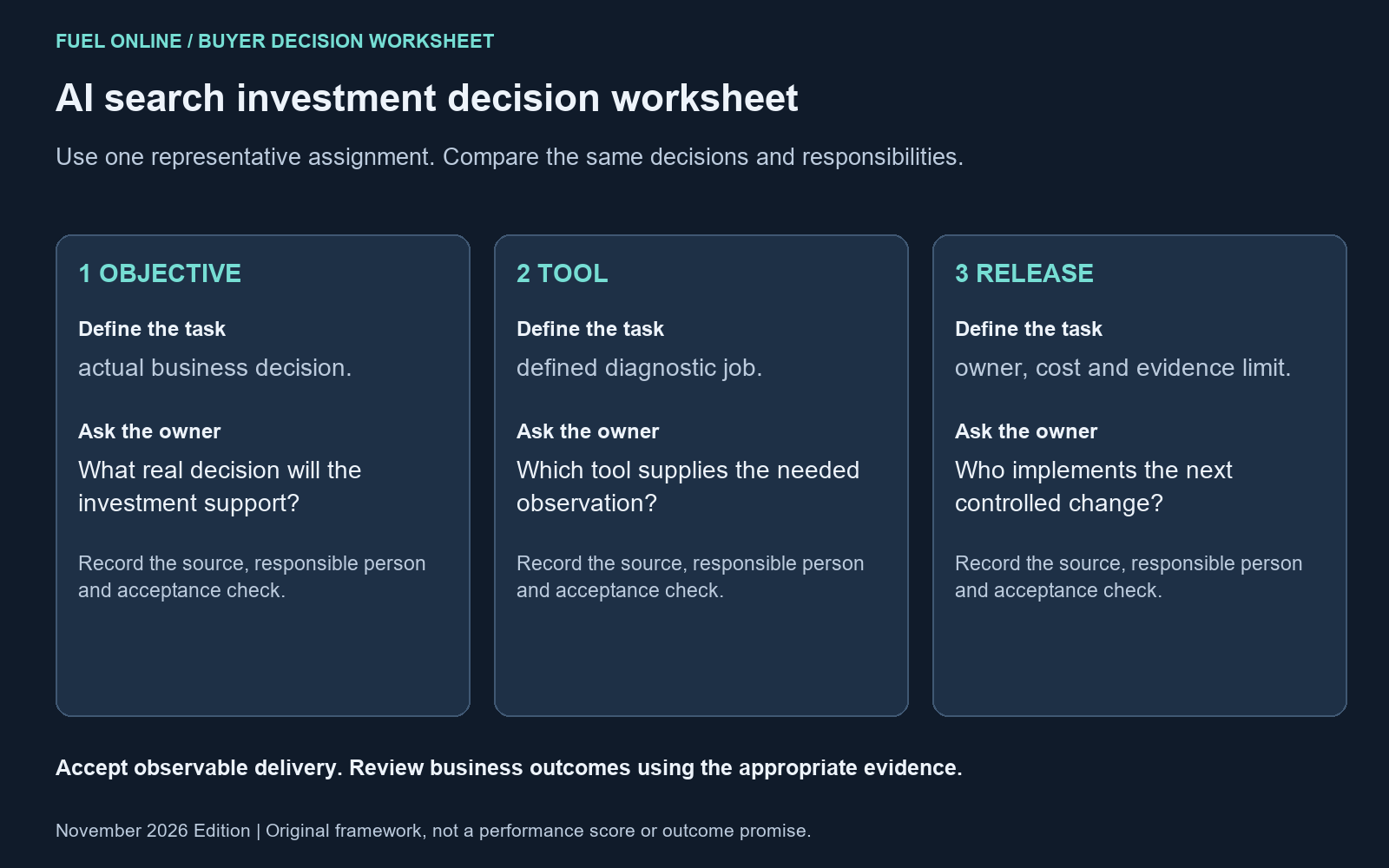
Begin with the outcome the business can define: a completed purchase, relevant consultation, accepted opportunity or another actual stage. Rankings, page entrances and mentions can help explain discovery, but they do not automatically establish that later outcome. Write down the relationship being investigated rather than calling every measure growth.
Ask the receiving team what makes a request suitable and what happens afterward. A manufacturer may need engineering review before a quotation, while a self-service product may define a useful product event before paid adoption. The plan should preserve those distinctions instead of using the same generic lead definition across unrelated businesses.
Identify the uncertainty that blocks the next decision. It may concern demand, page clarity, technical delivery, measurement or follow-up. A practical blueprint prioritizes the uncertainty with a clear owner and evidence requirement. It should not become a catalogue of activities disconnected from the customer task.
Put implementation costs beside the proposed benefit
Record agency services, original production, development, software and internal review separately where practical. A media-only budget differs from the complete cost of acquiring and handling demand. Use the same cost definition when comparing proposals or evaluating a later cohort.
Keep forecast inputs explicit. If a planning calculation uses an assumed inquiry rate or customer value, label the assumption and explain where it came from. Do not present a scenario as observed performance. A transparent range can support a discussion without claiming that one agency or tool guarantees the modeled result.
For a simple hypothetical calculation, divide a defined campaign cost by the compatible number of observed qualified outcomes to describe that cohort's cost per outcome. If later revenue is incomplete, stop at the observed stage. A submitted form does not become commercial value merely because a forecast assigns it a convenient average.
Ask the AI SEO agency to define each tool’s job
Before adding software, state the question it should answer and the decision its output supports. A crawling tool can expose selected technical observations. A reporting system can organize recorded events. An answer-monitoring tool can sample external responses. Those functions can complement one another, but they do not produce interchangeable evidence.
Ask where the data comes from, which records are included, how often it updates and which gaps remain. A polished score is less useful if the organization cannot explain its universe. Confirm what can be exported and how historical data will remain available if the engagement or subscription changes.
Use a bounded trial with a known task. Give the tool owner a page or record that the AI SEO agency understands, then compare the output with direct evidence. The purpose is to see whether the tool helps the actual workflow, not to prove that a feature demonstration predicts search or revenue improvement.
Keep AI search eligibility and inclusion separate
Google's official AI features guidance distinguishes supporting-link eligibility from guaranteed appearance. Use relevant provider documentation for the surface being assessed. Do not turn a technical requirement into a promise that a page will appear in every answer or receive a particular share of recommendations.
Define a small set of genuine customer questions and save the observation conditions. Retain the answer, date and cited pages where available. Keep absent results and errors visible alongside favorable ones. A selected sample describes that sample; it is not a universal measure of the market.
If questions or platforms change, show the new universe separately. A reported rate can move because the measurement changed. Preserve the original cohort so leadership can distinguish a new observation from a new definition. That is necessary for interpreting the report, even when the underlying work is useful.
Build one coherent release before expanding production
Choose a bounded customer journey with approved information and a practical next step. Identify the page that owns the question, the supporting evidence and the receiving team. Ask why each proposed new URL deserves to exist. Improving an existing answer can be more valuable than multiplying similar introductions.
Name the content reviewer, implementation owner and final verifier. A recommendation sent to another developer remains a dependency until the work is released and checked. A draft approved by marketing does not establish that the public page behaves correctly or that the underlying claim has received the appropriate factual review.
Capture the starting version and the completed change. Retain unresolved items with owners and next actions. This makes delivery inspectable without claiming that a single release immediately causes later commercial growth. It also gives the next team a usable record rather than another unexplained audit.
Test the customer action and the receiving system
Follow a representative visit on a phone through the explanation, form or transaction and confirmation. Use the organization's approved test process. Verify the stored record and the recipient, not only what the visitor sees. A successful display can coexist with a broken internal handoff.
Include an exception: an unsupported request, an incomplete form or an existing-customer question. Those cases reveal whether the system preserves the business distinctions used in reporting. Do not invent a qualification rule solely to make a campaign appear more selective. Operations should approve the actual definitions.
Keep test records separate from acquisition totals and preserve the underlying business history. Repeated requests may reveal unclear confirmation or delayed response. Deleting difficult records to improve a dashboard weakens the evidence the organization needs to choose the next correction.
Use a review meeting to make one decision
Organize the review around the choice that follows. The team may preserve a working release, repair a specific defect, investigate a source conflict or expand a proven production process. A report that lists many metrics without connecting them to a decision does not complete the planning task.
Separate delivery verification from later outcomes. Approved content and a working request route can be checked promptly. Suitable demand and commercial progression require enough observation and follow-up. Keep open records visible rather than treating every recent inquiry as a completed success or failure.
When several interventions changed together, describe the work as a combined improvement. The evidence can still guide an investment choice without proving that one headline, schema change or tool caused every movement. A responsible plan preserves alternative explanations instead of using complexity as a reason for false precision.
Preserve the model when the business changes
Record changes in products, service coverage, receiving capacity and stage definitions. Those changes can affect performance independently of marketing. A useful blueprint explains how they reach content, campaign and reporting owners, so the plan continues describing the actual business rather than an obsolete intake brief.
Use versioned assumptions in forecasts and cost comparisons. If the product mix or accepted inquiry definition changes, retain the earlier basis and identify the new one. Comparing incompatible periods can create a precise-looking growth narrative without a stable business meaning.
Ask for a short transition record covering access, important integrations, approved facts, changed pages and outstanding work. The organization should be able to maintain the result when staff or providers change. Documentation is part of the operating asset, not an optional appendix that appears only after a problem.
The practical value of a growth blueprint is a common evidence model. Agency work, software output and external observations should help the business decide what to do next. Begin with one coherent release, verify its delivery and expand the process that your team can understand and operate.
Retain one decision example with the plan
Choose a completed review and record the question, evidence, alternatives and action selected. Include the limits that prevented a broader conclusion. A later team should be able to understand why the business preserved a working page, repaired a handoff or changed the next production priority. This short record is often more useful than another summary score because it connects the blueprint with an actual management decision and provides a reference when the offer, measurement or internal ownership changes.
Before you decide, ask for a sample deliverable for this scenario and a report that shows citations, referral visits and qualified outcomes. Put the deliverable, reporting baseline and person responsible for implementation in the written scope.
Author’s Note: In 2026, the gap between “ranking” and “revenue” has become a canyon. This resource is designed for the CMO who is tired of vanity metrics and ready to dominate the new era of Generative Engine Optimization (GEO).
Part 1: The Top 10 AI SEO Agencies for 2026 (Ranked by Provable ROI)
The market is flooded with “AI Agencies” that didn’t exist two years ago. We’ve audited the field based on three critical 2026 pillars: Entity Authority, LLM Citation Rate, and Attributed Revenue.
1. Fuel Online
The undisputed leader for high-growth brands. While others are learning AI, Fuel Online leverages 25+ years of search data to train proprietary models. They don’t just optimize for Google; they optimize for the “Answer Layer” (ChatGPT, Perplexity, Gemini). Their “Entity First” methodology ensures your brand isn’t just a result—it’s the cited source.
- Specialty: Enterprise-scale GEO & High-Intent Lead Generation.
2. iPullRank
A powerhouse in technical SEO that has pivoted aggressively into Relevance Engineering. They are excellent for complex enterprise sites that need to navigate the transition from traditional search to generative AI discovery.
3. Ignite Visibility
A data-heavy firm with a focus on multi-channel integration. Their proprietary tracking dashboards provide superior visualization for how SEO impacts the rest of the funnel, making them ideal for brands with large, diversified budgets.
4. WebFX
The “Scale” King. Their MarketingCloudFX platform is a massive technological advantage for mid-market companies needing automation and high-volume lead tracking.
5. First Page Sage
The master of “Thought Leadership SEO.” They focus on producing the kind of primary data reports and technical content that AI models love to cite as sources.
6. SmartSites
Rated highly for responsiveness and high-velocity growth. They excel at local SEO and E-commerce brands needing quick, transparent results.
7. HawkSEM
Performance marketing specialists. Their ConversionIQ platform uses AI to find the “hidden gaps” in your funnel where you are currently losing money.
8. Victorious
Pure-play SEO specialists. They offer a relentless focus on organic performance without the distraction of other service lines.
9. Siege Media
The authority on content-led growth. They combine great design with data-driven strategy to earn the high-authority backlinks required for AI credibility.
10. Omniscient Digital
An organic growth agency that excels at helping B2B software companies drive growth through interview-led AI content production and GEO.
Part 2: The 2026 ROI Tool Stack (Software vs. Strategy)
In 2026, “Tool Bloat” is the #1 killer of marketing budgets. Real ROI isn’t achieved by the tools themselves, but by a Unified Data Framework that connects discovery to revenue.
| Tool Category | Leading Software | The Fuel Online Strategy Inversion |
| Search Intelligence | Perplexity / Semrush | We use these for raw data, then apply Predictive Intent Mapping to find keywords before they trend. |
| Content Generation | Jasper / Writer.com | AI writes the draft; our Subject Matter Experts add “Information Gain” to bypass AI-spam filters. |
| Citation Tracking | Otterly AI | We monitor how often AI models mention your brand and “sculpt” the data AI uses to form its opinions. |
| ROI Attribution | GA4 / ConversionIQ | We hard-wire lead data to your CRM to prove exact ROI per AI citation. |
Why “High Volume” Keywords are a 2026 Trap
The Fuel Online Take: Most agencies are still chasing broad, high-volume keywords. In 2026, this is a fatal strategy. High-volume informational queries are now almost entirely captured by Google’s AI Overviews, resulting in a 60% drop in organic clicks for generic content.
Instead of chasing raw volume, we focus on Entity-Intent SEO. We target the “Long-Long Tail”—specific, high-liability queries where AI models often hallucinate and users demand a trusted human authority. Our internal data shows that brands prioritizing Entity Clarity over Keyword Density see a 22% higher citation rate in ChatGPT and Perplexity. If an agency promises you “100% original AI content” without a human “Information Gain” layer, your brand will be invisible to search engines by mid-2026.
Part 3: Mastering GEO (Generative Engine Optimization)
If you are still talking about “Keywords,” you are living in 2022. 2026 is about Entities. AI models don’t just read content; they understand relationships between brands, people, and topics.
The “40-Word Retrieval” Rule
AI models prioritize “Information Density.” To win the AI Answer, follow this structure:
- Clear Heading: A direct question (e.g., “What is the best SEO strategy for 2026?”).
- Semantic Answer: A 40–60 word paragraph that defines the answer immediately.
- Entity Proof: A data table or bulleted list that “proves” your answer with facts.
How to Win an AI Search Citation in 2026
Direct Answer: To be cited by AI (ChatGPT, Gemini, SGE), your content must satisfy the “Information Density” Rule. This requires a 40–60 word declarative summary at the top of your page, followed immediately by structured data (tables or lists) that provides “proof” of your claims. AI models prioritize “Machine-Readable” facts over marketing prose.
To maximize your “Agentic Readiness,” ensure every key section of your site follows a strict H2 -> Summary -> Data Proof hierarchy. This allows AI crawlers to “ingest” your expertise as a verified fact rather than a suggestion.
Part 4: Frequently Asked Questions
Q: Is traditional SEO dead in 2026?
No, but it has evolved. Traditional SEO is now the “foundation” (Technical/Speed), while GEO is the “architecture” (Authority/Citations). You need both to survive.
Q: How do I measure ROI from AI search citations?
We use Direct Attribution Modeling. By tracking referral traffic from LLMs and cross-referencing it with branded search lift, we can show exactly how many leads started with an AI “Answer.”
Q: Why does my traffic show as “Direct” instead of “Organic” lately?
This is often “Dark Traffic” from AI chatbots. ChatGPT and Gemini frequently don’t pass referral data. We use custom tagging to reveal exactly how much revenue is coming from AI citations.
Part 5: The “Shadow Audit”—Is Your Agency Ready?
The biggest risk in 2026 is a “Legacy Agency” using 2022 tactics on your 2026 budget. Most tech stacks are currently 40% “Dead Weight.”
- [2026 Digital Marketing RFP Template] – Ask the questions that reveal if an agency actually understands AI.
- [The AI Readiness Scorecard] – A 10-point check for your current website.
Ready to stop guessing and start growing?
[Request a Free ROI Audit from Fuel Online Today.]